

From First Stream to Real Fan: How Artists Build Lasting Loyalty
TL;DR: Casual listeners become loyal music fans when they get repeated, meaningful reasons to come back. The most important move is to design a clear fan journey: discovery, second interaction, deeper context, direct connection, and repeat engagement. Instead of chasing only more streams, focus on actions that show intent: saves, follows, playlist adds, comments, email signups, merch interest, ticket clicks, and repeat listening.
A casual listener is not a failure. They are the first stage of a possible fan relationship. Someone heard your song once, watched a clip, found you through a playlist, saw your video in a feed, or clicked because a friend shared your music. The problem is that one touchpoint rarely creates loyalty by itself.
This matters because music discovery is fragmented. A person may discover you on TikTok, save you on Spotify, watch a live clip on YouTube, and only months later buy a ticket or join your mailing list. Streaming remains central to recorded music consumption, but streaming alone does not tell the full story of fandom. (IFPI – Global Music Report 2026)
The goal is not to force every listener into becoming a superfan. Most will not. The real goal is to create enough intentional touchpoints that the right listeners can move from passive attention to active support. This guide explains how independent artists can build that path without relying on gimmicks, fake engagement, or unrealistic promises.
Table of Contents
- Key Takeaways
- Stop Treating Discovery as the Finish Line
- Build a Listener Path, Not Just a Content Calendar
- Turn Platform Actions Into Fan Signals
- Give People a Reason to Care Beyond the Hook
- Move Warm Listeners Into Reachable Spaces
- Segment Fans by Behavior, Not Ego Metrics
- Create Repeat Moments Without Burning Out Your Audience
- Measure Loyalty Before You Spend More Money
- How BlockTone Records Fits Into the Fan Journey
- Frequently Asked Questions
- Sources Used
Key Takeaways
| Point | Details |
|---|---|
| Discovery is only the first step | A playlist add, viral clip, or first stream matters most when it leads to another action. |
| Loyal fans show intent | Saves, follows, personal playlist adds, repeat streams, comments, email signups, and purchases are stronger signals than passive reach. |
| Context builds connection | Fans need stories, visuals, live moments, lyrics, personality, and behind-the-scenes material to attach meaning to the music. |
| Direct channels protect your fanbase | Email, Bandcamp followers, YouTube community tools, SMS, Discord, and owned websites reduce dependence on algorithmic reach. |
| Segmentation improves messaging | New listeners, warm listeners, returning fans, and high-intent supporters should not receive the same content every time. |
| Sustainable fan growth is slow | The goal is repeat engagement over time, not overnight conversion from every listener. |
Stop Treating Discovery as the Finish Line
Many artists mistake reach for relationship. A song gets playlisted, a video performs well, or a clip gets shared, and the campaign is treated as a win. It may be a win, but only at the discovery stage.
A casual listener usually has low commitment. They may like the sound without knowing your name. They may recognize the hook but not the artist. They may stream once because the algorithm served the track at the right moment. That is attention, not loyalty.
The practical question is: what happens next?
| Stage | Listener Behavior | Artist Goal |
|---|---|---|
| Casual listener | Hears one song or sees one clip | Make the artist easy to identify |
| Interested listener | Saves, follows, comments, or checks another song | Give them a second doorway |
| Warm fan | Repeats songs, watches more content, joins a channel | Build familiarity and trust |
| Loyal fan | Buys, shares, attends, joins a list, supports releases | Maintain connection over time |
Spotify’s audience tools reflect the difference between broad listening and intentional listening. For example, Spotify defines monthly active listeners as people who intentionally streamed an artist from active sources, while super listeners are those who intentionally streamed the artist 15 or more times in the last 28 days. (Spotify Support – Audience Segments on Spotify)
Mistake to avoid: Do not build your whole strategy around “more exposure.” Exposure without follow-up creates temporary spikes. Fan growth comes from giving interested people a clear next step.
Build a Listener Path, Not Just a Content Calendar
A content calendar tells you what to post. A listener path tells you what each post is supposed to do.
For example, posting five random clips from a song may create awareness, but it may not deepen the relationship. A listener path gives each piece of content a role: the hook clip introduces the song, the lyric clip explains the emotional center, the live clip proves the song works outside the studio, and the story clip explains why you wrote it.
The “second doorway” test
Every discovery moment should lead somewhere. Ask yourself:
- If someone discovers this song today, what should they do next?
- Is my artist profile ready for them?
- Is there another song, video, playlist, or story that helps them understand me?
- Is there a reason for them to follow, save, comment, or join a direct channel?
- Can they tell what kind of artist I am within 30 seconds?
YouTube describes an Official Artist Channel as a main landing page for an artist’s music, brand, presence, and community. That same idea applies across your Spotify profile, Apple Music profile, TikTok account, Instagram page, Bandcamp page, and website. (YouTube for Artists)
Pro Tip: Audit your artist profiles as if you are a stranger. If the pinned content, bio, links, visuals, and latest release do not clearly show who you are, casual listeners may leave before they become curious.
Turn Platform Actions Into Fan Signals
Not every metric has the same meaning. A view may show exposure. A save shows intent. A comment shows emotional response. A playlist add may show repeat listening potential. A merch click shows commercial interest.
Spotify’s Fan Study highlights the value of personal playlisting and other deeper listener actions. The exact impact will vary by artist, but the strategic point is clear: personal actions are stronger signs of fandom than passive plays. (Spotify for Artists – Fan Study: Fan Connection)
What to ask for at each stage
Do not ask for everything at once. Match the call-to-action to the listener’s level of interest.
| Listener Type | Best CTA | Why It Works |
|---|---|---|
| First-time listener | “Save this if it hits you” | Low-friction and tied to emotion |
| Repeat listener | “Follow for the next release” | Converts interest into future reach |
| Commenter | “Tell me which lyric got you” | Turns listening into conversation |
| Playlist supporter | “Add this to your late-night playlist” | Connects the song to a use case |
| Strong fan | “Join the list for early demos or tickets” | Moves them into a direct channel |
The key is to make the action feel natural. “Stream my song” is weaker than “save this for the night drive home” because the second version gives the listener a reason and a context.
Mistake to avoid: Do not make every post a demand. If your content only asks people to stream, pre-save, buy, or share, it starts to feel transactional. Balance asks with value: stories, humor, gratitude, performance, education, vulnerability, and entertainment.
Give People a Reason to Care Beyond the Hook
Hooks create entry points. Meaning creates attachment.
A casual listener may like your chorus. A loyal fan usually connects with something deeper: your voice, story, values, aesthetic, vulnerability, performance style, humor, message, or world-building.
This is where many independent artists underuse their best material. They post the polished final song but hide the context that could turn interest into loyalty.
Content that deepens emotional connection
Use content formats that help listeners understand the song and the person behind it:
- A short explanation of the lyric that started the song.
- A stripped-down performance that reveals the vocal or writing.
- A “before and after” showing demo versus final version.
- A story about the real moment behind the track.
- A visual moodboard for the song’s world.
- A fan question: “What situation does this remind you of?”
- A rehearsal or studio moment that shows process.
- A catalog bridge: “If you liked this song, listen to this older one next.”
TikTok for Artists gives artists access to data around song performance, post performance, follower insights, and engagement signals such as views, likes, comments, shares, and completion rates. Use those signals to learn which stories, formats, and emotional angles make people stay. (TikTok Newsroom – TikTok for Artists Launches)
Make your music easier to remember
Listeners remember patterns. Give them repeatable elements:
- A consistent visual tone.
- A recognizable intro or tagline.
- Recurring themes in captions.
- A clear artist point of view.
- Similar cover art logic across releases.
- A playlist or series that groups your music by mood.
This does not mean becoming predictable. It means giving people enough consistency to recognize you again.
Pro Tip: Write one sentence that defines your artist world: “My music is for people who ____.” Use it privately to guide content, visuals, captions, and collaborations.
Move Warm Listeners Into Reachable Spaces
Algorithms can introduce you to people, but they do not guarantee you can reach those people again. That is why loyal fan development should include direct or semi-direct channels.
A direct fan channel gives you a place to communicate when you are not dependent on a feed deciding whether to show your post. Examples include email lists, SMS lists, Bandcamp followers, Discord servers, Patreon or membership communities, artist websites, YouTube community features, show RSVP lists, and merch customer lists.
Bandcamp emphasizes direct communication with fans, including artist messages that can reach followers on Bandcamp and by email. For independent artists, that kind of access is valuable because it connects you with listeners who have already shown interest. (Bandcamp – Artist Guide)
YouTube also encourages creators to build community through comments, posts, live streams, and memberships, with tools such as pinned comments, comment replies, hearts, and member-only perks. For artists, this means YouTube should not only be a video archive. It can be a fan relationship platform. (YouTube Blog – Building Community on YouTube)
What to offer in exchange for direct connection
People rarely join a list just because an artist says “sign up.” Give them a reason:
- Early access to tickets.
- First listen to demos.
- Behind-the-scenes voice notes.
- Tour city voting.
- Private livestreams.
- Lyric explanations.
- Discount codes.
- Limited merch drops.
- Release-day reminders.
- Fan-only acoustic versions.
Keep the offer simple. A small but real benefit is better than a vague promise of “exclusive updates.”
Mistake to avoid: Do not move fans into a direct channel and then only message them when you need something. Send value between releases so the channel stays alive.
Segment Fans by Behavior, Not Ego Metrics
Follower count is not a fan strategy. Behavior is.
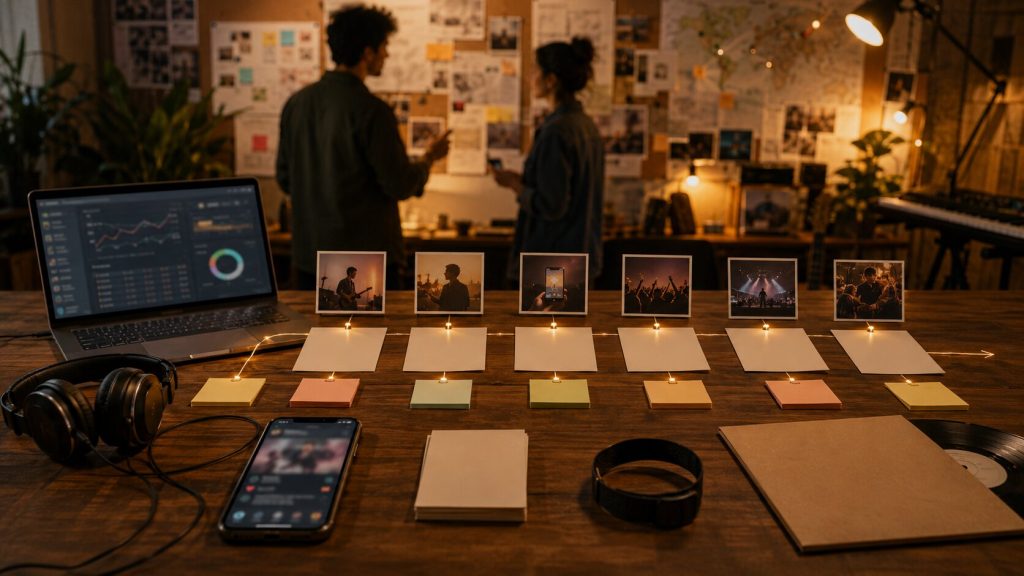
A person who saves every release but never comments may be more valuable than someone who liked one viral post. A person who buys one shirt may be more committed than someone who watched ten seconds of a video. A person who returns after six months may be worth re-engaging.
Spotify’s audience tools help artists understand whether people are moving toward deeper engagement or drifting away by distinguishing between different listener segments. You can apply the same thinking across your whole fanbase. (Spotify for Artists – New Audience Segmentation)
| Segment | What They Do | What to Send Them |
|---|---|---|
| New discovery listeners | Found one song or clip | Best song entry points, artist intro, pinned content |
| Warm listeners | Saved, followed, commented, replayed | Deeper stories, related songs, live clips |
| Returning fans | Engaged before but went quiet | “You might have missed this” updates |
| High-intent fans | Bought, joined, attended, shared | Early access, direct messages, special offers |
| Local fans | Engage in specific cities | Show announcements, local content, city-specific updates |
Apple Music for Artists lets artists analyze listener trends and geography, including where listeners are by city, state, country, or region. That kind of location data can help you decide where to run ads, pitch local press, test small shows, or create city-specific content. (Apple Music for Artists – Understand Your Analytics)
Pro Tip: Create a simple monthly fan report. Track top songs, saves, follows, comments, email signups, merch clicks, top cities, and repeat content themes. You do not need a complex dashboard to notice patterns.
Create Repeat Moments Without Burning Out Your Audience
Loyalty grows through repetition, but repetition does not mean posting the same clip forever.
A strong fan development plan gives listeners multiple moments to reconnect before, during, and after a release.
Before the release
Build recognition. Share the song idea, title, mood, lyric fragment, cover art process, or live test. Use pre-release tools as one part of a broader story, not as the entire campaign.
During release week
Make the song easy to find and easy to understand. Post the best hook, pin the release, update profiles, send your list a clear message, thank early supporters, and reply to comments quickly.
After release week
This is where many artists stop too soon. Continue with new angles:
- “The lyric people keep asking about.”
- “How we made the drums.”
- “The acoustic version changed the meaning.”
- “The fan comment that made me rethink the song.”
- “The older song that belongs in the same world.”
- “The live version from rehearsal.”
- “The playlist this song belongs on.”
Between releases
Give fans reasons to stay connected when nothing new is dropping. Share listening recommendations, writing updates, rehearsals, lessons learned, personal reflections, fan polls, and small creative experiments.
Mistake to avoid: Do not confuse silence with mystery. Some artists disappear between releases and then expect fans to react immediately when the next single drops. Most fans need light, consistent reminders.
Measure Loyalty Before You Spend More Money
Paid promotion can help, but it should not be used to hide weak conversion. Before increasing ad spend, check whether your current attention is turning into stronger fan signals.
Track these metrics:
- Saves per listener.
- Followers gained per release.
- Repeat streams.
- Playlist adds.
- Profile visits.
- Email signups.
- Link clicks.
- Comments with substance.
- Shares.
- Merch clicks or sales.
- Ticket interest by city.
- Returning viewers on YouTube.
- Completion rate on short-form videos.
- Direct messages from listeners.
Also watch for suspicious growth. Spotify warns that paid third-party services guaranteeing streams or playlist placement are not legitimate and may violate platform rules, with possible consequences including music removal. Fake numbers do not create loyal fans, and they can damage the data you need to understand real listener behavior. (Spotify Support – Third-Party Services That Guarantee Streams)
A simple 30-day conversion plan
Week 1: Identify interest. Pin the release everywhere, ask for one action, reply to every meaningful comment, and track which clips hold attention.
Week 2: Add context. Post lyric meaning, studio clips, live snippets, and story content. Share one older song connected to the new release and invite warm listeners to join your list or community.
Week 3: Deepen the relationship. Run a fan poll, share a behind-the-scenes breakdown, thank early supporters, and test a small ad only toward people who already engaged.
Week 4: Review and segment. Look at saves, follows, comments, locations, and repeat plays. Identify your warmest audience group and build your next content angle around what they responded to.
The expected result is not instant superstardom. The realistic goal is clearer data, more repeat engagement, and a better understanding of who is moving closer to real fandom.
How BlockTone Records Fits Into the Fan Journey
For artists building long-term fanbases, the most useful support is not just “promotion.” It is strategy: knowing which listeners to target, what story to tell, which platforms deserve attention, and how to turn each release into a larger relationship-building moment.
BlockTone Records can be positioned as a resource for artists who want to think beyond short-term spikes and build campaigns around listener conversion, audience retention, and stronger release planning. The best fan growth systems are built before the song is already fading from attention.
To explore more artist growth resources, visit blocktonerecords.com.
FAQs About Turning Casual Listeners Into Loyal Music Fans
How do casual listeners become loyal music fans?
What is the best platform for turning listeners into fans?
Should independent artists focus on streams or fans?
How often should artists communicate with fans?
Do viral songs create loyal fans automatically?
What is the biggest mistake artists make with fan engagement?
How long does it take to build a loyal fanbase?
Sources Used
- IFPI – Global Music Report 2026
- Spotify Support – Audience Segments on Spotify
- Spotify for Artists – Fan Study: Fan Connection
- Spotify for Artists – New Audience Segmentation
- Spotify Support – Third-Party Services That Guarantee Streams
- YouTube for Artists
- YouTube Blog – Building Community on YouTube
- TikTok Newsroom – TikTok for Artists Launches
- Apple Music for Artists – Understand Your Analytics
- Bandcamp – Artist Guide