Organic Music Promotion: What Still Works Today
TL;DR
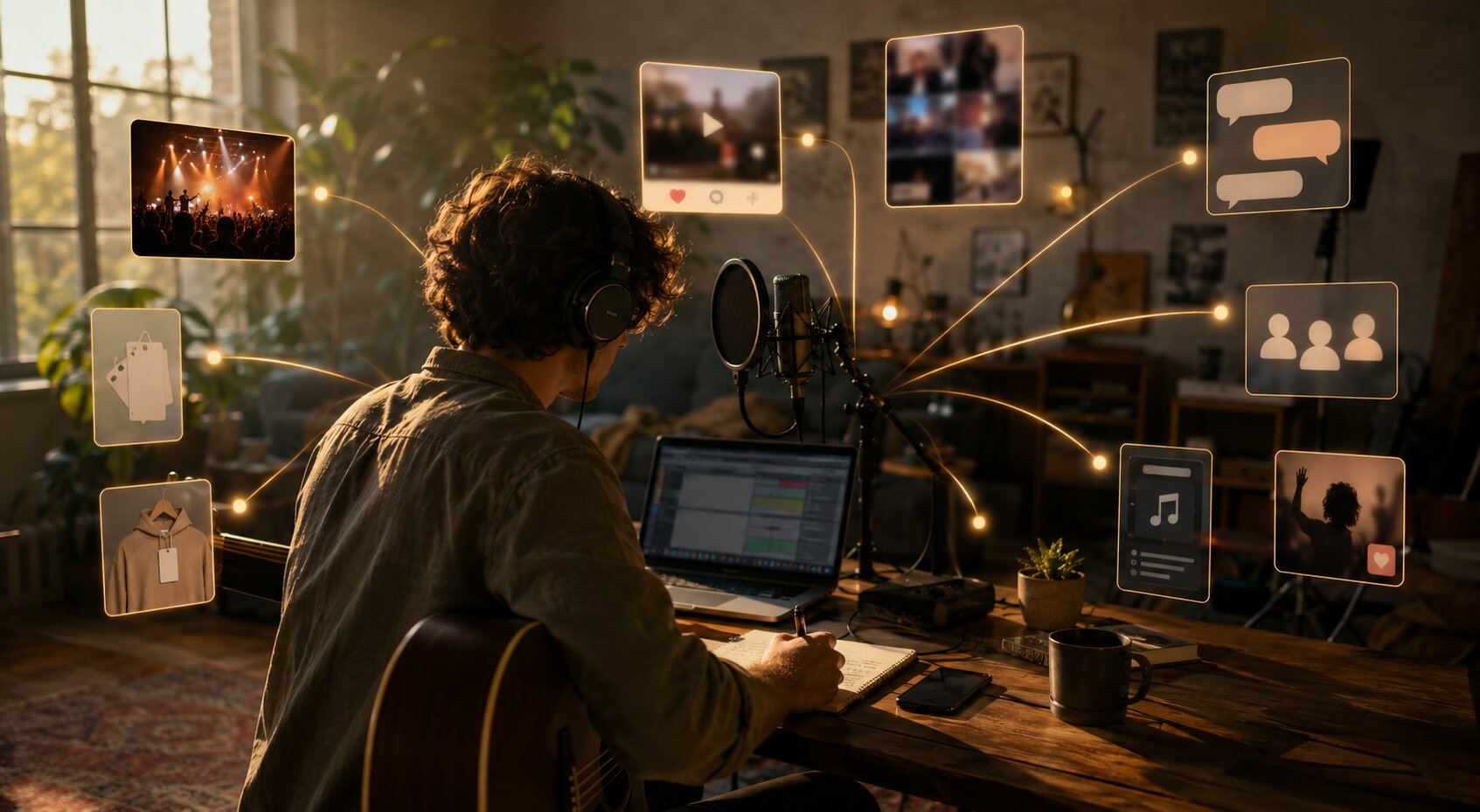
Organic music promotion still works when it is built around repeatable fan behavior, not random posting. The strongest strategy today combines platform-native content, direct fan connection, smart metadata, community participation, and consistent follow-up after release day. The goal is not to “go viral” once, but to turn discovery into saves, follows, shares, email signups, ticket interest, and repeat listening.
Introduction
Organic music promotion has become harder, but not useless. Independent artists are competing with more songs, more creators, shorter attention spans, and platforms that constantly change how music is discovered. Posting “new song out now” once or twice is no longer a real strategy.
At the same time, artists have more direct access to listeners than previous generations ever had. Spotify for Artists, YouTube Shorts, TikTok Artist Accounts, Bandcamp, email lists, newsletters, live clips, behind-the-scenes content, and fan communities all give musicians ways to build attention without depending entirely on paid ads or gatekeepers.
The problem is that many artists confuse organic promotion with passive promotion. Organic does not mean “free and easy.” It means earning attention through relevance, consistency, timing, and audience trust. This guide explains what still works today, what has become less reliable, and how independent artists can build a practical organic promotion system around each release.
Table of Contents
- Organic Promotion Works Best When It Has a Clear Fan Path
- Short-Form Video Still Matters, But the Angle Matters More Than the Clip
- Streaming Platforms Reward Preparation, Not Last-Minute Panic
- Direct-to-Fan Channels Are the Organic Advantage Most Artists Ignore
- Community Promotion Beats Cold Self-Promotion
- Organic Promotion Needs a Post-Release System
- What No Longer Works Like It Used To
- Building an Organic Promotion Routine You Can Actually Sustain
- Work With Block Tone Records
- Frequently Asked Questions
- Sources Used
Key Takeaways
| Point | Details |
|---|---|
| Organic promotion needs a path | Discovery should lead somewhere: a save, follow, email signup, merch page, show, playlist add, or direct fan interaction. |
| Short-form video is useful but not magic | TikTok, Instagram Reels, and YouTube Shorts work best when the content gives people a reason to care about the song, not just hear a preview. |
| Playlist pitching still requires timing | Artists should prepare releases early so platform pitching, profile updates, and fan messaging are ready before release day. |
| Direct fan platforms matter | Email, Bandcamp, fan communities, and newsletters help artists build relationships they can reach beyond algorithmic feeds. |
| Organic growth is slow but durable | The realistic goal is compounding attention: more repeat listeners, stronger fan relationships, better data, and more reliable engagement over time. |
Organic Promotion Works Best When It Has a Clear Fan Path
The biggest mistake artists make with organic music promotion is treating every platform like a billboard. They post the cover art, paste the streaming link, say “out now,” and hope the audience does the rest.
That rarely works because listeners do not move from stranger to fan in one step. Most people need a sequence: they discover the artist, connect with a moment, hear part of the song, recognize the artist again, listen properly, save or follow, and eventually engage more deeply.
A useful organic promotion plan should answer four questions:
- Where will new listeners first discover this song?
- What emotional or cultural angle will make them stop?
- What action should warm listeners take next?
- How will you keep reaching them after the first interaction?
For example, a bedroom pop artist might use short clips about the lyric’s real-life meaning, a live acoustic version, and a “song for people who miss someone but will not text first” angle. The first post creates emotional recognition. The second proves performance ability. The third gives the listener a reason to share the song with someone else.
The mistake to avoid is pushing the same message everywhere. A stranger on TikTok, an existing follower on Instagram, a playlist curator, and a Bandcamp supporter are not at the same stage of the fan journey. Organic promotion works better when each touchpoint has a specific job.
Short-Form Video Still Matters, But the Angle Matters More Than the Clip
Short-form video remains one of the strongest organic discovery tools for music, but the market is crowded. A clip of an artist lip-syncing in a room may work occasionally, but it is not a dependable strategy by itself.
YouTube’s Shorts guidance highlights accessible production, vertical video, quick attention capture, and creative formats such as tutorials, behind-the-scenes clips, trends, and musical snippets. YouTube has also expanded Shorts to support videos up to three minutes, giving artists more room to build context around a song. (YouTube Blog)
For musicians, the strongest short-form angles usually fall into a few categories:
| Content Angle | What It Does | Example |
|---|---|---|
| Emotional context | Gives the listener a reason to care | “I wrote this after realizing I was the backup plan.” |
| Performance proof | Shows talent without overexplaining | Live vocal take, guitar loop, stripped-down chorus |
| Relatable situation | Turns the song into a listener’s story | “Send this to the friend who always disappears.” |
| Process content | Makes the audience part of the creation | Demo vs final mix, writing session, beat breakdown |
| Fan participation | Encourages response and reuse | “What lyric should become the next hook?” |
The goal is not to trick the algorithm. The goal is to test which emotional doorway lets people enter the song.
A practical approach is to create five to ten short-form ideas from one track before release. Do not only post the hook. Try the strongest lyric, the funniest story behind the song, the most vulnerable line, the most visually interesting performance moment, and the clearest listener use-case.
Pro Tip: Treat the first three seconds like the headline. If the opening frame does not create curiosity, tension, humor, beauty, or emotional recognition, most people will not stay long enough to hear the song.
Streaming Platforms Reward Preparation, Not Last-Minute Panic
Organic promotion does not mean ignoring streaming platform tools. It means using them properly.
Spotify’s official guidance says artists can use Spotify for Artists to pitch an upcoming unreleased song to playlist editors. Spotify also notes that pitching a song at least seven days before release can help ensure it reaches followers through Release Radar, while editorial playlist placement is never guaranteed. (Spotify for Artists)
That detail matters. Many independent artists deliver a song late, pitch at the last minute, and then blame the platform when nothing happens. A better organic workflow starts before release day.
Before a release, make sure you have:
- Final audio and artwork delivered early through your distributor
- Correct artist profile access on major platforms
- Updated bio, images, links, and social profiles
- A Spotify pitch written with genre, mood, instrumentation, location, story, and promotion plans
- YouTube assets prepared, including Shorts, visualizers, lyric clips, or live versions
- A clear call-to-action for existing fans: pre-save, follow, save, comment, share, or join your list
Streaming is still central to music consumption. IFPI reported that global recorded music revenues grew in 2025, with streaming remaining the largest revenue category. RIAA has also reported that streaming continues to account for the majority of recorded music revenue in the United States. (IFPI; RIAA)
That does not mean streams are the only goal. It means streaming platforms are where many listeners confirm, repeat, and save what they discover elsewhere. Organic promotion should push listeners toward meaningful platform behavior, especially saves, follows, playlist adds, repeat listening, and profile visits.
Direct-to-Fan Channels Are the Organic Advantage Most Artists Ignore
Social platforms are useful for discovery, but they are unstable as relationship channels. Reach can drop. Algorithms change. Accounts can be restricted. Followers do not always see posts.
That is why direct-to-fan infrastructure still matters. An email list, SMS list, Bandcamp following, Discord community, membership platform, or private fan group gives an artist a way to reach supporters without relying completely on a feed.
Bandcamp’s artist guide describes the platform as a marketplace and community where fans can discover, follow, and support artists directly. It also emphasizes tools such as tagging, fan collections, recommendations, and the music feed as ways artists can improve discovery and sales opportunities. (Bandcamp Artist Guide)
For independent artists, direct-to-fan promotion can include:
- Offering early access to songs
- Sharing demos or alternate versions
- Selling digital albums, vinyl, cassettes, or merch
- Posting release notes or personal messages
- Inviting fans to small listening sessions
- Building a newsletter around your creative world
The mistake is waiting until you “blow up” to build direct fan channels. Organic promotion works best when every release captures a small number of reachable supporters. Ten real fans who open your emails, buy tickets, share your music, or purchase merch can be more valuable than thousands of passive impressions.
Community Promotion Beats Cold Self-Promotion
Organic promotion is not only about posting on your own profiles. It is also about entering the communities where your music naturally belongs.
This does not mean spamming Reddit threads, Discord servers, Facebook groups, or comment sections with links. That usually damages trust. Community-based promotion works when the artist contributes before asking.
A folk artist might participate in songwriting communities. A producer might share beat-making breakdowns. A metal band might engage with local scene pages, gear discussions, and show flyers. A dance artist might connect with DJs, small playlist curators, remixers, and niche club communities.
Good community promotion feels like participation. Bad community promotion feels like interruption.
Use this rule: before sharing a link, ask whether your post gives the community something useful, interesting, entertaining, or emotionally relevant. A story about how a song was written for a specific scene will usually perform better than “please stream my new single.”
Organic discovery often starts through trust transfer. A friend shares the song. A micro-curator includes it in a playlist. A local photographer posts a live clip. A DJ uses it in a set. A fan adds it to a mood playlist. These small signals compound when the artist keeps showing up with consistency.
Organic Promotion Needs a Post-Release System
Many artists put all their energy into release day. Then, after 48 hours, they stop promoting because they feel annoying.
That is a major missed opportunity. Most listeners do not know or care what day a song came out. To them, a song is new when they discover it. Organic promotion should continue for weeks, sometimes months, if the song has strong angles.
A useful post-release system might look like this:
| Timeframe | Organic Focus | Content Ideas |
|---|---|---|
| Week 1 | Awareness and first listens | Release clip, story behind the song, live chorus, fan thank-you post |
| Week 2 | Deeper context | Lyric meaning, production breakdown, acoustic version, visual mood board |
| Week 3 | Social proof | Fan reactions, playlist adds, live footage, user-generated clips |
| Week 4+ | New entry points | Remix, collaboration, behind-the-scenes video, alternate version, performance content |
The mistake to avoid is reposting the same link with the same caption. Instead, create new reasons to care. One post can focus on the hook. Another can focus on the lyric. Another can focus on the story. Another can focus on the production. Another can focus on what fans are saying.
TikTok describes Artist Accounts as a toolbox that gives artists profile features such as an Artist Tag, Music Tab, New Release highlighting, and the ability to pin a preferred post on a song discovery page. These tools can help artists connect platform discovery with release visibility. (TikTok Newsroom)
What No Longer Works Like It Used To
Some organic tactics still exist, but they are weaker when used alone. The issue is not always that the tactic is dead. The issue is that artists often use it without context, timing, or a clear listener action.
Posting Only Cover Art
Cover art can support a campaign, but it rarely creates enough emotional context by itself. Use it with a story, lyric, teaser, or question.
Begging for Streams
“Please stream my song” centers the artist’s need, not the listener’s experience. Replace it with a reason: mood, moment, story, identity, scene, or emotion.
Treating Playlists as the Whole Strategy
Playlisting can help, but it is not a fanbase. A listener can hear your song in a playlist and never learn your name. Use playlist activity as one signal, not the entire plan.
Copying Trends Without Artistic Fit
A trend can create reach, but if it does not connect to your music or audience, it may bring empty attention. The better question is whether the trend can become a natural doorway into your song.
Ignoring Profile Conversion
If a listener clicks your profile and finds outdated photos, weak bio copy, missing links, or no clear next step, the promotion leaks. Organic attention needs a clean destination.
Building an Organic Promotion Routine You Can Actually Sustain
The best organic strategy is one you can repeat without burning out. Independent artists often fail because they build a promotion plan that requires full-time content production, daily trend chasing, constant networking, and no rest.
Start smaller. A sustainable weekly routine could include:
- Two short-form videos built around different song angles
- One community interaction that is not self-promotional
- One direct fan message, newsletter, or Bandcamp update
- One profile improvement or catalog update
- One review of useful data: saves, comments, shares, watch time, listener locations, and traffic sources
Then adjust based on behavior. If people comment on a lyric, make more lyric-led content. If live clips perform better than polished videos, lean into performance. If a city keeps appearing in listener data, consider local press, creator outreach, or show opportunities there.
Organic promotion is not about doing everything. It is about finding repeatable signals and building around them.
The realistic result is not guaranteed virality. The realistic result is better odds: more people understanding the song, more listeners taking meaningful action, more data to guide the next release, and a stronger base of fans who recognize the artist over time.
Work With Block Tone Records
For independent artists, organic promotion works best when creative direction, release planning, content strategy, and fan development are connected. Block Tone Records can support artists who want to build campaigns that feel authentic instead of forced, with a focus on long-term audience growth rather than short-lived hype.
Visit blocktonerecords.com to learn more about music promotion, artist development, and release strategy support.
FAQs About Organic Music Promotion
Does organic music promotion still work?
What is the best platform for organic music promotion?
How often should an artist post when promoting a song organically?
Can you promote music organically without a budget?
Is playlist pitching organic music promotion?
What should I promote after release day?
How long should I keep promoting one song?
Sources Used