Cameron Whitcomb’s “Kingdom Of Fear”: Inside the Mirror, the Panic, and the Escape
What Is “Kingdom Of Fear” About?
“Kingdom Of Fear” is about living inside a mental world ruled by anxiety, shame, temptation, and self-protection. Cameron Whitcomb sings from the perspective of someone who can tell others he is fine while clearly struggling with what is happening underneath the surface.
At its core, the song is not just about fear as a temporary emotion. It presents fear as a place: a private emotional kingdom where the narrator has learned to survive by hiding parts of himself, shutting emotional doors, and trying not to fall back into old patterns.
Background and Release Context
“Kingdom Of Fear” was released as part of Cameron Whitcomb’s 2026 Deep Water era. Apple Music lists the song with a March 27, 2026 date, while the Deep Water EP arrived in April 2026 with “Kingdom Of Fear” included as one of its five tracks. (Apple Music)
The song was released through Atlantic Outpost, with YouTube’s official auto-generated credits listing Cameron Whitcomb as vocalist, Jack Riley as producer, Chance Emerson as additional producer, Mitch McCarthy as mixer, Nathan Dantzler as masterer, Rob Lowman on cello, and Jack Riley, Cal Shapiro, Nolan Winfield Sipe, and Cameron Whitcomb as writers. (YouTube)
The track also became a major commercial moment for Whitcomb. Billboard Canada reported that “Kingdom Of Fear” became his first Billboard Hot 100 entry, debuting at No. 96 on the chart dated June 20, 2026. (Billboard Canada)
In the broader Deep Water context, Whitcomb described the EP as part of reconnecting with songwriting after a difficult period. That background helps frame “Kingdom Of Fear” as a song that balances momentum with vulnerability: it moves fast, but emotionally it comes from a restless and exposed place. (People)
The Meaning Behind “Kingdom Of Fear”
The emotional center of “Kingdom Of Fear” is the distance between what a person shows and what they actually carries. The narrator appears to understand that total openness can feel dangerous, especially when fear, shame, temptation, and emotional instability are involved.
That is why the title works so well. A kingdom is not a passing room or a temporary mood. It has walls, borders, rules, and power structures. By calling his inner world a “kingdom of fear,” Whitcomb turns anxiety into an environment the narrator has been living inside for a long time.
The song’s tension comes from the fact that the narrator is self-aware but not fully free. He knows he is afraid. He knows he hides. He knows he says he is okay when he is not. But knowledge alone does not instantly break the cycle. The track captures the exhausting middle stage between denial and healing.
“Kingdom Of Fear” can be heard as a mental health song, a sobriety song, and a relationship song at the same time. The lyrics leave enough space for more than one reading, but the most consistent interpretation is that Whitcomb is singing about the private fight to avoid being controlled by old demons.
Lyrics Breakdown, Section by Section
Verse 1 Meaning: A Locked Door Inside the Self
The first verse introduces a narrator who controls how much of himself another person is allowed to see. He is willing to reveal a version of the truth, but not the whole truth. That makes the opening feel tense rather than simply romantic or confessional.
The image of a closed door suggests privacy, shame, and emotional damage control. The narrator may be trying to protect someone else from the full weight of his inner life, but he may also be protecting himself from being known too completely.
This creates the song’s first emotional conflict: closeness should bring comfort, but here it triggers suspicion and fear. The narrator wants connection, yet connection also threatens to expose what he has been hiding.
Pre-Chorus Meaning: Fear Becomes a Physical Reflex
The pre-chorus moves the song from guarded emotion into bodily anxiety. The narrator’s fear does not feel abstract. It feels physical, reactive, and difficult to control.
This section suggests that panic has become a body memory. The narrator is not only thinking about danger; he is feeling it in his nervous system. The song builds pressure because he seems to be holding back words, reactions, and confessions all at once.
The idea of biting one’s tongue is especially important. Silence here does not mean peace. It means restraint. He may be staying quiet because the truth could hurt someone, expose him, or pull him deeper into conflict.
Chorus Meaning: The Mirror Tells the Truth
The chorus is the emotional thesis of “Kingdom Of Fear.” When the narrator says he is doing fine, the listener understands that this is a mask. The real story is happening beneath the surface, where fear and distress are still active.
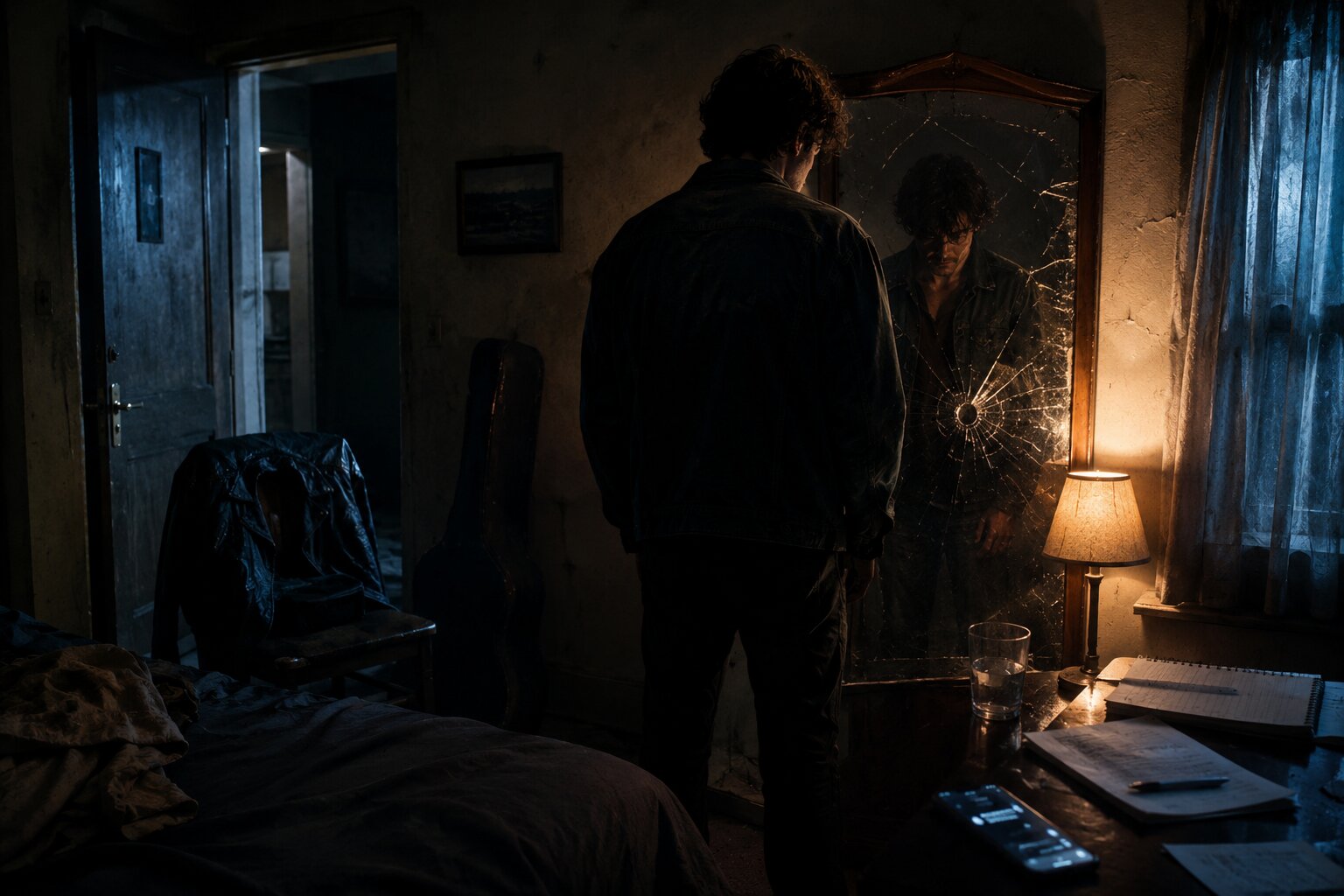
The mirror image matters because mirrors usually represent honesty. In this song, the mirror becomes frightening because it forces the narrator to face himself. He can manage what other people see, but he cannot fully escape his own reflection.
The phrase “another day” is also central to the chorus’s meaning. It suggests repetition, routine, and endurance. Fear is not presented as a single dramatic breakdown. It is something the narrator wakes up with and survives again.
Verse 2 Meaning: The Pull of Old Patterns
The second verse deepens the sense that the narrator is trying not to repeat himself. The emotional movement points toward temptation, relapse, or the return of a familiar destructive cycle.
This part of the song can be read through several lenses. On one level, it may describe a relationship that keeps reopening old wounds. On another level, it can be heard as a sobriety-related struggle, where the narrator recognizes the danger of letting an old impulse back into his life.
The strongest interpretation is that “Kingdom Of Fear” is about familiarity becoming dangerous. The narrator knows the route back into darkness. The urgency comes from the fact that he may be close enough to remember how easy it is to return.
Bridge Meaning: Confession Without a Clean Resolution
The bridge feels less like a solution and more like a pressure release. Instead of turning the song into a neat recovery anthem, it intensifies the sense that fear has momentum.
This is where the song’s high-energy production becomes part of the meaning. The track sounds like someone moving fast because slowing down would mean confronting everything. The bridge captures the feeling of trying to outrun one’s own thoughts.
Rather than offering a clean breakthrough, the bridge keeps the listener inside the emotional chase. That makes the song more honest. Fear rarely disappears just because it has finally been named.
Outro Meaning: Surviving Is Not the Same as Escaping
The outro leaves the song unresolved in a meaningful way. The narrator has admitted the truth of his fear, but the kingdom has not magically disappeared.
That ending is part of the song’s power. “Kingdom Of Fear” does not pretend that self-awareness automatically equals freedom. It shows a person still inside the fight, still trying to make it through another day without surrendering to the worst parts of himself.
Hidden Meanings, Metaphors, and Symbolism
The strongest metaphor is the title itself. A “kingdom of fear” suggests a whole inner world where fear has power. It is not only an emotion; it is the ruling force, the architecture, and the atmosphere.
The mirror symbolizes self-confrontation. It represents the moment when the narrator can no longer rely on performance, charm, or denial. Even if he can tell other people he is fine, the mirror forces a more honest reckoning.
The closed door symbolizes selective vulnerability. The narrator can let someone close enough to see part of him, but not close enough to see everything. That image captures the painful contradiction of wanting intimacy while fearing exposure.
The body imagery gives the song its urgency. Fear appears in the skin, the throat, the reflex to stay silent, and the panic of being alone with oneself. This makes the song feel less like a general sad confession and more like a lived psychological state.
Is the Song Based on a Real Person or Event?
There is no verified evidence that “Kingdom Of Fear” is about one specific person or one exact event. The lyrics can be interpreted through relationships, mental health, sobriety, and self-protection, but Whitcomb has not publicly confirmed a single real-life subject behind the song.
What can be said more safely is that the song fits the autobiographical emotional space Whitcomb is known for. His official site describes his earlier work in connection with hard truths, personal demons, and addiction recovery, which makes the recovery-focused reading of “Kingdom Of Fear” contextually reasonable. (Cameron Whitcomb Official Website)
So the safest conclusion is that the song appears rooted in real emotional experience, but the exact people, scenes, and incidents remain unconfirmed.
How This Song Fits Into Cameron Whitcomb’s Catalog
“Kingdom Of Fear” fits naturally into Cameron Whitcomb’s catalog because it continues his interest in confession, damage, recovery, and emotional volatility. He often writes from the point of view of someone who is not polished, not fully healed, and not trying to make pain sound prettier than it is.
Compared with some of his more wounded or reflective material, “Kingdom Of Fear” feels like panic in motion. It is vulnerable, but it is not slow. The song moves with urgency, making fear feel active rather than passive.
That makes it an important part of the Deep Water era. The EP presents Whitcomb as an artist reconnecting with instinct, movement, and emotional immediacy. “Kingdom Of Fear” keeps his confessional edge while adding a restless, hard-driving pulse.
Final Thoughts
“Kingdom Of Fear” resonates because it refuses to make fear look clean or poetic in an easy way. Cameron Whitcomb gives listeners a narrator who hides, performs, panics, recognizes his own damage, and keeps moving anyway.
The most likely meaning of the song centers on the daily fight against anxiety, shame, old patterns, and the pull of self-destruction. Whether listeners hear it as a mental health song, a sobriety song, or a relationship song, its emotional truth is the same: sometimes the hardest place to escape is the one you built inside yourself.
FAQs About “Kingdom Of Fear”
What does “Kingdom Of Fear” mean in Cameron Whitcomb’s song?
Who wrote “Kingdom Of Fear”?
Is “Kingdom Of Fear” based on a true story?
What is the chorus of “Kingdom Of Fear” about?
What album or EP is “Kingdom Of Fear” from?
When was “Kingdom Of Fear” released?
Did “Kingdom Of Fear” chart?
Sources Used
- Apple Music – “Kingdom Of Fear” song page
- YouTube – “Kingdom Of Fear” official auto-generated credits
- Billboard Canada – Cameron Whitcomb’s first Billboard Hot 100 entry with “Kingdom Of Fear”
- Billboard Canada – Spotify 2026 Songs of Summer predictions featuring “Kingdom Of Fear”
- People – Cameron Whitcomb on Deep Water and reconnecting with songwriting
- Cameron Whitcomb Official Website – artist background and catalog context