
Good Music Still Needs Smart Marketing
TL;DR
Great music is the foundation, but it is not a complete growth strategy by itself. Independent artists need smart marketing to help the right listeners discover, remember, save, share, and return to their music. The most important takeaway is simple: do not market harder at random; build a clear system around positioning, release timing, platform behavior, fan conversion, and consistent follow-up.
Introduction
Many artists quietly believe that if the song is good enough, people will eventually find it. That belief is understandable. Music is personal, emotional, and difficult to make well. After spending weeks or months writing, recording, producing, mixing, and mastering a track, marketing can feel like a distraction from the art.
But discovery does not work like a meritocracy. A great song can disappear if it has no release plan, no visual identity, no audience pathway, no reason for listeners to come back, and no consistent signal across platforms. At the same time, weaker songs can travel further when they are attached to a clear story, repeated exposure, short-form content, playlist strategy, and a community that knows what to do when the release drops.
This does not mean artists should become salespeople first and musicians second. It means good music deserves an intentional system around it. Streaming remains central to recorded music consumption and revenue: IFPI reported that paid subscription streaming grew 8.8% in 2025 and accounted for 52.4% of total global recorded music revenues. (IFPI Global Music Report 2026)
This guide explains how independent artists can market good music intelligently, without relying on fake hype, vague posting, or unrealistic promises.
Table of Contents
- Key Takeaways
- A Good Song Needs a Clear Reason to Be Noticed
- Marketing Starts Before the Song Is Released
- Match Each Platform to a Specific Job
- Turn Listeners Into Fans, Not Just Stream Counts
- Make Your Story Easier to Repeat
- Measure Momentum Without Chasing Vanity Metrics
- Common Mistakes That Make Good Music Harder to Find
- How Blocktone Records Can Help
- Frequently Asked Questions
- Sources Used
Key Takeaways
| Point | Details |
|---|---|
| Quality is the starting point, not the whole strategy. | A strong song still needs positioning, timing, visuals, distribution, and repeated exposure. |
| Marketing should begin before release day. | Artists need enough runway for distribution, profile updates, content creation, and pitching. |
| Each platform should serve a different purpose. | TikTok, Reels, Shorts, Spotify, YouTube, Bandcamp, SoundCloud, email, and live shows should not all repeat the same message. |
| Fan actions matter more than passive attention. | Saves, playlist adds, comments, email signups, merch interest, repeat streams, and show attendance reveal deeper demand. |
| Smart marketing protects the music. | Good strategy helps artists avoid desperate posting, fake playlist schemes, unclear branding, and wasted ad spend. |
A Good Song Needs a Clear Reason to Be Noticed
A listener does not discover music in a vacuum. They hear a song through context: a video, a playlist, a recommendation, a live clip, a friend’s post, a visual mood, a story, or a repeated phrase that makes them curious.
That context is marketing.
For independent artists, smart marketing begins with a simple question: why should someone stop, listen, and remember this specific song?
The answer should not be “because it is good.” That may be true, but it is not specific enough. A better answer sounds more like this:
- This is a breakup song for people who are angry but not over it.
- This is late-night indie pop for fans of emotional synth textures and intimate vocals.
- This is a high-energy track built for gym clips, dance edits, and live crowd moments.
- This is a cinematic folk song about leaving your hometown and still missing it.
Those descriptions help people place the song in their life. They also help you create content, pitch playlists, write captions, brief designers, choose short-form clips, and explain the release without sounding vague.
What to define before promotion begins
- The emotional hook: What feeling does the song deliver?
- The listener situation: When would someone play it?
- The sonic neighborhood: What genres, moods, or artist references help frame it?
- The visual world: What colors, places, textures, or imagery fit the track?
- The fan action: What do you want people to do after hearing it?
A smart marketing plan does not change the song. It gives the song a sharper path into the listener’s world.
Pro Tip: If you cannot describe your song in one memorable sentence, your audience will struggle to describe it for you.
Marketing Starts Before the Song Is Released
Many artists treat release day as the beginning of promotion. In practice, release day should be the moment when several prepared signals go live at once.
A song needs time to be delivered, reviewed, pitched, scheduled, and prepared for content. Spotify’s official guidance says artists can use Spotify for Artists to pitch one upcoming, unreleased song to playlist editors, and that pitching at least 7 days before release helps get the song into followers’ Release Radar playlists. Spotify also notes that pitching does not guarantee playlist placement. (Spotify for Artists – Pitching Music to Playlist Editors)
That one detail matters because it shows the difference between a casual upload and a planned release. If the song is uploaded too late, you may lose access to useful pre-release options.
A practical pre-release timeline
Four to six weeks before release: Finalize the master, artwork, distributor upload, short bio, press angle, content ideas, and release goal. This is also when you should decide whether the release is mainly about audience growth, playlist discovery, fan reactivation, live-show promotion, or building toward a larger project.
Two to three weeks before release: Prepare short-form clips, teaser posts, email or text updates, playlist pitch language, visual assets, and behind-the-scenes content. Confirm that artist profiles are updated and consistent.
Seven days before release: Make sure platform-specific pitching and profile updates are complete. This is the minimum window Spotify highlights for Release Radar eligibility through pitching.
Release week: Post with purpose. Do not simply announce “out now” once and disappear. Use multiple angles: the story behind the song, the best lyric, the production detail, the live performance moment, the fan reaction, the mood, and the reason people should save it.
Two to four weeks after release: Keep the song alive. Many listeners will not see your first post. Post new formats, respond to comments, create acoustic or live versions, pitch smaller outlets, update playlists, and track what content is actually causing listeners to act.
Mistake to avoid
Do not spend all your energy on the announcement post. Most songs need repeated context before people care enough to listen. One post rarely creates momentum on its own.
Match Each Platform to a Specific Job
Smart marketing is not about being everywhere. It is about knowing what each platform does best.
A common independent artist mistake is copying the same caption and graphic across every channel. That creates activity, but not necessarily strategy. Each platform has a different user behavior.
| Platform | Best Use | What to Avoid |
|---|---|---|
| Spotify | Streaming, saves, playlisting, listener data | Expecting playlist placement to replace fan building |
| YouTube | Music videos, Shorts, long-form storytelling, search | Uploading only official videos with no supporting content |
| TikTok / Reels | Discovery, repeat hooks, personality, trends | Forcing memes that do not fit the artist |
| SoundCloud | Early community, demos, direct engagement, niche scenes | Treating the profile as a dumping ground |
| Bandcamp | Direct support, merch, liner notes, collector culture | Sending fans there with no story or offer |
| Email / SMS | Fan retention and direct communication | Waiting until you “feel big enough” to start |
| Live shows | Converting attention into real-world loyalty | Playing shows without capturing future contact |
Apple Music for Artists offers promotional tools such as shareable assets, Milestones, badges, QR codes, and links that help artists send fans to their music more directly. (Apple Music for Artists – Promote Your Music)
SoundCloud’s own audience-growth guidance stresses profile presentation, consistent artist naming, discoverability, smart promotion, and engagement with listeners. (SoundCloud Help Center – How to Grow Your Audience)
The lesson is simple: platforms are not interchangeable. Use each one for the job it is built to perform.
Turn Listeners Into Fans, Not Just Stream Counts
A stream is valuable, but it is only one signal. A listener who hears a song once and never returns is different from a listener who saves it, adds it to a playlist, watches multiple videos, signs up for emails, buys a shirt, or comes to a show.
Smart marketing focuses on moving people from passive exposure to active connection.
Spotify’s Fan Study reported that “super listeners” made up 2% of an artist’s monthly listeners on average but drove more than 18% of monthly streams. Spotify also reported that after a listener adds an artist to a personal playlist, they stream 41% more and view the artist profile 12% more often on average. (Spotify for Artists – Fan Study: Fan Connection)
That does not mean every artist should obsess over one metric. It means deeper fan behavior matters.
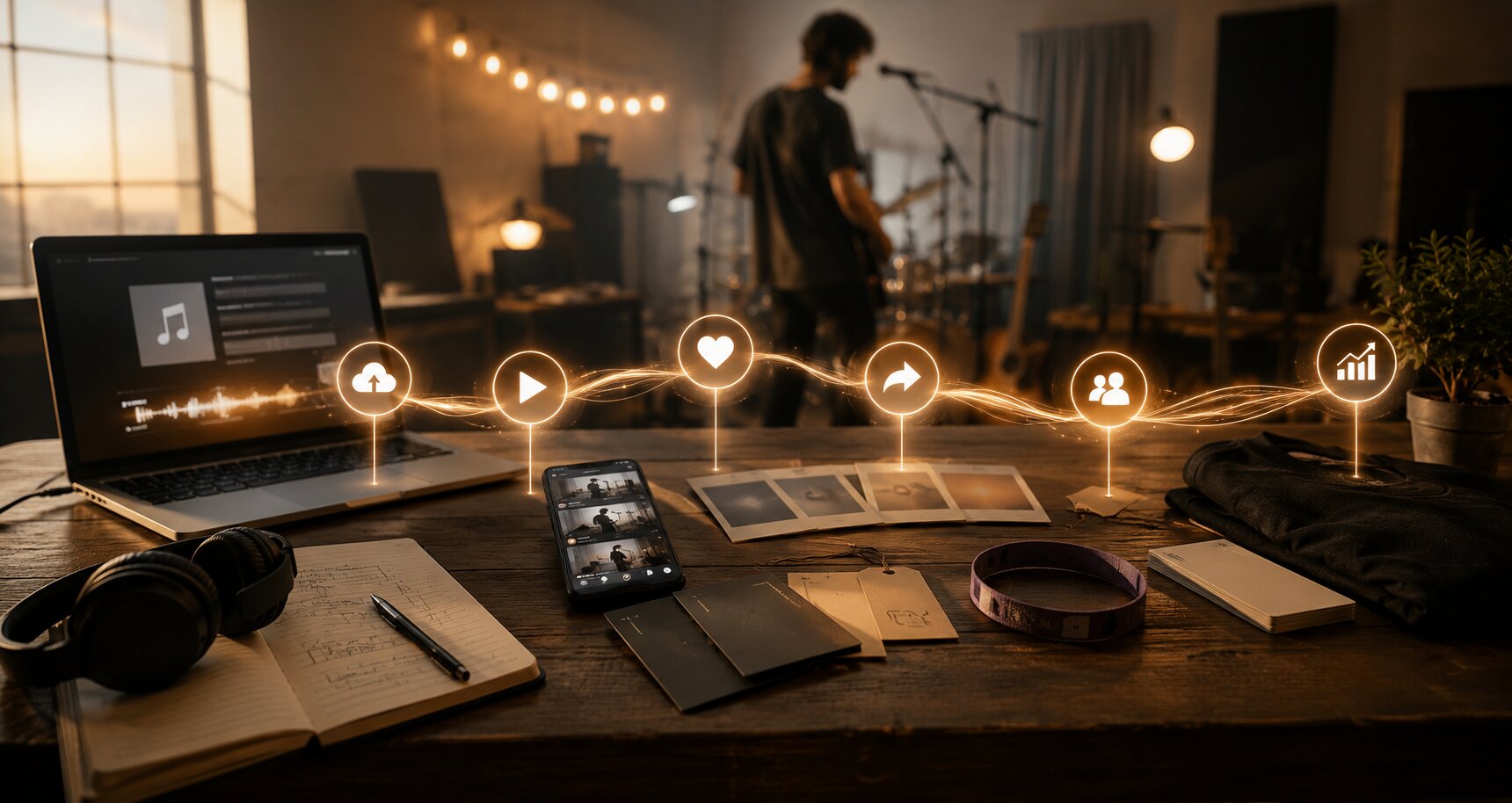
Build a simple fan journey
- Discovery: Someone sees a clip, hears the song, or finds you through a playlist.
- Curiosity: They visit your profile, watch another video, or read the caption.
- Commitment: They save the song, follow you, comment, or add it to a playlist.
- Connection: They join your email list, attend a live stream, buy merch, or share your work.
- Community: They return for the next release and bring other people with them.
Your job is to make the next step obvious.
For example, a TikTok clip can lead to a streaming link. A YouTube Short can point to the full video. A Spotify profile can feature merch or tour dates. A Bandcamp page can include liner notes that deepen the listener’s connection. A live show can include a QR code for the mailing list.
Pro Tip: Never let attention end without a next step. Even a small call to action, such as “save this for your late-night playlist,” gives the listener a role.
Make Your Story Easier to Repeat
Good marketing is not only distribution. It is memory design.
Fans share artists when they can explain them. If your music, visuals, captions, and profile all feel disconnected, people may enjoy one song but struggle to understand who you are.
A repeatable artist story includes:
- A recognizable emotional lane
- Consistent visual language
- A clear artist bio
- A few strong phrases that describe your sound
- A reason the music matters now
- Content that reinforces the same identity from different angles
This does not mean every song must sound the same. It means your audience should feel a thread between releases.
Example: weak vs. stronger positioning
| Weak Positioning | Stronger Positioning |
|---|---|
| New single out now. | A late-night alt-pop song about wanting closure from someone who keeps coming back. |
| Check out my music. | For fans of intimate vocals, heavy drums, and lyrics about complicated relationships. |
| Big things coming. | This release starts a three-song story about leaving, healing, and rebuilding. |
The stronger examples give listeners something to hold onto. They also give bloggers, playlist curators, fans, and collaborators language they can reuse.
Mistake to avoid
Do not confuse mystery with lack of clarity. You can be artistic, subtle, and emotionally complex while still giving people a reason to care.
Measure Momentum Without Chasing Vanity Metrics
Not all numbers mean the same thing.
A video with many views but no profile visits may be less useful than a smaller video that drives saves, comments, and repeat listeners. A playlist placement may look impressive but produce little long-term fan growth if listeners do not remember your name. A paid ad may bring clicks but fail if the song, landing page, or audience targeting is weak.
Track metrics that connect to real behavior.
| Goal | Metrics to Watch |
|---|---|
| Awareness | Reach, impressions, video views, profile visits |
| Streaming engagement | Saves, repeat streams, playlist adds, completion behavior where available |
| Audience growth | Follows, email signups, SMS signups, Discord or community joins |
| Content quality | Watch time, comments, shares, click-through rate |
| Revenue potential | Merch clicks, Bandcamp sales, ticket interest, direct purchases |
| Long-term loyalty | Returning listeners, repeat buyers, live attendance, fan messages |
The goal is not to make every metric perfect. The goal is to learn what moves people from one stage to the next.
A simple weekly review
- Which post brought the most real listeners?
- Which clip made people comment or ask about the song?
- Which platform produced saves, not just views?
- Which audience description performed best?
- Which call to action worked?
- What should be repeated, refined, or stopped?
Smart marketing improves through feedback. Guessing is normal at the beginning. Staying blind is the problem.
Common Mistakes That Make Good Music Harder to Find
Good music can underperform for reasons that have nothing to do with the song itself. These are some of the most common strategy problems.
Releasing with no runway
Uploading a track and announcing it the same day gives platforms, curators, fans, and your own content very little time to build momentum. Plan releases early enough to prepare assets, pitch properly, and create anticipation.
Promoting only once
Most fans do not see every post. Even when they do, they may need multiple reminders before listening. Promote the same release from different angles instead of repeating the exact same graphic.
Sending listeners to too many places at once
“Listen everywhere” is convenient, but it can also be vague. Use smart links, but make the desired action clear: save the song, watch the video, join the list, buy the tape, or share the clip.
Buying fake attention
Fake streams, bot playlists, and artificial engagement can damage credibility and distort your data. They also teach you nothing about real listeners. A smaller base of genuine fans is more valuable than inflated numbers that cannot convert.
Copying trends without context
A trend can help discovery, but only if it connects naturally to the music. If the content gets attention for the wrong reason, people may remember the joke but not the song.
Ignoring direct fan channels
Social platforms are useful, but you do not fully control them. Email lists, text lists, websites, Bandcamp followers, and live relationships give artists more stable ways to reach fans over time. Bandcamp describes itself as a music community where fans discover, connect with, and directly support artists. (Bandcamp for Artists)
Waiting until success to look professional
You do not need a major-label budget, but you do need clarity. Consistent artwork, clean profile images, updated bios, working links, and organized content make it easier for listeners and industry contacts to take you seriously.
How Blocktone Records Can Help
Good music deserves more than random posting and last-minute promotion. Blocktone Records helps independent artists think strategically about releases, audience growth, positioning, and long-term fan development.
For artists building their next campaign, the goal is not to force hype. It is to create a smarter path from first impression to real connection: the right message, the right platforms, the right release timing, and the right follow-up after the song is out.
Learn more at blocktonerecords.com.
FAQs About Smart Music Marketing
Does good music really need marketing?
How early should I start marketing a song?
Can independent artists market music without a big budget?
What is the biggest music marketing mistake?
Should I focus on playlists or social media?
How do I know if my music marketing is working?
Is paid promotion worth it for music?
Sources Used
- IFPI – Global Music Report 2026
- RIAA – 2025 Year-End Recorded Music Revenue Report
- Spotify for Artists – Pitching Music to Playlist Editors
- Spotify for Artists – Fan Study: Fan Connection
- Apple Music for Artists – Promote Your Music
- SoundCloud Help Center – How to Grow Your Audience on SoundCloud
- Bandcamp for Artists