

The Independent Artist as a Small Business
TL;DR
An independent artist is not only a creator; they are also the operator of a small media, rights, and fan relationship business. The goal is not to become corporate, but to build simple systems around revenue, releases, audience data, expenses, rights, and decision-making. Treat every song, fan interaction, show, video, and merch item as part of one connected business model.
Introduction
Many independent artists think the business side begins after the music starts working. In reality, the business side is what helps the music keep working after the first burst of attention fades.
You do not need a corporate office, a full team, or a label-style budget to think like a small business. You need a clear offer, a way to reach people, a system for tracking money, and enough structure to make better decisions when opportunities appear.
That structure matters because modern artists are no longer building careers through one channel. A single release might involve streaming platforms, short-form video, email, merch, live shows, sync potential, YouTube, direct-to-fan sales, and multiple royalty collection points. Global recorded music revenues reached $31.7 billion in 2025, according to IFPI, with paid streaming continuing to drive industry growth. (IFPI Global Music Report 2026)
This guide explains how to operate as an independent artist with a practical small-business mindset: revenue planning, rights, data, fan relationships, expenses, and decisions that make your creative work more sustainable.
Table of Contents
- Key Takeaways
- Separate the Artist Role from the Operator Role
- Build a Revenue Stack, Not a Streaming Fantasy
- Turn Your Catalog into Managed Business Assets
- Create a 90-Day Artist Operating Plan
- Treat Fans Like Relationships, Not Metrics
- Keep the Back Office Simple but Serious
- Make Founder-Level Decisions Without Killing the Art
- How BlockTone Records Can Help
- FAQs About Independent Artists as Small Businesses
- Sources Used
Key Takeaways
| Point | Details |
|---|---|
| Your artist project is a business model | Music, merch, shows, content, royalties, licensing, and fan data should work together instead of existing as disconnected tasks. |
| Streaming is one revenue lane | Streaming can create discovery and royalties, but sustainable artists usually combine multiple income paths. |
| Your catalog needs administration | Songs and recordings should be registered, organized, tracked, and promoted over time like business assets. |
| Small systems beat random effort | A simple 90-day plan, budget, content rhythm, and release calendar can improve consistency without requiring a large team. |
| Fan relationships are business infrastructure | Email lists, direct-to-fan platforms, merch buyers, and repeat listeners are more valuable than passive vanity metrics. |
| The back office protects future income | Bookkeeping, metadata, rights registration, contracts, and clean records prevent avoidable losses later. |
Separate the Artist Role from the Operator Role
The independent artist has at least two jobs. The first job is creative: writing songs, recording, performing, developing a sound, shaping visuals, and telling a story. The second job is operational: deciding what gets released, where money goes, how fans are reached, how rights are handled, and how results are measured.
The mistake many artists make is blending these roles until every decision becomes emotional. If a post performs badly, they question the music. If a single does not land immediately, they abandon the rollout. If merch does not sell on the first try, they assume fans do not care.
A small-business mindset creates distance. It lets you see the song as the product, the release as the campaign, the fanbase as the market, the catalog as the asset, the data as feedback, and the budget as a real constraint rather than a personal judgment.
This does not make the music less meaningful. It gives the music a better chance to survive contact with the market.
Define what your artist business actually sells
An independent artist does not only sell songs. Depending on the stage of the career, the business may generate value from streaming royalties, digital downloads, physical music, merch, tickets, VIP experiences, YouTube monetization, direct fan support, sync licensing, publishing royalties, production services, brand collaborations, community access, or educational content.
The important part is not having every revenue stream at once. The important part is knowing which ones make sense for your audience now.
A new bedroom-pop artist with no live market might focus on streaming, short-form discovery, YouTube, email capture, and limited merch drops. A folk artist with a strong local following might earn more from shows, vinyl, house concerts, and direct fan sales than from social reach. A producer might treat beats, sample packs, sync pitching, and artist collaborations as part of the business model.
Pro Tip: Write a one-sentence business definition for your artist project. For example: “I create emotionally direct indie-pop songs and build income through streaming, intimate live shows, direct fan support, and limited physical merch.”
Build a Revenue Stack, Not a Streaming Fantasy
Streaming matters, but it should not carry the entire financial burden of an independent career. In the U.S., RIAA reported that streaming accounted for 84% of recorded music revenues in the first half of 2025, while vinyl remained a major part of physical music revenue. For independent artists, the lesson is not to chase every format. The lesson is to understand where each format fits inside your own audience economy. (RIAA 2025 Mid-Year Report)
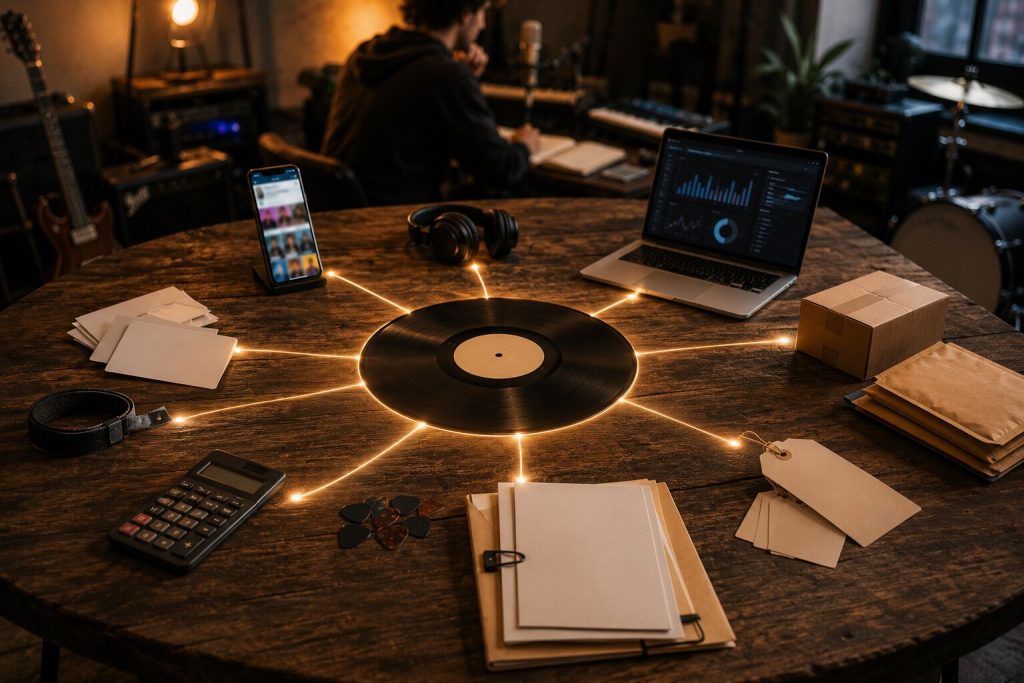
A revenue stack means combining several income sources that support each other. Streaming may help people discover the music. Merch may let fans express identity. Live shows may turn casual listeners into real supporters. YouTube may create search visibility and a visual home for the catalog. Bandcamp or direct sales may help the most committed fans support the artist more intentionally.
| Revenue Stream | Best Use | Common Mistake |
|---|---|---|
| Streaming | Discovery, catalog income, listener data | Expecting streams alone to fund the whole career early |
| Merch | Identity, fan loyalty, higher-value offers | Printing too much before demand is proven |
| Live shows | Community, cash flow, fan conversion | Playing shows without collecting fan contacts |
| YouTube | Search, video catalog, long-term visibility | Uploading only music videos and ignoring repeatable content |
| Direct sales | Supporter revenue, physical and digital sales | Treating the store like a passive link |
| Sync and licensing | Long-tail catalog opportunities | Pitching songs with unclear rights or poor metadata |
Spotify allows artists to connect merch through Spotify for Artists using its Shopify integration, while Bandcamp lists a 15% fee on digital items and 10% on physical goods, with payment processor fees separate. These tools are not magic revenue machines, but they can help artists connect listening behavior to fan support when used intentionally. (Spotify for Artists Merch) (Bandcamp Fees)
Start with one primary and two supporting revenue paths
Do not try to monetize everything at once. Pick a simple structure. An artist might choose streaming and catalog growth as the primary focus, supported by merch and live shows. Another artist might make direct fan sales the primary focus, supported by YouTube and email list growth. A producer might prioritize production services, supported by artist releases and sync pitching.
This keeps the strategy focused. You can still experiment, but your weekly work should support the revenue paths that actually matter right now.
Turn Your Catalog into Managed Business Assets
Your songs are not just posts in audio form. They are assets with ownership, metadata, royalty pathways, artwork, videos, alternate versions, performance history, and future licensing potential.
That means every release should have a basic asset record. At minimum, track the song title, writers, ownership splits, master owner, producer credits, ISRC, UPC, distributor, release date, lyrics, artwork file, instrumental version, clean version, publishing details, and links to DSPs, YouTube, Bandcamp, and social content.
This looks boring until someone asks to license a song, a collaborator disputes a split, a distributor needs metadata, or a track starts gaining attention months after release.
Know the difference between recordings and compositions
A song usually involves two major rights layers: the composition and the sound recording. The composition is the underlying song: melody, lyrics, and musical work. The sound recording is the specific recorded version.
Independent artists often control both, but not always. If you co-write, use producers, lease beats, collaborate with vocalists, or work with labels, the ownership picture can change quickly.
In the U.S., The Mechanical Licensing Collective administers blanket mechanical licenses for eligible streaming and download services and pays qualifying rightsholders. SoundExchange helps registered creators search and claim recordings, track catalog, and review digital royalty payments for the areas it administers. (The MLC) (SoundExchange)
Mistake to avoid: Releasing music before agreeing on splits. A casual collaboration can become a business conflict if the song later earns money or attracts licensing interest.
Create a 90-Day Artist Operating Plan
A traditional business plan can be useful, but many artists do not need a 30-page document to take action. They need a clear 90-day operating plan.
The U.S. Small Business Administration describes a business plan as a foundation for planning how a business will operate and grow. For artists, that idea can be translated into a leaner music-specific version focused on releases, audience, revenue, operations, and financial decisions. (U.S. Small Business Administration)
Your 90-day artist plan should answer six questions
- What are we promoting? A single, EP, live show, video series, merch drop, catalog song, or fan offer.
- Who is it for? Define the listener by taste, behavior, scene, mood, or community, not only age and location.
- What is the measurable goal? Examples include email signups, ticket sales, saves, repeat listeners, merch sales, YouTube subscribers, playlist adds, or direct purchases.
- What channels matter most? Choose based on where your fans already act. TikTok discovery is different from YouTube search, Instagram community, Spotify saves, or Bandcamp purchases.
- What is the budget? Include recording, mixing, mastering, artwork, video, ads, merch production, distribution, PR, content tools, and live costs.
- What happens after the campaign? Decide how you will retarget listeners, email fans, pitch the catalog, post alternate versions, sell merch, or build toward the next release.
| Timeframe | Focus | Artist-Business Action |
|---|---|---|
| Days 1–15 | Foundation | Finalize metadata, splits, artwork, budget, and content angles. |
| Days 16–30 | Setup | Deliver the release, prepare email assets, organize social content, and confirm links. |
| Days 31–45 | Pre-release | Build the story, tease content, pitch where eligible, and collect direct fan interest. |
| Days 46–60 | Release | Publish content, engage fans, monitor saves, streams, comments, and sales. |
| Days 61–75 | Expansion | Share alternate versions, behind-the-song content, live clips, and follow-up outreach. |
| Days 76–90 | Review | Compare goals to results, update the budget, and choose the next best move. |
For Spotify editorial pitching, Spotify says submitting a pitch at least seven days before release day gets the song into followers’ Release Radar, although editorial playlist placement is not guaranteed. (Spotify Playlist Pitching Guide)
Treat Fans Like Relationships, Not Metrics
Followers are not the same as reachable fans. Monthly listeners are not the same as buyers. Views are not the same as trust.
A small business needs a customer relationship. An artist needs a fan relationship. Platforms can create discovery, but the artist must build reasons for people to return.
Spotify for Artists separates audience behavior into segments such as monthly active listeners, previously active listeners, programmed listeners, and super listeners. That distinction matters because passive listening and intentional listening are not equally valuable for long-term fan growth. (Spotify Audience Segments)
Build a fan relationship ladder
- Discovery: They hear the song through a playlist, short video, friend, show, or algorithm.
- Recognition: They remember the artist name, sound, story, or visual identity.
- Repeat listening: They save, replay, follow, or search.
- Direct connection: They join an email list, Discord, text list, Patreon, Bandcamp following, or community.
- Support: They buy, attend, tip, subscribe, share, or bring friends.
- Advocacy: They become part of the artist’s growth engine.
Your job is to move fans one step deeper, not demand full loyalty immediately. Every high-attention moment should have a next step. If a video performs well, invite viewers to hear the full song. If a song gains streams, invite listeners to join the list. If fans buy merch, invite them to the next show or release event.
YouTube can also be part of this relationship ladder. YouTube describes an Official Artist Channel as a main landing page for an artist’s music, brand, presence, and community. (YouTube for Artists)
Keep the Back Office Simple but Serious
The back office is where many independent artists lose money without noticing. This does not mean you need complicated systems. It means you need basic discipline around income, expenses, contracts, files, and records.
The IRS says a business recordkeeping system should clearly show income and expenses, and business books should show gross income, deductions, and credits. Even outside the U.S., the principle is broadly useful: keep clean records so you can understand the business and meet local tax requirements. (IRS Recordkeeping Guidance)
What to track every month
- Income by source
- Expenses by category
- Profit or loss
- Cash on hand
- Upcoming obligations
- Content output
- Audience growth
- Email or direct fan growth
- Best-performing songs
- Best-performing platforms
- Highest-converting offers
Common artist expense categories
| Category | Examples |
|---|---|
| Recording | Studio time, session musicians, production |
| Post-production | Mixing, mastering, editing |
| Visuals | Artwork, photography, video, design |
| Marketing | Ads, PR, playlist pitching tools, content production |
| Distribution | Distributor fees, platform tools |
| Live | Rehearsal space, transport, lodging, gear rental |
| Merch | Design, samples, production, shipping materials |
| Admin | Website, email software, accounting, legal support |
Mistake to avoid: Measuring success only by gross revenue. If a merch drop brings in money but most of it disappears into production, shipping, and promotion costs, the result is very different from a campaign with healthy margin.
Make Founder-Level Decisions Without Killing the Art
A founder does not ask, “Did this make me famous?” after every campaign. A founder asks better questions: What did we learn? What asset did we build? What audience segment responded? Which channel produced real action? What should we stop doing? What should we repeat? What can become a system?
That mindset is especially important because artist growth is rarely linear. One song may become meaningful months later. One fan may bring ten more people. One live show may matter more than a week of posts. One direct buyer may be more valuable than hundreds of passive impressions.
Use data without becoming controlled by it
Artist dashboards are useful, but they are not your identity. Apple Music for Artists provides analytics that help artists compare listener actions, locations, demographics, and song-level engagement over time. (Apple Music for Artists Analytics)
Use that information to make decisions, not to chase every spike. Good data questions include: Which songs create repeat listening? Which cities show unexpected interest? Which platforms create direct fan actions? Which content formats lead people to the music? Which expenses are not producing useful outcomes?
Bad data questions include: Why did this one post not go viral? Should I change my entire sound because one video failed? How do I copy another artist’s numbers? Can I skip brand-building and just hack the algorithm?
A small business survives by learning. An artist business survives by learning without losing its creative center.
How BlockTone Records Can Help
For independent artists, the hardest part is often not knowing what to do. It is knowing what to prioritize next. A music career can become a scattered mix of songs, posts, unfinished rollout plans, unclear rights, and half-used platforms.
BlockTone Records can support artists by helping them think more strategically about releases, promotion, fan growth, and long-term positioning. The goal is not to turn the artist into a corporation. The goal is to build a clearer operating system around the music so each release has a stronger purpose and every fan interaction has somewhere to go.
Visit blocktonerecords.com to learn more.
FAQs About Independent Artists as Small Businesses
Is an independent artist really a small business?
Do I need to register a company before releasing music?
What is the best first revenue stream for a new independent artist?
How much money should an independent artist reinvest?
What business tools does an artist need first?
Should artists focus more on fans or platforms?
What is the biggest business mistake independent artists make?
Sources Used
- IFPI – Global Music Report 2026
- RIAA – 2025 Mid-Year Recorded Music Revenue Report
- Spotify for Artists – Sell Merch on Spotify
- Spotify for Artists – Pitching Music to Playlist Editors
- Apple Music for Artists – Understand Your Analytics
- YouTube for Artists – Official Artist Channel Resources
- Bandcamp Help Center – Bandcamp Fees
- The Mechanical Licensing Collective
- SoundExchange – For Artists, Labels, and Producers
- U.S. Small Business Administration – Write Your Business Plan
- IRS – What Kind of Records Should I Keep?