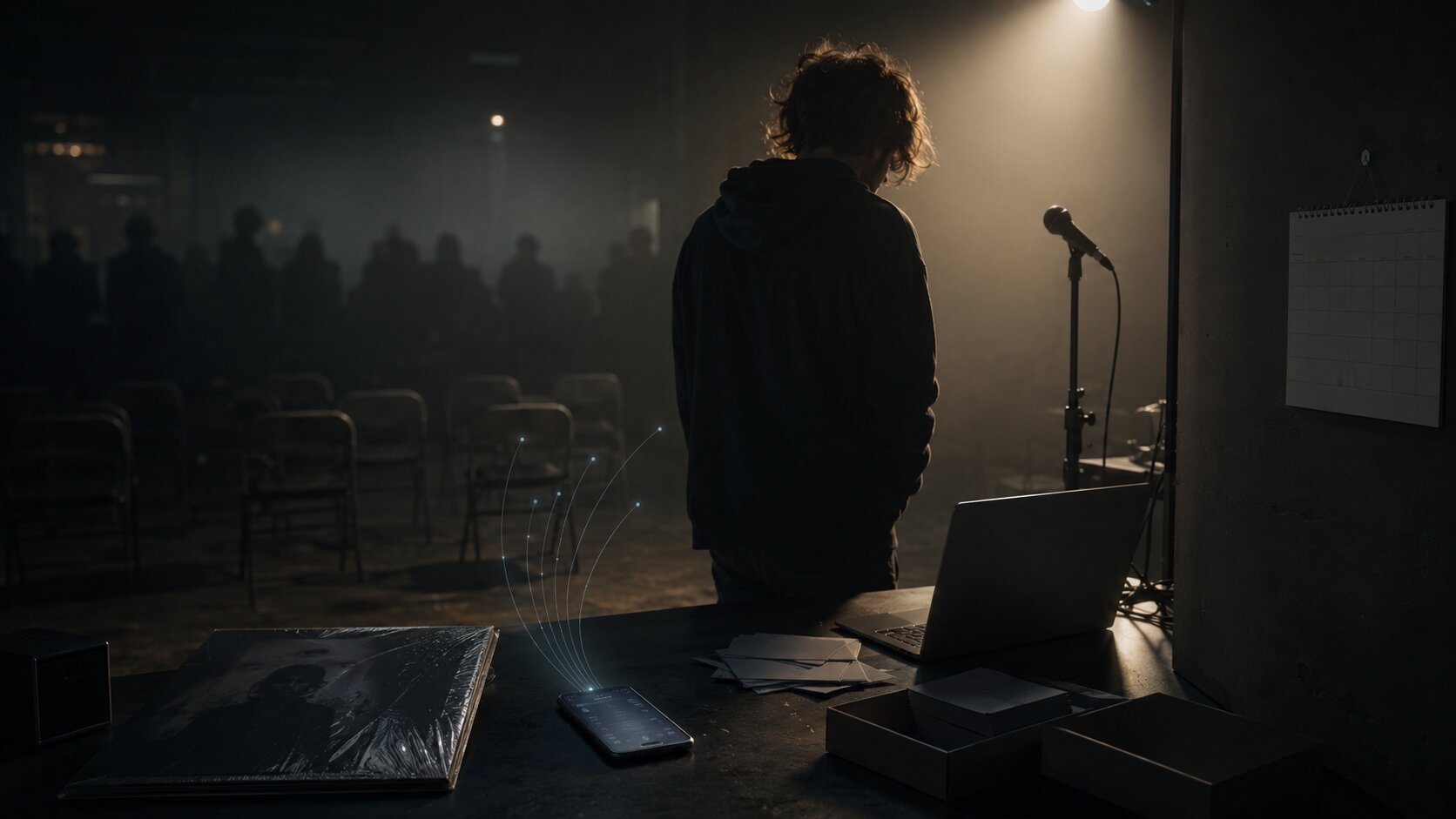
The Problem With Posting Only When You Release Music
TL;DR: Posting only when you release music forces every song to start from a cold audience. A stronger strategy is to stay visible between releases with lightweight content that builds recognition, trust, and fan signals before you need people to act. Release day should be the peak of an ongoing conversation, not the first time fans hear from you in months.
A lot of independent artists treat music promotion like a switch: off while they are writing, recording, mixing, or dealing with life, then suddenly on when a new song drops. The usual pattern is familiar: cover art, release date, presave link, a few short-form clips, then a post saying the song is out now.
The problem is not always the song. Often, the problem is the silence before the song.
Modern music discovery depends on attention, repetition, platform behavior, and audience memory. If followers have not heard from you in three months, your release announcement is not just competing with other artists. It is competing with everything else they have built a habit of watching, saving, sharing, and caring about.
This guide explains why release-only posting weakens music promotion, what independent artists can post between releases, and how to build a realistic content rhythm that makes each new song easier to support.
Table of Contents
- The Release-Day Trap: Why Attention Starts Too Late
- Algorithms Reward Audience Signals, Not Sudden Panic
- What to Post When You Have Nothing New Out
- A Simple Between-Releases Content System
- Keep Fans Reachable Outside the Feed
- Measure Warmth Before You Announce the Next Song
- Where blocktonerecords.com Fits Into the Plan
- Frequently Asked Questions
Key Takeaways
| Point | Details |
|---|---|
| Release-only posting starts too cold | Fans need repeated context before a release announcement feels natural. |
| Platform signals matter | Social and streaming platforms respond to audience behavior, not artist urgency alone. |
| Between-release content can be simple | You do not need to post constantly; you need a repeatable rhythm that keeps your audience warm. |
| Old songs still have value | Past releases can be reintroduced through stories, live clips, lyric explanations, and new visual angles. |
| Direct fan channels reduce risk | Email, Bandcamp followers, websites, and community channels help artists avoid relying only on social feeds. |
The Release-Day Trap: Why Attention Starts Too Late
Posting only when you release music creates a timing problem. You are asking people to care at the exact moment you need results.
That is backwards.
A release is not just a file going live on streaming platforms. It is a moment that asks fans to notice, listen, save, share, comment, add the track to playlists, buy merch, attend a show, or remember your name. Those actions are more likely when the audience already feels connected to you.
When you disappear between releases, several things usually happen:
- Casual followers forget your sound.
- New followers never learn your story.
- Your strongest fans receive no reason to stay engaged.
- Platform signals cool down.
- Every announcement feels like a request instead of a continuation.
This is especially risky for independent musicians because most do not have large press campaigns, major playlist support, radio budgets, or a full marketing team. For many artists, the relationship with the audience is the most important marketing asset.
The hidden cost of “I’ll promote when it’s ready”
Waiting until the song is finished sounds efficient, but it removes your chance to build context.
You have lived with the demo, the revisions, the artwork, the mix notes, the emotional meaning, and the reason the song exists. Your audience may only see one post saying the track is out now. Between-release posting closes that gap by helping people understand the world around the song before they are asked to stream it.
What release-only posting teaches your audience
If every post is an announcement, your audience learns that hearing from you means being asked for something. That does not mean you should never promote. It means your content mix needs more than requests.
Share the process, the taste, the story, the live energy, the influences, the small wins, and the unfinished ideas. Then, when you ask people to listen, the ask feels earned.
Algorithms Reward Audience Signals, Not Sudden Panic
Artists often talk about “feeding the algorithm,” but the more useful question is simpler: are people responding to what you post?
YouTube explains that its recommendation systems are shaped by what viewers watch and enjoy. For musicians, that means a release video does not perform well just because the song is important to the artist; it needs viewer behavior that tells the platform people care. (YouTube Help)
Instagram also explains that different parts of the app, including Feed, Stories, Explore, and Reels, use different ranking systems based on how people interact with content. One sudden release post is unlikely to perform well everywhere unless the audience already has a reason to engage. (Instagram Creators)
TikTok says its For You system considers signals such as user interactions and video information. In practical terms, a song clip has a better chance when the content itself gives viewers a reason to watch, rewatch, share, or respond. (TikTok Newsroom)
Streaming platforms also reward preparation. Spotify for Artists says artists can pitch unreleased music to playlist editors and that pitching at least seven days before release can help the song become eligible for followers’ Release Radar, although editorial playlist placement is not guaranteed. (Spotify for Artists)
The takeaway is clear: platforms are not only responding to the fact that a new song exists. They are shaped by audience behavior around your music, your content, and your fan relationship.
The mistake to avoid
Do not assume that more posts during release week can fully replace months of quiet.
A flood of last-minute content may help, but it often becomes repetitive because every post has the same message: “my song is out.” A stronger strategy gives each post a different job: introduce the emotion, show the process, create recognition, invite feedback, explain the lyric, connect to a visual idea, and then drive listening.
What to Post When You Have Nothing New Out
The biggest objection artists have is simple: “What am I supposed to post when I’m not releasing?”
The answer is not random content. It is artist-context content.
Between-release content should help people understand your sound, your world, your process, and your point of view. It should make the next release feel familiar before it arrives.
Post the world around the music
You can build anticipation without saying “new song soon” every week. Try content built around:
- The mood your songs live in.
- Records, films, places, or memories that influence your sound.
- Short performance clips of older songs.
- Behind-the-scenes recording moments.
- Lyric fragments with context.
- Stories about what a song changed for you.
- Fan reactions or questions.
- Rehearsal footage.
- Alternate versions, demos, or acoustic sketches.
- Honest reflections on what you are learning as an artist.
This type of content works because it does not depend on a release date. It keeps your audience close to the creative world you are building.
Reuse older songs without apologizing
Many artists stop promoting a song after the first week because they assume everyone has already heard it. Usually, that is not true.
A song can become content again through a new angle:
| Old Song Angle | Content Idea |
|---|---|
| Lyric meaning | Explain one line and why you wrote it. |
| Production | Show a stem, sound choice, or before-and-after demo. |
| Live performance | Share a stripped-down version or rehearsal clip. |
| Fan connection | Ask listeners where the song fits in their life. |
| Visual identity | Pair the track with a new short-form visual concept. |
The point is not to endlessly beg for streams. The point is to create new entry points into songs that still represent you.
Pro Tip: Build a content bank while you are creating. Capture 10-second studio clips, voice notes, messy lyric drafts, rehearsal moments, artwork options, and live snippets as they happen. You do not need to post them immediately. Save them so release promotion does not begin from an empty folder.
A Simple Between-Releases Content System
You do not need to post three times a day to avoid release-only marketing. You need a rhythm you can actually maintain.
A useful between-releases system has three layers: visibility, connection, and conversion.
Layer 1: Visibility posts
Visibility posts are lightweight reminders that you exist and are active as an artist. They do not need to be overly polished.
Examples include:
- Short performance clips.
- Personality-led videos.
- Rehearsal moments.
- Casual studio updates.
- Photos with a strong caption.
- Clips using your older songs.
The goal is to keep your name, voice, face, and sound in circulation. The mistake to avoid is waiting until every piece of content looks like a campaign asset. If everything has to be perfect, you will post less often and lose momentum.
Layer 2: Connection posts
Connection posts deepen the relationship between you and your audience. These posts help fans understand why your music matters, not just that it exists.
Examples include:
- Stories behind lyrics.
- What inspired a song.
- Questions for fans.
- Mini breakdowns of your sound.
- Honest updates about creative blocks or breakthroughs.
- Posts about the community around your music.
The mistake to avoid is being too vague. Specificity creates connection. “I wrote this after leaving a city I loved” is stronger than “this one means a lot.”
Layer 3: Conversion posts
Conversion posts ask fans to take action, but that action does not always have to be streaming a new song.
Examples include:
- Join the email list.
- Follow on Spotify, Apple Music, YouTube, or Bandcamp.
- Watch the full video.
- Save an older track.
- Vote on artwork direction.
- Reply for early access.
- Buy merch.
- Attend a show.
The goal is to build a habit of action before release day. If fans never click, reply, save, or sign up between releases, they may not suddenly do it when the stakes are higher.
A practical weekly rhythm
| Day | Post Type | Purpose |
|---|---|---|
| Monday | Process or behind-the-scenes clip | Show creative activity. |
| Wednesday | Story, lyric, influence, or personal context | Build emotional connection. |
| Friday | Performance, older song clip, or fan prompt | Reinforce the music. |
| Weekend | Optional direct CTA | Invite follows, signups, saves, merch purchases, or show attendance. |
This is not a rule. It is a starting framework. If you only manage two strong posts per week, that is still better than disappearing until release day.
Keep Fans Reachable Outside the Feed
Social platforms are useful, but they are rented attention. Your reach can change because of ranking shifts, audience behavior, format changes, or competition in the feed.
That is why independent artists need at least one direct fan channel.
Bandcamp describes followers as a powerful way for artists to reach fans when they release new music or merch, and it allows artists to message followers through the platform. For independent musicians, this kind of direct relationship can reduce dependence on social media visibility alone. (Bandcamp Artist Guide)
Apple Music for Artists also provides marketing tools such as badges, links, QR codes, and embeddable players that artists can use across websites, social media, and campaigns. These tools do not replace fan relationships, but they make it easier to send listeners to the right destination. (Apple Music for Artists)
A simple reachable-fan system can include:
- A website or landing page.
- An email signup form.
- Spotify and Apple Music follow links.
- Bandcamp follows.
- A YouTube subscribe link.
- A Discord, SMS list, or private community if you can manage it.
- A clear link-in-bio that is updated before every campaign.
Why this matters before release day
If the only way to reach fans is through a social feed, your release depends on whether the feed shows your post. If you have direct channels, you can announce more reliably.
That does not mean email, Bandcamp, or a private community will magically make every fan act. It means you are not relying on one algorithmic window to carry the entire release.
Measure Warmth Before You Announce the Next Song
A common release mistake is choosing a date before checking whether the audience is warm enough.
Warmth does not mean viral numbers. It means there are signs that real people are paying attention.
Look for signals such as:
- Comments that reference the music, not just the image.
- DMs asking when the song is out.
- People sharing your clips or using your sound.
- Saves and playlist adds on older songs.
- Repeat viewers on short-form content.
- Email signups.
- Bandcamp follows or purchases.
- YouTube subscribers from music-related videos.
- Stronger engagement on posts about the song’s theme or story.
If none of those signals exist, the answer may not be to delay forever. It may be to spend two more weeks warming up the audience.
A better pre-release question
Instead of asking, “When can I drop this?” ask:
What does my audience need to see, hear, or understand before this release lands?
That question changes your content.
For a heartbreak song, you might share lyric context, stripped-down vocals, the emotional backstory, and a visual moodboard. For a club track, you might test hook clips, DJ reactions, dance edits, or live crowd moments. For a producer project, you might show sound design, sample flips, arrangement breakdowns, and collaborator clips.
The goal is not to over-explain the music. The goal is to create recognition before the song asks for attention.
Where blocktonerecords.com Fits Into the Plan
For independent artists, the best release strategy is not just about uploading more content. It is about building a system that connects music, audience, timing, and follow-through.
blocktonerecords.com can support artists who want to think beyond one-off release posts and build a more consistent promotional foundation. That includes planning what to say before a release, how to keep older songs active, and how to turn casual listeners into reachable fans over time.
The strongest artists do not only appear when they need streams. They build trust before the release, give fans reasons to stay involved, and make every new song part of a larger artist story.
FAQs About Posting Only When You Release Music
Is it bad to post mainly during release week?
How often should musicians post between releases?
What should I post if I am still working on the music?
Should every post include a link to my music?
Can I keep promoting songs after release week?
What is the biggest mistake artists make between releases?
Does consistent posting guarantee more streams?
Sources Used