


Neighboring Rights Royalties: The Money Independent Artists Often Leave Unclaimed
TL;DR
Neighboring rights royalties are generally connected to the recorded performance and the sound recording, rather than the underlying songwriting copyright. Depending on the country, performers and recording rightsholders may earn money when recordings are broadcast, played publicly, transmitted through certain digital services, or used in other qualifying ways.
For independent artists, the practical issue is registration. Distributing a release does not replace checking whether you are properly registered with the relevant neighboring-rights organization, in the correct capacity, with accurate recording and performer data.
Introduction
An independent artist can distribute a song worldwide, collect streaming income through a distributor, register the composition with a performing rights organization, and still have another royalty stream sitting largely outside that workflow.
That stream is neighboring rights.
The terminology can be confusing because neighboring rights do not operate identically in every country. In the United States, the sound-recording public-performance right is narrower than in many other markets. In the UK and numerous other territories, collective management organizations can collect for performers and recording rightsholders when commercially released recordings are broadcast or played publicly. International agreements between collecting societies can also allow some royalties to move across borders. (U.S. Copyright Office)
For independent artists who own their masters and perform on their own recordings, this matters twice: the same person may potentially qualify as both a performer and a recording rightsholder.
This guide explains where neighboring rights sit within the music royalty system, how collection differs by territory, and how to audit your catalog before potentially claimable income remains unmatched or unclaimed.
Table of Contents
- Put Neighboring Rights in the Correct Royalty Lane
- Work Out Which Side of the Recording You Represent
- The Country Where Your Music Plays Changes the Rules
- Audit Your Catalog Before Chasing Royalties
- Choose a Collection Route Without Creating Overlaps
- Good Metadata Is What Turns Airplay Into a Payment
- The Neighboring Rights Mistakes That Cost Artists Money
- Build Neighboring Rights Into Your Release Administration
- Frequently Asked Questions
Key Takeaways
| Point | Details |
|---|---|
| Neighboring rights are not songwriting royalties | They relate primarily to performers and owners or controllers of recorded music rights. |
| You may have two roles | A self-releasing artist can be both the featured performer and the owner of the master recording. |
| Collection rules vary internationally | Broadcast, public-performance, digital and other neighboring-rights rules depend on the territory. |
| U.S. rules are unusually narrow | SoundExchange collects statutory royalties for qualifying non-interactive digital performances rather than a general terrestrial-radio sound-recording royalty. |
| Registration and repertoire data matter | Accurate identities, performer roles, ownership information and recording identifiers help collecting organizations match usage correctly. |
| International mandates require care | Artists should avoid overlapping representation for the same rights and territories unless they understand how the mandates interact. |
Put Neighboring Rights in the Correct Royalty Lane
A commercially released song can generate several separate kinds of music income. Understanding which right produces which payment is essential before you can identify what might be missing.
Start with the two copyrights. The musical composition covers the underlying music and lyrics. The sound recording, often called the master, covers the particular recorded performance. The U.S. Copyright Office treats these as separate copyright-protected works that can be owned and licensed independently. (U.S. Copyright Office)
Neighboring rights generally sit on the recording and performer side of that divide. International frameworks such as the Rome Convention recognize protections associated with performers and producers of phonograms, although the way those protections are implemented varies by country. (World Intellectual Property Organization)
That means neighboring rights should not be confused with songwriter performance royalties collected through organizations such as ASCAP, BMI, PRS or equivalent societies, mechanical royalties attached to compositions, ordinary master royalties paid under a distributor or label agreement, or synchronization fees negotiated for audiovisual uses.
A single recording can therefore generate multiple payment streams at the same time. The songwriter might earn composition royalties, the master owner might receive streaming revenue through a distributor, and eligible performers or rightsholders might separately have neighboring-rights income.
Create a royalty map for every important release
Instead of treating everything as “streaming royalties,” create separate categories for composition income, master income, neighboring rights and synchronization. That makes it easier to identify a registration gap when one revenue category has never been addressed.
Pro Tip: Keep the royalty map alongside your master catalog data. When you change distributor, publisher, label arrangement or collection partner, you can immediately see which rights are affected and which are not.
Work Out Which Side of the Recording You Represent
Neighboring-rights systems often distinguish between the people who performed on a recording and the party that owns or controls the relevant rights in the sound recording.
For independent artists, those roles frequently overlap.
Imagine you financed a recording yourself, released it through your own imprint and retained ownership of the master. You also performed the lead vocal. Depending on the applicable territory and collection system, you may need to register in two capacities: as a performer and as the recording rightsholder.
PPL, for example, represents both performers and recording rightsholders in the UK and allows self-releasing artists who satisfy the relevant criteria to participate on the rightsholder side. (PPL)
Featured and non-featured performers may be treated differently
Do not assume that every musician appearing on a recording receives an identical share or follows the same collection route.
Under the U.S. statutory system administered by SoundExchange, 45% of the relevant digital performance royalties are allocated directly to featured artists, 5% goes to a fund for non-featured performers, and 50% is allocated to sound-recording rights owners. (SoundExchange)
Session musicians, backing vocalists, producers, mixers and engineers should therefore check the specific rules and agreements that apply to them instead of assuming that a credit on the recording automatically creates the same entitlement as the lead performer.
The larger lesson is simple: identify your exact role on every master. “Artist” is often not precise enough for rights administration.
The Country Where Your Music Plays Changes the Rules
There is no single worldwide neighboring-rights rulebook. One of the most expensive administrative mistakes an artist can make is learning how royalties work in one market and assuming that the same framework applies everywhere else.
The United States focuses heavily on qualifying digital performances
U.S. copyright law provides a limited public-performance right for sound recordings involving digital audio transmissions. This differs from the broader public-performance framework that applies to musical compositions.
SoundExchange administers statutory digital performance royalties for qualifying non-interactive services such as satellite radio, webcasters and certain digital music services. It does not serve as a replacement for songwriter performance organizations, and its core U.S. statutory collections should not be confused with ordinary on-demand master royalties. (SoundExchange)
That distinction matters because an on-demand Spotify stream is not simply another SoundExchange performance. The sound-recording licensing route for an interactive service is different.
The UK includes important broadcast and public-performance uses
In the UK, PPL manages rights associated with uses including recorded music played in public, broadcast on television or radio, and certain other uses. PPL also states that it does not manage every recording right, including the on-demand streaming of specific tracks on services such as Spotify. (PPL)
This is why artists should avoid asking whether one company “collects all royalties.” The more useful question is: which rights, uses and territories does this organization actually represent for me?
International income can move through reciprocal agreements
Collecting societies frequently maintain agreements with counterpart organizations in other countries. These arrangements can allow eligible royalties generated abroad to flow back through the organization representing the performer or rightsholder.
However, qualification rules, recognized performer categories, claim periods, deductions and allocation methods can differ between territories. PPL specifically notes that international collective management organizations apply their own distribution and qualification rules. (PPL International Royalties)
International airplay is therefore worth investigating, but hearing that your recording was played overseas does not by itself establish exactly what you will receive.
Audit Your Catalog Before Chasing Royalties
The smartest first step is not opening accounts with every royalty service you can find. Start by building an accurate catalog record.
For every released recording, document the information needed to prove what the recording is, who performed on it, and who owns or controls it.
| Data to Verify | What to Record |
|---|---|
| Track identity | Official song title, version and mix |
| ISRC | The identifier assigned to that specific recording |
| Main performer | Correct professional or stage name |
| Additional performers | Featured artists, instrumentalists, vocalists and other contributors |
| Master ownership | The person or company that owns or controls the recording |
| Ownership period | Relevant dates if ownership or exclusive licensing has changed |
| Release information | Release date, label or imprint, and relevant territories |
| Existing registrations | Organizations already representing the performer or rightsholder |
| International mandates | Countries and rights already covered by an appointed organization |
Once the catalog exists, compare it with your accounts at each collection organization. Look for recordings that are absent, duplicated, attributed to the wrong artist, connected to the wrong rightsholder, or missing performer information.
Do not limit the audit to new music
Older recordings deserve particular attention because they may have been released before you understood neighboring rights or before you operated your catalog as a formal business.
- Review releases issued through former distributors.
- Check recordings originally released by an old label or imprint.
- Verify collaborations and featured-artist credits.
- Check remixes, alternate versions and remasters separately.
- Look for inconsistent spellings of artist or company names.
- Review recordings where ownership later reverted to you.
- Check whether eligible session performers were documented correctly.
A release does not stop having administrative value merely because its promotional campaign ended. Catalog recordings can continue receiving broadcasts, public performances and other qualifying uses years later.
Choose a Collection Route Without Creating Overlaps
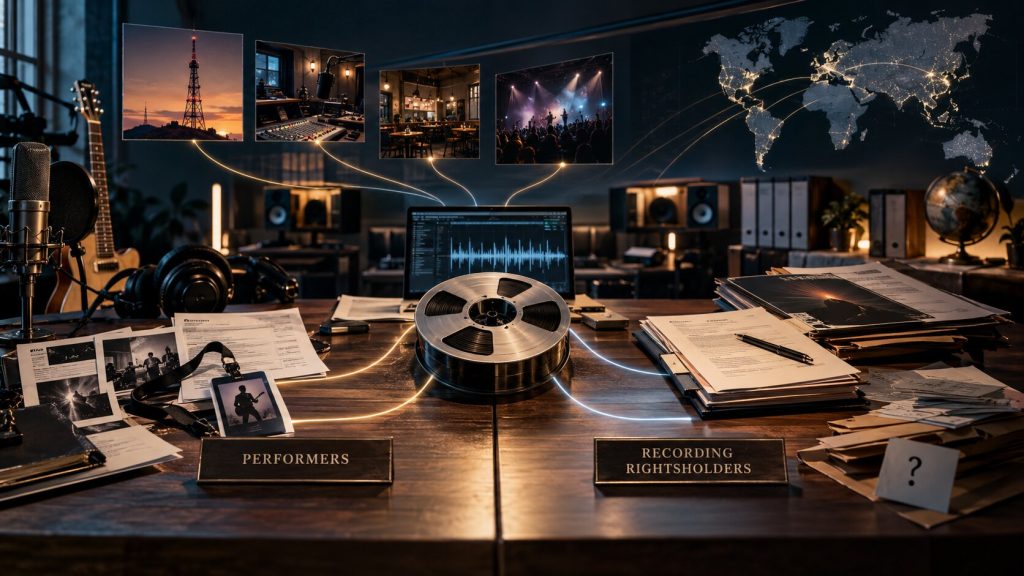
International neighboring-rights collection can involve a domestic collective management organization, reciprocal agreements with foreign societies, or an administrator authorized to collect in multiple territories.
The important issue is not simply choosing the organization with the longest country list. You need to understand exactly what authority you are giving it.
SoundExchange, for example, provides international neighboring-rights collection through agreements with counterpart organizations and requires participating creators to provide the appropriate international mandate. (SoundExchange International)
Before appointing any organization or administrator, ask:
- Which countries are included?
- Does the mandate cover performer rights, rightsholder rights, or both?
- Is the appointment exclusive in any territories?
- Which uses of the recording are included?
- What administration fees or deductions may apply?
- How are conflicting claims resolved?
- Can the organization pursue historical or unmatched royalties?
- How do you terminate or change the mandate later?
More collection accounts do not automatically create more revenue. Overlapping representation can create conflicts, duplicate claims or additional administrative work.
Pro Tip: Before signing an international collection mandate, make a territory-by-territory list of your existing appointments. Keep the effective date and termination rules for each agreement in the same document.
Good Metadata Is What Turns Airplay Into a Payment
Collection organizations process large volumes of repertoire and usage information. The money can only reach the correct recipient when a reported recording can be matched to reliable rights and performer data.
Your ISRC is particularly useful because it identifies a specific sound recording, but an ISRC alone does not replace proper repertoire registration.
You should also keep performer names, roles, master ownership, label information, recording versions and relevant territory data consistent.
A useful internal standard is to maintain one authoritative catalog file rather than typing recording information from memory every time you register with a new service.
What your catalog file should prevent
- A featured artist appearing under two different spellings.
- A remix being confused with the original master.
- An old label remaining listed after rights have reverted.
- Two different recordings accidentally sharing internal metadata.
- A performer contribution being omitted from one database.
- A rightsholder account being created under inconsistent company names.
Good metadata does not guarantee that every use will generate a royalty, but poor metadata can make legitimate usage harder to identify and allocate correctly.
The Neighboring Rights Mistakes That Cost Artists Money
Assuming your distributor handles every royalty
Digital distribution normally handles revenue covered by your distribution agreement. That does not mean your distributor has automatically registered every performer or rightsholder entitlement available through neighboring-rights systems.
Read the actual distribution agreement and service description rather than relying on a general promise about “royalty collection.”
Registering only as a performer
A self-releasing artist who owns the master may have both a performer role and a recording-rightsholder role. Registering only one side can leave the other side of the administration incomplete.
Confusing PRO registration with recording registration
Registering your composition with a songwriter performing rights organization does not automatically register the sound recording for neighboring-rights purposes. The song and its recording are separate copyright works.
Treating every Spotify payment as the same kind of royalty
On-demand streaming revenue, songwriter royalties and neighboring-rights collections follow different licensing and payment routes. The fact that all of them relate to the same track does not make them interchangeable.
Ignoring international airplay
An artist may focus entirely on streaming dashboards while overlooking broadcasts or public-performance activity in other markets. If your music has an international audience, check whether your current collection arrangements actually cover the territories that matter.
Letting ownership information become outdated
Catalog sales, label agreements, exclusive licences and rights reversions can change who controls a master. When ownership legitimately changes, update the relevant organizations rather than allowing conflicting claims to remain attached to the recording.
Waiting years to document contributors
It becomes harder to reconstruct session details after memories fade, collaborators move away and old project files disappear. Capture performer names and roles when the session happens, not when a royalty conflict appears.
Build Neighboring Rights Into Your Release Administration
Neighboring rights are easier to manage when they become part of the normal release process instead of a catalog-cleanup project years later.
For every new master:
- Confirm who owns or controls the sound recording.
- Document every performer and their correct role.
- Assign and store the correct ISRC.
- Record the release date, label and relevant territory information.
- Register or claim the recording with the appropriate neighboring-rights organization where applicable.
- Determine whether you qualify as both performer and recording rightsholder.
- Review any international collection mandates already in place.
- Check the recording again after release for missing data or conflicting claims.
This discipline matters especially for independent artists because the person recording the music may also be acting as label, manager, rights administrator and business owner.
A track being available on streaming platforms does not mean its rights administration is complete.
Strengthen the Business Behind Your Music with BlockTone Records
BlockTone Records publishes practical guidance for independent artists navigating releases, royalties, rights management and the business infrastructure behind a sustainable music career. Use these resources alongside information from your collecting societies, distributor, accountant and qualified legal professionals to build a rights-management process that fits your catalog.
FAQs About Neighboring Rights Royalties
What are neighboring rights royalties in music?
Are neighboring rights the same as performance royalties from a PRO?
Does SoundExchange collect neighboring rights royalties?
Does SoundExchange collect normal Spotify streaming royalties?
Can an independent artist collect as both performer and master owner?
Can session musicians earn neighboring rights royalties?
Do I need neighboring-rights registration if I already use a music distributor?
Sources Used
- U.S. Copyright Office – What Musicians Should Know About Copyright
- SoundExchange – Digital Performance Royalties
- SoundExchange – Frequently Asked Questions
- SoundExchange – International Neighboring Rights and Partners
- PPL – The Rights PPL Manages
- PPL – International Royalties
- WIPO – Summary of the Rome Convention