
Best Ways to Promote Your Music Without a Big Budget
TL;DR
You do not need a major-label budget to promote music effectively, but you do need a clear system. Start with a release goal, prepare your assets early, use free platform tools, turn one song into multiple pieces of content, and build direct fan relationships instead of chasing empty numbers. The most important takeaway is simple: promote consistently before, during, and after release day, not only when the song goes live.
Introduction
Most independent artists do not struggle because they lack talent. They struggle because they release music into silence, post once or twice, hope the algorithm helps, and then move on too quickly. When the budget is small, every post, pitch, message, link, and visual asset has to work harder.
Music discovery is still active, but it is fragmented. Fans now find songs through streaming platforms, short-form video, YouTube, playlists, friends, Discord communities, Bandcamp collections, live clips, memes, and artist stories. Streaming remains central to recorded music, with IFPI reporting continued global growth in recorded music revenues and streaming as the largest revenue segment. (IFPI)
That does not mean artists should chase streams at all costs. The smarter goal is to turn attention into repeat listeners, followers, email subscribers, merch buyers, show attendees, collaborators, and long-term fans. This guide explains how to promote your music without a big budget by using planning, platform tools, content, community, playlist strategy, and measurement.
Table of Contents
- Start with a fan path, not just a release date
- Prepare your release assets before the campaign begins
- Use free platform tools before paying for promotion
- Turn one song into repeatable short-form content
- Build momentum through small communities
- Pitch playlists without risking fake growth
- Measure signals, then repeat what actually worked
- How BlockTone Records fits into a lean promotion plan
- Frequently Asked Questions
Key Takeaways
| Point | Details |
|---|---|
| Budget promotion needs sequencing | Plan pre-release, release-week, and post-release actions instead of doing everything on one day. |
| Free tools are underused | Spotify for Artists, Apple Music for Artists, YouTube Studio, TikTok, SoundCloud, and Bandcamp can support promotion before paid advertising is necessary. |
| Content should come from the song | Hooks, lyrics, stories, studio clips, performance videos, and fan prompts usually work better than random trend-chasing. |
| Community beats passive posting | Small fan groups, local scenes, niche creators, playlist curators, and direct conversations can create early traction. |
| Playlist pitching must be careful | Legitimate pitching can help, but fake streams, bots, and guaranteed placement offers can damage long-term growth. |
| Measurement keeps costs low | Track saves, follows, comments, watch time, playlist adds, and direct fan actions so you know what to repeat. |
Start with a fan path, not just a release date
A release date tells you when the song becomes available. A fan path tells you how someone discovers it, why they care, where they listen, and what they do next.
For a low-budget campaign, this matters because you cannot afford wasted effort. Posting “new song out now” with cover art is not a strategy. You need a simple journey: someone sees a clip, story, playlist, email, or recommendation; they understand the mood or reason to listen; they click through to a platform; they save, follow, comment, share, or join your list; and you keep giving them reasons to return.
Before release day, write one sentence that defines the campaign. For example: “This song is for fans of late-night alternative R&B who like intimate vocals, slow drums, and lyrics about leaving a toxic relationship.” That sentence helps you choose visuals, captions, playlist categories, creator outreach, and hashtags.
Set one primary goal
Do not try to optimize everything at once. Choose one main goal for each release. You might want to grow Spotify followers, drive saves, build YouTube subscribers, collect email addresses, increase Bandcamp sales, book local shows, or reach playlist curators.
A small-budget artist needs focus. If the goal is Spotify growth, your links, calls to action, and content should push listeners toward Spotify follows and saves. If the goal is direct fan revenue, Bandcamp, merch, and mailing list growth may matter more.
Avoid the biggest early mistake
Do not wait until release day to start promotion. Give yourself at least two to four weeks of preparation when possible. That does not mean spamming people for a month. It means warming up your audience, testing content hooks, collecting assets, and making sure your profiles are ready.
Prepare your release assets before the campaign begins
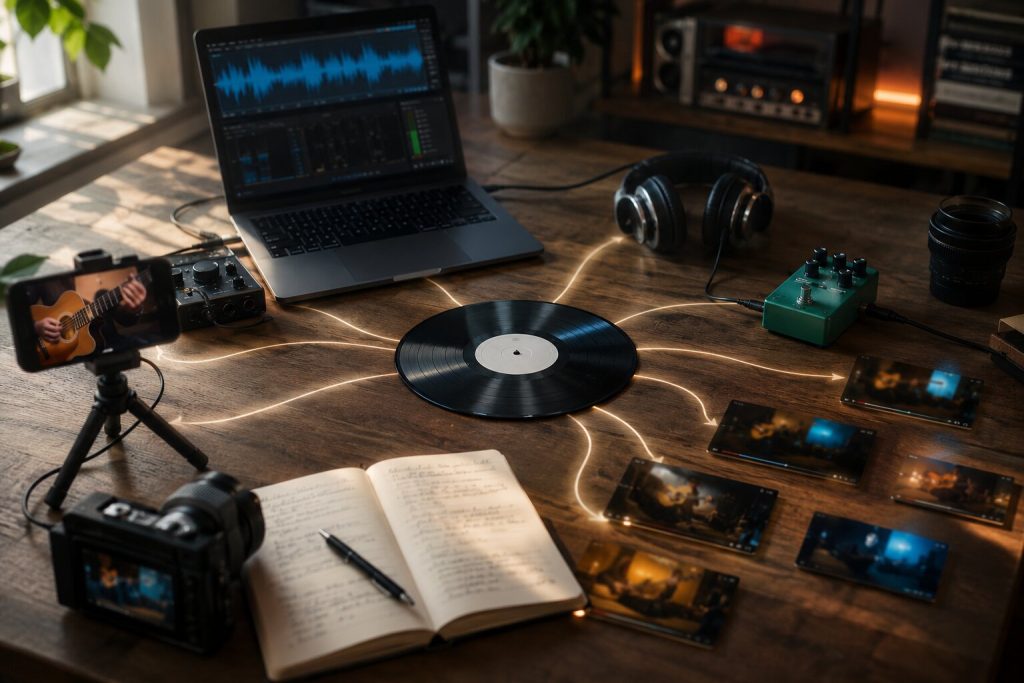
Promotion becomes cheaper when you are not making everything from scratch at the last minute. A strong release folder should include more than the audio file and cover art.
Create a basic campaign kit with final cover art, vertical video clips, a short artist statement, three caption angles, a streaming link or smart link, a pinned post plan, a press photo, lyric snippets, behind-the-scenes clips, a fan email, and a playlist pitch description.
Your goal is not to look like a major label. Your goal is to remove friction. When someone asks, “Send me something about the track,” you should not need two days to assemble a bio, link, and image.
Write better captions by changing the angle
| Angle | Example |
|---|---|
| Emotional | “I wrote this after realizing I missed the version of someone I invented.” |
| Production | “The drum groove started as a phone recording on my desk.” |
| Lyric-led | “The whole song came from the line: ‘I kept the light on for someone who left.’” |
| Scene-based | “For fans of rainy 2 a.m. drives and quiet endings.” |
| Participation | “Use this sound for the moment you finally chose yourself.” |
The song stays the same, but the reason to care changes. That gives you more posts without sounding repetitive.
Make your profiles release-ready
Check every platform before you send traffic there. Your bio, profile image, artist name, links, pinned content, and latest post should all match the release. If a listener clicks from a short-form video to your profile, they should immediately know what song to hear next.
This is where low-budget artists often gain an advantage. Many artists spend money sending traffic to messy profiles. A clean profile costs nothing and improves every campaign.
Use free platform tools before paying for promotion
Big campaigns often use ads, PR, radio, influencer budgets, and playlist networks. Independent artists should first use the tools already available inside major platforms.
Spotify for Artists
Spotify for Artists lets artists manage their profiles, understand their audience, and promote music on Spotify. Spotify also explains that pitching unreleased music through Spotify for Artists is the way to submit music to playlist editors, and that tracks must be delivered at least seven days before release for editorial pitching consideration. (Spotify for Artists)
Practical steps include claiming your profile, uploading music through your distributor early enough to access the pitch, pitching one unreleased track with accurate genre and mood information, asking existing fans to follow you before release, and using Spotify Promo Cards when useful.
Do not treat playlist pitching as a guarantee. Its real value is that it gives the platform better information and creates a cleaner release process.
Apple Music for Artists
Apple Music for Artists includes promotional tools for sharing songs, albums, music videos, milestones, badges, QR codes, embedded players, and links that let fans choose where to listen. (Apple Music for Artists)
Use these tools if your audience includes Apple Music listeners, Shazam users, or fans who respond well to polished visual assets. They are also useful when you want a simple link that does not force every listener to one platform.
YouTube and YouTube Shorts
YouTube is not only for official music videos. It can support lyric videos, visualizers, Shorts, live performances, acoustic versions, commentary, studio breakdowns, and fan-facing stories.
YouTube’s guidance for Shorts emphasizes clear titles, relevant hashtags, regular posting, linking viewers to related content, responding to comments, and using analytics to understand what resonates. (YouTube Official Blog)
A low-budget YouTube plan could include one visualizer or lyric video, five to ten Shorts using different hooks, one behind-the-song video, one live or stripped-down version, a pinned comment linking to the full song, and a playlist that groups related videos around the release.
TikTok for Artists
TikTok for Artists provides song performance, post performance, follower insights, and guides for artists with certified TikTok Artist Accounts. TikTok has also introduced artist-focused tools, including pre-release features in supported contexts. (TikTok Newsroom)
Do not assume TikTok promotion means dancing or comedy. Strong formats for musicians can include singing the hook live, explaining a lyric, showing the beat build, posting a demo-to-final comparison, asking fans which version they prefer, using the sound over a relatable scene, or explaining the real story behind the song.
The mistake to avoid is making every video a sales pitch. Short-form content works best when the post has its own reason to exist.
SoundCloud and Bandcamp
SoundCloud can be useful for discovery, early community building, demos, remixes, and direct listener interaction. SoundCloud Insights can show plays, likes, reposts, comments, downloads, top tracks, top fans, and location data. (SoundCloud)
Bandcamp is different because it is closer to a direct-to-fan store and community. Bandcamp explains that followers can be notified when artists release new music or merch, and artists can message followers through its artist tools. (Bandcamp Artist Guide)
For low-budget artists, Bandcamp is especially useful when fans value ownership, merch, physical editions, exclusive demos, or direct support.
Turn one song into repeatable short-form content
Short-form video is one of the best low-cost promotion channels because it rewards ideas more than production budgets. The challenge is that many artists make one clip, post it a few times, and quit.
Instead, build a content grid around the song. Each piece of content should offer a different way into the same track.
| Content Door | What to Post |
|---|---|
| The hook | The best 10 to 20 seconds of the chorus, drop, riff, or lyric |
| The story | Why the song was written |
| The process | Studio clip, beat breakdown, vocal take, or guitar part |
| The identity | Who the song is for |
| The challenge | A prompt for creators or fans to use the sound |
| The contrast | Demo version compared with the final version |
| The proof | Live reaction, crowd clip, comment, or milestone |
| The invitation | A request for fans to duet, remix, stitch, or share a memory |
This gives you many possible posts from one release without inventing a new concept every day.
Build content around moments, not the whole track
A listener rarely decides to care because you say the song is out. They care because one moment catches them. That moment might be a lyric, a drum fill, a bassline, a vocal tone, a visual scene, or a story.
Find the three strongest moments in the song: the most emotional lyric, the most memorable musical hook, and the most visually explainable idea. Then test different videos around each one. Keep what earns saves, comments, shares, profile visits, or repeat views. Drop what gets passive views but no action.
Pro Tip: Do not delete every post that underperforms. Low-budget promotion depends on learning. A weak post can still tell you that the hook, caption, opening line, or visual did not connect.
Build momentum through small communities
A big budget can buy reach. A small budget needs relationships.
Start with places where people already care about your sound: local music scenes, niche subreddits where promotion is allowed, Discord servers, college radio, independent playlist curators, small YouTube reaction channels, genre-specific blogs, producer communities, open mic networks, Bandcamp collectors, and other artists with similar audiences.
The key is to participate before asking. Comment on other artists’ releases. Share playlists. Attend shows. Join conversations. Support creators who support your genre.
Create a simple outreach list
Make a spreadsheet with columns for name, platform, genre fit, contact link, last thing they posted, why your song fits, date contacted, response, and follow-up date.
Keep outreach short and specific. A useful message might say: “Hey, I saw you’ve been sharing darker alt-pop and trip-hop lately. I have a new track coming out Friday that fits that lane: slow drums, vocal-heavy, melancholic hook. No pressure, but I thought it might suit your playlist or community.”
Do not send mass messages that sound copied. Low-budget promotion works because it is specific.
Trade value, not favors
Instead of asking everyone to share your song, offer something useful. You could make a guest playlist, record a live version for a channel, offer stems for a remix, share another artist’s release, invite a creator to use the sound first, give fans an early private link, or create a discount code for Bandcamp supporters.
The best promotion feels like participation, not begging.
Pitch playlists without risking fake growth
Playlists can help, but they are also one of the easiest areas to waste money. The danger is not only losing a few dollars. Fake streams, bot-driven playlists, and suspicious traffic can distort your data and create problems with platforms or distributors.
Use legitimate playlist paths first
Start with Spotify for Artists editorial pitching, your own artist playlists, fan-made playlists, genre communities, independent curators with transparent submission processes, collaborator playlists, YouTube playlists, SoundCloud repost networks with real engagement, and Bandcamp collections.
When evaluating a curator, check whether the playlist has real signs of life. Are there actual followers? Does the curator have a credible identity? Do songs on the playlist show normal engagement patterns? Is the genre consistent? Are they promising guaranteed streams?
Red flags to avoid
Avoid any service that promises guaranteed streams, guaranteed Spotify editorial placement, a fixed number of plays for a fixed fee, “algorithmic boost” without transparency, placement on huge playlists with no clear audience, or results that seem too cheap to be real.
A realistic playlist campaign focuses on fit, not fantasy. Getting added to a smaller playlist with real listeners in your genre is often more valuable than appearing on a massive generic playlist that produces skips.
Build your own playlist ecosystem
Create playlists that place your music alongside artists your audience already likes. Do this honestly and tastefully. A producer might create “Late Night Beats and Textured R&B.” A metal band might create “Underground Heavy Releases.” A folk artist might create “Quiet Songs for Long Drives.”
Add your song, but do not make the playlist only about you. Update it regularly. Share other artists. Tag them when appropriate. This can lead to reciprocal discovery without paying for placement.
Measure signals, then repeat what actually worked
Low-budget promotion improves when you stop guessing. You do not need enterprise analytics. You need a few simple signals.
| Signal | Why It Matters |
|---|---|
| Saves | Shows intent to return to the song |
| Follows | Indicates artist-level interest, not just track-level curiosity |
| Comments | Reveals emotional connection and content angles |
| Shares | Shows whether fans think the song says something for them |
| Watch time | Helps identify strong video openings and hooks |
| Profile visits | Shows whether content is creating curiosity |
| Email or Bandcamp follows | Builds an audience you can reach again |
| Playlist adds | Indicates listener ownership and repeat potential |
Do not obsess over vanity metrics. A video with 2,000 views and 100 profile visits may be more useful than a video with 50,000 views and no followers. A playlist add from a real fan can matter more than a passive stream.
Run a post-release review
Two weeks after release, ask which post created the most profile visits, which lyric or hook got the strongest comments, which platform drove the most saves or follows, which outreach messages got replies, which communities responded naturally, which content felt forced, what you would repeat next time, and what you would stop doing.
This turns every release into market research for the next one.
Keep promoting after release week
Many independent artists stop too early. A song can still gain traction weeks or months after release if you keep giving people new reasons to hear it.
Post-release ideas include an acoustic version, remix snippet, live rehearsal clip, producer breakdown, lyric explanation, fan reaction, “how it started vs. how it ended” video, visualizer clip, playlist update, Bandcamp supporter message, or behind-the-scenes mistake.
A small budget rewards endurance. The artist who keeps testing angles usually learns more than the artist who spends everything in week one.
How BlockTone Records fits into a lean promotion plan
For artists working without a major budget, the right support should make the campaign clearer, not more complicated. BlockTone Records can use a lean release approach built around practical positioning, platform readiness, content planning, and fan growth rather than inflated promises.
A smart partner helps artists define the audience, prepare release assets, organize promotion timelines, avoid risky shortcuts, and turn each release into a repeatable system. For independent musicians, that kind of structure can be more valuable than a one-time burst of paid attention.
FAQs About Promoting Your Music Without a Big Budget
How can I promote my music for free?
How early should I start promoting a song?
Is TikTok still useful for independent artists?
Should I pay for playlist promotion?
What is the cheapest paid promotion option?
What should I post if I do not like being on camera?
How do I know if my music promotion is working?
Sources Used