

How to Pitch Your Music to Blogs, Playlists and Curators
TL;DR
A strong music pitch is not just a link to your song; it is a targeted reason for a specific curator, writer, or playlist owner to care. Start by preparing a clean release package, researching outlets that already support your sound, and sending short, personalized messages with the right links. Avoid guaranteed playlist-placement services, track every response, and turn each small win into more credibility for the next campaign.
Introduction
Most independent artists do not struggle because nobody will ever care about their music. They struggle because their outreach is too broad, too rushed, or too difficult for the recipient to act on.
Music blogs, playlist curators, radio hosts, YouTube channels, and tastemakers receive more submissions than they can reasonably process. A vague “check out my new single” message is easy to ignore. A focused pitch that matches the curator’s taste, includes the right assets, and explains the story behind the release has a much better chance of being heard.
Pitching still matters because discovery is fragmented. Spotify editorial pitching, independent playlists, niche blogs, YouTube channels, TikTok creators, newsletters, and online radio can all play different roles in a release campaign. Spotify’s official playlist pitching tool, for example, is designed for upcoming unreleased music and requires artists to submit through Spotify for Artists before release. (Spotify for Artists – Pitching music to playlist editors)
This guide breaks down how to prepare your release, find the right outlets, write a professional pitch, avoid risky shortcuts, and follow up in a way that builds long-term momentum rather than chasing one lucky placement.
Table of Contents
- Build a Pitchable Release Before You Contact Anyone
- Sort Blogs, Playlists, and Curators by What They Actually Need
- Create a Music Pitch Kit That Removes Friction
- Write Outreach That Sounds Personal, Not Desperate
- Use Spotify Pitching as One Part of the Campaign
- Approach Independent Curators Without Risking Your Release
- Follow Up, Track Results, and Build Future Leverage
- How Block Tone Records Supports Smarter Music Promotion
- Frequently Asked Questions
Key Takeaways
| Point | Details |
|---|---|
| Targeting matters more than volume | A small list of relevant blogs and curators usually beats mass emailing hundreds of random contacts. |
| Your pitch needs a clear angle | Explain why the release is interesting now: sound, story, scene, collaboration, visual concept, or audience fit. |
| Timing affects opportunities | Spotify editorial pitches must be submitted before release, and many blogs prefer advance access rather than day-of-release emails. |
| Avoid guaranteed placement promises | Services promising streams or playlist placement for money can create serious platform and reputation risks. |
| Follow-up should be measured | One polite follow-up is reasonable; repeated chasing can damage future relationships. |
| Use every result twice | A blog feature, playlist add, or curator quote can support social proof, ads, future pitches, and your artist bio. |
Build a Pitchable Release Before You Contact Anyone
Before you send a single email or submission form, ask a blunt question: would a stranger understand why this release is worth covering?
A pitchable release has more than a finished master. It has context. Curators need to know what the song sounds like, who it is for, why it matters, and how it fits their platform. A bedroom pop blog, a metal playlist, a left-field electronic newsletter, and a college radio host will not respond to the same pitch angle.
Start with a one-sentence release position:
“This is a dark, sample-heavy alternative R&B single for fans of late-night production, minimal vocals, and emotionally direct songwriting.”
That sentence is more useful than “new single out now.” It gives the recipient a genre frame, mood, audience reference, and editorial hook.
Decide what the campaign is meant to achieve
Not every pitch should chase the same outcome. Your goal might be blog coverage for credibility, playlist adds for discovery, radio play for regional awareness, YouTube channel support, creator usage, or industry feedback before a larger release.
The mistake is treating every curator as if they exist only to create streams. A blog writer may care about story. A playlist curator may care about mood and sequencing. A YouTube channel may care about artwork, visual identity, and whether your track fits its audience. YouTube’s own artist guidance emphasizes that channel layout, playlists, thumbnails, and presentation help fans navigate an artist’s work, which is a useful reminder that curators often respond to the full package, not only the audio file. (YouTube for Artists – Channel optimization)
Give yourself enough runway
For independent artists, a practical pitching window is usually several weeks before release. Spotify’s official playlist pitch requires unreleased music, and Spotify says artists should deliver music at least seven days before release so editors have time to listen. The platform also states that artists can only pitch one song at a time and that pitching does not guarantee placement. (Spotify for Artists – Pitching music to playlist editors)
For blogs and independent curators, earlier is often better, but relevance still beats timing. A personalized pitch two weeks before release is usually stronger than a generic blast six weeks out.
Sort Blogs, Playlists, and Curators by What They Actually Need
“Curator” is a broad word. It can mean a Spotify playlist owner, a journalist, a radio programmer, a YouTube channel manager, a TikTok creator, a newsletter editor, or a DJ. Each one needs different information.
| Recipient Type | What They Usually Care About | Best Pitch Angle |
|---|---|---|
| Music blogs | Story, genre fit, originality, artist identity | Why the release deserves editorial attention |
| Playlist curators | Sound, mood, quality, listener fit | Where the song fits in their playlist experience |
| Radio hosts | Clean metadata, broadcast suitability, local or scene relevance | Why their listeners would respond |
| YouTube channels | Audio quality, artwork, visual identity, copyright clarity | How the track fits the channel’s aesthetic |
| TikTok and short-form creators | Hook, emotion, trend potential, usability | What moment in the song is immediately usable |
| Industry curators | Professionalism, long-term potential, team readiness | Why the project is worth following beyond one song |
Research before you submit
A good target list is built manually. Listen to the playlist. Read the blog’s last five articles. Check whether the outlet accepts submissions. Look for recent posts, not just impressive branding. If a blog has not published in a year, it may not be worth your time.
Hype Machine can be useful for discovering active music sites because it monitors music blogs and tracks recent posts and popular songs. Submission platforms can also help artists find curators faster, but they should be treated as research and outreach tools rather than guaranteed placement machines. (Hype Machine – About)
The same rule applies everywhere: if your song does not fit the outlet, the pitch is weak no matter how polished it looks.
Create a Music Pitch Kit That Removes Friction
Curators are busy. Your job is to make saying “yes” easy.
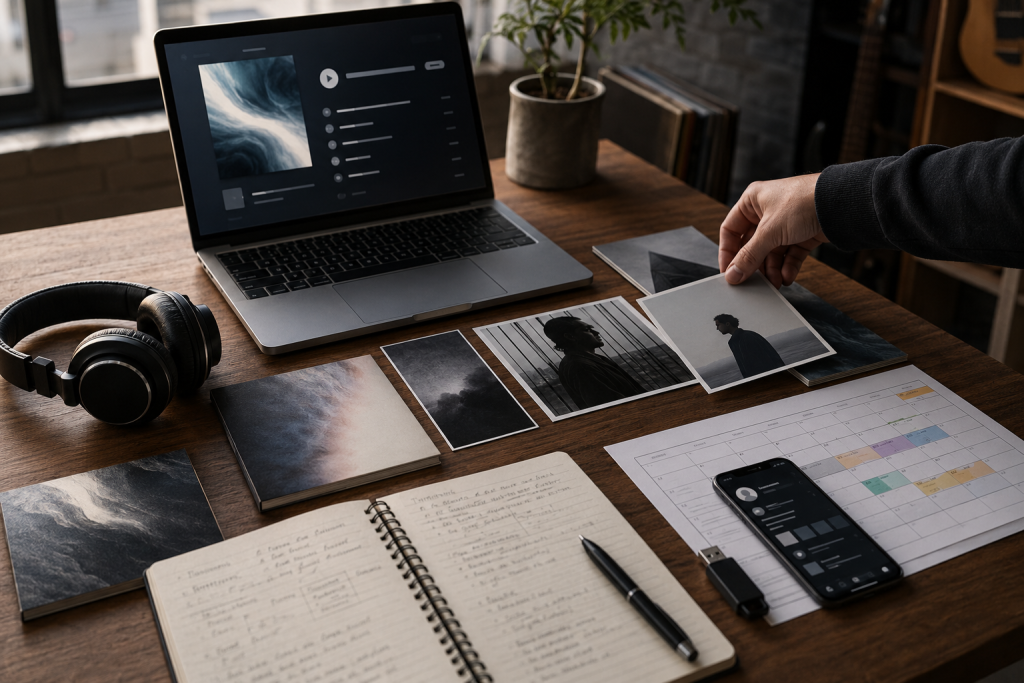
A useful pitch kit should include a private streaming link for unreleased music, public streaming links for released music, a short artist bio, a one-paragraph release description, a high-resolution press photo, cover artwork, lyrics if relevant, release date, genre, mood, comparable artists, social links, contact email, and any notable previous support.
Do not attach large audio files unless requested. Use private SoundCloud, unlisted YouTube, Disco, Dropbox, Google Drive, or another reliable link. Make sure permissions work before you send anything.
Build a short version and a full version
Your email pitch should be brief. Your full EPK can contain more detail. The best workflow is simple: the email contains the hook, private link, release date, and two proof points; the press kit link contains all assets; the follow-up contains one new reason to care, not the same message repeated.
Apple Music’s official marketing tools can also help after release because artists can create badges, links, embeddable players, and other promotional assets for songs and albums. (Apple Music for Artists – Apple Music Marketing Tools)
Pro Tip: Create a single release hub document for each campaign. Include your links, pitch text, target list, submission status, follow-up date, and results. This prevents mistakes such as sending the wrong release date, broken links, or duplicate pitches.
Write Outreach That Sounds Personal, Not Desperate
A strong pitch is short, specific, and easy to act on. It should not read like a press release pasted into an email.
Use this structure: personalized opening, one-line artist and song description, why it fits their outlet, private or public listening link, release date, asset link, and a polite close.
Here is a clean example:
Subject: New dark pop single for your late-night playlist
Hi [Name],
I noticed your playlist leans toward atmospheric pop with minimal production, especially tracks from [artist/reference]. My new single, “[Song Title],” sits in that same late-night space: sparse drums, close vocals, and a hook built around a repeating synth phrase.
Private stream: [link]
Release date: [date]
Press assets: [link]Thanks for listening, and I appreciate what you’re building with the playlist.
That is enough. The recipient does not need your entire biography in the first message.
Common pitch mistakes to avoid
Do not send a mass email with visible recipients. Do not claim your song is “guaranteed to be a hit.” Do not pressure curators with emotional language. Do not ask for feedback from people who do not offer feedback. Do not send an unfinished demo unless the outlet specifically accepts demos.
Also avoid fake urgency. “This drops tomorrow” is not compelling if the recipient had no advance notice. It tells them the campaign was not planned.
Make the subject line useful
Good subject lines are clear, not clever. Use lines such as “Submission: melodic techno single for your underground playlist,” “New indie folk release for possible blog coverage,” “Private stream: alt-pop single out June 14,” or “For [Outlet Name]: new UK garage-influenced track.”
Bad subject lines are vague or inflated. Avoid lines such as “You need to hear this,” “Next big artist,” “Urgent music submission,” and “Please support my song.”
Use Spotify Pitching as One Part of the Campaign
Spotify editorial pitching is important, but it should not be your entire release strategy.
Spotify’s official process lets eligible team members pitch an upcoming unreleased song through Spotify for Artists. The pitch can include details that help editors understand the track, and Spotify says more detail gives the song a better chance. (Spotify for Artists – Pitching music to playlist editors)
However, Spotify also makes clear that pitching does not guarantee placement. Editors may choose a different song from the release, and a track that is already live is no longer eligible for pitching through that tool.
What to include in your Spotify pitch
Use the pitch form to communicate what a playlist editor cannot hear instantly: main genre, subgenre, mood, activity context, instrumentation, language, cultural or regional context, release plan, marketing support, artist story, and any meaningful audience signals.
Avoid exaggeration. If you have a small but active local following, say that. If the song is tied to a tour, video, collaboration, or community, include it. Editors are not only evaluating audio; they are also trying to understand fit and context.
Do not wait until the last minute
Spotify says pitching at least seven days before release gets the song into followers’ Release Radar playlists, even though editorial placement is not guaranteed. For serious campaigns, deliver your release to your distributor earlier than that so you have time for metadata checks, profile updates, pre-save links, press outreach, and content planning. (Spotify for Artists – Pitching music to playlist editors)
Approach Independent Curators Without Risking Your Release
Independent playlists can help expose your music to new listeners, but they also carry risk when approached carelessly.
Spotify warns artists to avoid services that promise streams, followers, playlist placement, or algorithmic priority in exchange for money. The platform also says artificial streams do not earn royalties, do not count toward public stream numbers or charts, and do not positively influence recommendation algorithms. (Spotify for Artists – Artificial Streaming)
That does not mean every curator, submission platform, or PR campaign is unsafe. It means you need to distinguish between legitimate pitching and manipulation.
Safer signs
- The curator or service does not guarantee streams.
- It does not guarantee Spotify editorial placement.
- The curator can accept or reject the song.
- Submission terms are transparent.
- The playlist or outlet shows real audience activity.
- The curator does not ask for your Spotify login.
- The campaign focuses on fit, feedback, or editorial consideration.
Red flags
- “Guaranteed 50,000 streams.”
- “We control Spotify algorithmic playlists.”
- “Pay for permanent placement.”
- “No rejection possible.”
- “We need your artist account login.”
- “Streams from our network are safe.”
- “We can get you on official Spotify playlists for a fee.”
A legitimate campaign creates opportunities for real listeners to hear your music. A risky campaign creates fake signals that can harm your data, reputation, and distribution relationship.
Follow Up, Track Results, and Build Future Leverage

Pitching is not finished when you press send. The follow-up and measurement process is where many independent artists leave value on the table.
Send one polite follow-up after five to seven business days unless the submission guidelines say not to. Keep it short:
Hi [Name], just checking whether “[Song Title]” might be a fit for [blog/playlist/show]. The release is out on [date], and the private stream is here: [link]. Thanks again for listening.
If there is no reply after that, move on. Silence is common. It does not always mean the song is bad; it may mean the timing, fit, or inbox volume worked against you.
Track the right signals
Use a spreadsheet with columns for outlet name, contact name, email or submission link, genre fit, date submitted, follow-up date, response, result, coverage link, and notes for the next campaign.
Measure more than streams. Track playlist saves, listener retention, blog quotes, social shares, Shazams, mailing list signups, YouTube comments, and direct messages. A niche blog feature with a thoughtful quote may be more useful for your EPK than a low-quality playlist add with passive listeners.
Turn every placement into another asset
When you receive coverage, use it professionally. Thank the curator or writer, share the feature, tag the outlet where appropriate, add the quote to your EPK, mention the support in future pitches, save screenshots for your archive, and watch whether listeners continue engaging after the placement.
The goal is not one isolated post. The goal is a growing trail of proof that helps the next person understand why your project is worth attention.
How Block Tone Records Supports Smarter Music Promotion
For artists building a release strategy, Block Tone Records can serve as a practical resource for understanding promotion, positioning, and the business decisions behind independent music growth.
A strong pitch campaign works best when it connects the music, visuals, release timing, audience, and long-term artist identity. Instead of chasing random placements, artists need a repeatable system: prepare the release, choose the right targets, pitch professionally, measure results, and improve the next campaign.
That is the mindset independent musicians should bring to every blog submission, playlist pitch, and curator conversation.
FAQs About Pitching Music to Blogs, Playlists, and Curators
How early should I pitch my music to blogs and playlists?
Should I pitch unreleased or already released music?
Is it worth paying for music submission platforms?
Can I pay to get on Spotify playlists?
What should I include in a music blog submission?
How many curators should I contact for one release?
What should I do if nobody responds?
Sources Used
- Spotify for Artists – Pitching music to playlist editors
- Spotify for Artists – Artificial Streaming
- YouTube for Artists – Channel optimization
- Apple Music for Artists – Apple Music Marketing Tools
- Hype Machine – About
- SubmitHub – Music submission platform
- Groover – Music promotion and curator platform