


Inside Gracie Abrams’ “Hit the Wall”: Love at the Edge of Burnout
What Is “Hit the Wall” About?
“Hit the Wall” by Gracie Abrams is about reaching an emotional breaking point inside a relationship and realizing that love alone cannot repair what is happening internally. The song follows a narrator who wants closeness but keeps shutting down, spiraling, and pushing away the person trying to understand her.
The phrase “hit the wall” works as both a confession and a warning. It suggests exhaustion, emotional collapse, and the point where someone can no longer keep pretending they are fine. In the song, Abrams turns that phrase into a portrait of self-sabotage, burnout, and the painful awareness that another person cannot “solve” her inner turmoil.
Background and Release Context
Gracie Abrams released “Hit the Wall” on May 14, 2026, as part of the rollout for her third studio album, Daughter from Hell. Apple Music lists the track under the album, while Universal Music Canada described it as the lead single from the project. (Apple Music – “Hit the Wall”)
Daughter from Hell is scheduled for release on July 17, 2026 via Interscope Records. Universal Music Canada presented “Hit the Wall” as the beginning of a new chapter for Abrams and noted that the official video was directed by Renell Medrano, using surreal and symbolic imagery to introduce the album’s visual world. (Universal Music Canada – “Hit the Wall” press release)
The song continues Abrams’ close creative partnership with Aaron Dessner. Shazam credits Gracie Abrams and Aaron Dessner as writers and producers, with Justin Vernon listed for additional production. The credits also point to a broader, more atmospheric arrangement than a minimal acoustic ballad, including piano, synth, strings, and brass elements. (Shazam – “Hit the Wall” credits)
Early public reception showed strong interest in the single. Official Charts lists “Hit the Wall” with early chart activity in the UK and Ireland, including a No. 12 peak on the Official Singles Chart Update. (Official Charts – “Hit the Wall”)
The Meaning Behind “Hit the Wall”
The main meaning of “Hit the Wall” is emotional burnout inside intimacy. Abrams does not write the song as a simple breakup narrative where one person is clearly wrong and the other is clearly wounded. Instead, the narrator recognizes that her own inner instability is damaging the relationship.
That self-awareness gives the song its tension. She is not unaware of what she is doing. She can see herself pulling away, collapsing, and becoming difficult to reach. The tragedy is that understanding the pattern does not immediately give her the power to stop it.
The emotional center of the song is the idea that a partner cannot act as a cure. When the narrator insists that she is not a problem to be solved, she rejects a romantic fantasy often found in pop songwriting: the belief that the right person can rescue someone from fear, shame, or psychological exhaustion.
In that sense, “Hit the Wall” is not anti-love. It is more specific and more painful than that. The song suggests that love may be present, but love cannot erase every survival instinct, defensive habit, or private wound. The narrator wants connection, but she also knows she is carrying something heavier than the relationship can absorb.
Lyrics Breakdown, Section by Section
Verse 1 Meaning
The first verse introduces the narrator as someone already under pressure. Abrams uses images of damage, tension, and fragile protection to show a person who feels both guarded and exposed. The narrator seems to have built emotional defenses, but those defenses do not actually make her safe.
One of the strongest ideas in the opening is the contrast between protection and transparency. The narrator wants distance, control, and safety, yet the emotional walls around her are not solid. They reveal almost as much as they hide. This creates the feeling of someone trapped inside her own coping mechanisms.
The first verse also establishes the song’s central contradiction: the narrator can imagine closeness, but she does not trust herself inside it. She wants the relationship to work, yet she already senses the possibility of collapse. The emotional damage is not only happening after love ends; it is happening while love is still close enough to matter.
Pre-Chorus Meaning
“Hit the Wall” does not depend on a sharply separated pre-chorus in the traditional pop sense. Instead, the emotional turn arrives when the narrator moves from self-description into direct relational damage. She is no longer only explaining what she feels; she is showing how those feelings affect the person beside her.
This section works like the moment before impact. The narrator can feel the crash coming. She recognizes that her private chaos is no longer private. The other person can see the shutdown, the panic, and the emotional withdrawal, even if she cannot explain it cleanly.
Chorus Meaning
The chorus is where the title becomes a diagnosis. To “hit the wall” means the narrator has reached the limit of what she can endure, hide, or perform. It is not just tiredness; it is the point where emotional momentum stops abruptly.
The chorus also contains the song’s clearest boundary. The narrator does not want to be treated like someone else’s project. She understands that care can become pressure when the other person believes they can fix what is broken. The line between love and rescue becomes one of the song’s most important tensions.
What makes the chorus especially effective is that it does not sound like a clean declaration of independence. It sounds like someone trying to protect both herself and the person who loves her. She may be saying, in effect: do not build your hope around my ability to become easier to save.
Verse 2 Meaning
The second verse expands the song from relationship conflict into self-examination. Images associated with diagnosis, observation, and danger suggest that the narrator is trying to understand what is wrong, but the act of being examined only increases her discomfort.
References to things like medical rooms, inkblots, headlights, or blind spots create a world where the narrator is both patient and witness. She is being studied, but she is also studying herself. The result is not clarity. It is paralysis.
This section shows that the narrator’s problem is not lack of feeling. If anything, she feels too much and cannot process it safely. She wants stability but keeps collapsing inward. That makes the song feel less like one dramatic argument and more like a repeated emotional cycle.
Bridge Meaning
The bridge feels like memory rushing in. Abrams uses the later part of the song to widen the emotional frame, suggesting that the present relationship is not the only source of pain. The narrator is confronting older versions of herself, old patterns, and the accumulated shame of repeating the same mistakes.
This is where “Hit the Wall” becomes more than a breakup song. The wall is not only the person she cannot reach or the barrier she has built. It is also the final limit of denial. She cannot keep moving through life as though her patterns have no consequences.
The bridge gives the track the feeling of a reckoning. It does not offer a neat solution, but it does make the narrator more honest. The collapse becomes painful because it is finally visible.
Outro Meaning
The outro leaves the song unresolved. Rather than ending with recovery, forgiveness, or a clear decision, Abrams lets the repeated idea of hitting the wall linger. That lack of closure is part of the emotional truth of the song.
Burnout rarely resolves itself in one dramatic moment. More often, it arrives as a stop: the body, mind, or relationship simply refuses to keep operating under the same pressure. The outro captures that stalled feeling, where language becomes repetitive because the narrator has reached the edge of what she can explain.
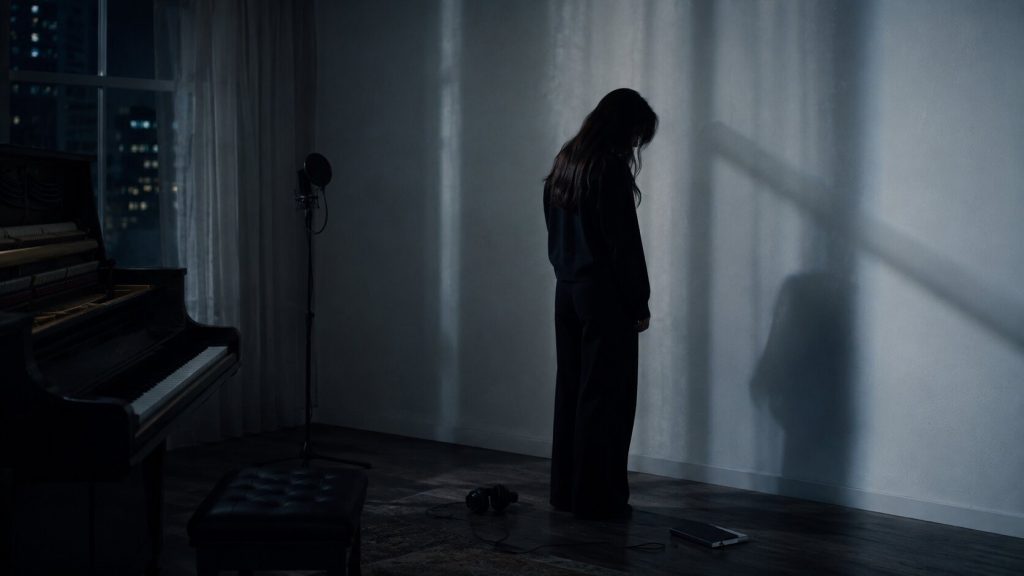
Hidden Meanings, Metaphors, and Symbolism
The central metaphor in “Hit the Wall” is the wall itself. It can mean the narrator’s emotional limit, the barrier she puts between herself and another person, or the impact point she reaches after running from her feelings for too long.
The song also uses images of failed protection. Fortresses, glass, doctors, headlights, and silence all suggest systems that should make someone safer or clearer, but instead make her feel more exposed. The narrator wants to be protected from pain, yet every defense seems to reveal another layer of vulnerability.
The diagnostic imagery is especially important. It suggests a fear of being analyzed and understood. For someone already ashamed of her inner life, being seen clearly can feel less like comfort and more like exposure.
The song’s symbolic world matches the visual direction described around the music video. Universal Music Canada characterized the video as shadowy, surreal, and symbolic, which supports the idea that “Hit the Wall” is not only a literal relationship confession but also an entry point into the darker psychological mood of the Daughter from Hell era. (Universal Music Canada – “Hit the Wall” press release)
Is the Song Based on a Real Person or Event?
There is no confirmed evidence that “Hit the Wall” is about one specific publicly named person. Abrams has not publicly identified a real-life subject for the song, and it would be misleading to present fan speculation as fact.
What can be said more safely is that the song appears to come from a real emotional place. Abrams’ writing often feels autobiographical and highly intimate, but “Hit the Wall” works best when read as a psychological confession rather than a coded gossip track. It is about a pattern, not necessarily a single person.
How This Song Fits Into Gracie Abrams’ Catalog
“Hit the Wall” fits naturally into Gracie Abrams’ catalog because it continues her focus on emotional contradiction. Many of her songs explore wanting someone, fearing the consequences of that wanting, and narrating the damage almost as it happens.
Compared with songs like “I miss you, I’m sorry,” “Risk,” or “I Love You, I’m Sorry,” this track feels darker and more internally pressured. It is not simply about missing someone after the ending. It is about realizing, before or during the collapse, that the narrator may be part of what makes closeness difficult.
As an introduction to Daughter from Hell, “Hit the Wall” suggests a sharper and more self-interrogating era. The song does not abandon Abrams’ confessional style, but it makes the confession feel more severe. Instead of asking why someone left, it asks why the narrator keeps becoming someone she does not want to be when love gets too close.
Final Thoughts
“Hit the Wall” is most likely about emotional exhaustion, self-sabotage, and the painful understanding that being loved does not automatically make someone ready to be reached. Gracie Abrams turns a phrase associated with burnout into a relationship metaphor, showing how inner collapse can become visible between two people.
The song resonates because it does not offer an easy villain. The narrator is hurting, but she also knows she is hurting someone else. That honesty makes “Hit the Wall” one of Abrams’ more psychologically direct songs, and a strong opening statement for the Daughter from Hell chapter.
FAQs About “Hit the Wall”
What does “Hit the Wall” mean in Gracie Abrams’ song?
Who wrote “Hit the Wall” by Gracie Abrams?
Is “Hit the Wall” based on a true story?
What is the chorus of “Hit the Wall” about?
What album is “Hit the Wall” from?
Who produced “Hit the Wall”?
What genre is “Hit the Wall”?
Sources Used