


La Roux “Old Flames”: New Album, Tracklist, Breakup Themes and the Story Behind Her Comeback
Six years after Supervision, La Roux returns with an album built around endings—but not one content to sound defeated. Old Flames, her fourth studio album, arrived on November 6, 2026 via Vertigo Records. Its central story is the collapse of a relationship that lasted about 17 years, yet Elly Jackson has framed the record more broadly as a reckoning with patterns in love, life and music. That breadth is crucial: this is a breakup record, but not merely a document of a breakup.
Jackson wrote, composed, produced and arranged the 11-track album herself. That unusually complete authorship gives the record’s reset language practical weight. Rather than presenting a return after a lengthy gap as a bid to recreate a previous commercial moment, Old Flames is framed around new creative freedoms—and, according to contemporary reviews, it sets that difficult material against warm, energetic, hook-led pop.
A self-authored reset after Supervision
Old Flames is La Roux’s first full-length release since 2020’s Supervision, a six-year interval that inevitably makes the album read as a comeback. But the more revealing detail is not simply the elapsed time. It is the degree of Jackson’s documented control: the official album store credits her with writing, composition, production and arrangement, while presenting the project as an opening toward “new sounds, new freedoms, new ways of living and loving.” La Roux’s official store therefore supplies a concrete basis for calling this a self-authored reset, rather than a vague assertion about artistic reinvention.
That distinction matters because comeback narratives tend to reduce artists to the distance between releases. Here, Jackson’s authorship makes the album’s personal language inseparable from its construction. The record is not only described as leaving behind old patterns; its principal creative roles are consolidated in the same artist who is narrating that departure. It does not establish ownership of every associated right, nor does it need to: songwriting, production and arrangement are already meaningful forms of creative direction, and should not be confused with the album’s label release through Vertigo.
The six-year gap need not be explained by one event, nor solved by one album. Old Flames follows a career in which the breakthrough remains a powerful reference point, but nostalgia is not its stated premise. Instead, the record’s language points toward a changed way of making and living, even as its material looks directly at what had to be left behind.
The breakup and its other wounds
The relationship at the centre of Old Flames lasted approximately 17 years, and Jackson has described the album as processing its end and saying goodbye to entrenched patterns in love, life and music, as reported by The Line of Best Fit. “Old flames” names that break while leaving room for the album’s other stated concerns: Jackson also links the songs to addiction, identity, sexuality, distrust and difficult experiences in the music industry, according to Apple Music. Its framing therefore includes internal and professional experiences alongside the relationship’s end.

An 11-track route back to self
The album’s 11-song sequence begins with “Old Flames (Intro)” and closes with “Old Flames (Reprise),” enclosing “Cabin Fever,” “Lose Myself,” “Falling,” “To Make Our Love,” “Your Lover,” “Final Fantasy,” “Night Vision,” “I Just Keep Crying” and “Babyline.” The full tracklist, published by the official La Roux store, offers a deliberately compact frame rather than an oversized statement of return.
Within that sequence, Jackson’s comments on two songs give the clearest available account of its emotional movement. She describes “Cabin Fever” in terms of feeling trapped and lost. “Babyline,” placed near the end, represents a return to oneself; Jackson said its lighter sound was part of the reason for that placement. The transition between those poles—confinement and self-recognition—makes sequence an active part of the album’s argument, not a neutral delivery system for songs.
The sequence points toward recovery without resolving it neatly: “I Just Keep Crying” immediately precedes “Babyline,” and the closing reprise suggests a return to the album’s central image, but neither title nor placement alone proves a final emotional resolution. What the supplied account does establish is that Jackson chose to place a lighter song close to the end because it embodied a return to self. Ongoing grief and renewed self-understanding can therefore coexist on the album.
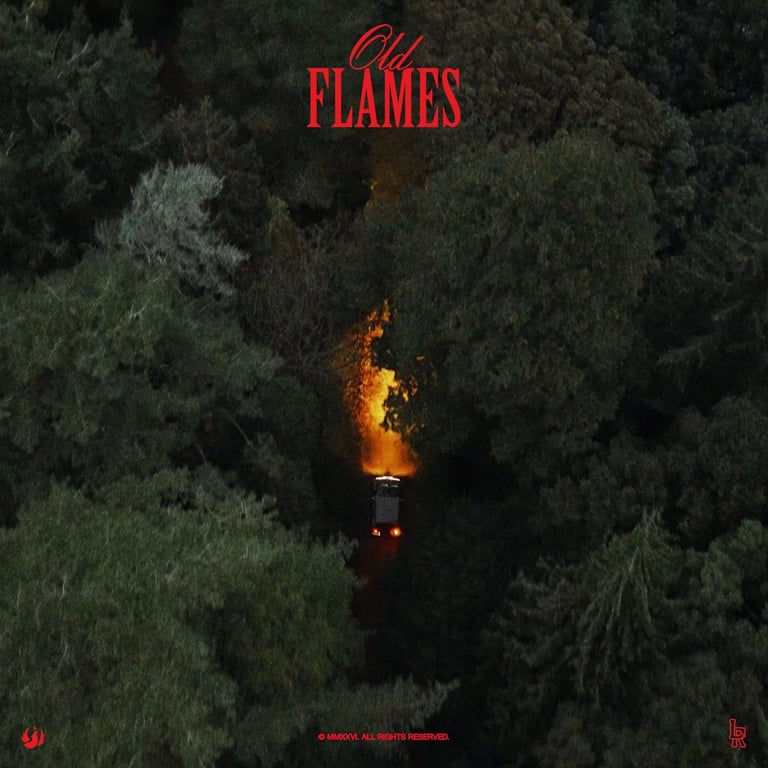
Officially published Old Flames album artwork — Source: The Line of Best Fit
Heartbreak in brighter colors
The strongest creative tension around Old Flames lies in the difference between its subject matter and its sound. A record processing a long relationship’s collapse, alongside addiction, distrust and painful industry experiences, could easily be introduced as a sombre confession. Reviews instead describe warm, hook-heavy pop drawing on 1990s R&B and early-2000s pop, with heartbreak delivered through energetic production rather than a predominantly mournful palette. The Guardian’s review identifies that tonal contrast directly.
This is not an argument that the brightness cancels the pain. It changes the terms on which pain is heard. Pop pleasure can become part of the recovery mechanism: a rhythmic and melodic insistence that refuses to let loss dictate every surface of the record. In this context, the lighter placement of “Babyline” is not an isolated sequencing choice. It coheres with a larger sound world in which emotional difficulty is not treated as a requirement for austere production.
The 1990s R&B and early-2000s pop reference points also keep the album from being mistaken for a simple return to La Roux’s late-2000s breakthrough aesthetic. They are specific stylistic coordinates, not a replay of a past era. If Old Flames is looking backward, it is doing so through the unstable material of memory, relationship and selfhood—not through an obligation to reproduce a former hit.
Beyond the “Bulletproof” shadow
La Roux’s 2009 debut yielded major hits including “Bulletproof” and “In for the Kill.” Later albums, 2014’s Trouble in Paradise and 2020’s Supervision, were less commercially dominant, according to MusicRadar. That career arc ensures that any La Roux return will be measured against breakthrough-era expectation, whether the artist wants that comparison or not.
Old Flames does not appear to evade that history, but its stated priorities redirect it. The album pairs an unavoidable personal rupture with complete creative involvement from Jackson and a sound reviewers hear as warm and propulsive. Those details make it less persuasive to call the record a straightforward return-to-form exercise: the form itself is being redefined around self-recovery, a wider set of wounds and the possibility of pleasure after upheaval.
The lasting pressure remains clear. “Bulletproof” and “In for the Kill” are still the scale against which La Roux’s public legacy is often understood, while Old Flames arrives after two less commercially dominant albums and a six-year absence from full-length release. Its most concrete answer is not a promise of repetition, but an 11-track album Jackson wrote, composed, produced and arranged herself.