

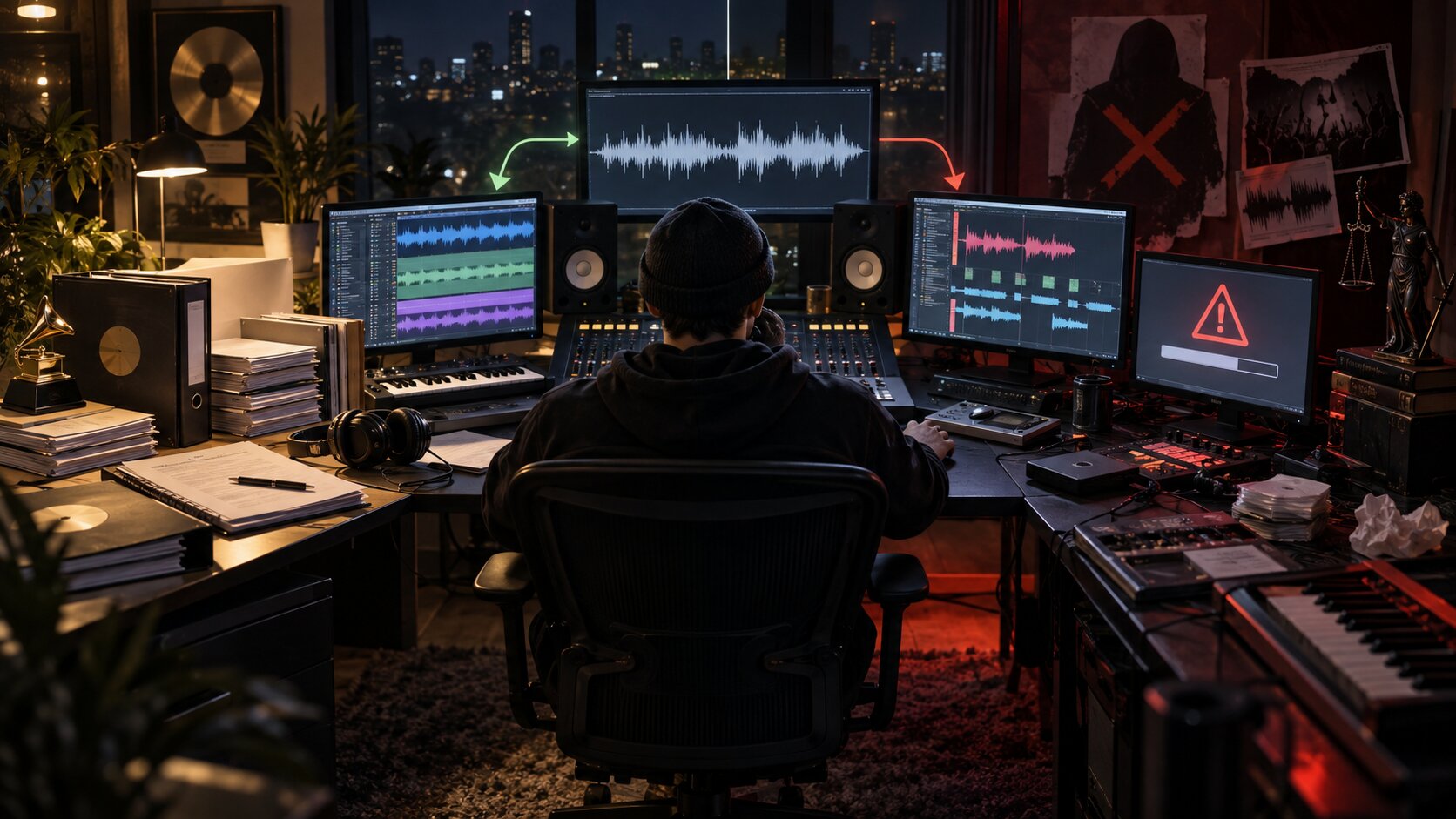
Remix Rights Explained: Official Remixes, Bootlegs and Derivative Works
TL;DR: An official remix is authorized by the relevant rights holders, while a bootleg remix is generally created without full permission. Because a remix can involve both the original sound recording and the underlying composition, permission from the performing artist alone may not be enough. Before distributing or monetizing a remix, confirm who controls the master, composition, release rights, and any third-party material contained in the original track.
Remixing occupies an unusual position in music culture. Producers routinely transform vocals, stems, hooks, drums, and entire arrangements into something that can sound dramatically different from the original recording. Creatively, the result may feel like a completely new record. Legally, however, changing the production does not automatically remove the copyright attached to the source material.
The confusion becomes greater because producers use terms such as official remix, bootleg, edit, flip, and rework quite casually. Copyright law does not necessarily treat these terms as separate legal categories.
What matters is what material was used, what was changed, who owns the relevant copyrights, and what authorization the producer has received.
This guide explains the practical difference between official remixes and bootlegs, how derivative-work rights can apply, which permissions may be required, what should be addressed in a remix agreement, and what independent producers and labels should clear before delivering a remix to a distributor.
Table of Contents
- Official Remix, Bootleg and Derivative Work: Three Different Ideas
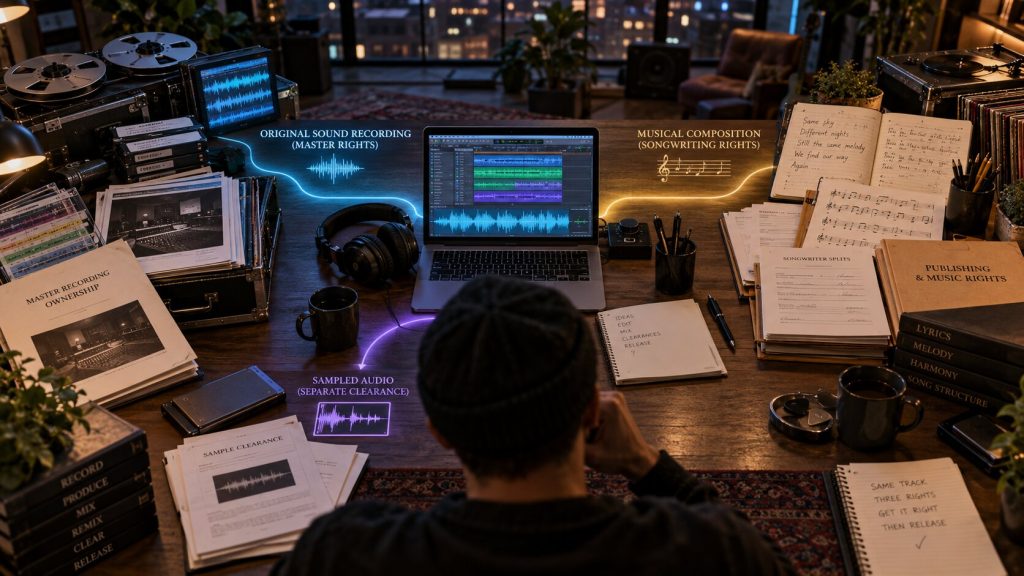
- A Remix Can Touch Two Copyrights at the Same Time
- What an Official Remix Agreement Needs to Cover
- Why a Bootleg Can Be Popular and Still Be Unlicensed
- Why a Cover License Does Not Clear a Remix
- What Platforms and Distributors Can Do to an Uncleared Remix
- A Practical Remix-Clearance Workflow
- Build the Rights Plan Before Release
- Frequently Asked Questions
Key Takeaways
| Point | Details |
|---|---|
| “Official remix” is primarily an industry term | What makes a remix official is authorization from the parties controlling the relevant rights, not a particular production technique. |
| A bootleg is not automatically legal because it is free | Giving a remix away, crediting the original artist, or avoiding monetization does not automatically create permission. |
| Master and composition rights are separate | Using the original recording can involve sound recording rights, while adapting the underlying song can involve composition rights. |
| A standard cover license is not a remix license | A cover normally involves making a new recording. It does not automatically authorize copying or altering another artist’s existing master. |
| Written permission matters | A remix deal should address ownership, compensation, credits, approvals, territories, distribution, and permitted use of stems. |
Official Remix, Bootleg and Derivative Work: Three Different Ideas
These terms are frequently used as though they mean the same thing, but they describe different aspects of a remix.
Official remix
An official remix is generally a remix created with authorization from the artist, label, master owner, publisher, or other relevant rights holders.
A label might send a producer isolated vocals and instrumental stems, commission a new version, approve the finished production, and then release it alongside the original single. An independent artist can do the same when they control all of the necessary rights themselves.
There is no particular sound, arrangement, or production method that makes a remix official. Authorization is the important distinction.
Bootleg remix
A bootleg remix is commonly understood in electronic and dance music as an unofficial rework created without complete authorization from the relevant rights holders.
A producer might use an extracted acapella, leaked stems, a purchased recording, or audio isolated with stem-separation software. Rebuilding every drum, bass, and synth around that vocal does not necessarily remove the copyright issues attached to the source audio.
The word bootleg is an industry or cultural label. It does not itself create a copyright exception.
Derivative work
Derivative work is a legal concept rather than a genre term. Under U.S. copyright law, a derivative work is based on an existing work and recasts, transforms, or adapts it. Copyright owners generally hold the exclusive right to authorize derivative works. U.S. law also addresses sound recordings whose recorded sounds are rearranged, remixed, or otherwise altered. (U.S. Copyright Office – Copyright Act, Title 17)
This makes derivative-work rights particularly relevant to remixes, although the exact rules and available exceptions vary between jurisdictions.
Pro Tip: Treat these three terms as answers to different questions. “Official” asks whether the remix was authorized. “Bootleg” describes how an unofficial remix is commonly understood in music culture. “Derivative work” concerns the copyright status of an adaptation or transformation.
A Remix Can Touch Two Copyrights at the Same Time
One of the most important concepts for remixers is that a commercially released song can contain more than one copyright.
In most cases, there are at least two separate works:
- The musical composition, which can include the melody, lyrics, and other protectable songwriting elements.
- The sound recording, meaning the particular recorded performance contained in the released master.
The U.S. Copyright Office treats musical compositions and sound recordings as separate works. Ownership of the composition does not automatically mean ownership of the recording, and vice versa. (U.S. Copyright Office – Copyright Registration for Sound Recordings)
Imagine that a producer receives the vocal stem from an existing single. Using that actual recorded vocal can require authorization from whoever controls the master recording. At the same time, changing protected elements of the song itself can also involve rights in the underlying composition.
The same individual or company may control both sets of rights, but that is not always the case. An independent artist may own the master while a publisher administers the composition. A label may control the recording while several songwriters and publishers have interests in the song.
This is why a casual message from the performing artist saying “go ahead” may not always be sufficient for a commercial remix release.
Watch for material that was already sampled in the original
A further complication appears when the source track already contains third-party samples.
The original artist or label may have licensed a sample for use in the original master, but that license does not necessarily give every future remixer unlimited permission to reuse the sampled material in a new version.
If a remix contains recognizable third-party material inherited from the original recording, confirm whether the original clearance extends to remixes and derivative versions.
What an Official Remix Agreement Needs to Cover
A professional remix arrangement should answer much more than a simple question such as, “Can I remix this track?”
Before serious production begins, the parties should know exactly what is authorized and what will happen to the finished remix.
A practical remix agreement may need to address:
- which master, vocal, stems, or other files the producer may use;
- whether the remix may be commercially released;
- who owns or controls the completed remix master;
- whether the remixer receives a flat fee, royalty, or other compensation;
- how the producer or remixer will be credited;
- whether the original rights holder has final approval;
- which territories and platforms are authorized;
- whether there is an exclusivity period;
- what promotional uses are permitted;
- whether supplied stems may be stored, shared, sampled, or reused;
- who is responsible for clearing new samples or collaborators added by the remixer.
For independent producers, ownership and royalties deserve particular attention. Do not assume that producing the remix automatically means you will own the new master. Likewise, a label should not assume that commissioning a remix automatically transfers every right in the producer’s contribution.
The agreement should state clearly how ownership and exploitation rights are structured.
The same principle applies to songwriting. If the remixer adds genuinely new compositional material, the parties should determine whether that contribution creates any songwriting interest and document the agreed split rather than leaving the issue unresolved until royalty registration.
Common mistake: Finishing the remix first and discussing the commercial terms only when the label is ready to release it. By that point, both sides have already invested time and creative value, making disagreements more difficult to resolve.
Why a Bootleg Can Be Popular and Still Be Unlicensed
Unofficial remixes have a long history in club culture. Some circulate through DJ sets, private downloads, blogs, social platforms, and streaming services for years.
Continued availability, however, does not necessarily mean a remix has been licensed.
A rights holder may not know that the remix exists. They may tolerate it temporarily, decide that enforcement is not worthwhile, or rely on automated copyright systems instead of requesting immediate removal. None of those situations is equivalent to receiving permission.
SoundCloud advises creators that remixing another person’s track can require permission from the original creator and any other relevant rights holders. It also notes that the performing artist may no longer control every right if a record company or other rights holder is involved. (SoundCloud Help Center – Best Practices for Creating and Uploading a Remix)
Several common disclaimers do not automatically solve the problem:
- “No copyright infringement intended.”
- “For promotional use only.”
- “Free download.”
- “All rights belong to the original artist.”
- “Credit to the copyright owner.”
- “I changed most of the track.”
Attribution can be respectful and may be contractually required, but it is not a substitute for authorization.
What about fair use?
Fair use exists under U.S. copyright law, but it is a fact-specific doctrine rather than a general remix license.
There is no universal rule stating that using only a certain number of seconds, changing the pitch, changing the genre, or giving the remix away for free automatically makes the use fair. The U.S. Copyright Office also cautions that simply changing another person’s work does not automatically give the new creator unrestricted rights in the original material. (U.S. Copyright Office – Fair Use FAQ)
Some highly transformative uses may require a different legal analysis, particularly in contexts such as commentary, criticism, or parody. Producers planning a conventional commercial music release should not treat the word “transformative” as an automatic replacement for rights clearance.
Why a Cover License Does Not Clear a Remix
A cover version and a remix can sound similar to listeners, but the underlying rights process can be very different.
In a traditional cover, the new artist generally makes a completely new recording of an existing composition. The original commercial sound recording is not copied into the new track.
A remix often does the opposite. It may directly use the original vocal, instrumental stems, drums, hooks, or other audio from an existing master.
Under the U.S. compulsory mechanical licensing framework, a compulsory license does not authorize someone to duplicate another person’s sound recording without permission. The law also limits how far an arrangement made under the compulsory license can alter the underlying song.
| Situation | Typical Rights Question |
|---|---|
| You re-record the song without using the original master | Composition and cover licensing |
| You use vocals or instruments from the released recording | Master authorization plus any relevant composition rights |
| You materially alter protected songwriting elements | Derivative or adaptation permission may also be relevant |
| You add an unrelated copyrighted sample | Separate sample clearance may be required |
The precise legal route depends on the territory and facts of the release. Calling a remix a “cover,” however, does not change the fact that the producer used audio from someone else’s existing recording.
What Platforms and Distributors Can Do to an Uncleared Remix
Successfully uploading a remix does not prove that the necessary rights have been cleared.
Online platforms use copyright-management systems that can identify or respond to protected material after upload.
On YouTube, Content ID can match uploaded content against reference files provided by participating copyright owners. Depending on the rights holder’s settings, a match may result in monetization by the rights holder, tracking, territorial restrictions, or blocking. A separate valid copyright removal request can result in removal of the content and a copyright strike. (YouTube Help – Copyright Claims and Content ID)
Crediting the copyright owner or choosing not to monetize does not automatically establish a right to use the material.
Distributors can also require documentation showing that an artist has permission to distribute third-party material. SoundCloud’s distribution guidance, for example, advises creators not to distribute unofficial remixes or uncleared music through its distribution service without the required rights and documentation. (SoundCloud for Artists – Copyright and Distribution)
The practical lesson is simple: platform availability and legal permission are not the same thing.
A remix may remain online for weeks, months, or years and still later be claimed, blocked, demonetized, rejected by a distributor, or removed.
A Practical Remix-Clearance Workflow
Rights clearance is easier when it begins before release planning rather than a few days before distribution.
1. Identify exactly what you used
Create an inventory of every element taken from outside your own production.
- original master;
- vocal stem;
- instrumental stems;
- acapella;
- sampled sections;
- lyrics;
- melody;
- new third-party samples;
- guest performers;
- licensed loops or sound-library material.
This provides a map of which rights need to be investigated.
2. Identify who controls the master
Check the release credits, record label information, artist team, distributor information where available, or contact the artist’s management.
Do not assume that the person performing the song personally owns or controls the recording.
3. Identify the composition stakeholders
Determine who wrote and publishes the song.
A single recording may involve several writers, publishers, or administrators. This becomes especially important if the remix materially changes the underlying composition rather than simply changing the production around it.
4. Ask for the specific permission you actually need
Avoid vague agreements such as “You can remix my track.” Instead, clarify whether the authorization covers commercial release, streaming, downloads, social platforms, promotional videos, monetization, worldwide distribution, and the use of supplied stems.
The more precise the scope of permission, the less room there is for conflicting expectations later.
5. Put the arrangement in writing
Keep agreements, email approvals, licenses, stem-delivery terms, and sample-clearance documents together.
Even when everyone involved has a good relationship, written documentation can become important months or years later if the release changes distributor, enters a licensing deal, or begins generating more revenue.
6. Confirm metadata before delivery
Agree on the release metadata before the track is submitted to distribution.
- track title;
- remix naming format;
- primary and featured artists;
- remixer or producer credit;
- label information;
- songwriting credits;
- ownership information;
- royalty accounting.
Having the correct rights but submitting incorrect metadata can still create administrative and royalty problems.
7. Clear anything new that you add
Permission to remix one track does not give the producer permission to introduce an unrelated copyrighted sample from another recording.
Any third-party elements added by the remixer should be reviewed separately and cleared where necessary.
8. Keep the clearance file after release
Store signed agreements and supporting documentation with the final master, artwork, metadata, stems, and royalty information.
A remix can remain part of a catalog for many years, long after the original email thread or messaging conversation has been forgotten.
Build the Rights Plan Before Release
A strong remix strategy is not only about production. Ownership, metadata, distribution, royalties, approvals, and release planning all affect whether the finished track can become a durable part of an artist’s catalog.
Blocktone Records publishes practical music-industry guides for independent artists, producers, and labels navigating these decisions. If you are planning an official remix campaign, treat rights clearance and documentation as part of the production process rather than paperwork to solve after the master is finished.
FAQs About Remix Rights
Can I legally release a remix if the original artist gave me permission?
Can I upload a bootleg remix if I do not monetize it?
Is changing the tempo, key, or genre enough to make a remix legally mine?
Do I need permission if I recreate the vocal instead of sampling the original recording?
Can a distributor reject an unofficial remix?
Does giving the original artist credit protect me from copyright claims?
Who owns an official remix after it is finished?
Sources Used
- U.S. Copyright Office – Copyright Act, Title 17
- U.S. Copyright Office – Copyright Registration for Sound Recordings
- U.S. Copyright Office – Fair Use FAQ
- SoundCloud Help Center – Best Practices for Creating and Uploading a Remix
- SoundCloud for Artists – Copyright and Distribution Guidance
- YouTube Help – Copyright Claims and Content ID