

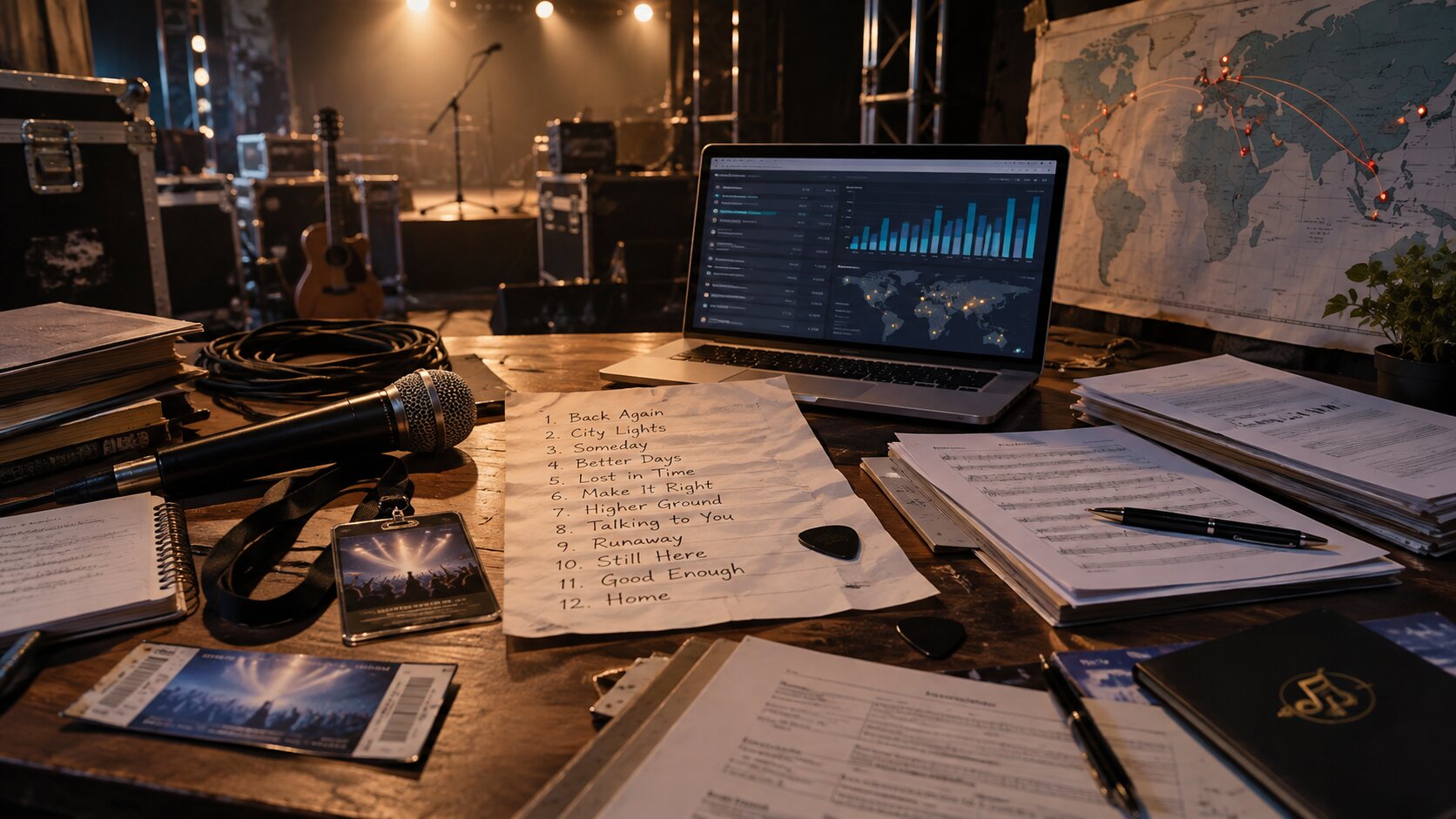
Setlists, PRO Reporting and Live Performance Royalties
TL;DR
A live setlist is more than a record of what you played: it can provide the performance data a performing rights organization needs to connect a concert with the songwriters and publishers who own the compositions. Register your songs before touring, keep accurate show records, submit eligible performances through the reporting process used by your PRO or collecting society, and check your royalty statements afterward. Do not assume that your venue, promoter, distributor, label, or booking agent has completed this process for you.
Introduction
Playing a show and getting paid for the show are not necessarily the end of the money attached to that performance.
When copyrighted songs are performed publicly, the compositions can generate performing-right royalties for their songwriters and publishers. In the United States, public performance is one of the exclusive rights associated with copyrighted musical works, while performing rights organizations collectively license those rights to venues, broadcasters, digital services, and other music users. (U.S. Copyright Office)
The difficulty is attribution. A collecting society may know that a venue is licensed without automatically knowing exactly which songs an emerging artist performed there on a particular night. That is why setlist and concert reporting remain important, particularly outside major tours where comprehensive performance data may be less readily available.
For independent songwriters, performing artists, managers, and publishers, live royalty administration should therefore become part of the normal post-show workflow. This guide explains where the money comes from, who can receive it, what information to save, how reporting differs between societies, and how to turn a touring calendar into usable rights-management data.
Table of Contents
- A Setlist Is Royalty Data, Not Just a Show Memory
- Separate the Gig Fee From the Songwriting Royalty
- Build Your Live-Royalty File Before the Tour Starts
- Report Qualifying Shows Before the Window Closes
- Handle Covers, Co-Writes and Changing Sets Carefully
- Treat International Shows as a Separate Admin Job
- Audit the Royalty Trail After Submission
- Make Live-Rights Administration Part of Your Career
- Frequently Asked Questions
- Sources Used
Key Takeaways
| Point | Details |
|---|---|
| A concert can generate more than a performance fee | Songwriters and publishers may also earn public-performance royalties from compositions played live. |
| Setlists help identify the music used | PROs and collecting societies use performance data to match songs with registered works and rightsholders. |
| Song registration comes first | Incorrect titles, splits, writers, or work registrations can delay or prevent accurate matching. |
| Reporting systems are not identical | BMI, ASCAP, PRS for Music, SOCAN, SESAC, and overseas societies use different portals, eligibility rules, and deadlines. |
| Covers belong on accurate setlists | The songwriter who owns the composition may be entitled to royalties even when another artist performs the song. |
| Submission is not the final step | Artists and publishers should review royalty statements and investigate missing or unmatched performances. |
A Setlist Is Royalty Data, Not Just a Show Memory
A setlist looks simple: song one, song two, song three, encore.
From a rights-management perspective, however, it describes copyrighted musical works being publicly performed at a particular place and time.
That information can help a PRO or collective management organization connect three important elements:
- A licensed event or venue.
- The musical works performed there.
- The writers and publishers registered as owning those works.
PRS for Music explains that live setlist information can be matched against registered works so royalties can be allocated according to the relevant distribution rules and ownership shares. Its live reporting guidance asks members for details such as the songs performed, songwriter information, and performance duration. (PRS for Music)
This is why a vague note such as “played the usual 10 songs” is poor royalty administration.
A useful performance record should contain the date, artist, venue, city and country, songs performed, and, where requested, information such as song duration, performance time, venue details, attendance, promoter information, or evidence that the concert occurred.
Pro Tip: Create a master setlist template containing the official registered title and work identifier for every composition in your repertoire. Duplicate and edit it after each concert instead of rebuilding your set from memory weeks later.
Separate the Gig Fee From the Songwriting Royalty
The most common point of confusion is the difference between being paid to perform and being paid because a composition was performed.
Imagine an independent singer-songwriter receives a fixed fee from a promoter for playing a club. That payment is compensation under the live-performance agreement.
If the songwriter also performs original compositions, a separate performing-right royalty process may apply to those songs. The relevant venue, promoter, event operator, or other music user may hold a public-performance licence, while the collecting society can distribute qualifying revenue to the songwriters and publishers represented in its repertoire.
This distinction also explains why the singer on stage is not automatically the person entitled to the composition royalty.
Performer and Songwriter Are Different Roles
Copyright treats the underlying musical work and the recorded performance as separate works. A musical composition consists of music and lyrics, while a sound recording captures a particular recorded performance of that composition. (U.S. Copyright Office)
For the PRO royalties discussed in this guide, the important asset is normally the composition.
If you wrote 100% of the song you perform, the connection is straightforward. If you perform a song written entirely by somebody else, you can still earn your agreed performance fee, but the relevant composition royalty belongs to the song’s writers and publishers.
If you co-wrote the song, your entitlement follows the registered ownership share and the applicable society’s distribution rules.
This is why accurate split sheets and work registrations matter long before the first tour date.
Build Your Live-Royalty File Before the Tour Starts
Trying to reconstruct six months of concerts from emails, social posts, and forgotten venue names is unnecessary administrative work. Build the system before you need it.
Register the Compositions
Confirm that every original song you plan to perform has been properly registered with the organization administering your performing rights.
Check the following information:
- Official song title.
- Songwriter names.
- Writer identifiers where applicable.
- Publisher or publishing administrator.
- Ownership percentages.
- Relevant work number or identifier.
- Alternate titles where supported.
A setlist cannot repair incorrect repertoire metadata. The reported performance still has to match the correct registered work.
Create One Concert Log
A basic spreadsheet can be enough. Give every show one row and maintain the same fields throughout the tour.
| Field | Example |
|---|---|
| Performance date | 18 September 2026 |
| Artist | Your performing name |
| Venue | Venue name |
| Location | City, country |
| Role | Headliner or support |
| Setlist | Link to saved set |
| Promoter | Company or contact |
| Evidence | Contract, ticket page, or poster |
| PRO status | Not submitted, submitted, or paid |
| Claim reference | Portal reference if available |
The value of this system becomes much more obvious once you are dealing with dozens of performances across different venues or countries.
Keep Evidence
Some societies request or may use supporting documentation to verify live performances. Useful files can include contracts, ticket pages, event listings, posters, settlement statements, promotional material, and the final setlist.
SOCAN’s live-performance resources, for example, describe the submission of concert and setlist information through its member tools. (SOCAN)
Save those files when the show happens rather than trying to locate them months later.
Report Qualifying Shows Before the Window Closes
There is no universal “submit my setlist” system covering the entire music industry.
Your reporting method depends on your society, territory, type of performance, and sometimes your role in the event.
BMI Live
BMI Live allows eligible performing songwriters to enter information about qualifying U.S. live performances through BMI’s online services. Current BMI guidance explains that songwriters can submit performance details and setlists so eligible performances can be considered for royalty distribution. (BMI Live)
International performances require separate attention. BMI provides a foreign live-performance notification process for qualifying performances outside the United States rather than treating every overseas concert as a domestic BMI Live submission.
ASCAP OnStage
ASCAP operates OnStage to help members report qualifying live performances that may not otherwise be captured through ASCAP’s other concert-survey processes.
The underlying principle is straightforward: provide enough reliable information about the event and works performed for the society to identify the performance and connect it with registered repertoire.
SESAC
SESAC affiliates also have mechanisms for providing live-performance information through SESAC’s member services. The exact workflow differs from other U.S. PROs, reinforcing the need to follow the system used by your own organization rather than copying another artist’s process.
PRS for Music and SOCAN
PRS for Music and SOCAN likewise provide mechanisms for members to submit eligible live-performance and setlist information. The applicable deadlines, documentation requirements, and distribution categories can differ between societies and may change over time.
The practical rule is simple: check your own society’s current guidance instead of relying on a deadline or reporting rule quoted in an old forum post or blog article.
Handle Covers, Co-Writes and Changing Sets Carefully
Live reporting becomes more complicated when the set contains more than your own solo-written songs.
Do Not Remove Covers From the Record
A setlist should reflect what was actually performed.
BMI’s live-performance guidance specifically addresses the reporting of songs performed during eligible shows, including repertoire that may not have been written solely by the performing artist. The broader principle is that the live performance of a composition concerns the rights in that composition, not simply the identity of the performer. (BMI)
If you perform a cover, you do not acquire the songwriting royalty simply because you sang or played the song on stage. The relevant composition rightsholders remain the writers and publishers registered for that work.
Keep Co-Writer Metadata Clean
Suppose three writers own a song in agreed shares. Reporting a performance does not transform it into a 100% royalty for whichever co-writer happened to perform the show.
Distribution follows the registered ownership information and the society’s applicable distribution rules.
Record the Set You Actually Played
If your Friday show contained 12 songs but Saturday’s encore replaced two of them, you now have two different performance records.
Do not blindly submit the same template for an entire tour unless the set really remained unchanged.
This becomes especially important with rotating covers, medleys, guest appearances, shortened festival sets, support slots, and improvised encores.
Treat International Shows as a Separate Admin Job
Touring across borders does not necessarily mean joining a different collecting society every time you enter another country.
Collecting societies commonly work through reciprocal representation agreements. CISAC explains that these agreements enable societies to represent foreign repertoires in their territories and facilitate the transfer of royalties between organizations. (CISAC)
That does not mean every international live royalty reaches a songwriter automatically without any administrative work.
The local society still needs usable performance information, the event must fall within applicable licensing and distribution rules, and your home society may require a specific foreign-performance notification.
Before an international tour, check:
- How your home PRO handles foreign concert notifications.
- Whether reporting happens before or after the performance.
- What supporting evidence is required.
- The applicable reporting deadline.
- Whether repeated setlists can be reused across multiple dates.
- Whether your publisher or publishing administrator handles any part of the claim.
Do this before beginning a long tour rather than discovering much later that different territories or societies use different claim procedures.
Audit the Royalty Trail After Submission
Submitting a setlist is not the same as confirming that a royalty reached your account.
Build a review process around your statements. At appropriate distribution intervals, compare your concert log with your royalty statements and reporting portal.
Look for the reported performances, compositions attached to them, ownership shares, submission statuses, and any unexpected omissions.
Was the Song Registered Correctly?
A title mismatch, unresolved ownership conflict, incorrect writer information, or incomplete registration can interfere with matching.
Was the Concert Submission Accepted?
Some systems distinguish between a claim being submitted, pending, processed, accepted, or paid. Recording a submission date and reference number makes later troubleshooting much easier.
Was the Venue or Event Covered by the Relevant Licensing System?
Reporting a performance does not guarantee a payment. Eligibility depends on the collecting society’s rules, the event, applicable licensing arrangements, available revenue, and other distribution criteria.
Did You File Within the Correct Reporting Period?
Late reporting can affect eligibility depending on the society and distribution category. This is one of the strongest reasons to make live-performance administration a routine part of touring.
Are You Waiting on an International Transfer?
Cross-border royalties may involve both the local collecting society and your home society, so the payment path can be more complex than a domestic submission.
Most importantly, do not estimate future live royalties using a universal “per song per show” figure. Distribution systems vary by society, territory, licensing revenue, event category, ownership, and other factors.
Make Live-Rights Administration Part of Your Career
Independent artists often build sophisticated systems for releases while treating concerts as isolated events: announce the date, sell tickets, play the show, and move on.
That leaves part of the rights workflow unfinished.
At Block Tone Records, we encourage artists to think about releases, rights, metadata, promotion, and performance activity as connected parts of the same career infrastructure. A correctly registered song is easier to administer when it moves from streaming platforms to radio, licensing opportunities, or the live stage.
Add one final task to every show checklist: archive the performance and handle the applicable royalty reporting.
A few minutes of organized administration after a concert is far easier than reconstructing an entire tour months later.
FAQs About Setlists, PRO Reporting and Live Performance Royalties
Do musicians earn royalties when they perform their own songs live?
Does the venue pay the artist’s PRO royalty directly?
Do I need to report every concert to my PRO?
Should cover songs appear on a submitted setlist?
Can my publisher report my live shows for me?
Can I receive live performance royalties from shows played overseas?
How much is one live performance worth in royalties?
Sources Used
- U.S. Copyright Office – Performing Rights Organizations and public performance rights
- U.S. Copyright Office – Copyright information for musicians
- BMI – BMI Live performance reporting
- PRS for Music – Claiming live performance royalties
- SOCAN – Live performance and member resources
- CISAC – Collective management organizations and reciprocal representation