Short-Form Video Ideas for Musicians Who Hate Dancing
TL;DR
You do not need to dance to make short-form video work as a musician. The strongest non-dance content usually comes from storytelling, studio process, lyrics, live moments, fan reactions, and simple visual concepts built around your song. Instead of chasing every trend, create repeatable formats you can film consistently and measure by saves, comments, shares, song clicks, and real listener interest.
Introduction
A lot of musicians avoid short-form video because they think the format demands choreography, acting, comedy, or a personality that feels completely separate from the music. That is a real problem for independent artists: video matters for discovery, but forced content can make an artist look uncomfortable, inconsistent, or disconnected from their own brand.
The good news is that dancing is only one language of short-form content. Musicians can use short videos to explain songs, show process, build emotional context, highlight lyrics, document live moments, respond to fans, and invite people deeper into a release.
YouTube for Artists frames Shorts as a tool for audience growth, fan engagement, and music promotion, while Spotify Clips are designed as short vertical videos attached directly to artist profiles, tracks, albums, or upcoming releases. (YouTube for Artists)
This guide gives you practical short-form video ideas for musicians who hate dancing, plus a simple system for turning one song into repeatable content without pretending to be someone you are not.
Table of Contents
- Key Takeaways
- Build a Video Identity That Fits the Artist, Not the Trend
- Use the Song as the Main Character
- 25 Short-Form Video Ideas That Do Not Require Dancing
- Turn One Song Into a Seven-Day Content Plan
- Film Faster With Repeatable Templates
- Adapt the Same Idea for TikTok, Reels, YouTube Shorts, and Spotify Clips
- Track Listener Signals, Not Just Views
- Mistakes That Make Non-Dance Music Videos Fall Flat
- How Block Tone Records Can Help
- Frequently Asked Questions
- Sources Used
Key Takeaways
| Point | Details |
|---|---|
| You do not need choreography | Short-form music content can work through lyrics, process, storytelling, performance, humor, emotion, or visual identity. |
| Start with a repeatable format | A consistent series is easier to film than inventing a new concept every day. |
| Show the song’s context | Explain what the line means, where the beat came from, or what emotion the song captures. |
| Keep videos platform-native | Vertical framing, captions, quick hooks, and clear visuals matter more than expensive production. |
| Measure deeper signals | Saves, comments, shares, profile visits, song clicks, and follower growth are more useful than views alone. |
Build a Video Identity That Fits the Artist, Not the Trend
The first mistake is assuming that “short-form video” means copying whatever is already viral. That can work for some artists, but it is not sustainable if the format makes you cringe every time you open the camera.
Instead, define your video identity in the same way you define your sound. Ask what people come to your music for: vulnerability, confidence, atmosphere, humor, storytelling, rebellion, nostalgia, technical skill, emotional intensity, or something else.
Your short-form content should reflect that answer. A dark alt-R&B artist does not need the same video style as a bright pop-punk band. A producer who rarely wants to be front-facing can still build compelling videos around beat breakdowns, arrangement choices, custom sounds, studio textures, and before-and-after transformations.
A useful rule: your videos should make the song easier to understand, remember, or feel. They do not have to make you look like a full-time influencer.
Pro Tip: Choose three content lanes and ignore everything else for 30 days. For example, use “song meaning,” “studio process,” and “live performance clips.” This gives you variety without chaos.
Use the Song as the Main Character
For musicians who hate dancing, the song itself should carry the video. That means your short-form idea should point attention back to a lyric, hook, emotion, beat switch, vocal moment, or listener use-case.
This matters because music platforms increasingly give artists tools that connect short videos directly to discovery. TikTok for Artists includes analytics for song performance, post performance, and follower insights, while TikTok Artist Account features such as Artist Tag, New Release, Music Tab, and Behind the Song are designed to help fans identify artists and explore their music. (TikTok Newsroom)
Instead of asking, “What trend can I copy?” ask better creative questions. What line would make someone stop scrolling? What moment in the song best explains the feeling? What visual situation would make this hook make sense? What question would a listener ask after hearing this?
For example, if your song is about a breakup, you do not need to act out the entire story. A simple video of you writing one line in a notebook, with the caption “I wrote this after realizing the apology was never coming,” can be stronger than a forced skit.
25 Short-Form Video Ideas That Do Not Require Dancing
Below are practical ideas you can adapt across TikTok, Instagram Reels, YouTube Shorts, and Spotify Clips.
Song Story Ideas
- The lyric explanation: Put one lyric on screen and explain the real meaning in one sentence.
- The “I wrote this when…” format: Start with the emotional trigger behind the song.
- The misunderstood line: Share a lyric people might interpret one way, then reveal what it really means.
- The voice memo origin: Play the rough idea, then cut to the finished hook.
- The title reveal: Explain why the song is called what it is.
- The “before the chorus” setup: Give context for the line right before the hook drops.
- The emotional weather report: Describe the song as a mood, such as “for the drive home after you said you were fine but weren’t.”
Studio and Process Ideas
- Beat build in layers: Add drums, bass, chords, vocals, and effects one by one.
- One sound, three versions: Show how a raw sound became part of the final track.
- Vocal stack reveal: Play lead vocal, harmony, ad-libs, then full mix.
- Bad demo to finished record: Show the contrast without overexplaining.
- Producer decision breakdown: Explain one small choice that changed the song.
- Mix detail spotlight: Point out a hidden sound that most listeners miss.
- Writing room clip: Film the room, the instrument, the notebook, and the hook playing over it.
Performance Without Choreography
- One-take acoustic hook: Perform the chorus seated, standing, or at the piano.
- Micro live performance: Sing one emotional line directly to camera.
- Backstage moment: Use a real clip from rehearsal, soundcheck, or green room.
- Crowd reaction: Show fans singing, clapping, or reacting to a specific moment.
- Instrument close-up: Focus on hands, strings, keys, pads, pedals, or drum hits.
- Tiny desk-style clip: Keep it intimate, simple, and performance-led.
Fan and Community Ideas
- Reply to a comment with a video: Turn fan questions into short-form content.
- “Someone said this song feels like…”: Use a listener comment as a visual prompt.
- Duet or stitch a reaction: Respond to someone using or reacting to your song.
- Fan use-case prompt: Ask listeners where they would play the song: gym, late-night drive, breakup walk, pre-game, or study session.
- Playlist identity: Frame the song as “for fans of…” without overclaiming or misleading listeners.
The best ideas are not always the most complex. A strong hook, clear visual, readable caption, and emotionally specific song moment often beat expensive production.
Turn One Song Into a Seven-Day Content Plan
A common reason artists quit short-form video is that they treat every post as a brand-new creative project. A better approach is to build a mini-campaign around one song.
| Day | Video Concept | Goal |
|---|---|---|
| Day 1 | “I wrote this song about…” | Give emotional context |
| Day 2 | Raw demo vs final hook | Show transformation |
| Day 3 | Lyric meaning breakdown | Make the song more memorable |
| Day 4 | Live or acoustic version | Prove performance value |
| Day 5 | Hidden production detail | Reward deeper listeners |
| Day 6 | Comment reply or fan prompt | Start conversation |
| Day 7 | Direct listening invitation | Send people to the release |
This works because it gives the audience several entry points. Some listeners care about lyrics. Some care about vocals. Some care about production. Some need the emotional story before they care about the song.
YouTube recommends that artists use Shorts differently depending on the goal: teasing songs during release cycles, posting performance highlights around tours, and keeping audience growth “always on” by highlighting catalog and engaging with fan content. (YouTube for Artists)
Film Faster With Repeatable Templates
You do not need a full production setup. You need a repeatable filming system.
Use this basic template:
- Hook: one sentence that creates curiosity.
- Visual: one simple action or scene.
- Song moment: the lyric, hook, beat drop, or instrumental section.
- Caption: context that makes people understand why the sound matters.
- CTA: a soft next step, such as “save this for later,” “full song is out,” or “what does this line mean to you?”
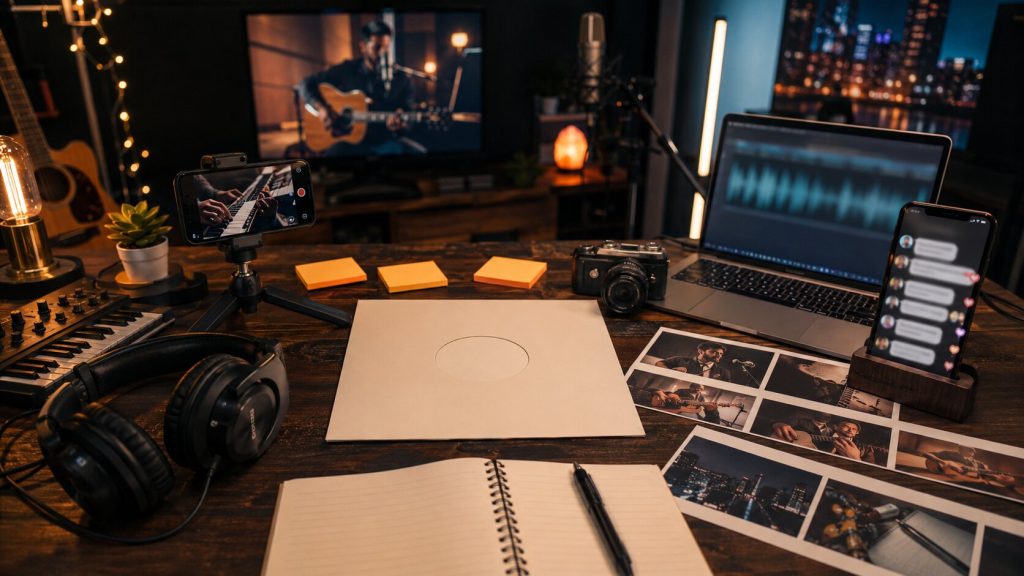
For musicians who dislike being on camera, use low-pressure visuals such as notebooks, instruments, lyric sheets, studio screens, city footage, empty venues, headphones on a studio desk, album artwork animations, night walks, or hands adjusting knobs, strings, keys, or drum pads.
Keep the first seconds clear. YouTube’s Shorts guidance recommends capturing attention quickly, filming vertically, using text overlays, and adding titles, hashtags, and descriptions that provide context. (YouTube Official Blog)
Adapt the Same Idea for TikTok, Reels, YouTube Shorts, and Spotify Clips
Do not simply export one file and post it everywhere without thinking. The core concept can stay the same, but the packaging should fit each platform.
TikTok
Use TikTok for conversation, discovery, and fan participation. Strong non-dance formats include story-behind-the-song videos, stitched reactions, fan prompts, messy demo clips, emotionally specific captions, and behind-the-scenes moments.
Instagram Reels
Use Reels for artist identity and visual consistency. Reels can be more polished than TikTok, but they should still feel native to vertical video. Strong formats include cinematic lyric clips, acoustic performance moments, studio visuals, release countdowns, and mood-based edits.
YouTube Shorts
Use Shorts to connect short discovery with your wider YouTube ecosystem. YouTube for Artists notes that artists can link Shorts to long-form videos, including official music videos, and recommends tracking creations, subscribers from Shorts, and song views from Shorts. (YouTube for Artists)
Spotify Clips
Use Spotify Clips for deeper storytelling once listeners are already close to your music. Clips are under-30-second vertical videos uploaded through Spotify for Artists and can be attached to artist profiles, tracks, albums, or upcoming releases. Spotify describes Clips as evergreen and focused on driving streams rather than likes. (Spotify for Artists)
Track Listener Signals, Not Just Views
Views can be useful, but they are not the whole picture. A video with fewer views can be more valuable if it sends people to your song, gets thoughtful comments, attracts followers, or helps fans understand your identity.
| Signal | What It Might Mean |
|---|---|
| Saves | The video or song idea had lasting value. |
| Shares | The content felt relatable or useful. |
| Comments | The topic created conversation. |
| Profile visits | Viewers wanted to know who you are. |
| Song clicks | The video connected interest to listening. |
| Follower growth | The content made people want more from you. |
Do not judge a format after one post. Test a concept at least three to five times with different hooks, visuals, and song sections. The goal is to find repeatable creative angles, not one lucky post.
Mistakes That Make Non-Dance Music Videos Fall Flat
Making Every Post a Direct Ad
“New song out now” is not a content strategy. Give people a reason to care before asking them to listen. Lead with the feeling, story, lyric, or transformation.
Hiding the Best Part of the Song
Do not save the hook for too late. Short-form viewers may scroll before the payoff. Start near the strongest lyric, vocal, beat drop, or emotional moment.
Posting Studio Clips With No Context
A clip of a DAW session can be interesting, but only if the viewer understands what they are watching. Add a caption like: “This harmony only appears once in the song, but it changes the whole chorus.”
Trying to Look More Polished Than You Are
Independent artists often win by being specific, honest, and visually clear. Overproduced videos can feel cold if the song needs intimacy.
Ignoring Rights and Platform Rules
Be careful with music usage, remixes, and third-party audio. YouTube’s Shorts music help page notes that Shorts can use music from the Shorts Audio Library, but eligibility and duration can vary by song, and longer Shorts with active Content ID claims may be blocked under certain conditions. (YouTube Help)
How Block Tone Records Can Help
Block Tone Records helps independent artists think beyond random posting and build promotion systems that connect music, visuals, release timing, and fan engagement. For musicians who hate dancing, that means developing content ideas that fit the artist’s real identity instead of forcing trends that do not match the music.
A strong short-form strategy should make your songs easier to discover, but also easier to understand. The goal is not to become a full-time content creator. The goal is to give listeners more reasons to care about the music you are already making.
FAQs About Short-Form Video Ideas for Musicians Who Hate Dancing
Do musicians need to dance on TikTok or Reels to promote their music?
What should I post if I hate being on camera?
How often should musicians post short-form videos?
Should I post the same video on TikTok, Reels, and Shorts?
What is the easiest short-form video idea for a beginner musician?
Do Spotify Clips replace TikTok, Reels, or Shorts?
How do I know if my non-dance videos are working?
Sources Used
- YouTube for Artists – Shorts for Artists
- YouTube Official Blog – Guide to Getting Started With YouTube Shorts
- YouTube Help – Use Music and Sound in Shorts
- TikTok Newsroom – TikTok for Artists Launches
- TikTok Newsroom – Artist Account Features
- TikTok for Business – Creative Best Practices
- Spotify for Artists – Spotify Clips
- Instagram for Business – Instagram Reels