

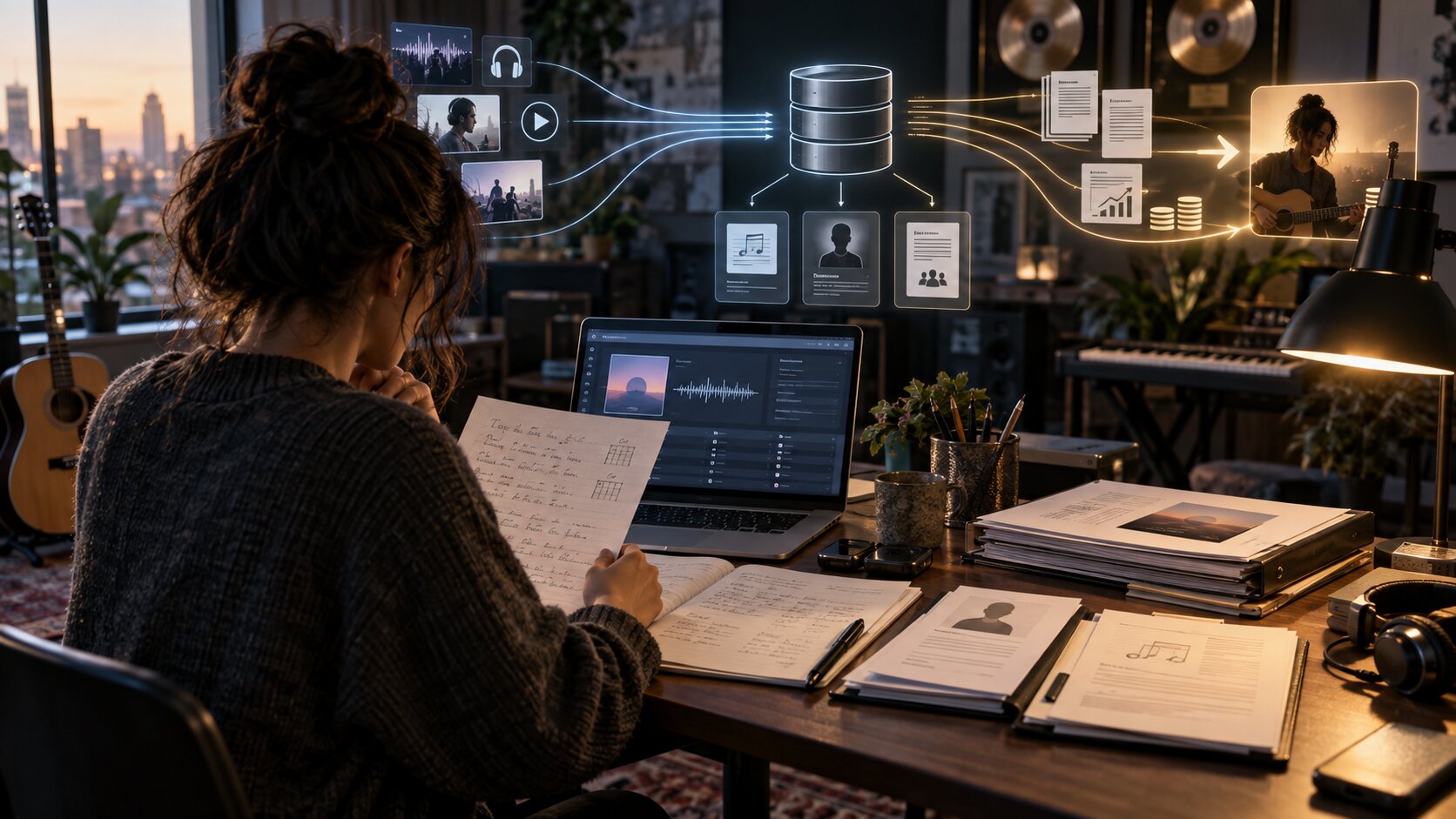
The MLC, Mechanical Royalties and Why Song Registration Matters
TL;DR
The Mechanical Licensing Collective, or The MLC, administers U.S. digital mechanical royalties for qualifying uses of musical works, including interactive streams and certain downloads. If you control your own publishing rights, accurate registration with The MLC can be an important part of collecting the mechanical royalties you are entitled to receive. The practical priority is to know who administers each composition, register the correct ownership shares, and connect released recordings to the underlying musical work.
For independent artists, releasing a song and registering a song are two different jobs.
A distributor can deliver your recording to streaming services, but distribution alone does not establish who wrote the underlying composition, who controls its publishing rights, or who should receive mechanical royalties generated by qualifying digital uses in the United States. Those questions belong to the publishing side of the music business.
That is where The Mechanical Licensing Collective enters the picture. Created under the Music Modernization Act, The MLC administers the U.S. blanket mechanical license for eligible digital music uses and works to distribute applicable royalties to songwriters, publishers, administrators, and other rightsholders. (U.S. Copyright Office)
Understanding the system does not require becoming a publishing lawyer. It does require separating recording income from composition income and treating song metadata as part of the release process rather than paperwork to revisit months later.
Table of Contents
- The royalty that lives behind the recording
- Where The MLC fits in the U.S. royalty map
- Registration is the bridge between a stream and a payment
- Build a clean song-data file before you touch the portal
- A practical MLC workflow for self-administered songwriters
- The registration mistakes that cause avoidable problems
- Make royalty administration part of every release cycle
- Frequently Asked Questions
Key Takeaways
| Point | Details |
|---|---|
| The MLC deals with musical works | Its statutory blanket licensing role concerns compositions rather than ownership of the master recording. |
| Its core scope is U.S. digital mechanical royalties | The blanket license covers qualifying digital phonorecord deliveries such as interactive streams and certain downloads. |
| Not every songwriter should collect directly | A publisher, publishing administrator, or other authorized organization may already be registering works and collecting the relevant royalties. |
| Registration and recording matching are separate tasks | A composition can exist in The MLC database while individual recordings still need to be associated with that work. |
| Accurate ownership data matters | Writer identities, publishers, controlled shares, and recording information help the system identify who should receive applicable royalties. |
| The MLC does not replace other registrations | PRO membership, copyright registration, sound-recording royalty collection, and distribution serve different purposes. |
The royalty that lives behind the recording
When one song appears on a streaming platform, there are at least two distinct copyright assets to think about: the sound recording and the underlying musical work.
The sound recording, often called the master, is the specific recorded performance that listeners hear.
The musical work, also called the composition, consists of the underlying music and lyrics.
Mechanical royalties relate to use of the musical work. The MLC describes mechanical licensing as permission to reproduce and distribute a musical work through physical or digital phonorecord deliveries, with relevant digital uses including interactive streams, limited downloads, and permanent downloads. (The MLC Help Center)
This distinction matters because an independent artist can own both copyrights while receiving revenue for them through different channels.
Imagine a singer-songwriter who writes a song, records it, owns the master, and sends that recording to streaming platforms through a distributor. The distributor may account for revenue associated with exploitation of the master under its agreement with the artist. That does not eliminate the separate publishing income associated with the composition.
For a self-administered songwriter, managing the recording side while ignoring publishing administration can therefore leave part of the royalty picture unattended.
Mechanical royalties are not simply one fixed per-stream rate
Streaming mechanical royalties should not be viewed as a universal amount multiplied by the number of streams. The U.S. statutory framework uses formulas that can vary by service and offering and may incorporate factors such as service revenue, subscriber figures, and other royalty calculations.
For an independent songwriter, the practical lesson is more important than memorizing a theoretical per-stream figure: first make sure the song is correctly represented, the proper ownership shares are claimed, and qualifying recordings can be connected to the composition.
Where The MLC fits in the U.S. royalty map
The Music Modernization Act established a blanket licensing structure for certain digital uses of musical works in the United States. Digital music providers operating under that system report applicable usage and royalties, while The MLC works to identify musical works and rightsholders and distribute matched mechanical royalties. (U.S. Copyright Office Music Modernization Act resources)
The important point is that The MLC is only one part of a larger rights-management system.
| Organization or service | Main role relevant to an independent songwriter |
|---|---|
| The MLC | Administers mechanical royalties under the U.S. statutory blanket license for qualifying digital audio uses of musical works. |
| Performing rights organization | Administers applicable public-performance royalties for musical works. |
| SoundExchange | Handles certain U.S. digital performance royalties associated with sound recordings. |
| U.S. Copyright Office | Handles federal copyright registration. |
| Music distributor | Delivers sound recordings to digital services and generally accounts for recording-side income according to its agreement with the artist or label. |
Joining The MLC does not replace membership in a performing rights organization or other registrations that may apply to your music. The MLC itself presents PRO registration, MLC registration, and copyright registration as separate elements of a songwriter’s rights-management workflow. (The MLC songwriter resources)
The MLC also should not be treated as a universal collection service for every mechanical royalty in every territory or format. Physical mechanical royalties and royalties generated outside the scope of the U.S. blanket digital license may require separate administration arrangements.
Pro Tip: Build your royalty setup around rights rather than company names. For each revenue stream, ask which copyright generated the money, where the use happened, and who is authorized to administer your share.
Registration is the bridge between a stream and a payment
A digital music service can identify that a particular recording was streamed. Publishing administration must also determine which composition that recording embodies and who controls the relevant publishing shares.
That matching process is one of the major reasons accurate registration data matters.
The MLC maintains musical-work data and provides tools that allow eligible rightsholders to register works, claim ownership interests, review catalog information, and help associate recordings with compositions.
A simplified workflow looks like this:
- The song is written.
- The writers agree on ownership.
- The musical work is registered with the appropriate organizations.
- A recording of the song is released.
- Digital usage is reported.
- The recording is associated with the underlying musical work.
- The relevant publishing ownership is identified.
- Applicable royalties can be distributed to the appropriate rightsholders.
A problem anywhere in that chain can make royalty administration more difficult.
For example, a composition might already exist in The MLC database while a particular recording has not yet been correctly connected to it. The MLC provides a Matching Tool that allows eligible users to suggest relationships between recordings and works in their catalogs. Searches can use recording information such as the title and ISRC. (The MLC Matching Tool guidance)
This becomes especially useful when one composition has several recordings. A songwriter may have an original studio release, an acoustic version, a live version, and cover recordings released by other artists, while all of those recordings still embody the same underlying musical work.
Build a clean song-data file before you touch the portal
Reliable registration begins before logging into The MLC or any other rights-management platform.
For every composition, maintain a central record containing the confirmed information you will need for publishing administration.
- Official composition title
- Alternative title, when genuinely applicable
- Legal or registered names of all writers
- Writer roles
- Writer IPI numbers when available
- Agreed songwriting splits
- Publisher or administrator information
- Publishing identifiers
- The percentage you or your administrator actually controls
- ISWC when available
- Recording title and artist
- ISRC for each released recording
- Relevant release information
- Copies of split sheets and publishing agreements
An IPI identifies an interested party such as a songwriter or publisher within music-rights data systems. An ISWC identifies a musical work, while an ISRC identifies an individual sound recording.
The distinction between ISWC and ISRC is particularly important because multiple recordings can represent the same composition. An original studio recording, remix, acoustic version, or cover can have its own recording identifier while still pointing back to the relevant musical work.
Finish the split conversation before registration
Do not treat songwriting percentages as something the collaborators can resolve after everybody has submitted different registrations.
For co-written songs, agree in writing who contributed to the composition and what ownership split applies. Then make sure the registrations entered by the writers, publishers, or administrators are consistent with that agreement and with any relevant publishing contracts.
If two self-administered writers each control only their own share, each should generally deal with the share they are authorized to administer rather than claiming the entire composition merely because the other writer has not completed a registration yet.
A straightforward split sheet completed during or shortly after the writing process can prevent much larger catalog problems later.

A practical MLC workflow for self-administered songwriters
The first question should not automatically be, “How do I join The MLC?”
The better question is, “Who currently administers my U.S. digital mechanical rights?”
If a music publisher or publishing administrator already registers your works and collects the relevant U.S. mechanical royalties on your behalf, duplicating its work can create conflicting claims or unnecessary administrative problems.
If you genuinely self-administer the relevant share, the following workflow provides a sensible starting point.
1. Create the appropriate MLC account
The MLC offers membership to eligible rightsholders that are authorized to administer musical works and receive applicable digital audio mechanical royalties. Membership itself is free. (The MLC Membership)
A songwriter who controls and administers their own publishing rights can potentially act as a self-administered Member rather than forming a publishing company solely for the purpose of having an MLC account.
2. Search before creating a new work
Before submitting a new composition, search the existing database.
Your song may already appear because a co-writer, publisher, former administrator, or another data source supplied information about it. Creating a second version unnecessarily can contribute to duplicate records and make ownership administration harder.
If the correct work already exists and you are authorized to control an available share, review the claiming options instead of automatically creating another work.
3. Enter writers, publishers, and controlled shares carefully
Add the known writers using accurate names and identifiers where available. Then identify the publisher or administrator connected to the share you actually control.
The phrase share you control is important. Your collaborator’s songwriting percentage is not automatically yours to administer simply because you know what that percentage is.
Registration data should describe the rights you or your organization are actually authorized to manage.
4. Add recording information
Recording information helps connect a musical work with recordings that embody it. Keep the ISRC for each released recording in your own catalog records and add or verify recording relationships through the available tools where appropriate.
Do not assume that registering an ISRC with a distributor is equivalent to registering the underlying composition. One concerns the recording; the other concerns the musical work.
5. Review the catalog after release
Registration should not be treated as a one-time task that ends when the track goes live.
After release, check whether the work appears correctly, confirm ownership information, and look for recordings that may need to be associated with the composition.
For artists with a growing catalog, periodic checks are much easier than trying to reconstruct years of missing metadata after a payment problem appears.
The registration mistakes that cause avoidable problems
Registering a composition twice
Search before creating a new work. A song appearing with slightly different metadata does not necessarily mean it is a separate composition.
Assuming your PRO automatically handles the MLC side
Performance-rights administration and mechanical-rights administration are different functions. A PRO registration does not automatically mean your self-administered share has been dealt with correctly for The MLC’s statutory digital mechanical system.
Confusing the master with the composition
Your distributor delivers the sound recording. An ISRC identifies that recording. Neither of those facts replaces proper administration of the publishing rights in the composition.
Claiming 100% because your co-writer has not registered yet
Only claim rights that you are actually authorized to administer. A collaborator’s delay does not automatically transfer administrative authority over their share to you.
Ignoring cover versions and alternative recordings
Other recordings of your composition may generate qualifying uses even though you do not own those masters. Maintaining the composition correctly and reviewing recording matches can therefore matter beyond your own artist release.
Registering once and never checking the catalog again
Catalogs change. New recordings appear. Publishing administrators change. Ownership information can require corrections. Treat song registration as catalog maintenance rather than a single checkbox.
Make royalty administration part of every release cycle
For independent musicians, the best time to organize publishing information is before release day.
Add a publishing and rights checkpoint to your normal release workflow:
- Confirm every songwriter.
- Finalize and document the songwriting splits.
- Determine who administers each publishing share.
- Register the composition with the appropriate organizations.
- Save the correct writer and publisher identifiers.
- Record the ISRC when the master receives one.
- Review the musical work after release.
- Check periodically for unmatched recordings, duplicate works, or incorrect ownership information.
This approach is more reliable than investigating publishing only after a track begins generating meaningful attention.
A song with modest activity still deserves clean metadata. If the composition later attracts more listeners, receives a cover recording, becomes part of a licensing opportunity, or simply remains active for many years, accurate rights information becomes increasingly valuable.
The broader principle is simple: releasing music creates a data-management responsibility alongside the creative work. The earlier you establish reliable publishing records, the easier it becomes to understand who controls each right and where relevant royalties should flow.
For more practical guides on royalties, publishing, independent releases, music rights, and artist strategy, explore BlockTone Records.
FAQs About The MLC and Mechanical Royalties
What does The MLC actually collect?
Do independent songwriters need to join The MLC?
Is joining The MLC free?
Do I still need a PRO if I use The MLC?
Is an ISRC the same as registering a song with The MLC?
What should I do if my song is already in The MLC database?
Does The MLC collect every mechanical royalty worldwide?
Sources Used
- U.S. Copyright Office – Section 115 and the Music Modernization Act
- U.S. Copyright Office – Music Modernization Act resources
- The Mechanical Licensing Collective – Membership information
- The Mechanical Licensing Collective – Resources for songwriters
- The MLC Help Center – Terms and definitions
- The MLC Help Center – Matching Tool guidance