

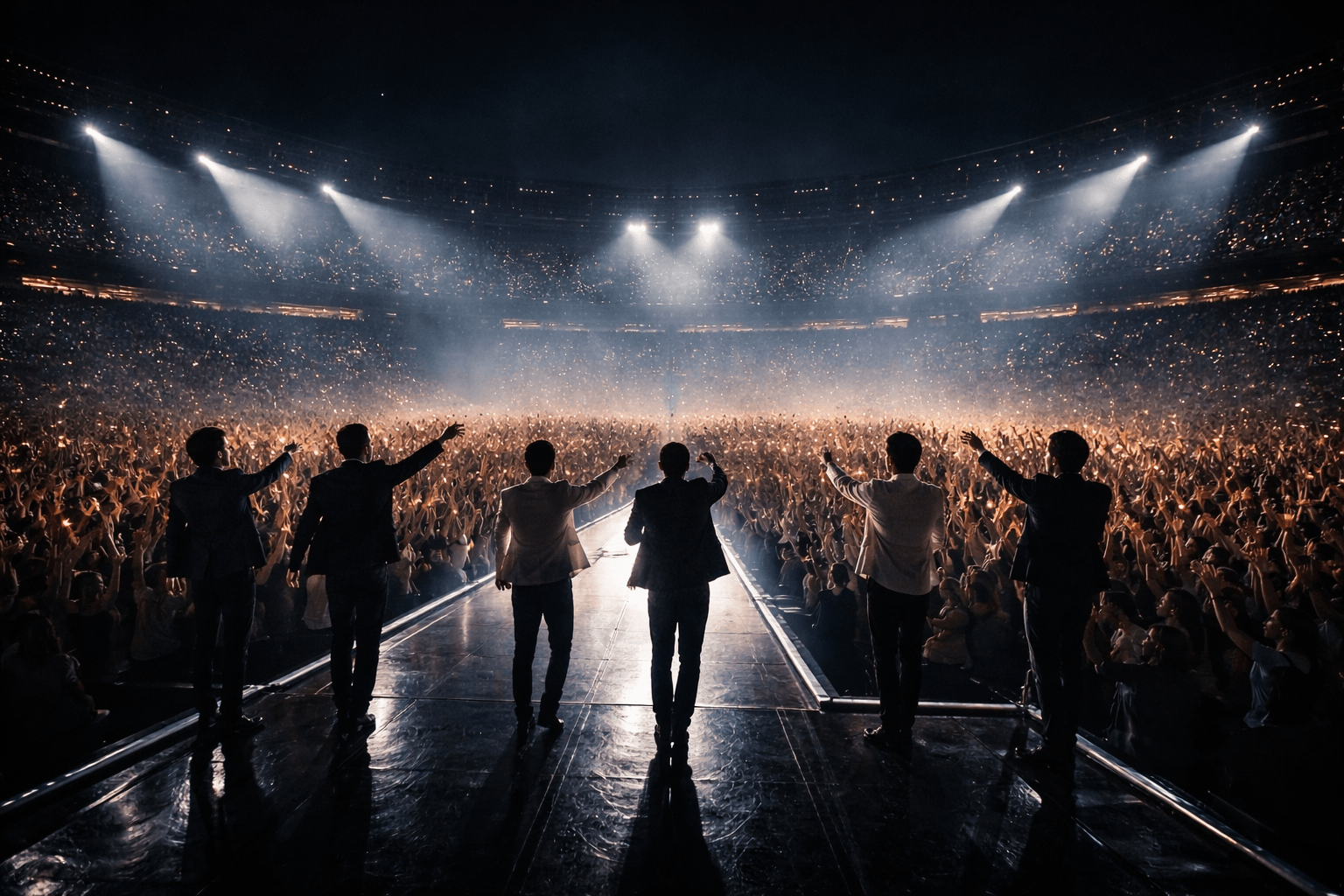
What is BTS “Body To Body” about?
BTS “Body To Body” Meaning Explained
“Body To Body” is a song about closeness, but not in a narrow romantic sense. BTS use the language of physical contact to talk about reunion, live energy, emotional presence, and the feeling of people becoming one inside a shared moment. As the opening track on ARIRANG, it works like a statement of return: the group is back, the crowd is back, and distance is something the song wants to erase. (Apple Music – “Body To Body”)
That is why the title matters. On the surface, “body to body” sounds intimate and immediate. In the song itself, though, it expands into something bigger: bodies in a stadium, bodies moving together, and human contact as an answer to separation, hostility, and emotional disconnection.
Background and Release Context
BTS released “Body To Body” on March 20, 2026 as the first track on ARIRANG, their 14-song studio album released through BIGHIT MUSIC. The comeback carried extra weight because it marked the group’s first original full-length album after the period shaped by military service and solo activity, making the opener feel less like a casual album cut and more like a deliberate reintroduction. (Apple Music – ARIRANG)
BIGHIT frames ARIRANG as an album rooted in BTS’s identity and in universal emotions, using Korea’s best-known folk-song title to connect the group’s present moment to a longer cultural tradition. That context is essential to “Body To Body,” because the track does not simply open the album with energy; it opens the album with a thesis about who BTS are in 2026 and how they want to sound. (BIGHIT MUSIC – ARIRANG album page)
Publicly available credit listings attribute the song to Ryan Tedder, Maxime Picard, Thomas Wesley Pentz, Akira Evans, Teezo Touchdown, Pdogg, RM, SUGA, j-hope, and Kirsten Allyssa Spencer, with production credited to Picard Brothers, Diplo, Ryan Tedder, and Pdogg. Even before you get to the lyrics, those credits suggest a song designed to be huge, rhythm-forward, and built for a crowd rather than for introspective minimalism. (Doolset – “Body To Body” credits and notes)
The Meaning Behind “Body To Body”

The core meaning of “Body To Body” is that real connection beats distance, image, and conflict. The song keeps returning to ideas of jumping together, putting the phone down, dropping pride, and coming closer. That combination matters because BTS are not presenting touch as pure sensuality; they are presenting closeness as something restorative and social.
One of the song’s smartest moves is the way it contrasts physical presence with digital behavior. When the lyrics tell listeners to put the phone down and later mention “guns, knives, and keyboards,” the song broadens its target. It is not only about party energy. It is also pushing against online hate, performative aggression, and the kind of distance that turns people into screens, profiles, or enemies instead of human beings standing in the same room.
That reading becomes even stronger when “Arirang” enters the song. Weverse Magazine’s analysis of the album notes that “Body To Body” begins with longing for a stadium and reframes that desire through a message about clearing away hate and narrowing the distance between “you and me.” It also points out how the repeated “Somebody like you” in the chorus flows naturally into communal singing of “Arirang,” turning the song into a call for solidarity rather than just a chant for excitement. (Weverse Magazine – BTS album analysis)
So the emotional tension in “Body To Body” is simple but effective: the world pushes people apart, and the song pushes them back together. BTS make that reunion feel physical, emotional, and cultural at the same time.
Lyrics Breakdown, Section by Section
Verse 1 Meaning
The first verse opens like a command to a crowd. The song does not begin in private; it begins in public, aimed at a full stadium. That instantly tells you the emotional scale. This is not a whispered confession or a one-person love letter. It is a record built to gather people into one shared pulse.
Very quickly, though, the verse becomes more than hype. The lyrics move from crowd motion into a rejection of hate, ego, and empty pride. That gives the opener real purpose. BTS are not only saying, “Come closer.” They are also saying, “Leave behind the attitudes that keep people divided.”
Pre-Chorus Meaning
The pre-chorus narrows the focus from the whole stadium to direct contact. “Skin to skin,” “hand in hand,” and the image of reaching toward the moon all push the song toward intimacy. But it is still an expansive intimacy, not a secretive one. The feeling is that two people can connect, and that connection can scale outward into something communal.
The sunrise image is especially important. In many songs, sunrise ends the fantasy. Here it does the opposite. The line about not going home at sunrise suggests a bond strong enough to outlast the temporary rush of the night. In emotional terms, that means the experience matters, not just the adrenaline.
Chorus Meaning
The chorus is built around repetition rather than detailed storytelling, and that is exactly why it works. “Somebody like you” gradually opens into “everybody like you,” blurring the line between one person and the whole crowd. The song keeps the wording simple so the emotional invitation can get bigger.
This is the point where “Body To Body” stops sounding like a song about one specific relationship and starts sounding like a song about collective belonging. The hook is less interested in describing love than in creating a space where listeners can feel included inside it.
Verse 2 Meaning
Verse two gives the song a stronger sense of shared identity. The lyrics move toward “our” style and a night that will not end in sleep, which turns the connection from temporary contact into a living culture. It is not just that people are close to one another; it is that they are building a shared atmosphere and shared momentum.
The line about the surging spirit of the people pushes that idea further. This is where the song starts feeling explicitly tied to a broader Korean frame rather than only to global pop language. BTS are connecting excitement, identity, and collective movement in a way that fits the wider concept of ARIRANG.
Bridge Meaning
The bridge is where the song becomes much deeper than a modern stadium anthem. By bringing in “Arirang,” BTS plug the track into a folk tradition historically tied to longing, separation, love, sorrow, and reunion. The bridge adds emotional memory to a song that otherwise could have remained all momentum and impact.
UNESCO describes “Arirang” as an evocative song form with the power to enhance communication and unity among Korean people at home and abroad. That description helps explain why its appearance here matters so much: BTS are not using the refrain as decoration. They are using it to turn a contemporary crowd record into something that carries cultural memory and collective feeling inside it. (UNESCO – Arirang, lyrical folk song)
Outro Meaning
The outro widens the frame again by calling out people at the side, the back, and the front. That is a subtle but important ending. After the song spends time exploring intimacy and shared feeling, it closes by making sure no one is excluded from the circle it has created.
Emotionally, the arc is clean: longing turns into gathering, gathering turns into unity, and unity turns into a final gesture of inclusion. That is why “Body To Body” feels like an opener in the strongest sense. It does not only begin the album; it opens the world the album wants listeners to enter.

Hidden Meanings, Metaphors, and Symbolism
The clearest symbolic contrast in the song is body versus screen. Physical presence stands for honesty, immediacy, and real emotion, while the references to phones and keyboards hint at performance, distance, and hostility. BTS do not make that contrast in an overly moralistic way, but they do make it clear that something more human happens when people actually show up for one another.
The moon and sunrise imagery add another layer. The moon suggests a shared point of longing or aspiration, while sunrise usually signals consequence, morning-after reality, or the end of an illusion. Because the song refuses to “go home” at sunrise, it imagines a connection that survives beyond the temporary heat of the moment. That gives the track a surprising emotional durability.
Then there is “Arirang” itself, which is the song’s biggest symbol. In “Body To Body,” it represents continuity between past and present, between Korean identity and global pop scale, and between private longing and collective singing. The song is strongest when you hear all of those meanings operating at once.
Is the Song Based on a Real Person or Event?
There is no verified evidence that “Body To Body” is based on one specific real person. The lyrics are too collective and too performance-oriented to read like a straightforward autobiographical confession. The most grounded interpretation is that the song is about reunion in a broader sense: artist and audience, people and people, present and past.
That said, the real-life context of BTS’s comeback absolutely shapes how the song lands. AP’s review of ARIRANG describes the album as the group’s return after a nearly four-year musical hiatus and notes that the opener “Body to Body” works in a melody from the traditional “Arirang.” That makes the song feel inseparable from the larger story of BTS returning as a full group. (AP News – ARIRANG review)
How This Song Fits Into BTS’s Catalog
“Body To Body” fits into a recognizable BTS tradition of turning performance into meaning. BTS have long been a group that treats the crowd not just as an audience but as part of the emotional architecture of the song. What feels newer here is how explicitly they connect that crowd energy to Korean cultural symbolism and to the rejection of public hostility.
It also makes sense as an opening track for this era. Rather than re-entering with a nostalgic ballad or a purely commercial pop single, BTS start ARIRANG with a song that is rhythmic, physical, collective, and culturally loaded. It announces that this chapter is not about playing smaller. It is about returning with scale and identity intact.
Final Thoughts
“Body To Body” works because it operates on multiple levels at once. It is a live-wire stadium opener, a song about emotional and physical closeness, a rejection of hate and distance, and a bridge between contemporary BTS and the deeper emotional world suggested by “Arirang.”
The most convincing interpretation is that BTS use the language of contact to describe reunion itself. The song is about being near enough to feel something real again, whether that means artist and fans, individual and community, or modern pop and cultural memory. That layered meaning is what keeps “Body To Body” from being just a high-energy opener. It turns it into a mission statement.
FAQs About “Body To Body”
What does “Body To Body” mean in BTS’s song?
What album is “Body To Body” from?
Who wrote “Body To Body” by BTS?
What is the chorus of “Body To Body” about?
Why does BTS use “Arirang” in “Body To Body”?
Is “Body To Body” based on a true story?
Sources Used
- Apple Music – “Body To Body” song page
- Apple Music – ARIRANG album page
- BIGHIT MUSIC – ARIRANG official album page
- Weverse Magazine – BTS album analysis mentioning “Body To Body”
- UNESCO – “Arirang, lyrical folk song in the Republic of Korea”
- AP News – review of BTS’s ARIRANG
- Bangtan Subs – “Body To Body” translation
- Doolset – “Body To Body” credits and translation notes