
Why release music independently: unlock control and revenue
TL;DR:
- Independent artists retain full ownership of their masters and publishing rights, maximizing income.
- Building direct fan relationships through email, merch, and live shows yields higher revenue than streaming alone.
- Success in independent music relies on community, collaboration, continuous learning, and strategic diversification.
Most musicians grow up believing that a record label deal is the golden ticket to a real music career. That belief is fading fast, and for good reason. Indies keep 85–100% of royalties while label artists keep just 12–20%, which means the financial math has shifted dramatically in favor of going your own way. Add in the creative freedom, direct fan access, and a global distribution infrastructure that any artist can tap into today, and the case for independent releasing has never been stronger. This guide walks you through exactly what independent releasing means, why ownership matters, and how to turn your music into a sustainable, joyful career on your own terms.
Table of Contents
- What does releasing music independently mean?
- Creative control and ownership: Keeping your rights
- Direct fan relationships: Building your own community
- Financial opportunities: Maximizing artist income
- Why independent doesn’t mean alone: Our hard-won lessons
- Ready to release your next project independently?
- Frequently asked questions
Key Takeaways
| Point | Details |
|---|---|
| Keep your rights | Independent release lets you keep full ownership of your music for maximum control and long-term revenue. |
| Earn more per fan | Building direct relationships means higher income per supporter compared to traditional streaming. |
| Leverage community | Success as an independent artist is amplified by strategic partnerships, not by working alone. |
| Industry shift | Independents are rapidly capturing a larger slice of the global music market and income. |
What does releasing music independently mean?
Going independent means you take full responsibility for your music’s journey from creation to listener. There is no label executive deciding your sound, your release date, or your album artwork. You are the artist, the manager, the marketer, and the business owner all at once. That might sound like a lot, but it also means every win belongs entirely to you.
A traditional label deal works differently. The label funds your recording, handles distribution, and promotes your work, but in exchange they own your masters and take the majority of your earnings. Independent artists retain full ownership of masters and publishing rights, which changes everything about your long-term earning potential.
The core steps of an independent release look like this:
- Write and record your music on your own timeline
- Mix and master to a professional standard
- Register your work with a performing rights organization
- Choose your music distribution channels to get on streaming platforms
- Promote your release through social media, playlists, and music sharing communities
- Collect and manage your royalties directly
As an indie artist, you wear many hats. Here is a quick look at what that means in practice:
| Responsibility | Independent artist | Label artist |
|---|---|---|
| Owns masters | Yes | Rarely |
| Keeps majority of royalties | Yes (85–100%) | No (12–20%) |
| Controls release schedule | Yes | No |
| Funds recording | Self-funded or grants | Label-funded |
| Creative approval | Full | Shared or label-controlled |
| Distribution setup | Artist-managed | Label-managed |
The table makes it clear: independence costs you some convenience, but it gives you something far more valuable. When you understand promoting music online and learn to use the right tools, those responsibilities become manageable and even rewarding.
Creative control and ownership: Keeping your rights
Ownership is the foundation of a lasting music career. Two terms matter most here: masters and publishing rights. Your masters are the original recordings of your songs. Your publishing rights cover the underlying composition, meaning the melody and lyrics. When a label signs you, they typically take ownership of your masters and a share of your publishing. That means they profit every time your music is used, sometimes for decades.
Keeping your masters means you decide who licenses your song for a film, a commercial, or a TV show, and you collect the full fee. Keeping your publishing means you earn every time your song is streamed, performed live, or broadcast. These rights compound over time, growing more valuable as your catalog expands.
Indie artists keep 85–100% of royalties, while label artists keep just 12–20%. Over a career, that gap represents life-changing income.
The independent market growth story is equally exciting. Non-major labels and direct artist releases are claiming a larger slice of global revenue every year, proving that ownership is not just a moral victory, it is a financial one.
As an indie artist, you control decisions that shape your entire brand:
- Release schedule: Drop music when it feels right for your audience, not when a label’s quarterly plan demands it
- Collaborations: Choose your features and co-writers freely
- Artwork and visuals: Express your identity without committee approval
- Pricing and formats: Offer digital single releases, bundles, or limited editions on your terms
- Licensing decisions: Say yes or no to any sync opportunity
Pro Tip: Register your songs with a performing rights organization and a music publisher the moment they are recorded. Early registration protects your rights and ensures you capture every royalty dollar from day one.
Ownership is not just about money. It is about legacy. The music you create today can fund your life for years to come, but only if you hold the rights to it.

Direct fan relationships: Building your own community
Owning your music is a joy, but the real magic happens when you connect directly with the people who love it. In a world of algorithms and playlist gatekeepers, your direct relationship with fans is your most valuable and irreplaceable asset.
Direct-to-fan strategies enable higher revenue per fan through owned channels like email lists, Patreon memberships, merchandise stores, and live shows. These channels do not disappear when a streaming platform changes its algorithm or a social media app loses popularity.
Here is a simple comparison that puts the revenue difference in sharp focus:
| Revenue source | Streams needed for $1,000 | Revenue per engaged fan |
|---|---|---|
| Streaming platforms | ~250,000 streams | ~$0.004 per stream |
| Direct fan support (Patreon, merch, live) | ~6–10 fans | Up to $180 per fan per year |
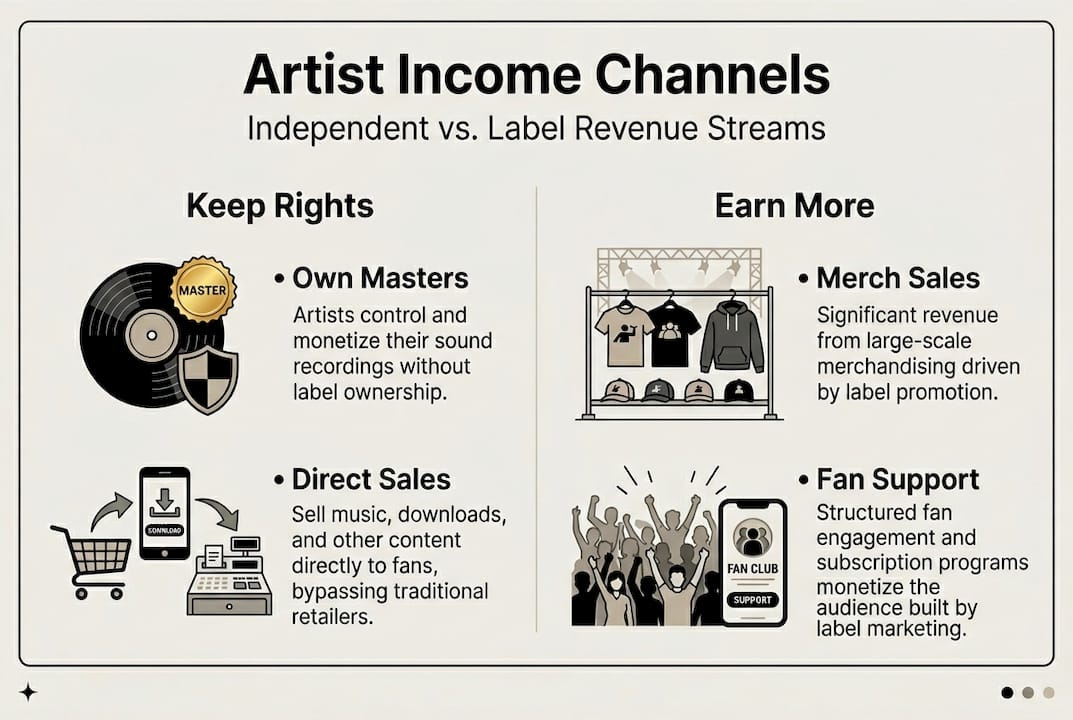
The numbers speak for themselves. A small, devoted community of direct supporters can outperform hundreds of thousands of passive streams.
Building that community takes intention. Here are the steps to get started:
- Choose your primary platform where fans can find and follow you consistently
- Start an email list from your very first release, using a free tool like Mailchimp
- Offer something exclusive to early subscribers, such as a demo track or behind-the-scenes video
- Engage regularly with comments, stories, and personal updates
- Set up a merch store even with just one or two items to start
- Play live as often as possible and capture contact info at every show
- Collaborate with other artists to reach new audiences through local music networking
Your discoverability as an indie artist grows every time you show up authentically for your audience. Think of each interaction as planting a seed that grows into long-term loyalty.
Pro Tip: Your email list is the one channel you truly own. Social platforms can change their rules overnight, but your email list is yours forever. Start collecting emails before you think you need to.
Learning how to approach showcasing music effectively will help you turn casual listeners into devoted fans who support your career for years.
Financial opportunities: Maximizing artist income
The financial reality of independent releasing is both honest and exciting. Streaming is a powerful discovery tool, but it is not where most independent artists build wealth. 250,000 streams equals roughly $1,000 in streaming income, while a direct-to-fan approach can generate up to $180 per fan annually. That math rewards artists who diversify.
The global picture is equally encouraging. Non-majors hold 29.7% of the recorded music market, and artists releasing directly generate around $2 billion annually, a number that keeps climbing. Independent artists are not just surviving outside the major label system. They are thriving.
Beyond streaming and direct fan support, here are the income streams worth building:
- Sync licensing: Place your music in films, ads, and video games for flat fees and ongoing royalties
- Merchandise: Apparel, prints, and limited-edition physical releases create tangible connections with fans
- Teaching and workshops: Share your skills through online lessons or in-person classes
- Session work and production services: Offer your talent to other artists for hire
- Live performances: Ticket sales, tips, and merch tables at shows add up quickly
- Grants and funding: Many regional arts councils offer grants specifically for independent musicians
Staying current with current industry trends helps you spot new income opportunities before they become crowded. The artists who thrive are the ones who treat their music like a business with multiple revenue lines, not a single income source.
Solid distribution tips can help you get your music onto every major platform efficiently, so you capture streaming income while you build your direct fan channels in parallel. Attending musician networking events also opens doors to sync opportunities, collaborations, and industry relationships that money cannot buy.
Why independent doesn’t mean alone: Our hard-won lessons
Here at Blocktone Records, we have seen a pattern that surprises many artists: the most successful independents are not the ones who do everything alone. They are the ones who build smart, intentional communities around their work while keeping full ownership of their rights.
The contrarian truth is this: independence is not about isolation. It is about choosing your collaborators rather than having them assigned to you. Seek out mentors, producers, and fellow artists who share your values. Learn from emerging artist support communities that offer real guidance without asking for your masters in return.
Collaboration is a force multiplier for indie artists. The right creative partnership can double your reach without costing you a single percentage point of ownership.
Invest in your skills continuously. Learn basic mixing, social media strategy, and music business fundamentals. Every skill you add reduces your dependency on expensive outside help and increases your confidence. The joy of building a career on your own terms, surrounded by people you chose, is one of the most rewarding experiences music has to offer.
Ready to release your next project independently?
If this guide has sparked something in you, that feeling of possibility and excitement is exactly where great music careers begin. The tools, the community, and the knowledge are all within reach.
Blocktone Records is built for artists like you. Whether you are looking for essential distribution tips to get your music onto every platform, music discovery tools to grow your audience, or a community of fellow artists to learn and grow alongside, the BlockTone platform has you covered. Explore our guides, connect with other independent musicians, and take the next step toward a career that is truly yours. Your music deserves to be heard, and you deserve every reward that comes with it.
Frequently asked questions
What are the biggest challenges of releasing music independently?
Self-released artists must manage writing, recording, promotion, and distribution themselves, but with solid planning and a supportive community, these challenges become manageable milestones rather than roadblocks.
How much do independent artists make per stream?
Independent artists earn about $0.004 per stream on major platforms, but direct-to-fan channels like Patreon and merchandise can generate dramatically more income per supporter.
Can I build a real fanbase as an independent musician?
Absolutely. Direct fan strategies have helped artists build $72,000-per-year businesses with as few as 400 devoted fans, proving that depth of connection matters more than raw follower counts.
Why is it important to own my masters?
Independents retain full ownership of their masters, unlike label artists, which means you control every licensing deal, collect the majority of royalties, and protect the long-term value of your catalog.