
Artist Websites in 2026: The Home Base Streaming Platforms Cannot Replace
Streaming profiles help people play your music, but they cannot fully replace an artist website that you control. A focused website gives each release a permanent destination, supports search visibility, collects permission-based fan contacts, and brings music, tickets, merchandise, press materials, and professional enquiries into one system. Start with a compact site built around one clear visitor action rather than an expensive collection of decorative pages.
Artists now have more platform-based profile tools than ever. Spotify artist pages can feature biographies, images, concerts, merchandise, social links, videos, playlists, and release campaigns. Apple Music for Artists allows eligible artists to manage profile images, lyrics, personal details, and selected promotional assets. YouTube channels can also display profile links and business contact information.
These tools are valuable, but each one operates inside a platform designed around its own product. A streaming service primarily wants visitors to keep streaming. A social platform wants them to continue scrolling. A ticketing service wants them to complete a ticket purchase.
An artist website connects those separate environments. It gives listeners, journalists, promoters, collaborators, and existing fans one reliable place to understand who you are and choose what to do next.
This guide explains what an artist website should accomplish in 2026, which pages deserve priority, how to connect it to streaming and social discovery, and how to launch a practical version without turning website development into a long and expensive distraction.
Table of Contents
- Streaming Profiles Are Rented Space, Not a Home Base
- Build the Minimum Viable Artist Website
- Give Every Release a Permanent Page
- Convert Visits Into Fan Relationships
- Connect Every Discovery Channel to One System
- Make the Site Fast, Searchable, and Measurable
- Launch in 30 Days and Maintain It
- Build Your Independent Music Infrastructure
- FAQs About Artist Websites in 2026
Key Takeaways
| Point | Details |
|---|---|
| Streaming remains essential | Use streaming platforms for listening and discovery, but do not rely on them as the only source of information about your career. |
| Each release needs a stable URL | A permanent release page can combine streaming links, credits, lyrics, videos, purchase options, press coverage, and related merchandise. |
| Email should be a primary conversion | Give interested visitors a clear reason to join a permission-based mailing list instead of immediately sending everyone back to another platform. |
| A compact website is enough | Most independent artists can begin with a homepage, music archive, live page, press information, contact details, and basic policy pages. |
| Measure meaningful actions | Track signups, ticket clicks, purchases, enquiries, downloads, and outbound listening clicks rather than focusing only on total traffic. |
| The website must stay current | Review it whenever a release, show, biography, visual identity, store item, or professional contact changes. |
Streaming Profiles Are Rented Space, Not a Home Base
Spotify describes an artist profile as the artist’s homepage within Spotify. Artists can currently use Spotify for Artists to manage images, biographies, Artist Pick, playlists, concerts, merchandise, social links, videos, fan-support links, and Countdown Pages. These tools make a Spotify profile an important part of an artist’s digital presence. (Spotify for Artists – Managing Your Artist Profile)
The limitation is contained in the phrase “within Spotify.” The page structure, available features, listener data, eligibility requirements, and calls to action are controlled by Spotify. Your profile can help someone listen, follow, save, or explore, but it cannot act as a completely customizable centre for every part of your career.
Apple Music presents a similar trade-off. Apple Music for Artists lets primary artists manage selected profile information, images, lyrics, and personal details, while some metadata corrections still need to go through the artist’s distributor. Certain submissions may also require review. (Apple Music for Artists – Manage Your Artist Content and Profile)
YouTube offers useful pathways beyond the platform. Its current channel tools allow creators to display up to 14 profile links, with the first link receiving more prominent placement. That is useful for directing viewers to an official website, store, tour page, or mailing list, but YouTube still determines where and how those links appear. (YouTube Help – Manage Your Channel Profile)
| Capability | Streaming or Social Profile | Artist Website |
|---|---|---|
| Primary purpose | Listening, viewing, or platform engagement | Career-wide information and conversion |
| Page structure | Determined by the platform | Designed around the artist’s priorities |
| Available actions | Limited to supported features | Email, tickets, store, press, bookings, licensing, memberships, and downloads |
| Content organisation | Organised according to platform rules | Organised around releases, campaigns, fans, and professional visitors |
| Measurement | Platform-specific activity | Cross-channel actions from multiple traffic sources |
The objective is not to pull listeners away from streaming services. It is to stop your career from becoming a disconnected collection of profiles that cannot communicate with one another.
Pro Tip: Treat streaming services as listening destinations and your website as the map that connects every destination.
Build the Minimum Viable Artist Website
An artist website does not need dozens of pages, custom animation, or a complicated visual concept. It needs to answer the visitor’s immediate question quickly.
A listener may want to hear the song that brought them to the site. A promoter may need live footage and booking details. A journalist may need an approved biography and photographs. An existing fan may be looking for tickets, merchandise, or the next release.
A practical first version should contain the following elements.
A Focused Homepage
The opening area should establish the artist’s name, visual identity, current priority, and primary call to action. That priority might be a new single, an upcoming tour, a physical release, or a mailing-list offer.
Choose one main action. “Listen to the new EP,” “Get tickets,” or “Join the mailing list” gives visitors a clearer direction than a row of equally prominent buttons.
A Music Archive
Create a central music page listing current and previous releases. Each significant single, EP, or album should connect to its own permanent page rather than disappearing when the next campaign begins.
A Live Page
Show confirmed dates, cities, venues, and legitimate ticket links. Remove cancelled dates immediately. Past shows can remain in an archive when they provide useful career history, but outdated purchase links should not stay active.
An About and Press Area
Provide a concise public biography, a longer press biography when necessary, approved images, selected live videos, notable credits, and clear professional contact information. Make downloadable files easy to identify without forcing every visitor to download a large PDF.
Clear Contact Routes
Separate booking, press, licensing, collaboration, and general enquiries when different people handle them. Do not make a promoter or journalist search through several social profiles to find a business email address.
Basic Trust Information
Add a privacy policy, cookie information where applicable, store terms if you sell products, and an accessible contact method. Requirements vary by jurisdiction and business activity, so artists collecting personal information or selling internationally should obtain appropriate legal and compliance guidance.
Mistake to Avoid: Do not build a dramatic homepage that hides the music, loads slowly, or makes mobile visitors search for basic navigation.
Give Every Release a Permanent Page
A smart link is useful during a launch, but a complete release page can perform a much broader role. It can serve fans during the campaign, support search discovery later, and give journalists or collaborators a reliable reference long after the release date.
A strong release page can include:
- Cover artwork
- Release title and date
- A concise description of the project
- Major streaming and purchase options
- An official audio player or video
- Songwriting, production, performance, mixing, and mastering credits
- Lyrics when appropriate
- Recording or production context
- Relevant press coverage
- Physical formats and related merchandise
- Upcoming shows connected to the release
- An email signup for future updates
A permanent page becomes especially valuable when a song attracts attention months or years after release. A new listener can find more than an isolated platform profile: they can understand the project, explore related music, identify the contributors, purchase a physical edition, or join the mailing list.
Keep embeds selective. Several streaming players, video widgets, social feeds, and store modules on one page can create a slow and distracting experience. One featured player followed by clearly labelled destination links is often enough.
Pro Tip: Create the permanent release URL before promotion begins. Use the same address in press pitches, advertisements, QR codes, video descriptions, email campaigns, and social posts.
Convert Visits Into Fan Relationships
A website becomes strategically useful when it turns anonymous attention into a relationship that can continue after the visit.
For many independent artists, the most valuable website conversion is a permission-based email signup. Unlike a follower count contained inside one platform, an appropriately managed mailing list can support announcements across releases, tours, stores, crowdfunding campaigns, and membership offers.
Give visitors a specific reason to subscribe. Useful offers can include:
- Early access to new music
- Ticket presales
- Local show announcements
- Studio updates
- Limited physical editions
- Unreleased demos or alternate versions
- A monthly artist letter
“Subscribe to my newsletter” explains the mechanism but not the benefit. “Get early access to new releases and local ticket alerts” gives the visitor a practical reason to share an email address.
Keep the initial form simple. An email address is normally sufficient. Ask for location or musical preferences only when you have a clear plan for using that information.
Bandcamp can complement this system. Fans who buy music or follow an artist are given the choice to join that artist’s mailing list, and artists can require an email address for selected free downloads. This makes Bandcamp useful as a direct-to-fan channel, but consent should remain central when transferring or using contact information. (Bandcamp Help Center – How Do I Collect Emails?)
After someone subscribes, send a useful welcome message. Introduce the artist, recommend one release, explain what subscribers will receive, and provide an easy unsubscribe route.
Mistake to Avoid: Do not collect contacts during a release campaign and then remain silent until the next launch. A smaller list receiving relevant communication is more useful than a larger neglected database.
Connect Every Discovery Channel to One System
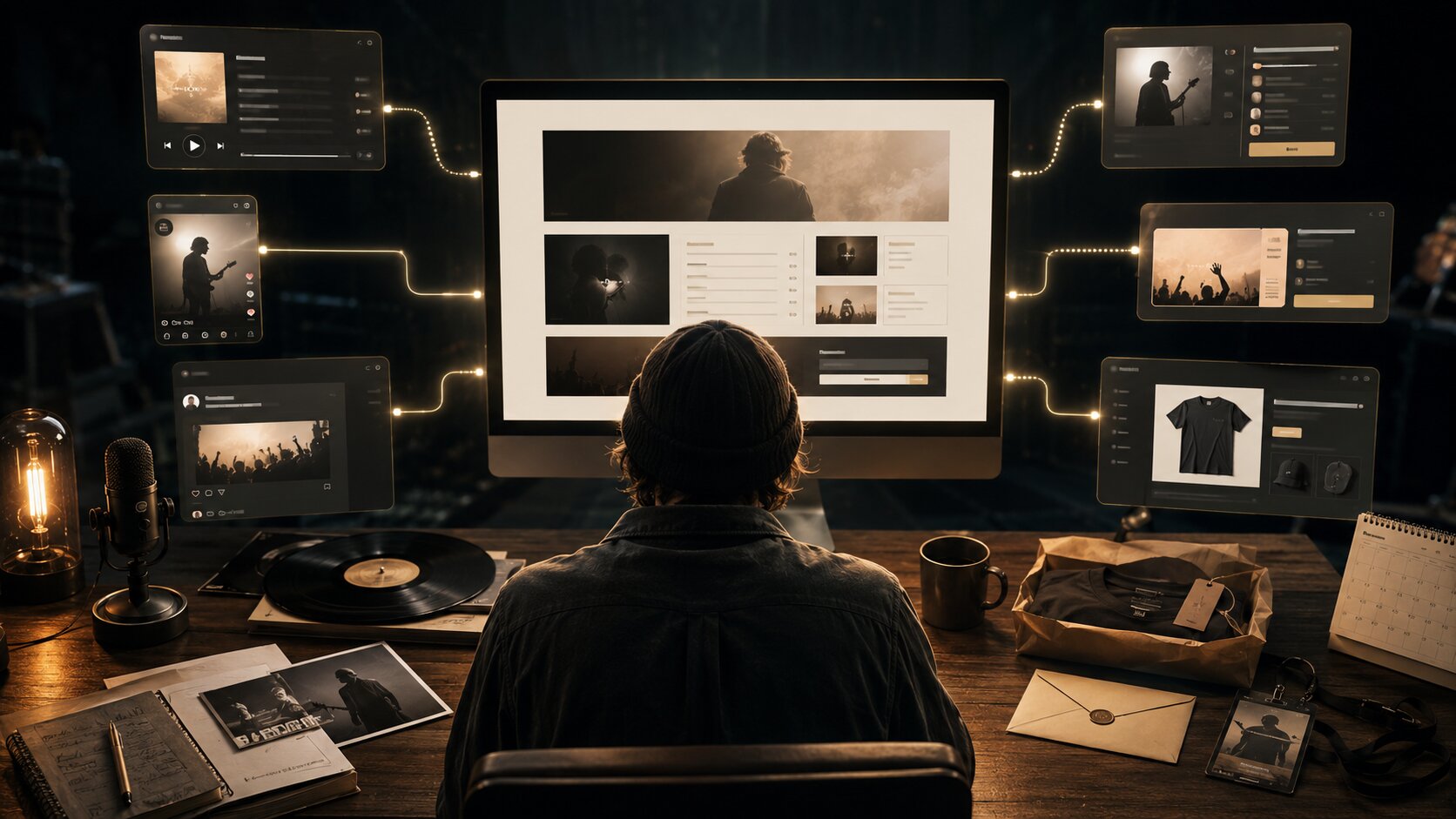
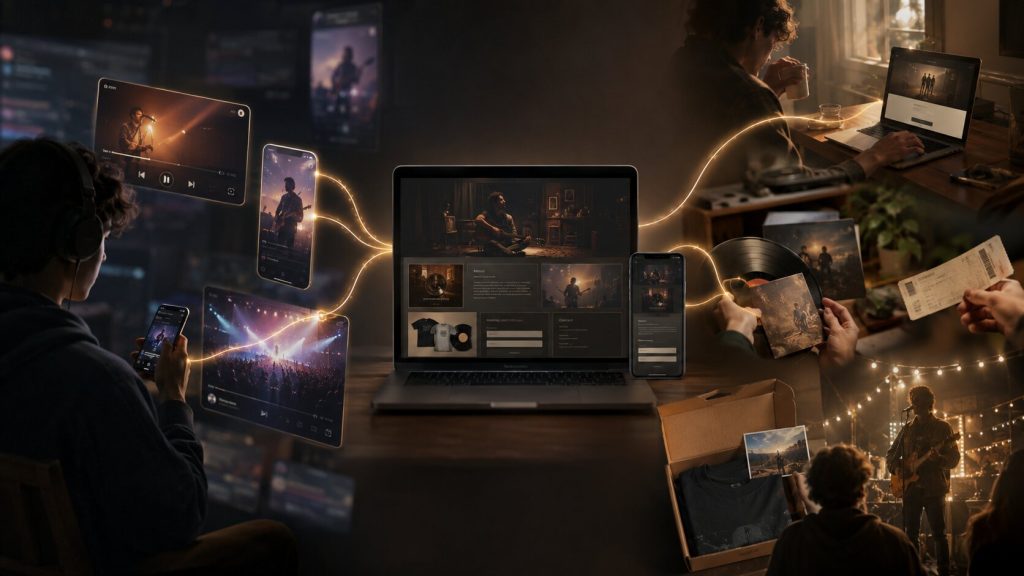
Your website should not compete with Spotify, Apple Music, YouTube, TikTok, Instagram, Bandcamp, ticketing platforms, or online stores. It should give those channels a shared destination.
A practical visitor journey looks like this:
- A short-form video, playlist placement, interview, performance clip, or recommendation creates curiosity.
- The listener follows a campaign-specific link.
- The landing page immediately delivers what the original content promised.
- The page presents one primary action and a limited number of secondary choices.
- Analytics records which source produced a meaningful action.
The landing page must match the visitor’s reason for clicking. A live performance clip should lead to that performance or song. A tour announcement should lead directly to dates and ticket options. A merchandise preview should lead to the featured product rather than a generic homepage.
Avoid turning every page into an undifferentiated link directory. When visitors see 15 equal buttons, they must make a decision before they understand what matters.
Instead, create a hierarchy:
- Primary action: The main campaign goal
- Secondary action: A useful alternative for interested visitors
- Navigation: Access to the wider artist catalogue and story
This turns the website into a conversion layer rather than another profile that people briefly open and leave.
Make the Site Fast, Searchable, and Measurable
Owning a domain does not automatically make an artist website discoverable. Search engines still need to crawl, interpret, and index its pages.
Verify the domain in Google Search Console and submit or monitor an XML sitemap. Google explains that a sitemap helps communicate which URLs and files a site considers important, although submitting one does not guarantee that every page will be indexed. Many content management systems create a sitemap automatically. (Google Search Central – Build and Submit a Sitemap)
Apply basic on-page SEO to each important page:
- Write a descriptive and unique page title
- Create a useful meta description
- Use one clear H1
- Organise subheadings logically
- Add descriptive alternative text to meaningful images
- Use readable, permanent URLs
- Link related releases, videos, shows, and biographies together
- Avoid publishing several thin pages targeting the same topic
Use the artist name consistently across the site and connect the website to verified external profiles. Accurate structured data can also help search engines interpret articles, videos, events, breadcrumbs, organisation details, and other supported content. Structured data can improve eligibility for enhanced search displays, but it does not guarantee that Google will show a rich result. (Google Search Central – Supported Structured Data)
Performance matters because artist websites often contain large photography, embedded players, video, custom fonts, and animation. Compress oversized images, limit unnecessary scripts, and test the most important pages on real mobile devices. Search Console’s Core Web Vitals report uses field data to identify groups of pages with poor, improving, or good user-experience measurements. (Google Search Console Help – Core Web Vitals Report)
Measure actions connected to career goals rather than treating page views as the only measure of success. Google Analytics allows important actions to be marked as key events and reported across landing pages and acquisition sources. (Google Analytics Help – About Key Events)
Useful artist-website events include:
- Mailing-list signup
- Ticket click
- Merchandise purchase
- Booking enquiry
- Press-kit download
- Outbound streaming click
- Membership or fan-club signup
Traffic without context can be misleading. A modest number of visitors who subscribe, purchase, or request information may be more useful than a much larger audience that leaves without taking action.
Launch in 30 Days and Maintain It
Do not postpone a useful website while waiting for perfect photography, a fully custom design, or a complete archive of every past project.
Week 1: Define the Website’s Job
Choose the domain, primary audience, navigation, and current conversion goal. Collect approved images, biographies, credits, contact details, release information, ticket links, and store URLs.
Week 2: Build the Core Pages
Publish the homepage, music archive, release-page template, live page, about or press page, contact page, and any necessary policy pages.
Week 3: Connect the System
Add the email provider, analytics, Search Console, sitemap, streaming profiles, social channels, ticketing destinations, store, and professional contact routes.
Week 4: Test and Simplify
Check every page on mobile. Test forms and outbound links. Compress images, proofread credits, remove unnecessary scripts, and ask several people to complete the site’s primary action without guidance.
After launch, conduct a monthly review. Check show dates, links, forms, contact information, broken embeds, sold-out products, campaign banners, biographies, and official photographs. Maintain backups of the website and permitted contact data according to the tools you use.
A website becomes a long-term career asset through accumulation: one release page, one subscriber, one press mention, one ticket buyer, and one useful update at a time.
Build Your Independent Music Infrastructure
BlockTone Records publishes practical resources for independent artists working through releases, promotion, music rights, fan development, content strategy, and long-term career planning.
Use the guides on BlockTone Records alongside your website to build a connected system rather than depending on isolated campaigns or individual platforms. Your website does not need to replace the services helping people discover and hear your music. It needs to make those services work together in support of your wider career.
FAQs About Artist Websites in 2026
Do independent musicians still need a website in 2026?
Can a link-in-bio page replace an artist website?
What pages should a musician website include?
How much does an artist website cost?
Should music play automatically on an artist website?
Should an electronic press kit be a web page or a PDF?
How often should an artist website be updated?
Sources Used
- Spotify for Artists – Managing Your Artist Profile
- Apple Music for Artists – Manage Your Artist Content and Profile
- YouTube Help – Manage Your YouTube Channel Profile
- Bandcamp Help Center – How Do I Collect Emails?
- Google Search Central – Build and Submit a Sitemap
- Google Search Central – Supported Structured Data
- Google Search Console Help – Core Web Vitals Report
- Google Analytics Help – About Key Events