
Opening Slots, Local Shows and Scene Credibility for Independent Artists
Opening slots are rarely won by sending hundreds of generic booking emails. Independent artists become easier to book when they fit the bill, communicate professionally, contribute to the local scene, promote responsibly, and prove they can deliver a strong set without creating problems for the headliner or promoter.
The most useful goal is not simply getting one bigger show. It is becoming the artist local bookers, bands, venues, and audiences are comfortable inviting back.
For an emerging artist, a good opening slot can look deceptively simple: play 25 or 30 minutes before a more established act, meet some new listeners, post the photographs, and move on.
The real value runs deeper. Grassroots and independent venues remain important places where developing artists build audiences, relationships, and practical live experience. Organizations representing independent venues regularly describe these spaces as essential parts of the artist-development ecosystem. (National Independent Venue Association)
That makes local shows part of an artist-development system rather than isolated performances. The promoter remembers whether you answered emails. The engineer remembers whether your setup made sense. Other bands notice whether you watched their sets. Audience members remember whether you gave them a reason to pay attention before the artist they originally came to see.
This guide explains how to build that kind of credibility, identify worthwhile opening opportunities, pitch them effectively, perform the support role well, and convert individual gigs into a stronger position within your local music scene.
Table of Contents
- Treat the Local Circuit as a Trust Network
- Become Bookable Before Chasing Bigger Stages
- Target Bills Where Your Music Actually Belongs
- Pitch Yourself as a Solution, Not a Favor
- Understand the Job of the Opening Act
- Turn One Strong Show Into the Next Three
- Recognize the Opening Slots That Are Not Worth Taking
- Keep Building Beyond the Gig
- Frequently Asked Questions
Key Takeaways
| Point | Details |
|---|---|
| Scene credibility is accumulated | Reliability, musical fit, audience contribution, and professional behavior matter across multiple shows. |
| Opening slots are about compatibility | A smaller artist with the right sound and audience can be more useful than a larger but poorly matched act. |
| Your booking materials should reduce work | Give promoters concise music links, live footage, location, availability, and relevant information. |
| The opener has a specific role | Deliver a focused set, respect timing, support the full bill, and make the night better rather than competing with the headliner. |
| Fair terms still matter | Exposure does not automatically justify unclear payment, hidden costs, unreasonable ticket obligations, or pay-to-play arrangements. |
| Every show should create evidence | Good live footage, promoter relationships, audience contacts, and repeat bookings are more valuable than a single impressive poster. |
Treat the Local Circuit as a Trust Network
A local music scene is not simply a list of venues.
It is an overlapping network of promoters, talent buyers, sound engineers, photographers, artists, managers, DJs, small labels, record stores, rehearsal spaces, and regular concertgoers. The same people frequently encounter one another across different shows.
That changes the way an independent artist should think about growth.
Instead of asking, “Which venue is big enough to make me look established?”, ask, “Who needs to trust me before I become a natural choice for stronger bills?”
Independent-venue organizations consistently frame small and grassroots stages as places where artists develop, audiences form, and local creative communities connect. That makes participation in the scene useful even before it produces an immediate booking. (NIVA)
Credibility Starts When You Are Not Performing
Attend relevant local shows. Learn which promoter books your type of music. Notice which artists repeatedly appear on compatible bills. Follow the venues where touring acts in your genre regularly play.
Then participate without treating every conversation as a booking request.
Support other artists. Buy tickets when possible. Share shows you genuinely care about. Talk to people after sets. Become familiar enough with the ecosystem that your eventual pitch has context.
That is very different from approaching someone you have never met and immediately asking them for access to their audience.
Pro Tip: Focus on becoming recognizable for the right reasons. Five meaningful relationships inside your actual genre community can be more useful than hundreds of indiscriminate industry contacts.
Become Bookable Before Chasing Bigger Stages
Promoters cannot book potential. They have to book the version of your act that can perform now.
Before aggressively pursuing support slots, make sure your project has enough evidence to answer a few basic questions:
- What does the artist sound like?
- What does the artist look and feel like live?
- How long a set can they confidently perform?
- Are they based close enough for the booking to make logistical sense?
- Will they communicate reliably?
- Can the production team accommodate their setup?
Programmers and venues generally need artists to communicate their identity clearly, provide usable promotional materials, understand their technical requirements, and demonstrate that the performance fits the room and audience. Tallinn Fringe has highlighted those factors when explaining what programmers consider when selecting artists. (Tallinn Fringe Festival)
You do not need an enormous electronic press kit. You need a useful one.
A Practical Opening-Slot Booking Package
- One strong artist photo
- A short two-to-four-sentence bio
- One primary streaming or music link
- One or two convincing live-performance videos
- Your city or region
- A concise genre description
- Current notable local shows, if relevant
- Your approximate available set length
- Direct contact information
- Links to your main artist profiles
Many venue submission forms ask for exactly this type of practical information: music links or an EPK, location, availability, expected audience, and preferred dates. The goal is to help the booker evaluate your act quickly rather than make them search for basic information. (The Foundry)
Do Not Exaggerate Your Draw
If 20 people reliably attend your local shows, saying you can bring 100 does not make you look ambitious. It creates a future problem.
A realistic audience estimate gives the promoter something they can plan around.
Your reputation after delivering what you said you could deliver is considerably more valuable than temporarily appearing bigger in an email.
Target Bills Where Your Music Actually Belongs
One of the weakest booking strategies is writing to every venue and touring artist in the city.
Support slots depend heavily on context.
A promoter may reject an excellent artist simply because the evening already has enough acts, the room is unsuitable, the technical setup does not work, or the audiences do not overlap. Programming decisions involve more than determining whether the music itself is good.
Build a target list instead.
| Opportunity | Usually Strong When | Usually Weak When |
|---|---|---|
| Local headline support | Your audiences or genres overlap | You have no meaningful connection to the bill |
| Touring artist support | You provide relevant local audience context | You contact unrelated tours purely for visibility |
| Multi-band showcase | The curator has a clear musical identity | The bill feels random and nobody promotes it |
| Small venue headline | You can reasonably activate your own audience | The room is far larger than your current demand |
| Community event | It reaches listeners suited to your music | You accept purely because a stage is available |
Study the Calendar Before Pitching
Look at a venue’s previous and upcoming shows.
Identify touring artists approximately one step above your current position rather than targeting only major names. Search for genre compatibility, audience overlap, and geographic logic.
Track opportunities in a simple spreadsheet or database with fields such as:
- Artist
- Venue
- Promoter
- Show date
- Booking contact
- Why your act fits
- Date contacted
- Response
- Follow-up date
This turns gig outreach into deliberate business development instead of random emailing.
Pitch Yourself as a Solution, Not a Favor
A promoter assembling a bill has a problem to solve.
They need an artist who sounds right, is available, fits the production limits, responds quickly, and ideally contributes some additional audience or promotional reach.
Write accordingly.
A useful pitch can often be handled in a few short paragraphs. State who you are, where you are based, which specific show you are interested in, why your music fits the bill, one relevant live achievement or audience point, and links to your best music and live footage.
A practical email subject could be: Local support consideration — Artist Name — Headliner / Date.
Avoid a long autobiography. Avoid sending large attachments unless requested. Avoid pretending you have a personal relationship with the headliner. Most importantly, avoid making the booker work to understand why you are contacting them.
Follow Up Without Becoming a Problem
One concise follow-up is reasonable when enough time has passed.
Repeated direct messages, emails to multiple employees, public comments asking why nobody responded, and daily reminders create the opposite impression from professionalism.
Booking teams may receive more submissions than they can answer individually. Silence can be frustrating, but it is not automatically personal and it is not a reason to escalate across every available communication channel.
Understand the Job of the Opening Act
Getting the slot and succeeding in the slot are different skills.
An opener is there to contribute to the evening being successful.
That means playing for the people already in the room rather than behaving as if your shorter set is an inconvenient version of your own headline show.
Build a Support Set, Not a Compressed Headline Set
If you have 25 minutes, choose the songs that establish your identity fastest.
Remove unnecessary transitions. Keep tuning and equipment changes under control. Rehearse the complete set with a timer.
The goal is to leave people wanting another song, not wondering when the main artist begins.
Respect Production
Once a show is confirmed, clarify the practical details before show day.
The Musicians’ Union recommends confirming important terms and logistics such as load-in, equipment sharing, technical specifications, soundcheck, set length, doors, payment, expenses, and promotional responsibilities. It also advises using a written agreement once terms have been settled. (Musicians’ Union)
Exact practices vary between countries and venue levels, but the principle is straightforward: ambiguity becomes a problem on show day.
Arrive when requested. Bring the correct cables and equipment. Know your stage setup. Do not casually exceed your allotted time.
If the promoter says your set finishes at 8:25, finishing at 8:34 does not demonstrate passion. It pushes problems into everyone else’s schedule.
Support the Entire Night
Promote the event as a bill rather than presenting yourself as the only artist who matters.
Tag the venue, promoter, and other performers correctly where appropriate. Stay to watch the other sets when practical. Thank the people working the show.
Your behavior around the performance becomes part of your professional reputation.
Turn One Strong Show Into the Next Three
Many artists treat gigs as finished the moment they leave the venue.
That wastes much of their value.
Within the next day or two, thank the relevant promoter or booker. Keep the message short. If appropriate, mention that you would be interested in future compatible support opportunities.
Then convert the evening into useful career assets.
- New live footage
- Professional photographs
- Audience email signups
- Merchandise customers
- New followers
- Relationships with another band
- A promoter reference
- Evidence that your act works in that room
- Proof that you can support a specific type of headliner
The objective is compounding credibility.
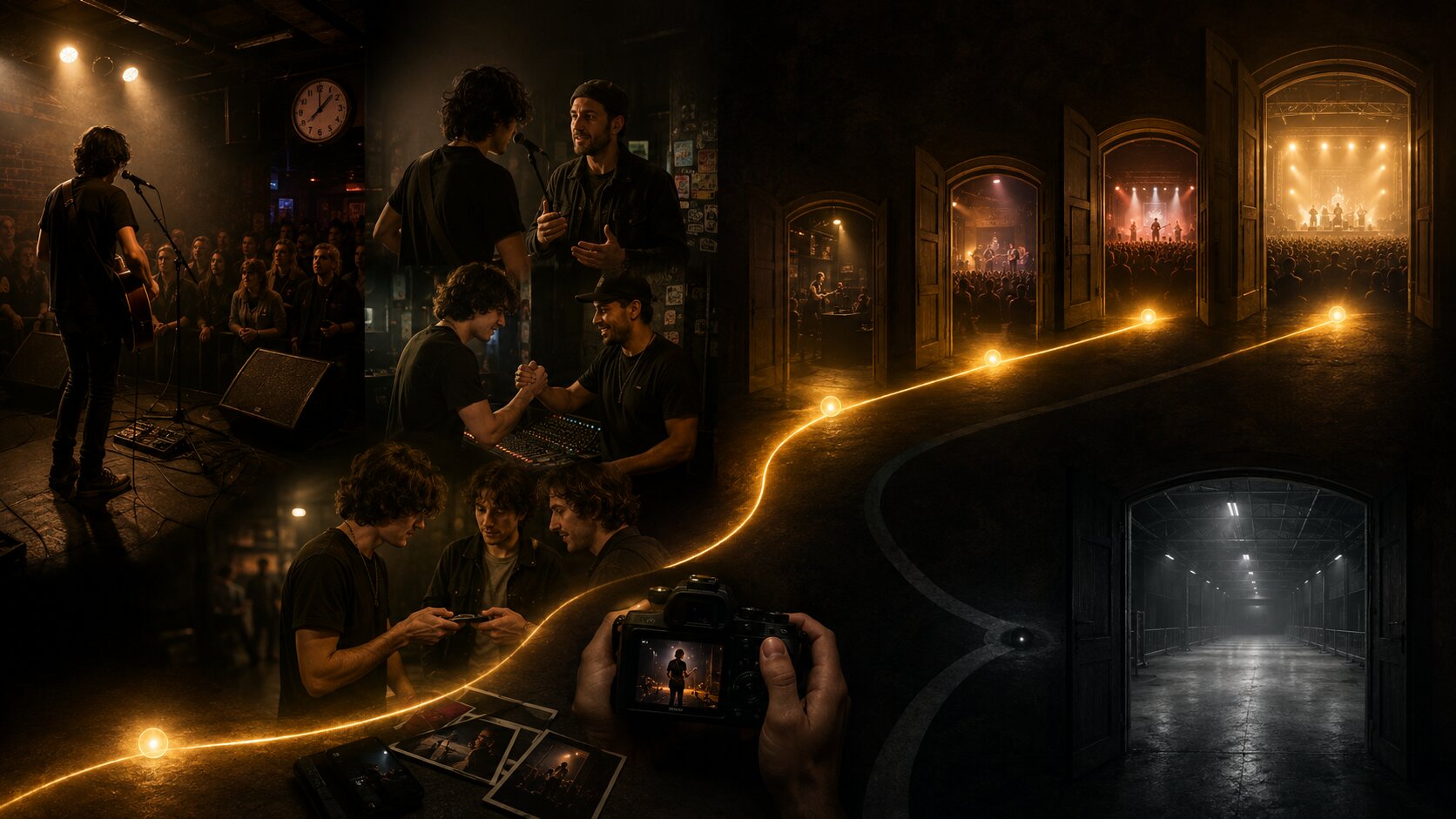
One successful small-room appearance can lead to another suitable local bill. Several successful bills can make a promoter more comfortable placing you before a touring artist. Strong support performances can eventually make your own headline show a lower-risk proposition.
That progression is healthier than repeatedly skipping ahead toward rooms you cannot yet activate.
Pro Tip: Keep a private live-history document containing dates, venues, promoters, attendance estimates where known, ticket performance where available, notable support slots, and usable media. It becomes increasingly valuable as your live career develops.
Recognize the Opening Slots That Are Not Worth Taking
Not every opportunity deserves a yes.
“Exposure” can hide weak or unfair terms.
The Musicians’ Union’s Fair Play Venue Scheme was developed in response to concerns including poor treatment, pay-to-play practices, and unfair ticketing arrangements at grassroots venues. Its guidance encourages artists to understand payment, deductions, ticket deals, responsibilities, and other conditions before agreeing to perform. (Musicians’ Union Fair Play Venue Scheme)
Be cautious when:
- You must buy a large block of tickets yourself.
- Undisclosed costs are deducted from your payment.
- Nobody will explain the financial arrangement.
- The promoter expects significant sales while offering little clarity about their own responsibilities.
- The lineup has no meaningful audience compatibility.
- Travel costs greatly exceed the strategic value of the show.
- Technical conditions make a good performance unlikely.
- The organization consistently communicates poorly.
- You are pressured to agree before basic terms are provided.
This does not mean every early-career gig must pay a large guarantee.
Door splits, modest fees, community shows, charity appearances, and strategically useful unpaid opportunities can all exist legitimately.
The important question is whether you understand what you are agreeing to and why the show is useful.
Keep Building Beyond the Gig
Opening slots are most powerful when they form one part of a broader artist-development strategy.
Use local shows to discover which songs actually hold attention. Learn what type of audience responds most strongly. Develop relationships with photographers, engineers, bands, promoters, and listeners. Improve your set until people who did not come for you start asking where they can hear more.
That is scene credibility.
It cannot be manufactured entirely through branding or social metrics because other people have to experience it.
Build Your Independent Career with Block Tone Records
Block Tone Records publishes practical resources for independent artists navigating releases, promotion, audience development, music business decisions, and long-term career building.
Treat live performance the same way you would treat a release campaign: choose opportunities deliberately, prepare professionally, learn from the results, and build systems that make the next opportunity easier to earn.
FAQs About Opening Slots and Local Shows for Independent Artists
How do independent artists get opening slots?
Start by identifying local promoters, venues, and artists whose audiences genuinely overlap with yours. Build a strong live set and simple booking package, attend relevant shows, develop real relationships, and send specific pitches for suitable bills rather than generic requests for any available opportunity.
Do I need a large following to open for another artist?
Not necessarily. Audience size can matter, particularly when ticket sales are important, but musical fit, professionalism, local relevance, live quality, and the ability to contribute to promotion can also influence booking decisions. Different promoters weigh these factors differently.
Should I contact the headliner or the venue for a support slot?
It depends on who controls support selection. The promoter, venue talent buyer, booking agent, or headline artist may make the decision. Research the event before contacting anyone, and use a venue’s official booking procedure when one is provided.
What should I send when asking for a gig?
Keep the first contact concise. Include your artist name, location, genre, the relevant show or dates, a short explanation of why you fit, one music link, a strong live video, and direct contact details. Additional technical information can be supplied when requested or once the show is being confirmed.
How long should an opening set be?
There is no universal opening-set length. Support sets are usually shorter than headline performances, but the promoter should confirm your exact stage time. Rehearse a set that fits the allocated duration rather than assuming you can extend it on the night.
Should an independent artist accept unpaid opening slots?
Sometimes an unpaid show may have genuine strategic, community, or developmental value, but assess it carefully. Consider travel costs, ticket obligations, production expenses, promotional expectations, audience relevance, and what you can realistically gain from participating.
What creates credibility in a local music scene?
Credibility comes from consistency. Artists build it by performing well, communicating reliably, respecting schedules and other performers, supporting the wider scene, promoting responsibly, and repeatedly showing that they are easy to work with. It usually develops across multiple positive interactions rather than one high-profile booking.
Sources Used
- Musicians’ Union – Engagement Booking for Unsigned and Emerging Artists
- Musicians’ Union – Fair Play Venue Scheme
- National Independent Venue Association – independent venue and live music resources
- Tallinn Fringe Festival – What Programmers and Venues Look for in Festival Artists
- The Foundry – artist booking and venue submission information