

Why Noah Kahan Keeps Circling Home in “Orbiter”
“Orbiter” is a song about reaching a level of success that once seemed impossible and discovering that arrival can feel more disorienting than expected. Noah Kahan places himself inside the strange machinery of fame while looking toward the people who still make him feel recognizable to himself.
The song’s central image is astronomical. Kahan imagines himself as an astronaut moving through unfamiliar territory while another person becomes the moon: something distant but dependable, powerful enough to give his movement direction. The metaphor makes “Orbiter” both a love song and a meditation on dependence, identity, ambition, aging, and the fear of losing the relationships that keep a person grounded.
The Real Question Behind “Orbiter”
At its core, “Orbiter” asks what happens when your external life changes faster than your internal sense of self. Kahan’s world has become larger, louder, and more public, but the emotional solution he reaches for is surprisingly small: familiarity.
The song continually moves between two forces. One pulls outward toward California, award ceremonies, cameras, crowds, and professional ambition. The other pulls inward toward home, memory, family, intimacy, and the people who knew him before enormous success complicated his relationship with himself.
That reading is especially important because Kahan has explained that the song is not centered on only one person. While introducing “Orbiter” during his 2026 tour, he said it was about multiple important relationships in his life, specifically mentioning his wife, his mother, and his fans. (Holler)
The person addressed in the song is therefore best understood not as a secret identity listeners are supposed to solve, but as a role: someone whose presence restores perspective when everything around the narrator begins to feel artificial.
Where “Orbiter” Lands in The Great Divide
“Orbiter” appears on The Great Divide: The Last Of The Bugs, the 21-track expanded edition of Kahan’s fourth studio album. The expanded version was released on April 25, 2026, one day after the original 17-track edition of The Great Divide. “Orbiter” is track 20, immediately before the closing song, “Dan.” (Apple Music)
Official release metadata credits Noah Kahan as composer, lyricist, vocalist, and producer. Aaron Dessner is also credited as a producer, with Gabe Simon serving as additional producer. Ryan Hewitt mixed the track and Ted Jensen handled mastering. (Noah Kahan / Universal Music Group)
The broader album context matters. After the extraordinary success of Stick Season, Kahan found himself dealing with an unfamiliar combination of achievement, anxiety, public expectation, and uncertainty about what should come next. In a 2026 interview, he described needing to rediscover who he was when the crowds were gone and the surroundings became quiet again. (Rolling Stone UK)
Apple Music’s album commentary similarly frames The Great Divide as Kahan examining the impact that his rapidly changing life had not only on himself but also on the people closest to him. That tension between public transformation and private relationships forms the emotional foundation of “Orbiter.” (Apple Music)
California Is Less a Place Than a Different Planet
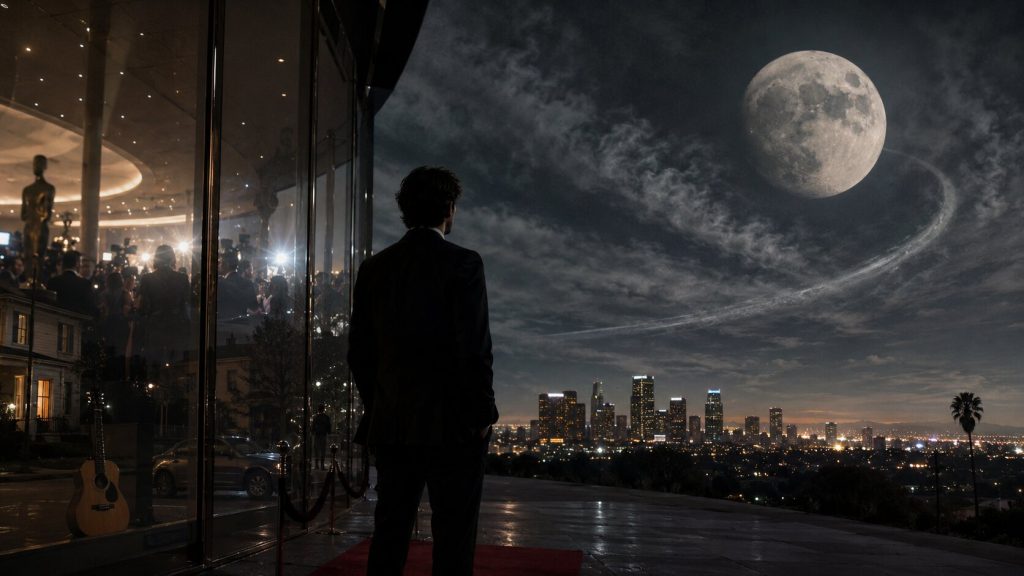
The song begins inside the culture of celebrity, but Kahan does not describe that environment as glamorous. He presents an exhausted narrator navigating a red-carpet world where awards, visibility, competition, and cameras have become part of ordinary professional life.
The emotional importance of the scene comes from the companion standing beside him. Instead of treating an award or public recognition as proof of his worth, that person reduces the event to its proper scale. There is a larger world beyond whichever room happens to be judging him that evening.
This distinction is essential to the meaning of “Orbiter.” Public validation may be valuable, but it is unstable. Awards are won and lost. Attention moves elsewhere. Industry enthusiasm can disappear. The people closest to Kahan offer another measurement system entirely.
The insect outside the glass
Kahan also uses insect imagery to characterize the experience of trying to enter an industry that can ignore people until they become impossible to overlook. Within the larger The Great Divide era, bugs carry personal meaning for Kahan. He has explained that his mother called him her “little bug,” and that seeing insects return around him became connected with the idea of life returning during a healthier creative period. (Rolling Stone UK)
In “Orbiter,” however, insect imagery becomes more uncomfortable. It can suggest the aspiring artist on the other side of the glass: persistent, visible, but still easy for the industry to dismiss.
Success changes the direction of that insecurity without necessarily removing it. Before recognition, the question is whether anybody notices you. After recognition, the question can become whether you deserve the attention you are receiving.
The Wolves Have Forgotten What They Are Chasing
The wolf imagery introduces another side of the song’s criticism of ambition. Kahan imagines people repeating the rituals of competition and visibility until those rituals become detached from their original purpose.
A wolf normally howls for a reason. In “Orbiter,” the image suggests people who continue performing the behavior expected of them even after they have forgotten why they wanted the prize in the first place.
That interpretation fits the song’s celebrity setting. An artist may begin with an uncomplicated desire to write songs, perform, and be heard. Once a career becomes large enough, however, creation becomes surrounded by charts, campaigns, awards, expectations, social reactions, ticket sales, and constant comparison.
The danger is not ambition itself. The danger is losing the ability to distinguish between wanting to make meaningful work and needing an audience to prove that you are meaningful.
Then Kahan notices the person beside him through the noise and camera flashes. Their reaction briefly breaks the spell. The industry has not disappeared, but its ability to define the moment has weakened.
Why the Astronaut and Moon Metaphor Works So Well
The chorus transforms the social discomfort of the opening into something much larger. Kahan describes his surroundings as alien territory and compares the person he has become with an earlier, more ordinary version of himself.
The defining image arrives in the short line, “I’m an astronaut, you’re the Moon.” It works because an astronaut represents exploration and extraordinary achievement, but also displacement. An astronaut has traveled somewhere few people ever reach, yet that achievement places them far away from ordinary human surroundings.
The moon functions differently. It is recognizable. It can be seen from many places. Most importantly, it exerts gravity.
That makes the idea of orbiting more complicated than simple devotion. An orbit exists because another body determines its path. Kahan is not merely saying that he loves someone enough to remain close. He is admitting that this relationship helps organize his emotional world.
The metaphor therefore contains comfort and vulnerability at the same time. Having something to circle gives him direction, but depending on that center also creates the possibility of catastrophic loss.
Watertown Represents the Life Before the Spacesuit
One of the song’s most concrete geographical references is Watertown, Massachusetts. The detail is autobiographical rather than a generic New England reference. After the City of Watertown acknowledged the mention in “Orbiter,” Kahan publicly responded that he had enjoyed the roughly year he spent living there. (Watertown News)
Within the song, Watertown represents normal-scale existence. It belongs to a world of neighborhoods, driving, routine, privacy, and days that do not automatically become content or public events.
Placing that memory against California creates an emotional distance larger than the literal distance between two places. One environment feels human-sized. The other feels extraterrestrial.
This is why the astronaut metaphor is not simply a clever way of describing love. Kahan has traveled so far from his former circumstances that ordinary life itself can begin to feel like something visible from another planet.
The Leaking Roof Offers an Escape — and He Refuses It
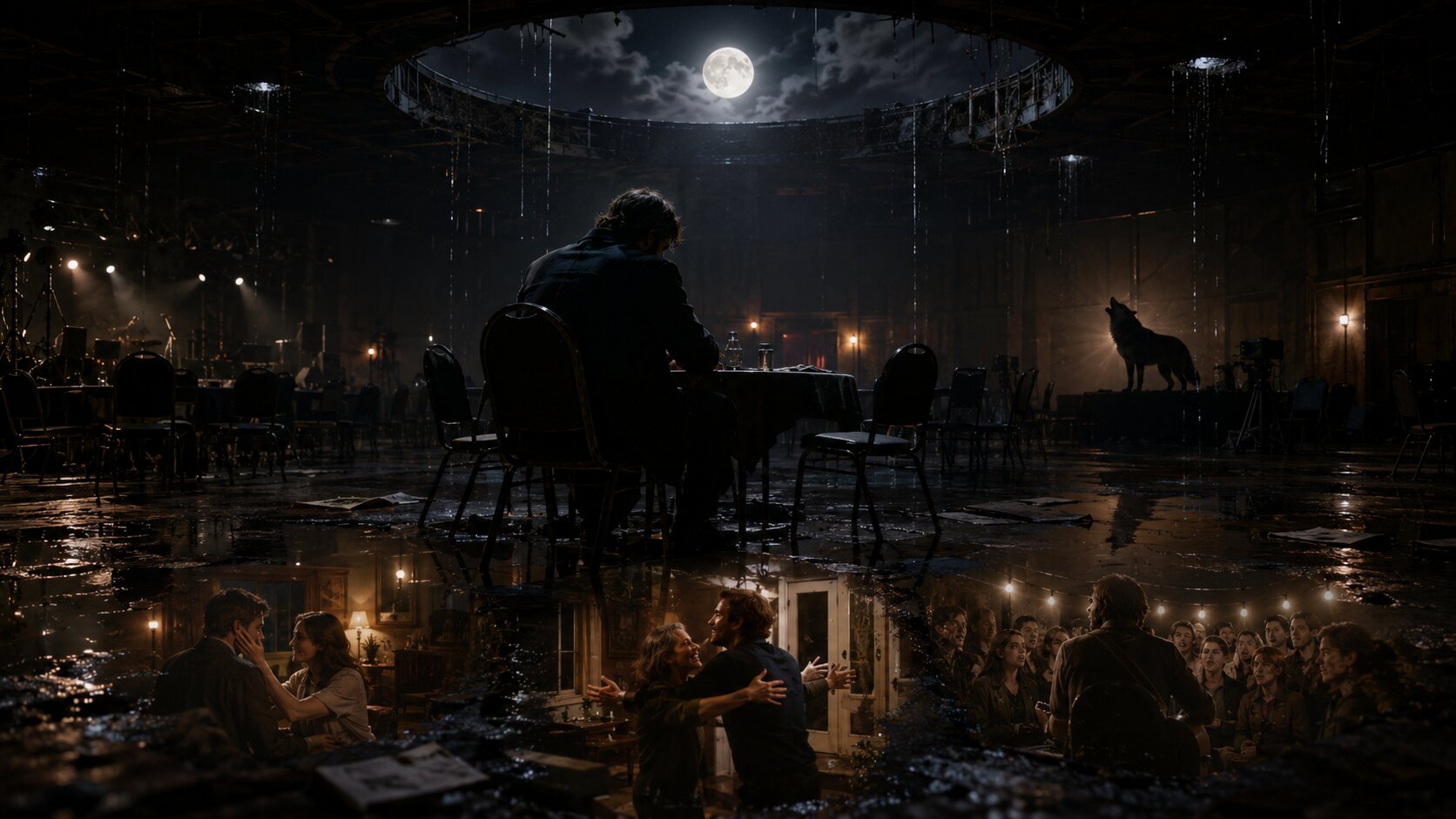
Later, “Orbiter” moves away from the public spectacle and into an enclosed setting where rain begins penetrating a metal roof. The person beside Kahan humorously interprets the malfunction almost as a message from above: perhaps this environment is not where he belongs.
The narrator does not immediately accept the invitation to leave.
That choice prevents the song from becoming a simplistic rejection of celebrity. Kahan is uncomfortable with parts of the world he has entered, but he also worked for years to reach it. Achievement can be frightening without becoming meaningless.
The tension is more psychologically interesting than a straightforward fame-is-bad narrative. Part of Kahan wants distance from the machinery surrounding his career, while another part remains emotionally attached to the success he pursued.
That conflict echoes Kahan’s descriptions of the difficult period that followed Stick Season. His rapid rise created enough pressure and creative uncertainty that he reconsidered his relationship with music before eventually finding a healthier way to continue making it. (Rolling Stone UK)
When the Wolf Gets Older, Hunger Changes
Near the end of the song, the wolf returns, but the symbolism has changed. Earlier, wolves could be read as people caught inside automatic competition. Now Kahan turns the metaphor toward himself.
This version of the wolf is older and less interested in blood. The image suggests someone whose appetite for winning has changed after actually experiencing the consequences of the chase.
That does not mean ambition has vanished. The narrator remains inside the room. He has not abandoned the career or rejected everything success has given him.
What has changed is the question.
An unknown artist asks, “Will I ever make it?” The narrator of “Orbiter” has already crossed that threshold. His problem is what happens afterward: “Why am I still searching for reassurance now that I have the thing I thought would provide it?”
Both the Wolf and the Astronaut Need the Moon
One of the most effective features of “Orbiter” is the way its separate symbolic systems eventually begin to overlap.
A wolf howls toward the moon. An astronaut moves around it. Both images describe distance combined with attraction. Both involve looking toward something that remains visible while the narrator occupies uncertain territory.
This overlap helps explain why Kahan can credibly describe the song as being about his wife, his mother, and his audience rather than only one romantic relationship. (Holler)
Each relationship is different, but each can perform a similar emotional function. These are people capable of reminding him where he came from, reflecting an identity that existed before fame, or making an unfamiliar life feel temporarily comprehensible.
The Ending Changes What “Orbiting” Means
For much of the song, orbiting sounds reassuring. The narrator can enter strange environments because something familiar remains at the center of his emotional universe.
The outro complicates that comfort by introducing the possibility of loss.
Suddenly, the moon is not simply something dependable. It is something the narrator might someday have to live without. That possibility makes the earlier dependence more frightening.
The ending does not clearly identify the cause of the feared loss. It could reflect the pressure fame places on relationships, the ordinary knowledge that every relationship changes eventually, or Kahan’s own tendency toward anxious anticipation.
There is no verified public explanation establishing that the outro predicts a specific breakup, death, or event. Reading it as a literal statement about one particular relationship would therefore go beyond the available evidence.
The ambiguity is part of what makes the ending powerful. Anything important enough to stabilize your world is also important enough to make its absence terrifying.
So, Is “Orbiter” About Noah Kahan’s Wife?
Yes, but only partly.
Kahan has explicitly identified his wife as one of the people behind “Orbiter.” In the same statement, however, he also identified his mother and his fans. The evidence therefore argues against interpreting every image as coded biography about his marriage alone. (Holler)
A stronger interpretation is that Kahan draws from several real relationships and combines them into one broader idea: the people who provide emotional gravity when his career pulls him into unfamiliar territory.
From Stick Season Geography to Orbiter Gravity
Kahan has long used geography as emotional language. Across Stick Season, Vermont and New England are rarely just scenery. Towns, roads, houses, and landscapes become ways of talking about memory, stagnation, belonging, resentment, and the desire to escape.
“Orbiter” advances that theme into a different stage of his career.
The narrator has already left. He has achieved the extraordinary outcome the younger artist might once have imagined. He has access to glamorous rooms, major audiences, awards, and a career operating at international scale.
Instead of solving the old conflict between leaving and staying, success creates a new version of it. Home becomes valuable precisely because he now understands what emotional distance from it feels like.
This is consistent with the broader framing of The Great Divide. When Kahan announced the album, he described looking across an emotional distance toward old friends, family members, his younger self, and Vermont while trying to communicate things he had struggled to say directly. (Rolling Stone Australia)
In that context, “Orbiter” feels like a logical evolution of Kahan’s older obsession with home. Home is no longer necessarily a town you return to. Sometimes it is a person whose gravity makes you feel located.
Why “Orbiter” Hits Harder After the Success Story
The most compelling interpretation of “Orbiter” is that success has expanded Noah Kahan’s world without automatically making him feel more secure inside it.
Cameras, awards, travel, and enormous audiences increase his visibility. Yet the larger his public life becomes, the more valuable familiar relationships appear to be.
That is why the moon metaphor carries more weight than a conventional romantic image. The moon represents emotional orientation. It stands for the people capable of reminding Kahan who he was before strangers began publicly measuring his value.
At the same time, the ending refuses to make that dependence completely comforting. Once another person becomes your source of gravity, imagining life without them becomes frightening.
“Orbiter” ultimately lives inside that contradiction. Kahan has traveled farther than the younger version of himself could have expected, only to discover that distance makes the idea of home more important. The farther the astronaut goes, the more clearly he understands what he is circling.
FAQs About “Orbiter” by Noah Kahan
What does “Orbiter” by Noah Kahan mean?
Who wrote “Orbiter”?
Who is Noah Kahan singing about in “Orbiter”?
What does the moon symbolize in “Orbiter”?
What does Watertown mean in “Orbiter”?
What album is “Orbiter” on?
Is “Orbiter” about fame?
Sources Used
- Noah Kahan / Universal Music Group – “Orbiter” official release page and credits
- Apple Music – The Great Divide: The Last Of The Bugs album page and Noah Kahan commentary
- Rolling Stone UK – Noah Kahan interview on The Great Divide, fame, anxiety, and returning to himself
- Holler – Noah Kahan on the people who inspired “Orbiter”
- Watertown News – Noah Kahan’s connection to Watertown and his response to the song reference
- Rolling Stone Australia – The Great Divide album announcement and Noah Kahan’s statement about its themes