
How New Songwriters Should Register With ASCAP, BMI or SESAC
TL;DR: If you write songs in the United States, affiliating with a performing rights organization is an important part of collecting public-performance royalties generated by your compositions. ASCAP and BMI currently allow eligible songwriters to apply directly, while SESAC remains invitation-only. The job does not end when you open a PRO account: you also need to register your compositions accurately, keep songwriter and publisher information consistent, and make sure your other publishing rights are administered separately.
A songwriter can distribute a track, receive an ISRC, appear on Spotify and still have an incomplete publishing setup. Distribution primarily deals with the sound recording. It does not automatically tell every organization responsible for the underlying composition who wrote the song or how its ownership is divided.
That is where performing rights organizations, commonly called PROs, enter the picture. Organizations such as ASCAP, BMI and SESAC license public performances of musical compositions and distribute corresponding royalties to the songwriters and publishers they represent.
The confusing part for beginners is that “registering with a PRO” can describe two different actions. First, you affiliate yourself as a songwriter. Then, once your account exists, you need to make sure the individual songs in your catalog are registered with correct ownership data.
Table of Contents
- A PRO Tracks the Composition, Not Every Right Around the Recording
- Choose Your PRO Before Your Catalog Becomes Complicated
- Prepare Your Songwriter Identity Before Entering Songs
- Register the Composition Without Creating a Split Dispute
- ASCAP, BMI and SESAC Have Different Entry Doors
- Your PRO Is Only One Piece of the Royalty System
- Turn Registration Into a Release Administration Habit
- Keep Rights Administration Part of Your Artist Strategy
- FAQs About ASCAP, BMI, SESAC and PRO Registration
- Sources Used
Key Takeaways
| Point | Details |
|---|---|
| Choose an appropriate PRO | ASCAP and BMI currently accept direct songwriter applications, while SESAC affiliation is invitation-only. |
| Membership is not song registration | Opening a songwriter account does not automatically register every composition you create. |
| Agree on splits first | Confirm songwriting percentages, legal names, IPI numbers and publishing information before submitting a collaborative work. |
| PRO registration is not copyright registration | A PRO manages performance rights in compositions; registration with the U.S. Copyright Office is a separate process. |
| Performance royalties are not all publishing royalties | U.S. digital mechanical royalties are handled separately, including through The MLC for eligible uses and rightsholders. |
| Metadata consistency matters | Use consistent songwriter names, titles, identifiers and ownership information across the organizations administering your music. |
A PRO Tracks the Composition, Not Every Right Around the Recording
The first concept new songwriters need to understand is that a commercially released track can involve two different copyrighted works: the musical composition and the sound recording.
The composition consists of the underlying music and any lyrics. The sound recording is the particular recorded performance of that composition. The U.S. Copyright Office treats these as separate copyright-protected works. (U.S. Copyright Office)
ASCAP, BMI and SESAC primarily matter to songwriters because of the public-performance right in the composition. That distinction prevents several common administrative mistakes.
Registering a composition with BMI does not register your master recording. Joining ASCAP does not automatically collect every mechanical royalty a song may generate. PRO affiliation also does not replace federal copyright registration.
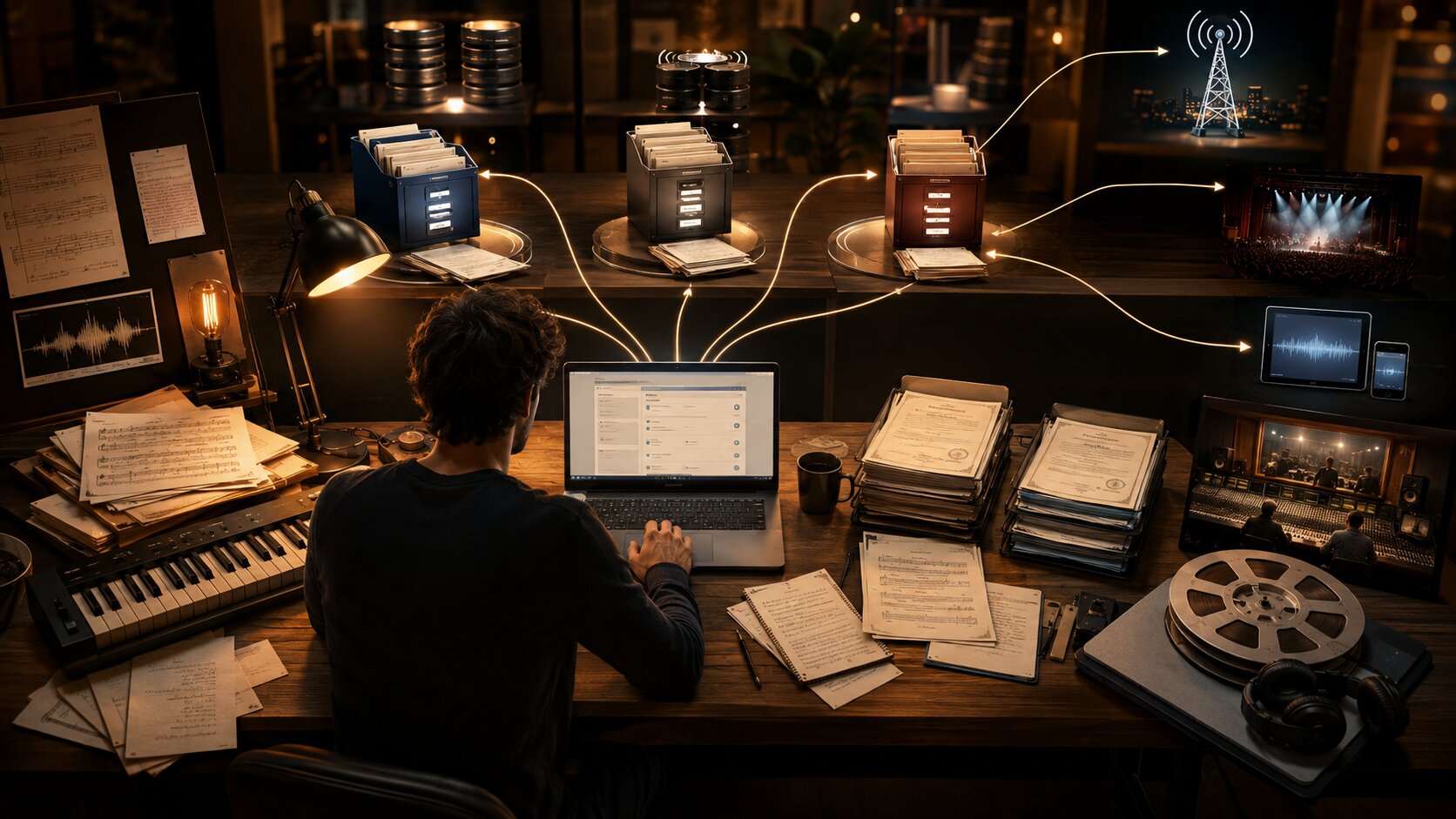
It is more useful to think of music rights administration as several connected but separate lanes:
- ASCAP, BMI, SESAC or another PRO: public-performance royalties associated with the composition.
- The MLC, a publisher or publishing administrator: digital mechanical royalties in the United States where applicable.
- SoundExchange: certain digital performance royalties associated with sound recordings.
- U.S. Copyright Office: federal registration of copyright claims.
- Distributor or record label: delivery and monetization of the master through streaming and download services.
The distinction between PROs and The MLC is particularly important for independent writers. The MLC administers blanket mechanical licenses for eligible streaming and download services in the United States, while PROs administer a different right. (The Mechanical Licensing Collective)
Pro Tip: Do not think of “registering a song” as one universal action. A single release can need accurate information in several rights systems because those systems collect different types of royalties.
Choose Your PRO Before Your Catalog Becomes Complicated
For many beginning U.S. songwriters comparing ASCAP, BMI and SESAC, the immediate decision is between ASCAP and BMI because both provide a direct affiliation route for songwriters. SESAC works differently and describes its songwriter affiliation model as invitation-only.
Do not choose a PRO simply because a successful artist you admire uses it. A major artist’s publishing structure may bear little resemblance to that of a self-released songwriter.
Instead, consider practical questions:
- Are you currently eligible to affiliate?
- Do you understand the organization’s membership or affiliation agreement?
- Will you remain self-published?
- Do you intend to create a separate publishing entity?
- Are any of your compositions already represented through another agreement?
- Are you currently affiliated with a foreign performing rights society?
ASCAP currently states that joining as a new writer member is free and that writers joining as a writer and publisher at the same time can also have the publisher application fee waived. (ASCAP)
BMI also states that joining as a songwriter or composer is free, with no songwriter or composer annual dues. Its publishing affiliation is a separate decision and should not be confused with songwriter affiliation. (BMI)
For a new writer, the most important outcome is not finding a supposedly perfect PRO. It is establishing a legitimate affiliation, understanding what that organization administers, and keeping the catalog accurate once songs begin accumulating.
Prepare Your Songwriter Identity Before Entering Songs
A clean publishing catalog starts before you type the first song title into a registration form.
One identifier you will encounter is the IPI number, sometimes referred to alongside the older CAE terminology. An IPI is an international identifier used to distinguish writers and publishers participating in musical works. ASCAP advises songwriters to share their IPI with collaborators because it helps the correct party be identified during work registration. (ASCAP IPI guidance)
Create a basic songwriter metadata record for yourself containing:
- your legal songwriter name;
- your professional or performing name;
- registered aliases, if applicable;
- your PRO affiliation;
- your IPI or CAE number;
- your publisher name and publisher IPI, if applicable;
- a reliable email address for rights administration.
Do not automatically substitute your artist name
Your stage name on streaming services is not necessarily the name under which your songwriting interest is registered.
Imagine a producer releasing music as Night Atlas while their PRO record identifies them under a legal name and an approved alias. If collaborators enter only an informal version of “Night Atlas” into their paperwork without the correct writer identity or IPI, the ownership data becomes less precise.
Rights metadata is not the place for creative variations in spelling. Consistency makes matching writers, publishers and compositions considerably easier.
Register the Composition Without Creating a Split Dispute
The most important piece of information may be settled before anyone logs into a PRO account: the songwriting split.
Suppose three collaborators write a song and agree that their underlying composition is divided as follows:
- Writer A: 50%
- Writer B: 30%
- Writer C: 20%
Document that agreement while the session and each person’s contribution are still fresh. Waiting until someone starts registering the song months later is an unnecessary way to create disagreement.
A useful written split record should identify the song title, songwriters, agreed percentages, publishing entities where relevant, PRO affiliations and IPI numbers.
Do not assume every PRO displays shares in the same way
The underlying agreement among the songwriters is one thing; the conventions used inside a particular PRO’s registration system are another.
For example, ASCAP instructs members using its registration system to make writer shares total 50% and publisher shares total 50%. BMI describes its royalty accounting unit using a 200% framework, with the writer and publisher sides represented separately. (ASCAP work registration guidance)
That is why you should never look at a percentage in another organization’s database and copy it into a new form without understanding what the field represents.
Check the data before submitting
Before completing a registration, verify:
- The exact title of the composition.
- Every songwriter who owns a share of the composition.
- The correct IPI numbers.
- The agreed songwriting splits.
- Publisher or publishing administrator information where applicable.
- Artist and recording information requested by the registration system.
If a co-writer or publisher has already registered the composition correctly, investigate the existing entry before creating another version. Duplicate or conflicting registrations can make a simple catalog harder to administer.
Pro Tip: Keep a master catalog spreadsheet containing one row per composition and columns for title, alternate title, writers, IPIs, splits, publishers, PRO registration status, release date and relevant recording identifiers.
ASCAP, BMI and SESAC Have Different Entry Doors
The three organizations are frequently discussed together, but a new songwriter cannot approach all three in exactly the same way.
| PRO | Direct songwriter application? | Current beginner-level distinction |
|---|---|---|
| ASCAP | Yes, subject to eligibility | New writer membership is currently free, and eligible writers can apply directly. |
| BMI | Yes | Songwriter and composer affiliation is currently free. |
| SESAC | No open unsolicited application | SESAC describes itself as invitation-only and recommends that a representative contact the organization on a songwriter’s behalf. |
ASCAP
ASCAP provides direct writer membership and online work registration through Member Access. For an independent writer who wants a separate publisher membership, ASCAP also provides a path for creating that side of the account structure.
BMI
BMI also accepts direct songwriter and composer affiliations. A new writer should distinguish clearly between affiliating as a writer and deciding whether a separate publishing entity is necessary for their business.
SESAC
SESAC is not simply a third open application to complete after comparing ASCAP and BMI. SESAC states that its affiliation is invitation-only and that it does not accept unsolicited submissions. It recommends having a representative such as a lawyer, manager or agent contact the organization on the songwriter’s behalf. (SESAC)
For a beginner, that means there is little reason to leave a growing catalog administratively unattended while hoping for a future SESAC invitation. Evaluate the options that are actually available to you and establish a workable system.

Your PRO Is Only One Piece of the Royalty System
A common mistake is to join ASCAP or BMI, register a few titles and assume the publishing side of the career is finished.
It is not.
Interactive streaming can generate both performance and mechanical royalties associated with a composition. The MLC administers the blanket compulsory license for eligible digital audio mechanical uses in the United States and pays qualifying rightsholders, including eligible self-administered songwriters who become Members and properly register their works. (The MLC)
If you are self-administered, determine whether you need to register the shares you control with The MLC. If you have a publisher or publishing administrator, first establish what that company is already registering and collecting on your behalf.
Do not create duplicate administration simply because you discover another royalty organization online.
The sound recording also remains separate. SoundExchange collects certain U.S. digital performance royalties for sound recordings, including royalties connected with eligible non-interactive digital uses. That is different from the composition performance royalties administered by ASCAP, BMI or SESAC. (SoundExchange)
Copyright registration is another independent layer. The existence of your PRO registration should not be treated as a substitute for deciding whether to register your work with the U.S. Copyright Office.
Turn Registration Into a Release Administration Habit
The publishing mistakes that cause problems later are often not sophisticated legal mistakes. They are unfinished administrative tasks: missing writers, outdated aliases, forgotten compositions or splits that were never documented properly.
The simplest solution is to make rights administration part of every release workflow.
Before the release
- Confirm songwriting splits in writing.
- Collect legal writer names and IPI numbers.
- Identify any publishers or administrators.
- Determine who controls each share.
- Agree on who will submit the composition registration.
When the song is being released
- Register or verify the composition with the appropriate PRO.
- Handle mechanical-rights registration through the appropriate party or system.
- Save final release metadata and recording identifiers.
- Keep copies of split agreements and publishing contracts.
After registration
- Search for the composition in the relevant repertory.
- Check the spelling of every songwriter’s name.
- Verify publisher information.
- Compare listed ownership with your agreed split.
- Investigate conflicting or missing information rather than ignoring it.
Songview can also be useful when researching U.S. composition ownership data. The service began as an ASCAP and BMI collaboration, and ASCAP, BMI, GMR and SESAC announced an expansion in 2025 to incorporate additional GMR and SESAC musical-works information. (BMI)
The realistic goal is not to register a song once and never look at it again. It is to maintain a catalog whose titles, identifiers, ownership information and administrative relationships remain accurate as your career grows.
Keep Rights Administration Part of Your Artist Strategy
For independent musicians, publishing administration should sit alongside distribution, release planning, marketing and catalog management rather than becoming an emergency task only after a song begins attracting attention.
BlockTone Records publishes practical resources for independent artists navigating music releases, rights, promotion and long-term career development. The same discipline you apply to your masters and release schedule should also apply to your compositions: document splits early, understand which organization handles each right and keep your catalog records organized.
A good rights setup cannot manufacture streams or guarantee significant royalty income. What it can do is reduce avoidable uncertainty and make it easier for legitimate royalties to be connected with the correct songwriter, publisher or other rightsholder.
FAQs About ASCAP, BMI, SESAC and PRO Registration
Can I join ASCAP and BMI at the same time as a songwriter?
Is ASCAP or BMI better for a new songwriter?
Can a new songwriter apply directly to SESAC?
Do I need to register every song after joining a PRO?
Do I need a publishing company before registering my first song?
Does registering a song with ASCAP, BMI or SESAC register the copyright?
Do ASCAP, BMI or SESAC collect all of my Spotify songwriting royalties?
Sources Used
- ASCAP – songwriter membership and application information
- ASCAP – registering musical works and ownership shares
- BMI – songwriter and composer affiliation FAQs
- SESAC – affiliation and songwriter FAQs
- The Mechanical Licensing Collective – information for self-administered songwriters
- U.S. Copyright Office – copyright guidance for musicians
- SoundExchange – digital performance royalties for sound recordings