
One-Sheet vs EPK vs Press Kit: The Difference Musicians Should Know
A one-sheet is a one-page snapshot designed for fast evaluation. An EPK is a broader digital hub containing your music, story, visuals, achievements, and contact information, while a press kit is a collection of media-ready assets assembled for journalists or a specific campaign. The practical rule is simple: send the smallest format that answers the recipient’s immediate questions, then make deeper materials easy to access.
Musicians often hear the same instruction before pitching a venue, journalist, festival, label, radio station, or industry contact: send your press materials. The problem is that terms such as one-sheet, EPK, and press kit are frequently used as though they describe exactly the same thing.
They do not, although the terminology is not completely standardized. A one-sheet is generally a single-page promotional summary, while an electronic press kit gives industry professionals access to a wider collection of music, biography, imagery, video, career information, and contact details. (ICMP)
In practice, the boundary between an EPK and a digital press kit can be much less rigid. Both may contain biographies, professional photographs, music, video, press coverage, achievements, social links, and contact details. What matters most is not the label on the page but whether the material helps the recipient do their job efficiently. (ASCAP)
A talent buyer scanning submissions does not need the same package as a journalist preparing a feature. An editor who needs publication-ready photography has different priorities from a promoter trying to determine whether your live show belongs on a particular bill. This guide explains where each format fits and how independent musicians can build all three without maintaining three completely separate identities.
Table of Contents
- The Fastest Way to Tell the Three Apart
- A One-Sheet Is Built for the 30-Second Scan
- An EPK Is Your Living Industry Hub
- A Press Kit Is a Campaign-Ready Media Package
- Pick the Asset by Recipient, Not by Career Level
- Build One Asset Library, Then Create Three Outputs
- Send Less, Link Better, and Keep Every Version Current
- Put Your Artist Materials to Work with BlockTone Records
- Frequently Asked Questions
Key Takeaways
| Point | Details |
|---|---|
| One-sheet = fast summary | Usually one page, focused on the information needed to evaluate an artist, release, or booking opportunity quickly. |
| EPK = professional hub | A digital destination containing music, biography, photos, videos, achievements, important links, and contact information. |
| Press kit = usable media assets | Built around materials a journalist, editor, or media outlet may need when covering an artist or release. |
| The terminology overlaps | EPK, digital press kit, and press kit may be used interchangeably, so the recipient’s submission instructions should take priority. |
| Different recipients need different depth | A promoter may prioritize live footage while a journalist may need photos, credits, release context, and downloadable assets. |
| Maintain one source of truth | Organize your core artist assets once, then create recipient-specific versions instead of maintaining unrelated documents. |
The Fastest Way to Tell the Three Apart
The easiest way to understand a one-sheet, EPK, and press kit is not to start with the files they contain. Start with the job each format is supposed to perform.
| Format | Primary Job | Typical Format | Best For |
|---|---|---|---|
| One-sheet | Summarize | One-page PDF or concise digital page | Quick pitches, releases, radio, booking |
| EPK | Present | Web page or organized digital portfolio | Venues, festivals, press, agents, labels |
| Press kit | Supply | Downloadable folder, web page, or media package | Journalists, editors, publicists, media campaigns |
A one-sheet compresses information. An EPK organizes information. A press kit supplies materials another person may need to use.
Those functions can overlap. Your one-sheet can link to your EPK. The same one-sheet can also be available inside a downloadable press kit. Your EPK may contain nearly every file that would traditionally have been distributed as a press kit.
This is why two industry professionals can use different terminology while expecting similar materials. Berklee, for example, discusses an EPK or one-sheet as useful material when contacting promoters, demonstrating that several formats may serve the same initial pitching workflow. (Berklee Online)
The recipient’s instructions therefore matter more than your preferred terminology. If a festival explicitly asks for an EPK link, give them an EPK link rather than deciding that your downloadable press kit is close enough.
A One-Sheet Is Built for the 30-Second Scan
A musician one-sheet is intentionally restrictive. Its greatest strength is that it forces you to decide which information deserves attention first.
Rather than presenting your complete career history, it should help someone understand the current opportunity quickly. A useful artist or release one-sheet might include:
- artist name and a strong promotional image;
- a concise positioning statement;
- the current release, project, tour, or booking objective;
- a short biography or release description;
- selected achievements or credible media coverage;
- one essential streaming, video, or live-performance link;
- release date or relevant performance information;
- contact details;
- a link or QR code leading to the full EPK.
Change the emphasis according to the pitch
Your booking one-sheet does not need to be identical to your new-single one-sheet.
A booking one-sheet can emphasize live photography, genre, previous performances, strong live footage, relevant markets, upcoming routing, and booking contact information.
A release one-sheet can give more space to the song or album, release date, artwork, collaborators, a concise release story, listening link, notable previous coverage, and publicity contact.
A radio-focused one-sheet may move the recording information, release details, credits, clean-version availability, and contact information closer to the top.
The major mistake is treating the one-sheet as a miniature autobiography. If every career achievement, streaming service, social network, quotation, photograph, and paragraph has to fit onto one page, the document loses its advantage.
Pro Tip: Build the one-sheet around the decision you want the reader to make. If you are pitching a concert promoter, the page should help that person decide whether to investigate your live act further rather than document every release you have ever made.
An EPK Is Your Living Industry Hub
An EPK, or electronic press kit, gives you more room to present an artist professionally without forcing everything onto a single page. CD Baby describes the EPK as a digital portfolio that brings together elements such as an artist’s music, biography, visuals, and press materials for professional pitching. (CD Baby DIY Musician)
The best EPKs are not simply long artist biographies with a few links underneath. They are structured so that someone can find the relevant information quickly and investigate deeper only when they want to.
Your artist story
Include a concise biography that explains who you are, what kind of music you make, and what is currently significant about the project. Avoid forcing the reader through a year-by-year career chronology before they understand the basic proposition.
Maintaining both a short biography and a longer version is useful. A festival program may need only a few lines, while a journalist working on a larger feature may want more context.
Music that can be heard immediately
Do not make a recipient search Spotify, YouTube, or another platform just to locate the song you are pitching.
Place the current priority release or most relevant music near the top of the EPK. Your broader catalog can appear later. The first listening option should match the reason you contacted the person.
Professional visual assets
Provide strong promotional photography and make high-resolution versions easy to download. It is useful to have both portrait and landscape options because editors, blogs, venues, and event organizers may need different crops.
Keep photographer credits with the files. A photograph named artist-photo-01.jpg with clear usage information is considerably more practical than an anonymous image buried inside a cloud folder.
Live evidence when live work matters
If you are pitching promoters, booking agents, or festivals, include convincing live footage. A polished studio track tells someone what your recording sounds like; a good live video helps them understand what happens when you are actually onstage.
Selective proof
Relevant press coverage, credible performances, awards, festival appearances, collaborators, or other verifiable achievements can establish context.
Be selective. A few strong proof points are usually more persuasive than a wall of weak achievements or inflated claims.
One obvious contact route
An interested journalist, promoter, or agent should never have to search through your social profiles to work out how to reach you.
Include the appropriate email address clearly and identify whether it belongs to the artist, manager, booking representative, or publicist when relevant.
A Press Kit Is a Campaign-Ready Media Package
This is where music-industry vocabulary becomes less precise.
Historically, a press kit could describe a physical package containing photographs, a biography, recordings, press clippings, and other promotional materials. Today, most of that workflow has moved online. Berklee’s Red Room, for example, directs artists toward electronic communication rather than mailed physical press kits and CDs for booking submissions. (Berklee College of Music)
In modern publicity, the phrase press kit may simply refer to an EPK. In other situations, it is useful to think of the press kit more specifically as a media production package: the files an editor or journalist needs when turning your pitch into published coverage.
A release-focused music press kit could contain:
- a short artist biography;
- a longer biography;
- a release announcement or press release when relevant;
- high-resolution promotional photographs;
- photographer credits;
- cover artwork;
- music and video links;
- songwriter, producer, featured artist, and recording credits where relevant;
- selected press quotations;
- a release one-sheet;
- publicity or management contact information.
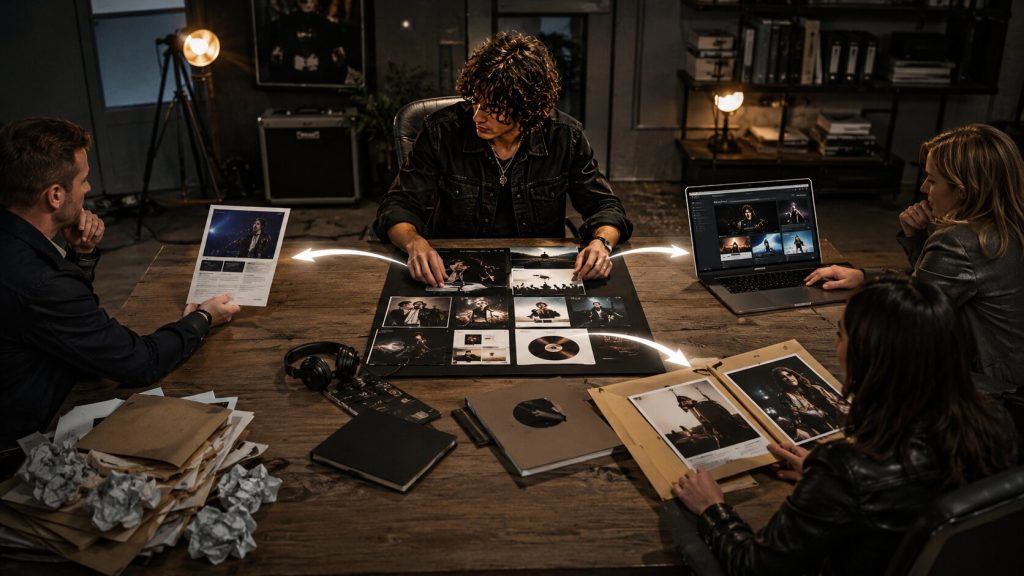
The practical distinction is straightforward: an EPK helps someone understand your project, while a media-focused press kit helps someone publish something about it.
If your EPK already contains well-labeled downloadable photographs, artwork, biographies, credits, and other media materials, one digital destination can perform both jobs.
Pick the Asset by Recipient, Not by Career Level
Artists sometimes assume that beginners use one-sheets and more established musicians eventually graduate to EPKs and press kits. That is not a useful way to think about the formats.
The right asset depends on the task and the recipient.
Venue or talent buyer
Start with a short pitch supported by a booking-focused one-sheet or EPK.
Prioritize live footage, musical style, relevant performance history, market information when available, upcoming routing, and a clear booking contact. A talent buyer needs evidence that helps evaluate the live proposition, not a folder containing every publicity photograph you have ever taken.
Journalist or music editor
Send a personalized pitch that leads to a media-ready EPK or press kit.
Prioritize the actual news angle, current release, short biography, music, high-resolution imagery, relevant credits, and a press contact. Berklee’s career guidance describes publicists as preparing materials such as biographies and promotional photographs for distribution to media contacts. (Berklee College of Music)
Festival
Follow the application instructions exactly.
If the festival asks for an EPK, biography, live video, streaming link, specific image dimensions, or information entered directly into an application portal, provide those materials in the requested format. Do not replace requested fields with a link to a large generic folder and expect the reviewer to find the information themselves.
Manager, agent, or label contact
An EPK generally gives these recipients enough depth to investigate an artist after a successful introduction.
The email still needs to explain why you are approaching that specific person. Your EPK supports the pitch; it should not be expected to make the pitch for you.
Fans
Usually, fans do not need any of these formats.
Your artist website, streaming profiles, mailing list, social channels, merchandise pages, and direct-to-fan platforms perform a different job. Professional press materials are primarily designed to reduce friction when working with people who may book, cover, represent, broadcast, or otherwise support your music career.
Build One Asset Library, Then Create Three Outputs
Maintaining three completely unrelated sets of artist materials creates unnecessary work. It also makes outdated biographies, incorrect dates, broken links, and old photographs more likely to remain in circulation.
A more efficient system starts with one master asset library.
- Biographies: maintain short, medium, and full versions where useful.
- Photography: organize portrait, landscape, live, and approved promotional images.
- Music: keep the current priority release and essential listening links easy to identify.
- Video: maintain official videos, strong live performances, and other relevant footage.
- Release information: store dates, credits, artwork, collaborators, and campaign information.
- Professional proof: save legitimate coverage, significant performances, awards, and other verifiable milestones.
- Contacts: keep management, booking, publicity, label, or direct artist contact information current.
From that library, create three different views of the same verified information.
Your one-sheet becomes the compressed version.
Your EPK becomes the browsable version.
Your press kit becomes the downloadable media version.
This approach makes customization much easier. When you release a new single, you can update the underlying assets and create a campaign-specific one-sheet without rebuilding your complete professional presentation from scratch.
Send Less, Link Better, and Keep Every Version Current
Having professional press materials does not mean sending every asset to every person.
Start with the actual pitch. Explain who you are, why you are contacting the recipient, what the relevant project is, and what you want them to consider. Then provide the smallest useful next step.
- Booking pitch: concise email → live one-sheet → full EPK.
- Media pitch: concise story angle → priority release → press kit or media-ready EPK.
- Industry introduction: personalized email → general EPK.
Avoid sending a large collection of unsolicited attachments when a reliable link will make the information easier to access. The objective is to remove friction rather than demonstrate how many promotional files you have created.
Audit your materials before major campaigns
- Is the priority release still correct?
- Are listed tour or release dates current?
- Do all music and video links work?
- Are press quotations attributed accurately?
- Can media contacts download high-resolution photographs easily?
- Are photographer credits included?
- Does the listed contact email reach the correct person?
- Does the one-sheet still fit comfortably on one page?
- Is the EPK usable on mobile devices?
- Have outdated achievements crowded out more relevant recent information?
Presentation matters, but usability matters more. A visually impressive EPK with broken links and inaccessible downloads is less useful than a simple, organized page that gives a journalist or promoter exactly what they need.
Put Your Artist Materials to Work with BlockTone Records
Professional press materials are most valuable when they support a broader artist strategy rather than existing as documents you update once and forget.
BlockTone Records publishes practical resources for independent musicians navigating releases, promotion, music business, career development, and industry outreach. Treat your one-sheet, EPK, and press kit as working assets: update them alongside new campaigns and tailor what you send according to the opportunity you are pursuing.
The goal is not to create more paperwork. It is to make it easier for the right person to understand your music, verify the important information, and take the next step.
FAQs About One-Sheets, EPKs, and Press Kits
Is a one-sheet the same as an EPK?
Is an EPK the same as a press kit?
Do independent musicians need a one-sheet, EPK, and press kit?
Should a musician one-sheet be a PDF?
Should I attach my EPK to an email?
How often should musicians update an EPK?
What is the biggest mistake musicians make with press materials?
Sources Used
- ICMP – What to Include on an Artist One-Sheet
- ASCAP – Guidance on Building a Digital Press Kit
- CD Baby DIY Musician – EPK Checklist for Artists
- Berklee Online – Booking, Planning, and Promoting a Live Concert
- Berklee College of Music – Music Publicist Career Overview
- Berklee College of Music – Red Room Booking and Rental Guidelines