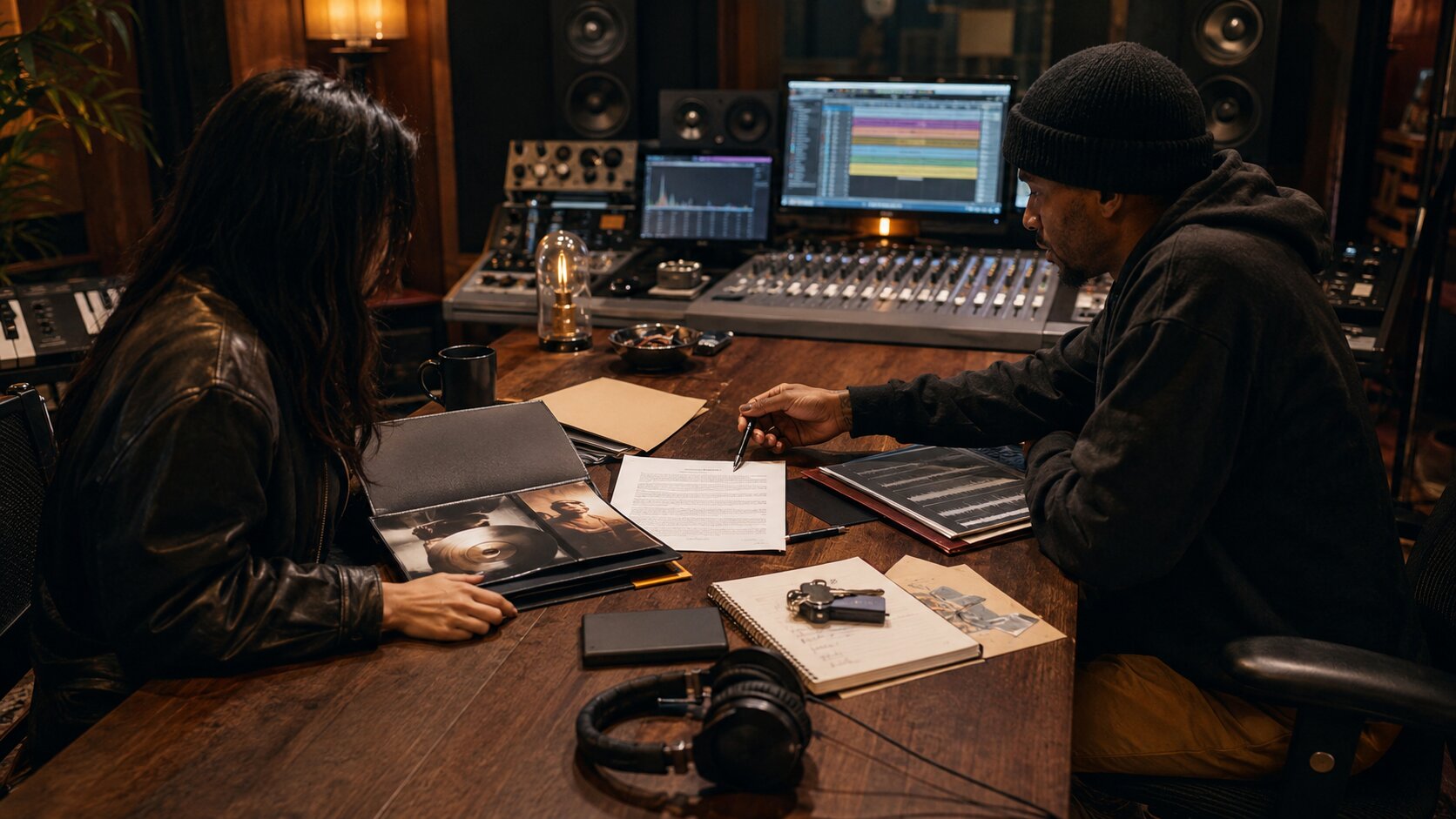
Producer Agreements Every Independent Artist Should Understand
A producer agreement should answer five questions before a recording is released: who owns the master, how the producer gets paid, whether the producer receives songwriting ownership, what must be delivered, and what happens if the project stops. Never assume that paying a production fee automatically transfers every right, and do not treat producer royalties and songwriting shares as the same thing.
A strong agreement does not need to make a creative relationship unnecessarily complicated. Its purpose is to make the important expectations clear while everyone still agrees about what the project is supposed to be.
A producer can shape nearly every important part of a recording: arrangement, instrumentation, vocal production, sound selection, editing, recording, and sometimes even the underlying songwriting. Yet many independent artists begin these relationships with little more than a price agreed through messages.
That arrangement can appear perfectly adequate until the song is finished. Then questions emerge: Who owns the master? Does the producer receive royalties? Did producing the instrumental make them a co-writer? Who is responsible for an uncleared sample? What files does the artist actually receive?
A written music producer agreement is designed to answer those questions before they become disputes. For independent artists, it creates a record of what the producer was hired to do, what the producer receives in return, and which rights belong to each party.
This guide focuses on the practical deal points artists should understand rather than contract boilerplate. Copyright and contract rules differ between jurisdictions, so substantial agreements should be reviewed by a qualified entertainment lawyer familiar with the applicable law.
Table of Contents
- First Decide What the Producer Is Actually Being Hired to Do
- Treat the Fee, Producer Points, and Recoupment as Separate Negotiations
- Keep Master Ownership and Songwriting Ownership Separate
- Define Delivery Before “Finished” Becomes an Argument
- Make Third-Party Sounds Somebody’s Clear Responsibility
- Protect the Release With Credits, Accounting, and Royalty Instructions
- Use a Pre-Session Deal Memo When the Long Form Is Not Ready
- Producer Agreement Red Flags Worth Stopping For
- Build the Business Around the Recording
- Frequently Asked Questions
Key Takeaways
| Point | Details |
|---|---|
| A production fee is not the entire deal | The agreement should separately address fees, continuing royalties, expenses, ownership, and other compensation. |
| Master rights and songwriting rights are different | A producer may participate economically in the recording without automatically owning part of the underlying composition. |
| Producer points need a defined royalty base | A percentage means little unless the contract explains what revenue it applies to and which deductions or recoupment rules apply. |
| Deliverables should be specific | Masters, stems, instrumentals, session files, revisions, metadata, and deadlines should be discussed before delivery. |
| Third-party material can create release problems | Samples, loops, beats, musicians, and other outside contributions should be identified and properly licensed where required. |
| Royalty promises need administration | If the producer is entitled to ongoing payments, the agreement should explain statements, payment timing, accounting, and any separate royalty-direction documents. |
First Decide What the Producer Is Actually Being Hired to Do
“Producer” can describe very different jobs. One producer might receive a nearly finished demo, record vocals, edit the performance, and prepare a finished production. Another might create the instrumental, write chord progressions, reshape the arrangement, record musicians, develop melodies with the artist, and supervise the entire recording process.
Those situations should not automatically lead to identical agreements.
Before negotiating percentages, define the producer’s scope of work. Depending on the project, that might include:
- pre-production and arrangement;
- beat or instrumental creation;
- recording and vocal production;
- sound design and programming;
- editing and tuning;
- hiring or supervising session musicians;
- mix preparation or mixing;
- instrumental, clean, or alternate versions;
- stems and session-file delivery;
- revision rounds.
This matters because a producer’s creative contribution can raise copyright questions in addition to payment questions. The U.S. Copyright Office notes that sound-recording authorship can include production contributions such as recording, manipulating, mixing, and editing sounds. (U.S. Copyright Office – Sound Recording Author)
For an independent artist, the useful question is therefore not simply, “Who produced this song?” It is: “What exactly did this producer contribute, and what rights or compensation are they receiving for that contribution?”
| Deal Model | Typical Structure | Main Issue to Clarify |
|---|---|---|
| Flat-fee production | The producer receives an agreed payment for services. | Whether the agreement also transfers or licenses relevant rights in the master. |
| Fee plus producer royalty | The producer receives upfront compensation plus continuing participation. | The royalty base, deductions, recoupment, accounting, and payment timing. |
| Producer and co-writer collaboration | The producer receives production compensation and may also own part of the composition. | The songwriting split must be agreed separately from master participation. |
Pro Tip: Do not reduce the entire producer relationship to one number. “$1,000 per song” or “three points” does not tell you who owns the master, whether publishing is involved, which expenses are included, or what the producer must deliver.
Treat the Fee, Producer Points, and Recoupment as Separate Negotiations
A producer can potentially receive several forms of compensation. The agreement should identify each one instead of combining everything into vague language about the producer being “paid.”
Production Fee
The production fee is the amount paid for the producer’s services. The agreement should state the total amount and when payments become due.
Useful details include:
- whether the fee applies per track or to the entire project;
- the deposit amount;
- payment milestones;
- whether studio expenses are included;
- whether musicians or engineers are additional costs;
- what happens to money already paid if the project is cancelled.
Language such as “remaining balance due on completion” can still create disagreement if the contract never defines what completion means.
Producer Points
A producer may also negotiate continuing participation in income generated by the master recording. This participation is often discussed informally as “producer points.”
The percentage alone is not enough. A clause saying that the producer receives “3%” leaves an obvious question unanswered: 3% of what?
The agreement should identify the royalty base. It should also explain which income is included, whether deductions are permitted, when royalties become payable, and how the producer receives statements.
For an independent artist who owns and self-releases the master, a clearly defined percentage of specified receipts may sometimes be easier to administer than royalty language copied from an old record-label contract. Whatever structure is chosen, terms such as “net receipts” should be defined rather than left open-ended.
Recoupment
Recoupment determines whether agreed costs are recovered before particular royalty payments become payable.
For example, the parties may need to decide how production fees, studio expenses, mastering, session musicians, or other recording costs affect the producer’s royalty calculation. There is no benefit in relying on a phrase such as “standard recoupment” if the artist and producer have different ideas about what that standard means.
The agreement should state the actual economic rule.
Keep Master Ownership and Songwriting Ownership Separate
One of the most important distinctions in a producer agreement is the difference between the recording and the song itself.
A commercially released track generally involves two separate copyrighted works: the musical composition, which covers the underlying music and lyrics, and the sound recording, which covers the particular recorded performance. The U.S. Copyright Office treats the musical composition and sound recording as distinct works that may have different authors and owners. (U.S. Copyright Office – Musical Compositions and Sound Recordings)
Who Owns the Master?
The producer agreement should state who owns the completed master and how any rights arising from the producer’s contribution are handled.
Do not assume that paying a production invoice automatically resolves copyright ownership. Under U.S. copyright law, copyright ownership initially belongs to the author or authors unless another legal rule applies, while transfers of copyright ownership generally require a signed writing. (U.S. Copyright Office – Copyright Ownership and Transfer)
A producer agreement may therefore address:
- ownership of the final master;
- assignment or licensing of the producer’s applicable rights;
- ownership of outtakes and alternate versions;
- use of unreleased recordings;
- rights in producer-created beats or instrumentals;
- what happens to the material if the project is abandoned.
Be Careful With “Work Made for Hire” Language
Some agreements describe the producer’s contribution as a “work made for hire.” Artists should not assume that inserting this phrase automatically resolves every ownership issue.
Under U.S. law, work-made-for-hire status is governed by specific statutory rules. Depending on the relationship and the nature of the commissioned work, contractual assignment language may therefore be important in addition to any work-for-hire provision.
This is one reason ownership clauses deserve professional legal review when meaningful rights or revenue are involved.
Is the Producer Also a Songwriter?
Production credit does not automatically mean songwriting ownership.
If the producer contributes original music or lyrics to the underlying composition, the parties may agree that the producer is also a co-writer. If the producer only contributes to the recording, composition ownership is a separate question.
Resolve songwriting percentages while everyone’s memory of the session is still clear. The Mechanical Licensing Collective provides songwriter split-sheet resources designed to help collaborators document information such as writer names, ownership percentages, PRO affiliations, IPI numbers, and publisher information. (The MLC – Songwriter Tools)
Mistake to avoid: Do not give a producer “publishing” when what you actually intended to offer was participation in revenue from the master. Publishing ownership and master-recording royalties are different rights and different revenue streams.
Define Delivery Before “Finished” Becomes an Argument
Creative projects often run into problems over one deceptively simple word: finished.
The artist may believe production includes vocal edits, instrumental versions, consolidated stems, and multiple revision rounds. The producer may believe that delivering one approved stereo mix completes the job.
Neither side necessarily acted improperly. The scope was simply never defined.
Depending on the project, a producer’s delivery package might include:
- the approved final master or premaster;
- instrumental version;
- clean version;
- performance or TV mix;
- alternate vocal versions;
- consolidated stems;
- multitrack audio;
- MIDI files where agreed;
- DAW session files where agreed;
- tempo and key information;
- production credits;
- sample and musician information.
The contract can also specify file formats and technical requirements where these matter to the artist’s mixing, mastering, live-performance, sync, or archival workflow.
Put Revisions on Paper
Unlimited revisions can create an unpredictable workload for a producer. No revision language at all can create equally predictable frustration for an artist.
Specify how many revision rounds are included, what qualifies as a revision, and what additional revisions cost.
The agreement should also describe approval. If the artist can postpone approval indefinitely, the producer may never reach the payment milestone. If the producer alone decides when the project is finished, the artist may be forced to accept a delivery that does not meet the agreed brief.
Make Third-Party Sounds Somebody’s Clear Responsibility
A technically excellent recording can still create major release problems if nobody knows where its component sounds originated.
Before delivery, determine whether the recording includes:
- samples from existing commercial recordings;
- interpolated melodies or compositions;
- beats licensed from another producer;
- sample-pack sounds or loops;
- guest musicians;
- additional producers;
- programmers;
- engineers;
- outside vocalists.
The producer agreement should establish who must identify third-party material and who is responsible for obtaining necessary licenses or approvals.
If the producer inserts a sample from an existing recording, the artist should not discover the issue after distribution has already been scheduled or a licensing opportunity appears.
One practical solution is a sample disclosure schedule attached to delivery. The producer either confirms that no third-party material requiring additional clearance was knowingly used or identifies material that needs further review.
Artists should also retain receipts and license terms for commercial sample libraries, beats, and other licensed production assets. “Royalty-free” does not mean that an asset has no license conditions. The actual license determines what uses are permitted.
Protect the Release With Credits, Accounting, and Royalty Instructions
Settling the percentage is only part of the producer relationship. If the producer has ongoing rights or compensation, someone has to administer them.
Production Credit
Specify the agreed producer credit and where it should appear when reasonably practicable.
Depending on the release, credit may appear in distributor metadata, streaming-service credits, physical packaging, official video descriptions, press materials, or other relevant release information.
The producer should provide the correct professional name and any other required credit information before release delivery.
Royalty Statements and Payments
If the artist is responsible for paying continuing producer royalties, the agreement should define:
- how often royalty statements are provided;
- how often payments are made;
- the revenue included in the calculation;
- permitted deductions;
- currency or exchange-rate treatment where relevant;
- minimum payment thresholds, if any;
- record-retention obligations;
- audit or inspection rights.
There is little value in promising royalties without creating a practical method for calculating and reporting them.
SoundExchange Payments May Require Additional Instructions
In the United States, SoundExchange administers certain statutory digital performance royalties for sound recordings. SoundExchange provides a Letter of Direction process that allows eligible featured artists to direct a percentage of their royalties to qualifying creative participants such as producers, mixers, and engineers. (SoundExchange – Letters of Direction)
This means that agreeing contractually to a particular payment arrangement may not always complete the administrative process. The parties should determine whether separate forms, registrations, or royalty-direction instructions are also required.
Use a Pre-Session Deal Memo When the Long Form Is Not Ready
The producer agreement that everyone plans to sign “later” is often the agreement that never gets signed before the song is finished.
If a complete long-form contract cannot be finalized before recording starts, a short written deal memo can document the terms most likely to cause a later disagreement.
At minimum, consider recording:
- the artist’s and producer’s legal names;
- the recordings covered by the deal;
- the production fee and payment schedule;
- any producer royalty;
- the intended master ownership structure;
- the expected songwriting arrangement;
- sample and third-party-material responsibilities;
- the principal deliverables;
- the agreed production credit;
- what happens if the project is cancelled.
A longer agreement can expand those terms later. The advantage is that the core economics and ownership expectations have already been documented.
Pro Tip: Discuss production economics before substantial recording begins, confirm songwriting splits while the writing session is still fresh, and settle final delivery requirements before the release is submitted for distribution. Waiting until a song becomes valuable makes every unresolved question harder to negotiate.
Producer Agreement Red Flags Worth Stopping For
An unusual contract term is not automatically unreasonable. However, certain provisions should make an independent artist examine the agreement more carefully.
- Undefined percentages: The producer receives a percentage without the contract identifying what that percentage is calculated from.
- Publishing hidden inside production terms: Composition ownership appears in the agreement even though songwriting participation was never discussed.
- Unclear master ownership: Both sides appear to assume that they control the recording.
- Overly broad deductions: Producer payments are based on “net” income without defining what can be deducted.
- No accounting procedure: The contract promises royalties but does not require statements or specify payment timing.
- Unnecessary exclusivity: The agreement restricts the artist’s ability to work with other producers beyond what the particular project reasonably requires.
- No cancellation procedure: Nobody knows what happens to deposits, unfinished recordings, or rights if the project ends early.
- Unrestricted reuse: Beats, vocals, unreleased recordings, or unfinished productions can be reused despite the artist expecting exclusivity.
- No sample responsibility: Neither party is clearly responsible for identifying or dealing with third-party material.
- Conflicts with another agreement: The producer contract creates obligations inconsistent with an existing label, distribution, publishing, or other rights agreement.
Pre-Signature Producer Agreement Checklist
Before signing, an artist should be able to answer each of these questions without guessing:
- What exactly must the producer deliver?
- When is each production payment due?
- Does the producer receive continuing royalties?
- What revenue does that royalty cover?
- Are any expenses recouped before royalties become payable?
- Who owns the master recording?
- Is the producer also a songwriter?
- What songwriting percentage has been agreed?
- Were any samples or other third-party materials used?
- Who is responsible for any necessary clearance?
- What production credit must be given?
- How will ongoing royalties be calculated and reported?
- Are audit rights included?
- What happens if the recording is never completed or released?
- Can unfinished material or beats be reused?
- Are additional royalty-direction documents required?
If several answers are still “we will decide later,” the business terms probably are not finished.
Build the Business Around the Recording
Independent artists naturally spend most of their attention getting the music right. But the paperwork surrounding a recording determines whether everyone understands the ownership, compensation, credits, and responsibilities attached to it.
BlockTone Records publishes practical resources for independent musicians who want to approach releases as both creative projects and sustainable music businesses. Documenting producer terms, songwriting splits, ownership, metadata, and third-party contributions while a project is still fresh is much easier than reconstructing them after a release starts generating opportunities or revenue.
FAQs About Producer Agreements for Independent Artists
Do independent artists really need producer agreements?
Does paying a producer mean I automatically own the master?
Does a music producer automatically receive songwriting credit?
What are producer points in a music contract?
Can an independent artist pay a producer only a flat fee?
Should a producer receive part of an artist’s SoundExchange royalties?
When should a producer agreement be signed?
Sources Used
- U.S. Copyright Office – Sound Recording Author guidance
- U.S. Copyright Office – Musical Compositions and Sound Recordings
- U.S. Copyright Office – Copyright Ownership and Transfer
- The Mechanical Licensing Collective – Songwriter Tools
- SoundExchange – Letters of Direction for producers, mixers, and engineers