

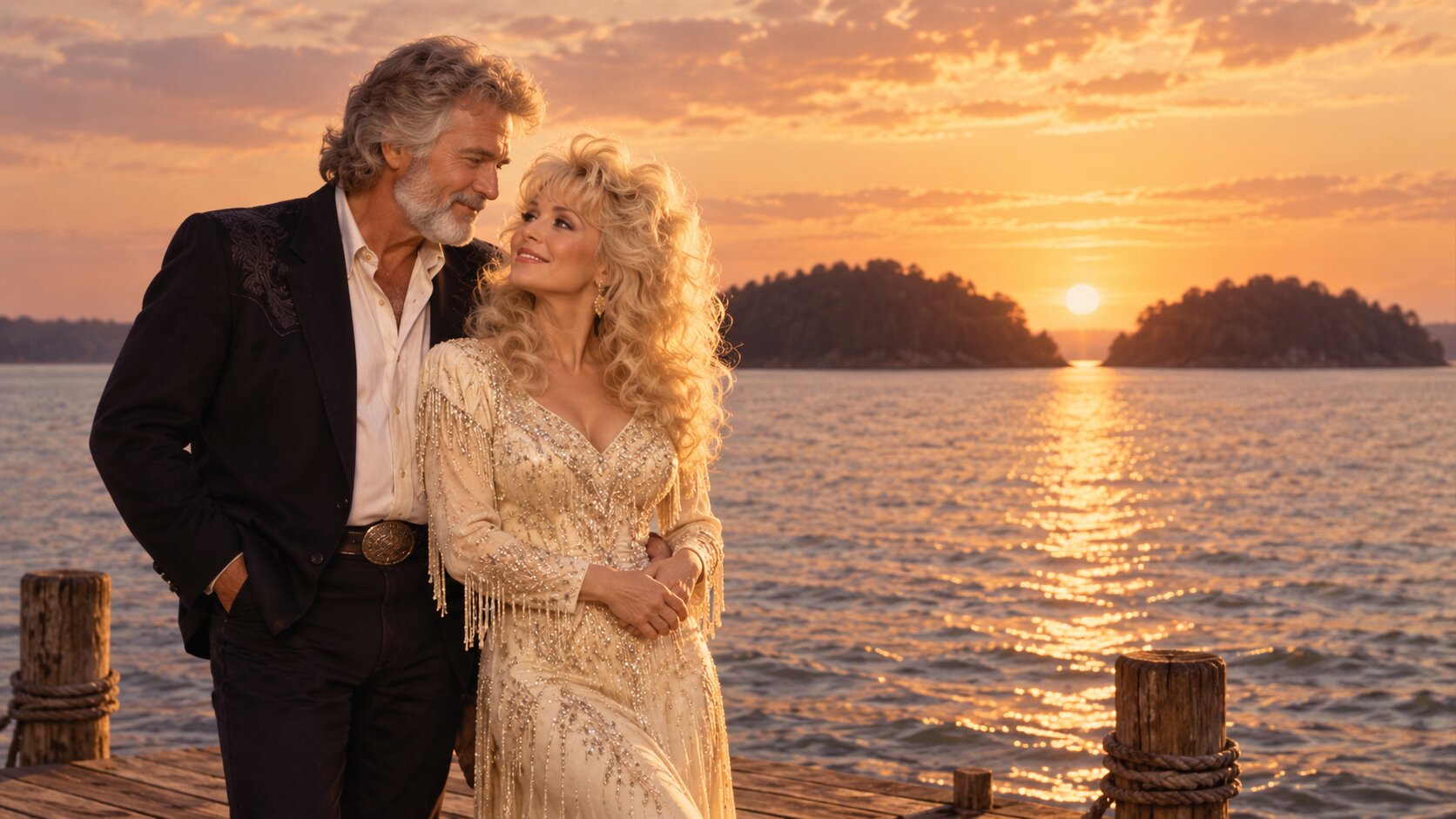
Islands in the Stream Meaning: Two Lovers Against the Current
Few romantic duets sound as uncomplicatedly joyful as “Islands in the Stream.” Yet beneath its bright melody and famous vocal chemistry, the song is built around a more interesting idea: love does not erase two separate people. Instead, it gives them something dependable to hold onto while the rest of life keeps moving.
Recorded by Kenny Rogers and Dolly Parton and written by Barry, Robin, and Maurice Gibb of the Bee Gees, the 1983 hit transformed a simple water metaphor into one of country-pop’s most recognizable declarations of mutual commitment.
A Love Song About Two People Choosing the Same Current
At its core, “Islands in the Stream” is about two lovers who see their relationship as a refuge from uncertainty, loneliness, and emotional pain.
The central image presents them as separate islands surrounded by moving water. They remain individual people, but there is no meaningful emotional distance between them. Their strength comes from mutual trust: neither partner is carrying the relationship alone.
That distinction matters. This is not primarily a song about pursuit, infatuation, or heartbreak. The lovers have already discovered their connection. The emotional question is what they will do with it once attraction becomes commitment.
The answer is mutual reliance. Throughout the song, love is connected with certainty, dedication, closeness, and the belief that two people can face an unstable world as long as they continue moving through it together.
From the Bee Gees to Kenny Rogers and Dolly Parton
“Islands in the Stream” was released in 1983 and became the lead single associated with Kenny Rogers’ album Eyes That See in the Dark. The album itself was released on August 22, 1983. The song was written by all three Bee Gees — Barry Gibb, Robin Gibb, and Maurice Gibb — while Barry Gibb, Albhy Galuten, and Karl Richardson handled the production. (Kenny Rogers Official Discography)
Those credits help explain why the record does not sit neatly inside conventional country music. Rogers and Parton were two of country’s biggest stars, but the Bee Gees brought a polished melodic sensibility shaped by pop, soft rock, soul, and R&B. The resulting recording could move naturally between country radio and mainstream pop.
The crossover worked spectacularly. “Islands in the Stream” reached No. 1 on the Billboard Hot 100 and also topped Billboard’s country and Adult Contemporary charts. Dolly Parton’s official career timeline notes that the single spent two weeks at No. 1 on the Hot 100. (Dolly Parton Official Website)
The famous duet also developed differently from the way the session originally began. Rogers later recalled that the recording was not fully working for him until Barry Gibb suggested bringing Dolly Parton into the studio. Parton happened to be nearby, and her arrival transformed the song into the conversational duet listeners now know. (The Washington Post)
The song also had R&B roots before becoming a country-pop duet. Different recollections have connected its early conception with Diana Ross or a Marvin Gaye-style approach, so it is safer to describe it as a song initially imagined with an R&B sensibility rather than claim that one specific singer was definitively supposed to record it.
Its title has a separate literary origin. “Islands in the Stream” was borrowed from the title of Ernest Hemingway’s posthumously published 1970 novel. There is no strong evidence, however, that the song’s romantic storyline is meant to retell Hemingway’s book. (Rhino)
The Real Emotional Center Is Mutual Reliance
The most important idea in “Islands in the Stream” is not simply romance. It is dependence freely chosen by both people.
Many love songs concentrate on desire: wanting someone, chasing someone, missing someone, or suffering because the other person is unavailable. This song begins after that initial uncertainty. These lovers have found each other, and their concern is how to preserve what they have.
The lyrics repeatedly connect love with dedication. That makes the relationship feel more deliberate than accidental. Attraction may have brought the couple together, but lasting intimacy requires both partners to participate.
The song also briefly imagines what life would feel like without that connection. Loneliness and emotional emptiness remain possible outcomes. The lovers understand what they could lose, which makes their confidence in the relationship feel more meaningful.
This creates a subtle tension beneath the cheerful production. The music sounds effortless, but the words imply that lasting love is valuable precisely because emotional security is never guaranteed.
Inside the Lyrics: How the Relationship Develops
The Opening: Someone Breaks Through the Defenses
The song begins with Kenny Rogers describing the effect another person has had on him. His perspective is vulnerable rather than commanding. Something about the relationship has changed his emotional state before he can fully explain why.
The imagery suggests attraction that is both emotional and physical. The new connection reaches beneath the surface and begins removing defenses that previously kept the narrator isolated.
As Dolly Parton enters the performance, the structure itself reinforces the story. What starts as one person describing his feelings becomes a conversation between two people who recognize the same bond.
The Build: Falling in Love Is Not Enough
Before the chorus delivers the song’s famous metaphor, the lyrics introduce the idea of dedication.
That is an important shift. The characters are not simply celebrating the fact that they fell in love. They recognize that maintaining the relationship requires intention.
Movement also begins to dominate the imagery. The song repeatedly suggests travelling, riding, sailing, and moving toward another place. Love is therefore not presented as a static shelter where nothing changes. It is something that allows the couple to move through change together.
The Chorus: Why the Island Metaphor Works
The chorus is built around an apparent contradiction. Islands usually symbolize isolation because they are physically separated from the surrounding world. Yet Rogers and Parton use islands to describe two people who insist that there is no meaningful distance between them.
That contradiction is what gives the metaphor its strength.
The lovers do not lose their individual identities. They remain two separate people. What connects them is trust, emotional intimacy, and a shared willingness to depend on each other.
The stream can therefore be interpreted as life itself: time, change, outside pressure, uncertainty, or circumstances neither person can fully control. The song never assigns the water one precise symbolic meaning, which allows the image to remain universal.
The invitation to sail away together extends the metaphor. Love becomes both a refuge and a means of movement. Their relationship gives them enough security to imagine travelling beyond their present circumstances rather than hiding from the world.
Dolly Parton’s Section: Imagining Love’s Absence
When Parton takes greater prominence, the lyrics briefly become more reflective. Instead of concentrating only on what love provides, this part considers what life would feel like without genuine connection.
Material success and ordinary activity are implicitly contrasted with emotional fulfillment. A person may continue functioning and accumulating things while still feeling that something essential has disappeared.
That possibility introduces a darker shade into an otherwise optimistic song. The couple’s bond matters not simply because being in love feels good, but because they understand the loneliness that could exist without it.
Parton’s voice also creates a more equal dramatic structure. The relationship is no longer being explained from only one side. Both partners reveal what they value and what they would risk losing.
The Next Promise: From Vulnerability to Commitment
After acknowledging the possibility of loneliness, the song moves decisively in the opposite direction. The couple make it clear that they are not planning to abandon what they have built.
Their language becomes increasingly permanent. Emotional vulnerability is converted into a promise: neither partner wants to cause the other more pain, and both treat the relationship as something intended to last.
In that sense, this portion of the song functions almost like a wedding vow. The characters have moved beyond describing desire and begun defining the responsibilities created by their love.
The Ending: Repetition as Reassurance
There is no dramatic narrative twist at the end of “Islands in the Stream.” Instead, the central refrain keeps returning.
That repetition makes sense because the emotional problem has already been resolved. These two people have chosen each other. There is no mystery left to solve.
Each return to the chorus therefore feels like reassurance rather than new information. The outside world may continue moving, but the promise between the two singers remains consistent.
The duet ends by repeating the same emotional compact it has spent the entire song establishing: two individuals, one shared direction.

Water, Distance, and the Song’s Hidden Contrasts
Although the imagery in “Islands in the Stream” is accessible, the song contains several contrasts that make its metaphor more sophisticated than it first appears.
Islands Usually Mean Isolation
An island is normally an image of separation. It exists apart from everything around it. By turning two lovers into islands, the song acknowledges their individuality rather than pretending that intimacy requires two people to become indistinguishable.
The romantic ideal here is therefore not complete fusion. It is closeness without the disappearance of personal identity.
The Water Moves While the Relationship Stays Steady
A stream never stops moving. The lovers, however, speak about their connection as something dependable.
This contrast creates one of the song’s most useful interpretations: circumstances change, but a strong relationship can provide continuity while those changes happen.
Sailing Combines Risk With Security
Sailing implies leaving stable ground. Ordinarily, that would increase uncertainty. In the song, the couple can take that risk precisely because they trust one another.
Love does not protect them by preventing movement. It gives them confidence to move.
Instinctive Attraction Becomes Deliberate Commitment
The early lyrics suggest an almost instinctive attraction, but the later parts repeatedly emphasize commitment and dedication.
The emotional arc therefore moves from something uncontrollable to something consciously maintained. Falling in love may happen unexpectedly; staying together is a choice.
Does Hemingway Explain the Song?
The Hemingway connection is real at the level of the title, but it should not be exaggerated.
Ernest Hemingway’s Islands in the Stream was published after his death in 1970, and the Bee Gees used its title for the song. However, there is no verified evidence that the Kenny Rogers and Dolly Parton recording is intended as a direct interpretation of the novel’s characters or plot. (Rhino)
The literary connection is better understood as a borrowed phrase that produced a memorable romantic metaphor. Trying to map individual lyrics onto Hemingway’s story would go beyond the available evidence.
Was “Islands in the Stream” About Kenny Rogers and Dolly Parton?
There is no evidence that the song documents a real romantic relationship between Kenny Rogers and Dolly Parton.
The Bee Gees wrote the song, and Rogers and Parton were performers interpreting its fictional romantic perspective. Their unusually convincing chemistry did, however, cause some listeners to wonder whether there was more to their relationship.
Rogers publicly discussed that chemistry while describing Parton as a close friend rather than a romantic partner. The affection audiences heard in their performances was genuine friendship and musical compatibility, not proof that the song was autobiographical. (CBS News)
That may actually help explain why the recording works so well. Rogers and Parton did not need the song to reflect their private lives in order to make its emotional exchange believable.
Why the Duet Became Bigger Than a Single Hit
For Kenny Rogers, “Islands in the Stream” fit naturally into a career already built around crossing the boundary between country and mainstream pop. Working with Barry Gibb and his production collaborators on Eyes That See in the Dark pushed that crossover approach even further.
Dolly Parton was following a similarly expansive path. By the early 1980s, her career extended well beyond traditional country music through major pop records, film roles, television appearances, and increasingly broad international recognition.
The success of “Islands in the Stream” also established Rogers and Parton as a recurring musical partnership. They later recorded the holiday album Once Upon a Christmas, reunited for “Real Love,” and eventually recorded “You Can’t Make Old Friends” decades later.
Parton’s official discography describes “Real Love” as reuniting the pair after the success of “Islands in the Stream,” reinforcing how strongly the earlier duet had become associated with both artists. (Dolly Parton Official Website)
Why “Islands in the Stream” Still Feels Convincing
The meaning of “Islands in the Stream” can ultimately be reduced to one promise: two people choose to rely on each other while everything around them remains capable of changing.
What gives that simple idea depth is the progression behind it. Attraction creates vulnerability. Vulnerability creates a need for trust. Trust develops into dedication, and dedication allows the couple to imagine a future together.
The island metaphor captures that progression particularly well because it preserves both independence and closeness. Rogers and Parton remain distinct voices throughout the recording, yet its most memorable moments arrive when those voices meet.
That is why the duet format is essential to the song rather than merely decorative. A solo singer could describe reciprocal love. Kenny Rogers and Dolly Parton allow the listener to hear both sides answering each other.
More than four decades after its release, that sense of reciprocity remains the song’s central appeal. “Islands in the Stream” is not simply about finding somebody. It is about finding somebody with whom uncertainty becomes easier to face.
FAQs About “Islands in the Stream”
What does “Islands in the Stream” mean?
Who wrote “Islands in the Stream”?
What album is “Islands in the Stream” from?
Is “Islands in the Stream” based on a true story?
Were Kenny Rogers and Dolly Parton a couple?
Why is the song called “Islands in the Stream”?
Was “Islands in the Stream” originally written for another singer?
How successful was “Islands in the Stream”?
Sources Used
- Kenny Rogers Official Website – discography and Eyes That See in the Dark information
- Dolly Parton Official Website – 1980s career timeline and “Islands in the Stream” chart information
- The Washington Post – Kenny Rogers and Dolly Parton’s friendship and the recording of “Islands in the Stream”
- Rhino – background, chart history, and Hemingway title connection
- CBS News – Kenny Rogers on his relationship and chemistry with Dolly Parton
- Dolly Parton Official Website – Real Love and the later Rogers-Parton collaboration