


Music streaming vs downloads: which saves you more in 2026
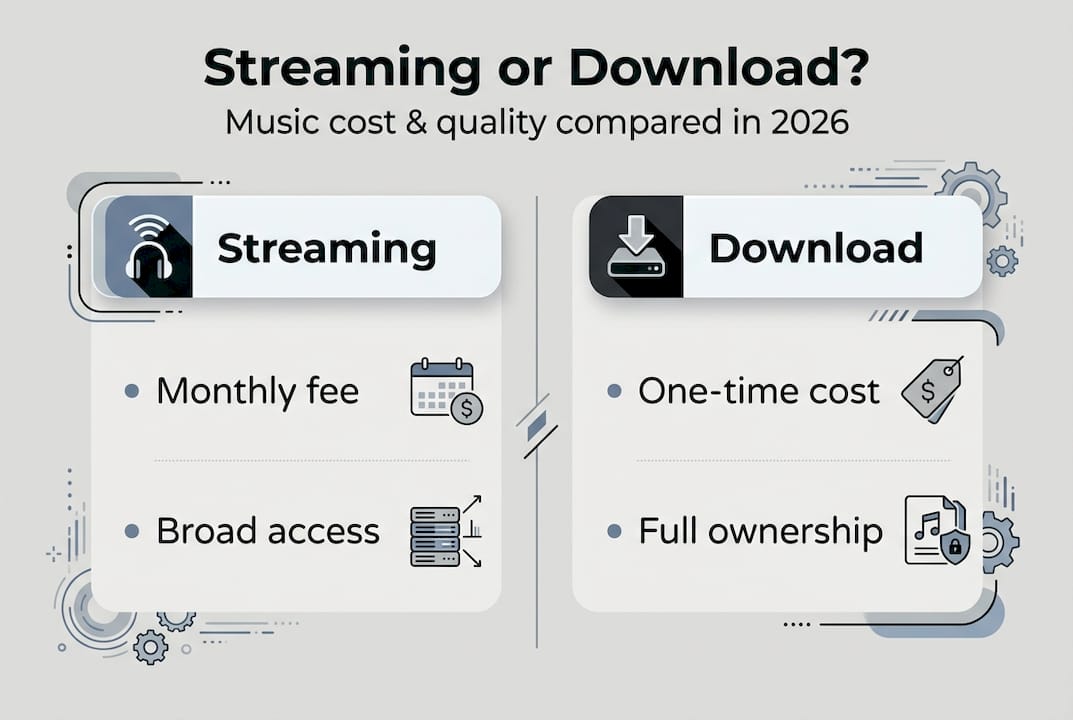
Many music fans believe streaming is always cheaper and more convenient than downloads, while others assume downloads are obsolete in the subscription era. The truth is more nuanced, and your ideal choice depends on listening habits, audio quality preferences, and how you value ownership. Casual listeners prioritize convenience, artists evaluate distribution revenue, and audiophiles demand fidelity. This guide breaks down the real advantages and trade-offs of streaming versus downloads across cost, quality, artist impact, and long-term value so you can make an informed decision for your music needs.
Table of Contents
- Key takeaways
- Understanding music streaming: convenience and cost
- Why music downloads still matter: ownership and audio quality
- Audio quality comparison: streaming compression versus download fidelity
- Artist impact and revenue: streaming royalties versus download sales
- Explore music distribution options with blocktone records
- FAQ
Key Takeaways
| Point | Details |
|---|---|
| Convenience and access | Streaming offers instant access to millions of tracks and offline caching but relies on subscription and internet connectivity. |
| Ownership and cost | Downloads grant permanent ownership and typically offer higher fidelity without ongoing costs, making them cost effective if you buy few albums. |
| Audio quality gap | Lossless and hi resolution formats are available with downloads while streaming compresses audio to save bandwidth and may miss subtle details. |
| Artist earnings | Streaming pays fractions per play whereas downloads provide upfront sales revenue, affecting artist compensation under each model. |
| Data and battery efficiency | Streaming uses more data and drains battery faster over time, whereas local downloaded files use less data and conserve power. |
Understanding music streaming: convenience and cost
Music streaming transformed how we consume audio by delivering extensive catalogs instantly through internet connections. Services like Spotify, Apple Music, and Amazon Music offer tens of millions of tracks accessible from any device with a subscription. You search, tap, and listen without managing files or storage. Streaming provides convenience with vast libraries and offline caching, but relies entirely on internet connectivity and active subscriptions.
Offline caching allows limited access without live connections. Most services let you download playlists to your device for airplane mode or areas with poor signal. However, cached files remain encrypted and tied to your subscription. Cancel your account, and those downloads vanish. This model suits listeners who want variety without commitment to individual albums but accept ongoing payments for access.
Subscription fees are mandatory and recurring. Individual plans typically cost $10-12 monthly, family plans $15-20, and student discounts around $5. Over a year, that’s $60-144 per person. Compare this to purchasing albums at $10-15 each: if you buy fewer than six albums yearly, downloads cost less. If you explore dozens of artists monthly, streaming offers better value. The math shifts based on your listening breadth.
Data and battery consumption patterns vary across platforms. Streaming at 320kbps uses roughly 2.4MB per minute, or 144MB per hour. A daily hour-long commute consumes over 4GB monthly. Battery drain increases because your device constantly decodes compressed audio and maintains network connections. Offline playback from cached files reduces data use but still drains battery faster than local file playback from downloads.
Pro tip: monitor your monthly data usage in streaming app settings. Switch to lower quality on cellular networks (128kbps) to preserve data caps, and reserve high quality for Wi-Fi or offline cached listening.
Why music downloads still matter: ownership and audio quality
Music downloads grant permanent ownership without dependency on subscriptions or internet access. When you purchase a track or album as an MP3, FLAC, or WAV file, it’s yours indefinitely. You can play it on any compatible device, back it up to external drives, and transfer it freely. Downloads offer permanent ownership and potential higher fidelity without ongoing costs, making them ideal for collectors and listeners who value control.
Lossless and hi-res audio formats deliver superior sound fidelity for audiophiles. Downloads allow lossless formats like FLAC at 1411kbps (CD quality) or hi-res files up to 9216kbps, preserving every detail the artist recorded. Streaming services compress audio to save bandwidth, sacrificing subtle nuances in complex passages. If you own high-end headphones or speakers, downloads unlock their full potential.
Local playback conserves battery and data compared to streaming. Downloads use 19-23% less battery for local playback because your device reads files directly from storage instead of decoding compressed streams over network connections. No data charges apply once files are downloaded. For frequent travelers or users with limited data plans, this advantage compounds over time.

Ideal scenarios for downloads include offline environments, low-bandwidth situations, and critical listening sessions. Airplane trips, rural areas with spotty coverage, and gym workouts in basement facilities all favor local files. Audiophiles conducting A/B comparisons or mixing music professionally need uncompressed sources. Downloads also future-proof your collection: if a service removes an album or artist, your files remain intact.
Pro tip: use VLC Media Player or foobar2000 for maximum format compatibility. Both handle FLAC, ALAC, WAV, and obscure formats seamlessly across Windows, Mac, and mobile platforms, ensuring your downloaded library plays anywhere.
Audio quality comparison: streaming compression versus download fidelity
Streaming services compress audio to balance quality and bandwidth efficiency. Spotify uses 320kbps Ogg Vorbis, Apple Music delivers 256kbps AAC, and YouTube Music streams 256kbps AAC. These lossy formats discard inaudible frequencies to shrink file sizes. For casual listening on standard earbuds or laptop speakers, the difference from CD quality is negligible. Compression artifacts become noticeable only on high-end audio equipment during quiet passages or complex orchestral arrangements.
Downloads support lossless and hi-res formats that preserve original recording fidelity. FLAC files at 1411kbps match CD quality bit-for-bit. Hi-res downloads reach 24-bit/192kHz (4608kbps) or even 24-bit/384kHz (9216kbps), capturing ultrasonic frequencies and greater dynamic range. Audiophiles claim these formats reveal spatial depth, instrument separation, and subtle reverb tails lost in compression. Whether you perceive the difference depends on your hearing acuity, playback equipment, and listening environment.
| Format | Bitrate | Quality Level | Use Case |
|---|---|---|---|
| Spotify/Apple Music | 256-320kbps | Lossy compressed | Casual listening, mobile |
| CD/FLAC | 1411kbps | Lossless | Audiophile, archival |
| Hi-res FLAC | 2304-9216kbps | Studio master | Critical listening, production |
| Tidal/Qobuz streaming | Up to 9216kbps | Lossless/hi-res | Premium streaming with compatible hardware |
Lossless streaming services like Tidal and Qobuz offer up to 24/192 FLAC or ALAC, matching download quality. However, they require compatible digital-to-analog converters (DACs), high-quality headphones or speakers, and stable high-speed internet. Buffering issues or network throttling degrade the experience. Downloads eliminate these variables by storing files locally.
Blind listening tests reveal interesting perceptual limits. MP3 at 320kbps is often indistinguishable from FLAC in controlled studies with trained listeners. The human ear struggles to detect differences above 256kbps in typical listening conditions. Placebo effects and expectation bias influence perceived quality more than actual bitrate. That said, archival purposes and professional use cases justify lossless formats regardless of perceptual thresholds.
Pro tip: conduct your own blind test using Foobar2000’s ABX plugin. Rip a favorite track to FLAC and 320kbps MP3, then compare on your best headphones. If you can’t reliably identify the lossless version, save money and storage with high-quality compressed downloads or streaming.
Artist impact and revenue: streaming royalties versus download sales
Artists earn vastly different amounts from streaming versus downloads due to contrasting revenue models. Streaming pays $0.003-$0.005 per play on Spotify, with Apple Music slightly higher at $0.01 per stream. These micro-royalties get pooled, then split among rights holders, labels, and distributors. An artist needs roughly 250,000 streams to earn $1,000. Downloads generate revenue from direct sales: a $10 album sale might net the artist $7 after platform fees, providing immediate income without requiring millions of plays.
Streaming favors popular back-catalog tracks and chart-topping hits due to algorithmic biases. Platforms prioritize songs with high engagement, creating winner-takes-all dynamics. Streaming dominates 69-84% of recorded music revenue, but 120 million tracks receive fewer than 10 streams yearly, effectively demonetizing most independent releases. Algorithms push mainstream content, making discovery harder for emerging artists without label backing or viral momentum.
Independent artists face structural challenges with streaming revenue models. Without marketing budgets or playlist placements, new releases struggle to accumulate meaningful play counts. A self-released album might earn $50-200 from streaming over its first year, barely covering production costs. Downloads offer better margins for niche audiences: selling 100 albums at $10 each generates $700 after fees, versus needing 175,000 streams to match that income.
| Scenario | Streaming Revenue | Download Revenue |
|---|---|---|
| 1,000 plays/sales | $3-5 | $7,000 |
| 10,000 plays/sales | $30-50 | $70,000 |
| 100,000 plays/sales | $300-500 | $700,000 |
Revenue concentration means most artists earn little from streaming while superstars rake in millions. The top 1% of artists capture over 90% of streaming royalties. Downloads democratize income by rewarding direct fan support. A loyal fanbase of 500 people buying an album outearns 500,000 casual streams from algorithm-driven playlists.
Combining both models optimizes income streams for independent musicians. Streaming builds audience reach and discovery, while downloads and merchandise convert engaged fans into direct revenue. Artists can offer exclusive download bonuses, lossless versions, or bundled content to incentivize purchases. Music distribution channels and supporting emerging artists become critical strategies in this hybrid approach.
Fans who want to support artists financially should prioritize downloads, concert tickets, and merchandise over passive streaming. Even using platforms like Spotify playlist planning tools to boost streams helps, but direct purchases deliver far greater impact per transaction.
Explore music distribution options with blocktone records
Navigating the streaming versus download landscape requires informed strategies, especially for independent artists seeking sustainable revenue. Blocktone Records empowers musicians by providing comprehensive resources to distribute, monetize, and promote their work across multiple channels. Whether you’re evaluating streaming platforms, optimizing download sales, or building direct fan relationships, understanding distribution mechanics is essential.
Our music distribution tips for independent artists guide breaks down platform comparisons, royalty structures, and promotional tactics to maximize your reach. Explore what is music streaming to understand algorithmic discovery and playlist pitching. For artists focused on connecting with engaged listeners, music discovery for artists offers actionable frameworks to build authentic audiences. Blocktone Records bridges the gap between artistic vision and commercial success, helping you make strategic choices that align with your goals.
FAQ
Is streaming audio quality good enough for most listeners?
Yes, most listeners find 320kbps streaming comparable to CD quality in casual environments using standard headphones or speakers. Compression artifacts become noticeable only on high-end audio equipment during critical listening sessions. Lossless downloads or hi-res streaming suit audiophiles with compatible hardware who demand maximum fidelity.
Can I listen to downloaded music offline without internet?
Absolutely. Downloads play anytime without relying on internet connections or active subscriptions. You own the files permanently and control playback across any compatible device. Streaming offers offline mode through cached files, but those remain encrypted and disappear if you cancel your subscription.
Which option benefits independent artists more financially?
Downloads provide upfront revenue per sale, avoiding streaming’s low per-stream rates that require hundreds of thousands of plays to generate meaningful income. Streaming helps reach broader audiences through algorithmic discovery but dilutes earnings for less popular artists. Combining both models optimizes income: streaming builds awareness while downloads and supporting emerging artists directly convert fans into revenue.
Do downloads really use less battery than streaming?
Yes, local playback from downloaded files uses 19-23% less battery because your device reads files directly from storage instead of decoding compressed streams over network connections. Streaming constantly maintains internet connectivity and processes data in real time, increasing power consumption. For frequent mobile listening, downloads extend battery life noticeably.
Are streaming subscriptions cheaper than buying music?
It depends on your listening volume. Streaming costs $60-144 yearly per person for unlimited access. If you explore dozens of new artists monthly, streaming offers better value. If you listen to a small core collection and buy fewer than six albums yearly, downloads cost less long-term with permanent ownership and no recurring fees.