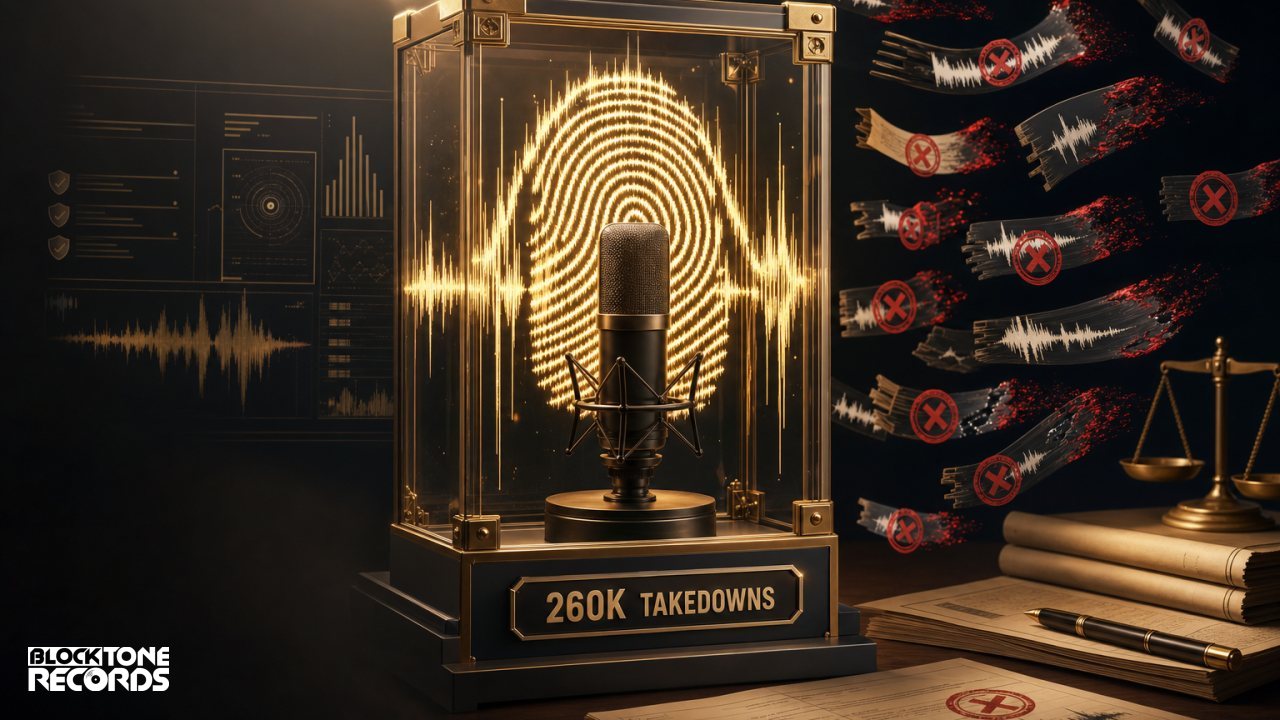
Sony Music’s 260,000 AI Deepfake Takedowns: What It Means for Artist Voice and Likeness Rights
Sony Music’s reported AI-deepfake enforcement numbers have become large enough to describe an operational problem rather than an occasional abuse. By the end of September 2026, the company had asked platforms to remove more than 260,000 AI-generated tracks impersonating its artists, nearly twice the 135,000 requests it had reported at the end of March 2026. The number is striking, but its meaning needs discipline: it counts requests, not confirmed removals, successful legal claims or necessarily 260,000 unique works.
That distinction does not make the figure less important. It identifies a workload created by scalable imitation—one that cannot always be resolved by asking the familiar copyright question of whether a protected recording or composition was copied. A convincing synthetic vocal can trade on the market value of an artist’s identity even where the rights analysis around the musical material is uncertain or incomplete. Sony’s response is consequently two-track: pursue unauthorized replicas while also seeking AI products built on consent and compensation.
Sony Music’s 260,000 requests measure an enforcement workload, not 260,000 proven infringements
The trajectory is steep. Sony reported more than 20,000 AI-content takedowns during calendar year 2023 in its 2024 investor presentation. By March 2025, it said it had made more than 75,000 takedown requests. The later figures—135,000 by the end of March 2026 and more than 260,000 by the end of September—show an accelerating volume of alleged impersonation material reaching platforms. The 2023 and March 2025 figures are set out in Sony Group Corporation’s investor materials; the September 2026 total was reported by Music Business Worldwide.
It would be a mistake, however, to treat the total as a court-tested infringement count. A request is an assertion to a platform, not a judicial finding. The available figure also does not establish how many requests concerned duplicate uploads, how many resulted in removal, or which legal right supplied the basis for each demand. It is evidence of reporting and enforcement activity, not a clean census of infringing tracks.
That limitation points to the more revealing issue. At this scale, removal systems can become a recurring response to material that can be generated and redistributed quickly. The statistic therefore measures the burden of identifying and contesting apparent impersonation as much as it measures the prevalence of any one legally defined violation.
An AI replica can trigger rights that a conventional copyright takedown does not settle
A fake artist track can involve a stack of distinct interests. There may be rights in an underlying composition, rights in a particular sound recording, contractual interests affecting how recordings or performances can be used, and interests in the artist’s voice, likeness or commercial identity. Those categories do not automatically belong to the same party, operate in the same jurisdiction or receive the same legal treatment.
This is why the question cannot be reduced to whether an AI output copied a master recording. A generated vocal that evokes a performer may raise a claim about commercial identity even if it does not reproduce a specific protected recording. Conversely, a track can raise composition or recording issues without necessarily establishing a separate claim over a voice. The practical facts—what was used to make the output, what the output contains, how it is presented and where it is exploited—matter to the analysis.
In its UK consultation, the government expressly asked whether existing law adequately protects people from digital replicas and whether further intervention is needed. Sony’s submission framed unauthorized replicas as an issue extending beyond ordinary sound-recording copyright to control over voice, likeness and commercial identity. That framing appears in the UK government consultation on copyright and AI.
For artists and rightsholders, this is not merely a theoretical taxonomy. Copyright may provide a route in some cases, but it is not a universal substitute for a clearly defined right against an unauthorized marketable replica. Nor should this analysis be read as legal advice: the available claims and remedies depend on jurisdiction and specific facts.
The UK and U.S. offer no single nationwide answer to artist voice cloning
In the United Kingdom, the government’s 2026 report on copyright and AI concluded that a broad copyright exception with an opt-out was no longer its preferred approach. That is a significant policy direction, but it did not create a universal regime governing voice and likeness. The report itself underscores that copyright-policy choices and protection for digital replicas are related but not interchangeable questions. The March 18, 2026 UK report is consequently a constraint on one proposed copyright route, not a comprehensive answer to artist impersonation.
The United States is similarly fragmented, though in a different way. It still lacks a comprehensive federal right governing unauthorized AI replicas of voice and likeness. The proposed NO FAKES Act of 2024, introduced as H.R. 9551, would create a federal property right in a person’s voice and visual likeness and impose liability for unauthorized digital replicas. But a bill is not enacted law; the proposal cannot be described as a current nationwide protection. Its text is available through Congress.
Tennessee provides a narrower illustration of the state-level response. Its ELVIS Act, Public Chapter 588, expanded the state’s publicity-rights framework to protect an individual’s voice and covers unauthorized commercial use. That is meaningful within its jurisdiction, but it does not establish a national rule for an artist, platform or AI developer operating across state and national borders. The Tennessee General Assembly’s 2024 legislative abstract records the measure’s place in that state framework.
The resulting gap is commercial as well as legal. An artist’s recognisable voice can be central to the value of a recording, yet the authority to license, challenge or monetize that identity may not map neatly onto ownership of a master or a publishing interest.
Sony’s enforcement campaign sits alongside a consent-and-compensation AI strategy
Sony’s December 2025 announcement of Klay’s AI licensing deals with Sony Music Publishing, Universal Music Publishing Group and Warner Chappell places the takedown campaign in a broader commercial context. Sony has pursued licensing discussions and partnerships for AI music experiences involving consent and compensation for artists, songwriters and rightsholders, so the campaign does not establish opposition to generative AI generally. The company’s announcement presents enforcement and licensing as part of the same approach.
What matters in the dispute is not simply that an output was generated with AI. It is whether the use of music, voice or identity was authorized and on what terms: licensed products can be organized around permission and payment, whereas unauthorized replicas may try to capture an established artist association without them.
That leaves a narrower legal question beyond any individual deal. Private licensing covers only its parties and specified uses; it cannot by itself determine who has authority over a recognizable artist identity in every case.
The unresolved question is who can authorize a marketable artist identity
Platform removals are useful as a practical response, but they are not a universal rule of entitlement. Sony’s 260,000-request figure shows how often the company believes intervention is necessary; it does not resolve whether copyright, contract, publicity rights or another theory governs each alleged replica. The UK has not established a universal voice-and-likeness regime, while the U.S. remains without the comprehensive federal replica right contemplated by the unenacted NO FAKES Act.
That leaves a central mismatch. AI licensing can create consent-and-compensation structures for participating artists, songwriters and rightsholders. But the legal system remains uneven on the more basic question exposed by synthetic impersonation: who may authorize a commercially exploitable voice or likeness when a platform, creator and audience operate across jurisdictions?