Sync Licensing Basics for Independent Artists
Sync licensing allows music to be licensed for use alongside visual media such as films, television shows, advertisements, games, trailers, and online productions. A commercially released track normally involves separate rights in the underlying musical composition and the specific sound recording. (U.S. Copyright Office)
For independent artists, one of the biggest advantages is often simple administration: clear ownership, accurate metadata, professional audio files, useful alternate mixes, and the ability to approve a license quickly can make a catalog substantially easier to work with.
Introduction
A song does not need millions of streams to be valuable to a filmmaker, television producer, game studio, advertising agency, or music supervisor. It needs to fit the scene, and the people licensing it need to know that the necessary rights can actually be cleared.
That makes sync licensing particularly interesting for independent artists. A placement can create licensing income, introduce a song to listeners in a completely different setting, and give existing catalog material another commercial purpose. However, sync is not simply a matter of uploading tracks to a music library and waiting for a major television placement.
Copyright ownership, songwriter splits, master rights, metadata, samples, alternate mixes, usage terms, and communication all influence whether a track is genuinely ready for licensing.
This guide explains the practical side of sync licensing: what is being licensed, how to prepare your catalog, what music supervisors and licensing teams need, what to examine in a deal, and how independent artists can approach sync opportunities without treating them as a lottery ticket.
Table of Contents
- What a Sync License Actually Covers
- Make Your Rights Clear Before Your Music Leaves Your Inbox
- Build a Catalog That Is Easy to Place
- Pitch the Scene, Not Your Streaming Numbers
- Read the License Before You Celebrate the Placement
- A Placement Can Create More Than One Revenue Stream
- Choose Your Sync Pipeline Deliberately
- Build a More Licenseable Catalog with BlockTone Records
- Frequently Asked Questions
Key Takeaways
| Point | Details |
|---|---|
| Two copyrights may require clearance | A released song normally involves separate rights in the underlying composition and the specific sound recording. |
| Ownership speed matters | A strong track can become difficult to license when nobody can quickly confirm who controls the required rights. |
| Metadata is part of the product | Writer splits, publishers, master ownership, performing rights affiliations, and clearance contacts should be organized before pitching. |
| Alternate versions improve flexibility | Instrumentals, clean versions, stems, and useful edits can make a song easier to place around dialogue and visual edits. |
| Sync fees are deal-specific | Compensation depends on the production, type of use, duration, media, territory, term, and other negotiated rights. |
| A placement may generate additional royalties | Certain audiovisual uses can also generate public-performance royalties for songwriters and publishers when properly documented. |
What a Sync License Actually Covers
The first concept every independent artist should understand is that one released track can contain two different copyrighted works.
The musical composition is the underlying song: its melody, lyrics, harmony, and other compositional elements. The sound recording, often called the master, is the particular recorded performance of that composition. These are legally distinct works and can have completely different owners. (U.S. Copyright Office)
When an existing recording is synchronized with film, television, advertising, or other visual media, two permissions are therefore commonly relevant.
| Right | What It Covers | Typical Controlling Party |
|---|---|---|
| Synchronization license | Permission to synchronize the underlying composition with visual media | Songwriter, publisher, or publishing administrator |
| Master use license | Permission to use the specific recorded master | Artist, label, or other master owner |
ASCAP similarly explains that filmmakers using prerecorded music generally need permission covering both the composition and the master recording. (ASCAP)
If you wrote, produced, recorded, and released a song yourself while retaining complete ownership, clearance may be relatively straightforward. If the composition has several writers, a publisher controls one share, a label owns the master, and the recording contains a sample, approval can become much more complicated.
That is why clearance can influence which song ultimately gets selected. Two tracks may fit a scene equally well, but the one with transparent ownership and an available decision-maker can be much easier for a production team to license.
Pro Tip: Treat rights administration as part of sync preparation, not as paperwork to solve after somebody requests the song.
Make Your Rights Clear Before Your Music Leaves Your Inbox
Music supervisors, production teams, agencies, and licensing representatives often work against deadlines. A great track becomes less practical when it takes days to determine who can authorize its use.
Before actively pitching a song, document the essential rights information in one place.
- Every songwriter and their ownership percentage
- Publishers or publishing administrators
- Relevant performing rights organization affiliations
- The owner of the master recording
- The percentage of the master you control
- The person authorized to approve a license
- Current clearance contact information
- Any samples, interpolations, or other third-party material
Professional sync platform DISCO recommends including information such as writer splits, publishers, rights ownership, and clearance contacts when preparing tracks for sync pitching. (DISCO)
Understand What “One-Stop” Means
A track may be described as one-stop when one party can authorize all of the relevant master and publishing rights instead of forcing the licensee to contact several owners separately.
For an independent artist who genuinely controls both sides of a release, that can be a practical advantage. It reduces the number of people involved in approval and makes it easier to give a fast answer when a licensing request arrives.
However, never describe a song as one-stop simply because you are the performing artist. A producer could own part of the master. A co-writer may have transferred publishing administration. A sample could require separate permission.
Verify the actual contracts and ownership before making clearance claims.
Build a Catalog That Is Easy to Place
Sync readiness is partly creative and partly logistical. A supervisor can love the complete vocal version of a song and still discover that it is difficult to use because important lyrics clash with dialogue or the arrangement has no natural edit point.
Preparing useful alternatives gives editors more flexibility without requiring you to rebuild a recording session after a request arrives.
Create a Sync Delivery Folder
For each track you intend to pitch seriously, keep an organized folder containing the materials that may be requested.
- Full-resolution WAV master
- Instrumental version
- Clean version when relevant
- Useful alternate mix or reduced-vocal version
- Stems when appropriate
- Lyrics
- BPM and key
- Songwriter and publisher information
- Master ownership details
- Clearance contact information
Not every opportunity will require all of these files. The objective is readiness. If someone needs an instrumental immediately, you should not have to locate an old session, reopen plugins, and create the first instrumental export months after release.
Give Editors Places to Work
A sync-friendly arrangement does not need to sound like generic production music. However, editors benefit from identifiable transitions, clean openings, definite endings, instrumental passages, breaks, drops, and other moments where picture can change direction.
Listen to your track as an editor might. Could someone find a useful 15-second, 30-second, or 60-second passage without making the song feel abruptly damaged?
If not, the recording is not necessarily unsuitable for sync. It may simply offer less flexibility for certain types of placements.
Pitch the Scene, Not Your Streaming Numbers
Artists naturally introduce songs through achievements: streaming totals, press coverage, playlist placements, tour history, or previous collaborations.
Those details can support credibility, but sync decisions usually begin with a more immediate question: does this music solve the creative problem in the scene?
A brief could ask for restrained electronic tension, nostalgic indie rock, intimate acoustic vocals, aggressive instrumental hip-hop, celebratory pop, dark cinematic ambience, or another very specific combination of mood, tempo, lyrical theme, instrumentation, and production style.
Your submission should make the relevant characteristics obvious quickly.
- Genre or sonic style
- Mood
- Tempo
- Vocal type
- Lyrical subject
- Comparable sonic territory when genuinely useful
- Availability of an instrumental
- Whether explicit lyrics are present
- Who controls the rights
- Whether clearance can happen through one contact
Do Not Send Your Entire Catalog
If a brief asks for tense minimalist electronic music, send the strongest tracks that genuinely meet that description. Do not add an acoustic love song merely because you want someone to hear it.
Sending a small number of highly relevant tracks demonstrates that you understood the request. Sending dozens of unrelated songs transfers the filtering work back to the recipient.
Pro Tip: A focused three-track submission that matches the brief is usually more useful than a playlist containing everything you released during the last five years.
Read the License Before You Celebrate the Placement
A message saying that a production wants to use your song is exciting, but it is not the point where you should stop asking questions.
There is no universal fixed sync fee. ASCAP notes that fees are negotiated and can depend on matters such as how music is used, the duration of the use, the number of uses, and where a production will be exhibited. (ASCAP)
Review the actual scope of the license, including:
- Media: television, theatrical film, streaming, online advertising, games, trailers, social media, or other formats
- Territory: a specific country, region, or worldwide
- Term: a limited period or potentially perpetual use
- Type of use: background, featured use, opening titles, trailer, advertisement, or another context
- Exclusivity: whether competing or related uses are restricted
- Edit rights: what the licensee is permitted to do when adapting the track to picture
- Fee: what is being paid for the rights granted
A small fee is not automatically a poor deal, and a large fee is not automatically a good one. The commercial scope matters.
A narrowly defined student film and a worldwide advertising campaign may both involve synchronization, but the rights requested and potential value are very different.
If a contract involves substantial money, broad exclusivity, unusual ownership language, or long-term restrictions, consider obtaining professional legal advice before signing.
A Placement Can Create More Than One Revenue Stream
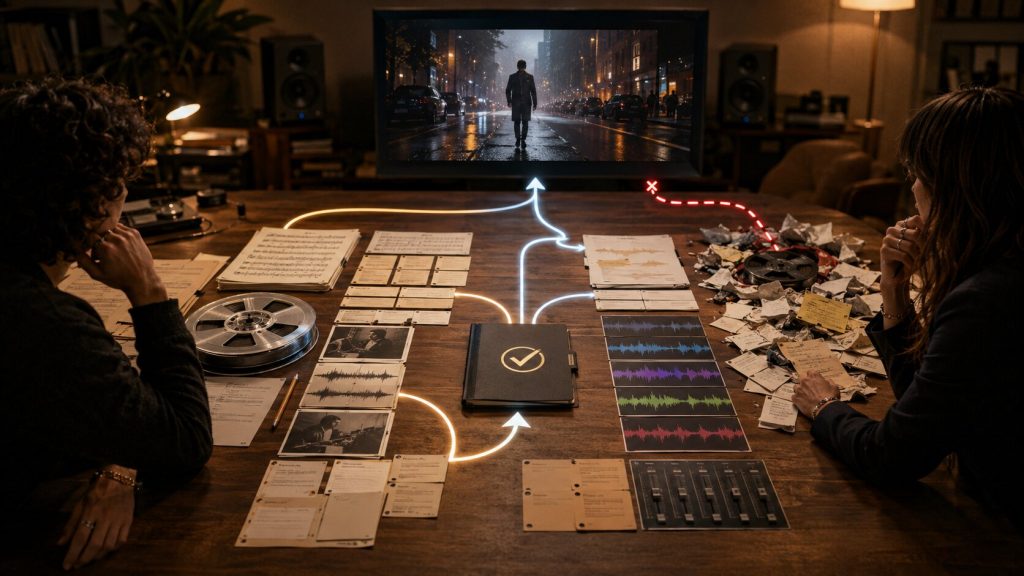
The upfront synchronization fee is the most visible source of income from a placement, but it may not always be the only one.
In qualifying film and television contexts, public performances of the composition may also generate performance royalties for songwriters and publishers. Performing rights organizations use documentation called cue sheets to help identify music appearing in audiovisual productions. (ASCAP Cue Sheet Guidance)
A cue sheet can contain information such as:
- Production or episode title
- Song or cue title
- Composer information
- Publisher information
- Ownership shares
- Duration of the music use
- Type of use
This also highlights an important distinction for beginners. Registering music with a performing rights organization does not normally mean that the organization is granting synchronization permission on your behalf. BMI, for example, explains that it licenses public performing rights rather than synchronization rights. (BMI)
After a significant broadcast placement, keep accurate records of the production and make sure the relevant compositions, ownership information, and registrations are correct with the organizations administering your rights.
Choose Your Sync Pipeline Deliberately
There is no single route into the sync business. Independent artists can encounter opportunities through libraries, representatives, marketplaces, publishers, labels, managers, and direct industry relationships.
Music Libraries
Music libraries maintain catalogs that production companies and other buyers can search for suitable tracks. Agreements vary substantially, so review commission structures, exclusivity, contract duration, territories, and the specific rights the library is authorized to license.
Sync Agents and Licensing Representatives
A sync representative may actively pitch selected music to supervisors, agencies, production companies, brands, or other buyers.
The potential advantage is access to established relationships and active pitching. The trade-off may include a commission, representation rights, exclusivity, or contractual restrictions on where the same songs can be represented elsewhere.
Licensing Marketplaces
Some platforms allow rights holders to make music available for licensing or submit songs to relevant opportunities. Songtradr, for example, operates music licensing and artist-service offerings connected to uses across audiovisual media. (Songtradr)
Direct Relationships
Artists, managers, publishers, and labels can also develop direct relationships with music supervisors, editors, agencies, and production teams.
This approach rewards relevance and patience. Avoid collecting hundreds of names and sending identical unsolicited emails. Research what a person actually works on, follow any stated submission policy, and contact them when your catalog genuinely fits their work.
Be Careful with Exclusive Agreements
Exclusivity is not automatically good or bad. It depends on exactly what the contract restricts and what the representative offers in return.
Before signing, determine:
- Which songs are covered?
- Which territories are included?
- How long does the agreement last?
- Can you terminate the agreement?
- Can the same songs be pitched elsewhere?
- Who has authority to approve licenses?
- What percentage of licensing revenue does the representative retain?
Maintain an internal catalog spreadsheet or rights-management system showing where each track is represented. Accidentally granting conflicting rights to multiple companies can create clearance problems precisely when a useful opportunity arrives.
Build a More Licenseable Catalog with BlockTone Records
Sync readiness starts before a licensing request appears. Strong recordings, complete credits, organized rights information, professional audio assets, and disciplined catalog management all make an independent artist easier to work with.
BlockTone Records publishes practical resources for independent musicians who want to approach releases, promotion, rights, and long-term career development more strategically. Use these guides alongside your sync preparation so that both the music and the business surrounding it are ready when a genuine opportunity appears.