
Turn a Song Link Into a Story Fans Remember
TL;DR
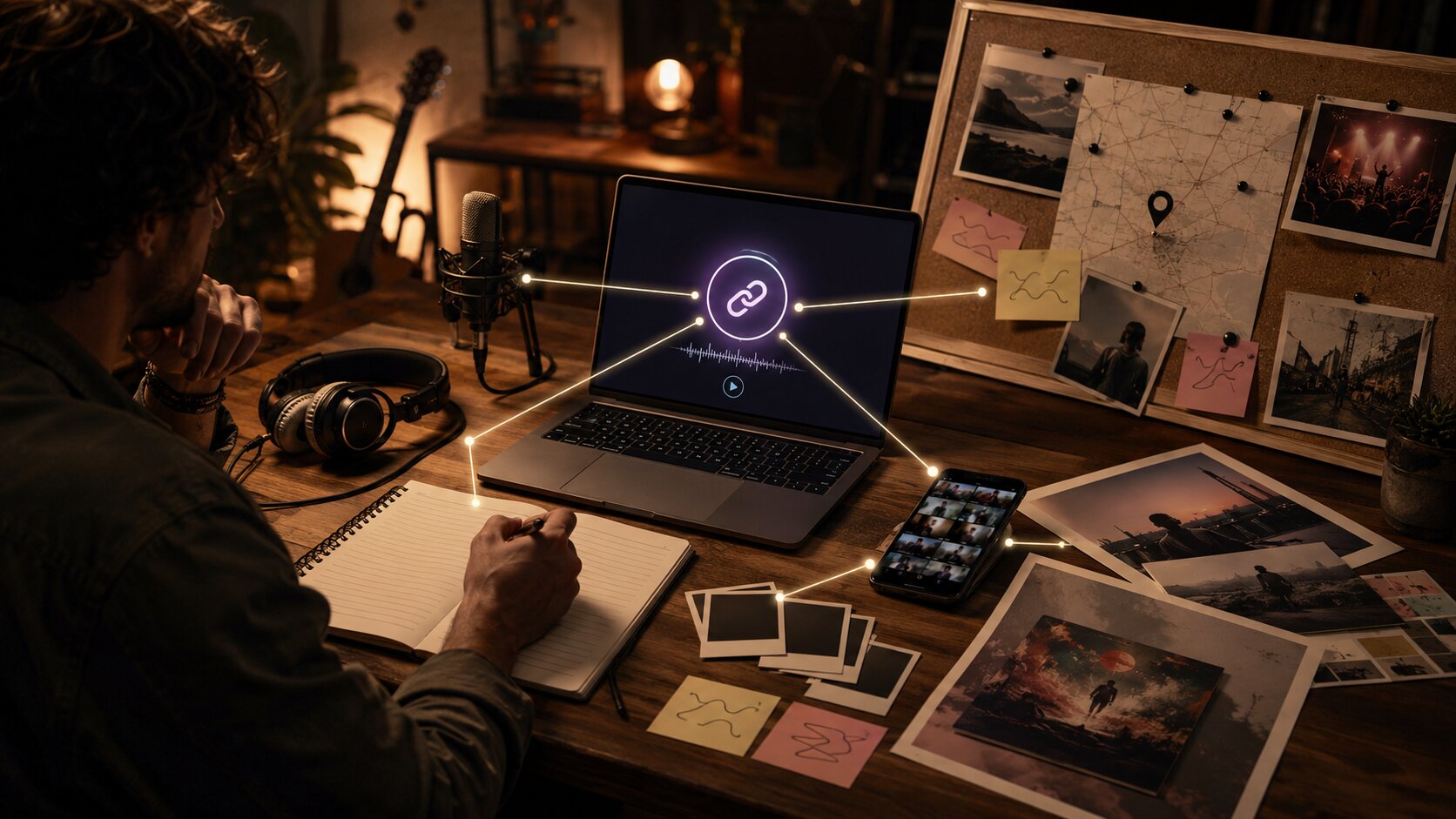
A link gives fans somewhere to listen, but a story gives them a reason to care. The strongest song promotion connects the track to a feeling, conflict, moment, visual world, or personal reason that people can understand before they ever press play. Build the story first, then use your link as the next step in a larger fan journey.
Introduction
Most independent artists know the feeling: the song is out, the link is ready, the cover art is posted, and the caption says some version of “new single out now.” Then the post disappears into the feed almost as quickly as it arrived.
The problem is not always the song. Often, the problem is the way the song is introduced. A streaming link is useful, but it is not a complete message. It does not explain why the track exists, who it is for, what emotion it carries, or why a stranger should stop scrolling long enough to listen.
Music discovery now happens across streaming services, short-form video platforms, creator feeds, artist profiles, playlists, direct fan communities, and search. Streaming remains central to the recorded music business, but discovery is not only about availability. It is about meaning, repetition, context, and fan connection. (Reuters)
This guide explains how to turn a song into a story-driven release message: one that can fuel social posts, short videos, artist bios, press pitches, email updates, landing pages, and fan conversations without sounding forced.
Table of Contents
- Key Takeaways
- The Link Is the Doorway, Not the Pitch
- Find the Emotional Engine Behind the Song
- Build a Story Spine Before You Make Content
- Turn One Song Into Multiple Story Angles
- Match the Story to the Platform
- Make the Link Part of a Bigger Fan Path
- Measure Whether the Story Is Working
- Where BlockTone Records Fits Into the Process
- Frequently Asked Questions
- Sources Used
Key Takeaways
| Point | Details |
|---|---|
| A song link is not enough by itself | Fans need context before they click: emotion, identity, conflict, mood, or a reason to share. |
| The best promotion starts before release day | Create the song’s story spine early so captions, videos, visuals, and pitches all feel connected. |
| One song can carry several angles | Use origin, lyric meaning, studio process, visual world, fan use case, and personal stakes as separate content lanes. |
| Platform context matters | A Spotify profile, YouTube Short, TikTok post, Bandcamp message, and email update should not all say the same thing. |
| Story-driven metrics are deeper than views | Saves, shares, comments, profile visits, playlist adds, email replies, and repeat engagement show whether people care. |
The Link Is the Doorway, Not the Pitch
A link answers one question: “Where can I hear it?”
A story answers better questions: “Why should I hear it?” “What does it feel like?” “What moment in my life does this belong to?” “What kind of artist made this?”
That difference matters because most fans do not experience your release in a clean, focused environment. They encounter it between other videos, messages, ads, memes, playlists, and notifications. If your entire campaign depends on people clicking a link without context, you are asking for attention before you have earned curiosity.
| Link-first promotion | Story-first promotion |
|---|---|
| “My new single is out now.” | “I wrote this after realizing I was missing someone I didn’t actually want back.” |
| Streaming link is the main message | Streaming link is the next action after emotional context |
| One caption repeated everywhere | Different angles adapted to each platform |
| Focuses on release availability | Focuses on meaning, mood, and fan relevance |
| Easy to ignore | Easier to remember, comment on, or share |
The goal is not to stop sharing links. The goal is to stop making the link carry the whole campaign.
A strong release post might still include a streaming link, but the caption, visual, video, or voiceover should do the persuasive work first. By the time the fan sees the link, they should already understand what kind of experience the song offers.
Mistake to avoid: treating every platform like a billboard. “Out now” is an announcement, not a story. It works better after people already care.
Find the Emotional Engine Behind the Song
Every song has an emotional engine. It might be heartbreak, confidence, revenge, desire, grief, escape, nostalgia, ambition, faith, loneliness, celebration, or self-protection. The story starts when you name that engine clearly.
This does not mean explaining every lyric literally. Sometimes mystery helps. But listeners still need a frame.
Ask yourself five questions before you promote the track:
- What feeling does this song capture better than my other songs?
- What real-life situation would make someone play it?
- What line, sound, or moment best represents the song?
- What did I understand after making it that I did not understand before?
- What kind of listener is most likely to feel seen by it?
For example, “this is a breakup song” is too broad. A more useful story might be: “This is about the moment after the argument, when you know you were right but still feel empty.” Another version might be: “This is for people who act unbothered in public and fall apart in private.”
Create a one-sentence story statement
Before you write captions or plan videos, create one sentence that explains the song’s emotional purpose.
Use this structure: This song is about [specific emotional situation] for people who [recognizable listener experience].
- This song is about rebuilding your confidence after someone made you feel replaceable.
- This song is about chasing a night so hard that you know tomorrow will hurt.
- This song is about missing your hometown but knowing you had to leave.
That sentence may never appear publicly. Its job is to keep your campaign focused.
Pro Tip: Avoid turning your story into a diary entry unless vulnerability is part of your artist brand. Fans need enough truth to connect, not every private detail.
Build a Story Spine Before You Make Content
A story spine is the core structure that holds your campaign together. It helps you avoid random posting and gives every asset a purpose.
For a song release, your story spine can include:
- The trigger: what inspired the song
- The tension: what emotional conflict sits inside it
- The sound: how the production supports the feeling
- The image: what visual world belongs to the track
- The listener role: when fans should play it
- The action: what fans should do next
| Story Element | Example |
|---|---|
| Trigger | A late-night drive after ending a relationship |
| Tension | Freedom feels exciting and lonely at the same time |
| Sound | Sparse drums, wide synths, intimate vocal tone |
| Image | Empty streets, dashboard lights, city reflections |
| Listener role | For anyone trying not to go back |
| Action | Save it for your next night drive playlist |
This gives you much more than a caption. It gives you a release language.
You can use the trigger for a behind-the-song video. You can use the tension for a lyric caption. You can use the sound for a studio breakdown. You can use the image for cover art, vertical video, and press visuals. You can use the listener role as the call-to-action.
Spotify’s artist tools point in this direction: Clips are short vertical videos designed to let artists bring fans closer to the creative process, while artist profile tools can support releases with visuals, merch, tour dates, Fan Support links, and more. (Spotify for Artists)
Mistake to avoid: creating content first and searching for meaning later. When the story spine is weak, the campaign often becomes a scattered set of unrelated posts.
Turn One Song Into Multiple Story Angles
A good song story is not one caption repeated ten times. It is a set of related angles that reveal the track from different sides.
The origin angle
Explain where the song began. This could be a voice memo, a phrase someone said, a bad decision, a city, a memory, a producer’s loop, or a moment on tour. The origin angle helps fans feel close to the creative process.
Example post idea: “Before this became a full track, it was just one line in my notes app: ‘I miss the version of you I invented.’ That line became the hook.”
The lyric angle
Choose one lyric and explain the emotional situation behind it. Do not post a full lyric sheet. Pick the line that opens the world of the song.
Example post idea: “The line ‘I changed the locks but kept the key’ is not really about a house. It is about pretending you moved on while leaving one small way back.”
The sound angle
Talk about production choices in simple, emotional language. Fans do not need technical jargon to understand why the drums are dry, why the vocal is close, or why the chorus opens up.
Example post idea: “We kept the first verse almost empty because the song needed to feel like someone talking to themselves before admitting the truth.”
The visual angle
Show the world around the song: colors, textures, clothes, locations, objects, lighting, or movement. This is especially useful for short-form video and cover art.
Example post idea: “If this song were a room, it would be blue light, a half-packed suitcase, and a phone face down on the bed.”
The listener angle
Tell fans when to use the song. This makes the listener the main character instead of making the artist the only focus.
Example post idea: “Play this when you are finally over someone, but your body still remembers the old version of the relationship.”
The community angle
Invite fans to respond with their own version of the feeling. This creates conversation rather than only consumption.
Example post idea: “What is the song you play when you need to feel untouchable for three minutes?”
Pro Tip: Create a simple content bank with these six angles before release day. You will have enough material for pre-release, release week, and post-release without repeating “stream now” every day.
Match the Story to the Platform
The same story should change shape depending on where fans encounter it.
Spotify, Apple Music, YouTube, TikTok, Instagram, Bandcamp, email, and your website all serve different moments in the fan journey. The mistake is copying the same caption everywhere and expecting each platform to do the same job.
Spotify and Apple Music: make the profile tell the story
Streaming platforms are not just playback destinations. They are also credibility and context spaces. Spotify for Artists highlights profile features, short video tools, Canvas, Countdown Pages, and visuals as ways artists can deepen fan connection around releases. Apple Music for Artists also offers promotional tools that help artists create assets and links for songs, albums, videos, and milestones. (Spotify for Artists) (Apple Music for Artists)
Use these spaces to support the story:
- Update your artist bio if the new song signals a new era.
- Use profile highlights where available to feature the release.
- Add visuals that match the song’s mood.
- Keep links clean and easy to find.
- Make sure the profile image, cover art, and release message feel aligned.
For album campaigns, Spotify Countdown Pages can help fans pre-save, preview the tracklist, watch countdown videos, and access related merch in one place. (Spotify for Artists)
YouTube and Shorts: lead with the first seconds
Short-form video gives artists very little time to create curiosity. YouTube’s creator resources emphasize the importance of thinking carefully about the opening seconds of Shorts because viewers are scrolling quickly through the feed. (YouTube Creators)
For artists, that means the story has to arrive immediately.
- Stronger opening: “I wrote this song for people who look fine but are not fine.”
- Stronger opening: “This chorus started as a voice note I was embarrassed to keep.”
- Weaker opening: “Hey guys, my new single is out.”
- Weaker opening: “Please go stream this.”
The first type of opening creates curiosity. The second asks for a favor too early.
TikTok and Instagram Reels: make the feeling repeatable
Short-form platforms reward ideas that people can understand quickly and reuse. TikTok for Artists is built around music insights and fan engagement, which makes it useful for testing which parts of a song or story create response. (TikTok for Artists)
Instead of only posting performance clips, build formats around the song’s emotional use:
- “Songs for when you almost text them.”
- “POV: you finally stop explaining yourself.”
- “This part is for the people who left before they were chosen last.”
- “Use this sound for your main character exit.”
The point is not to chase every trend. The point is to make your song understandable as a moment, mood, or identity.
Bandcamp and email: speak to the warmest fans differently
Not every fan needs the shortest version. Some fans want the full context. Bandcamp gives artists direct communication tools, including messages to fans that can be targeted by location and support level. (Bandcamp for Artists)
Use longer fan channels for:
- the full backstory
- demo notes
- production credits
- personal reflections
- merch or vinyl context
- early access
- local show announcements
Warm fans do not need to be sold as aggressively. They need to feel included.
Make the Link Part of a Bigger Fan Path
A song link should be one step in a path, not the entire path.
A stronger fan path might look like this:
- Fan sees a short video about the song’s emotional idea.
- Fan comments because the situation feels familiar.
- Fan hears the hook in the video.
- Fan clicks to the full song.
- Fan saves it or adds it to a playlist.
- Fan visits the artist profile.
- Fan follows, joins an email list, buys merch, or comes back for the next release.
The story starts the journey. The link continues it.
Build a better link destination
If you use a landing page or smart link, do not make it feel like a dead end. Add enough context to reinforce the story.
A release landing page can include:
- cover art
- one-sentence song story
- streaming buttons
- music video or visualizer
- short artist note
- email signup
- merch or ticket link, if relevant
- press quote or playlist mention, if real and verified
Keep it simple. The page should not distract from listening, but it should make the release feel intentional.
Use calls-to-action that fit the story
“Stream now” is not always wrong, but it is often too flat.
Try more specific CTAs:
- Save this for your late-night drive playlist.
- Send this to the friend who needed the reminder.
- Comment with the lyric that hit first.
- Add this if you are building a no-contact playlist.
- Watch the visualizer before you hear the final chorus.
A precise CTA gives fans a role. It tells them what kind of participation matters.
Mistake to avoid: asking for five actions at once. Pick one primary action per post: save, comment, share, watch, join, buy, or listen.
Measure Whether the Story Is Working
Story-driven promotion is creative, but it still needs measurement.
The best signals are not always the biggest numbers. A video with fewer views but more saves, shares, comments, profile visits, or link clicks may be more useful than a high-view post that brings no listener action.
| Stage | Useful Signals |
|---|---|
| Awareness | Views, reach, impressions, new profile visits |
| Interest | Watch time, comments, shares, saves, replies |
| Listening | Link clicks, streams, completion behavior where available |
| Fan intent | Follows, playlist adds, repeat listeners, email signups |
| Deep connection | Merch sales, Bandcamp purchases, ticket interest, direct messages |
Spotify’s Fan Study frames fan connection around the world an artist builds around the music, including visuals and storytelling, not only the existence of the track itself. (Spotify for Artists Fan Study)
Review your story after release week
After the song has been out for seven to fourteen days, look at what people actually responded to.
Ask:
- Which lyric got the most comments?
- Which video angle created the most saves or shares?
- Did fans respond more to the personal story, the production story, or the listener-use angle?
- Did profile visits increase after certain posts?
- Did anyone describe the song back to you in their own words?
- Which platform produced the most meaningful fan action?
Then use that information to shape the second wave of promotion. The post-release phase should not be a weaker repeat of release day. It should be a smarter version of what worked.
Pro Tip: Save screenshots of real fan responses. Do not fake hype. Real language from listeners can reveal the clearest version of your song’s story.
Where BlockTone Records Fits Into the Process
For independent artists, the hard part is not only releasing music. It is turning each release into a clear message that fits the artist’s identity, audience, and long-term direction.
BlockTone Records can support artists who need a more strategic approach to song storytelling, release planning, and music promotion. A strong campaign does not rely on one link or one post. It connects the song’s meaning, visuals, platform assets, fan communication, and follow-up content into one coherent path.
For artists building their next release, blocktonerecords.com can be positioned as a resource for moving from “my song is out” to “my audience understands why this song matters.”
FAQs About Song Story Marketing
Why is a story more effective than just posting a song link?
Does every song need a personal backstory?
What should I post before the song is released?
What if my song is already out?
How many story angles should I create for one song?
Should I use the same caption on every platform?
What is the biggest mistake artists make with song storytelling?
Sources Used
- Spotify for Artists – Video & Visuals
- Spotify for Artists – Countdown Pages
- Spotify for Artists – Fan Study: Fan Connection
- Apple Music for Artists
- Apple Music for Artists – Promote Content, Milestones, and Custom Assets
- YouTube Creators
- TikTok for Artists
- Bandcamp for Artists
- Reuters – Streaming boosts global music revenues once again, 2025 report shows