
Music release promotion workflow for indie artists
TL;DR:
- A structured, phased promotion workflow is essential for music release success.
- Consistent content, playlist pitching, and analyzing metrics build long-term growth.
- Releasing singles regularly with a repeatable system outperforms one-off album efforts.
You put everything into recording a track, and then release day comes and goes with barely a ripple. No streams, no shares, no momentum. That silence is not a talent problem. It is a structure problem. Without a deliberate, phased promotion workflow, even genuinely great music gets buried under the thousands of songs uploaded every single day. At Blocktone Records, we have seen what separates artists who break through from those who stall, and the answer is almost always the same: a repeatable system. This guide walks you through every step of a music release promotion workflow, from the assets you need to the metrics that tell you what is actually working.
Table of Contents
- What you need for an effective promotion workflow
- Step-by-step music release promotion workflow
- Maximizing engagement: Content, socials, and playlists
- Avoiding common mistakes and troubleshooting your campaign
- Analyzing results and evolving your workflow
- Why a repeatable promotion system beats single campaigns
- Unlock your music’s potential: Next steps with BlockTone
- Frequently asked questions
Key Takeaways
| Point | Details |
|---|---|
| Start early | Begin your promotion workflow at least 6 weeks before release to maximize impact and playlist outreach. |
| Use phased strategies | Segment your campaign into foundation, pre-release, launch, and post-release phases for best results. |
| Prioritize engagement | Focus on repeat listens and save rates over vanity metrics for better algorithmic growth. |
| Avoid common pitfalls | Schedule uploads early, build pre-buzz, and maintain consistent content to avoid rookie mistakes. |
| Refine with data | Analyze campaign results to improve your workflow and grow your audience release after release. |
What you need for an effective promotion workflow
Before you dive into the workflow, let’s take stock of everything you’ll need at hand. Think of this phase as gathering your ingredients before cooking. Rushing into promotion without the right materials is one of the most common reasons indie releases underperform.
Here are the core assets you need to prepare:
- Mastered audio file in the required format for your distributor (WAV or FLAC preferred). Use a reliable mastering checklist to confirm your track is ready.
- Cover art at 3000×3000 pixels minimum, with no blurry edges or text too close to the borders.
- Press photos in high resolution, at least three variations for different platform formats.
- Updated artist bio and social media profiles, consistent across every platform.
- Smart link (a single URL that routes fans to their preferred streaming service).
- Email list connected to a service like Mailchimp or ConvertKit.
- Content calendar mapping out every post from announcement day to post-release week.
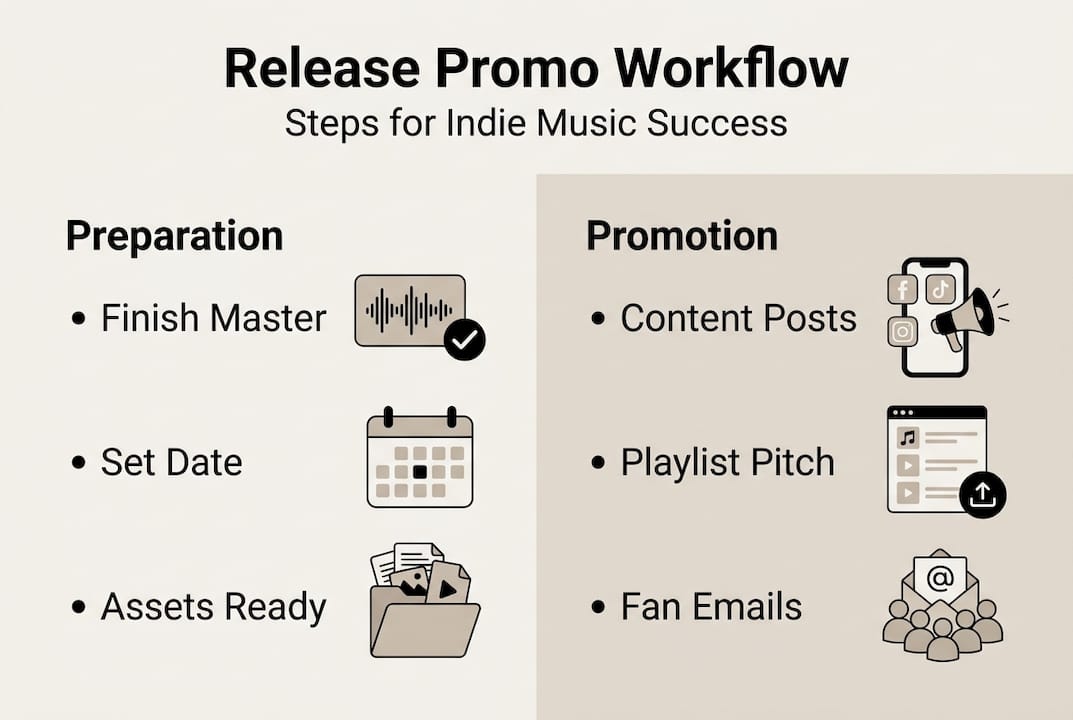
The standard promotion workflow for independent artists spans 6 to 8 weeks pre-release through 4 weeks post-release, structured in distinct phases. That timeline is not arbitrary. Streaming platforms and playlist curators need lead time, and so does your audience.
| Weeks before release | Key tasks |
|---|---|
| 8 weeks out | Finalize master, confirm cover art, set release date |
| 6 weeks out | Submit to distributor, start building pre-save page |
| 4 weeks out | Pitch Spotify editorial, reach out to playlist curators |
| 2 weeks out | Begin teaser content, activate email list |
| Release week | Full content push, social media blitz, live engagement |
| 2 to 4 weeks after | Analyze data, pitch secondary playlists, repurpose content |
For deeper guidance on getting your music onto the right platforms, explore these music distribution tips and review how different music distribution channels compare for indie artists.
Pro Tip: Always finalize every asset before you announce your release date publicly. Last-minute cover art changes or audio swaps can delay distributor approvals and cost you valuable playlist submission windows.
Step-by-step music release promotion workflow
With your materials ready, it’s time to walk through each release phase in order. Each phase builds on the last, so skipping ahead tends to create gaps that hurt your results.
- Foundation phase (8 weeks out): Finalize your master, lock in your release date, and set up your distributor account. Confirm your artist profiles are complete on Spotify, Apple Music, and Amazon Music.
- Distribution phase (6 weeks out): Upload your track to your distributor. This lead time is essential for Spotify editorial pitching, which requires submission before release.
- Pre-release buzz phase (4 weeks out): Launch your pre-save campaign, send your first email teaser, and pitch independent playlist curators. This is also the right moment to start building local music networks for offline support.
- Teaser build-up (2 weeks out): Post short-form video content, share behind-the-scenes clips, and count down to release day. Consistency here seeds the algorithm.
- Release week: Execute your full content push across all platforms simultaneously. Go live, reply to every comment, and send your release-day email. Check out this music promotion tip checklist to make sure nothing falls through the cracks.
- Post-release push (weeks 1 to 4 after): Pitch secondary playlists, share listener reactions, and repurpose content. Read more about showcasing new music effectively to extend your release window.
| Phase | Early campaign | Launch week | After release |
|---|---|---|---|
| Focus | Build anticipation | Maximize reach | Sustain momentum |
| Content | Teasers, pre-saves | Full drops, lives | Reposts, reactions |
| Outreach | Curator pitches | Fan engagement | Secondary playlists |
Research confirms that singles every 4 to 8 weeks outperform albums for fan discovery and algorithmic reach. Planning to release singles digitally on a consistent schedule gives you more opportunities to grow.
Pro Tip: Schedule your entire campaign backward from a Friday release. Friday drops maximize algorithm potential because streaming platforms refresh their editorial playlists at the start of the weekend.
Maximizing engagement: Content, socials, and playlists
Once your workflow is in motion, focus on what truly drives listener engagement and streaming growth. Execution without engagement is just noise. Here is how to make your content work harder.
Core content types to rotate throughout your campaign:
- Short-form video (TikTok, Instagram Reels, YouTube Shorts): Show the story behind the song, a snippet of the hook, or a raw reaction moment.
- Static graphics: Lyric cards, release countdown posts, and cover art reveals.
- Stories and polls: Low-effort, high-engagement content that keeps your profile active daily.
- Email blasts: Sent at announcement, one week before release, and on release day itself.
Aim for 3 to 5 posts per week across TikTok and Reels during your pre-release window. Repurpose each video across platforms rather than creating everything from scratch. Pre-save campaigns, short-form video, and email blasts are the core methodologies that consistently move the needle for indie artists.
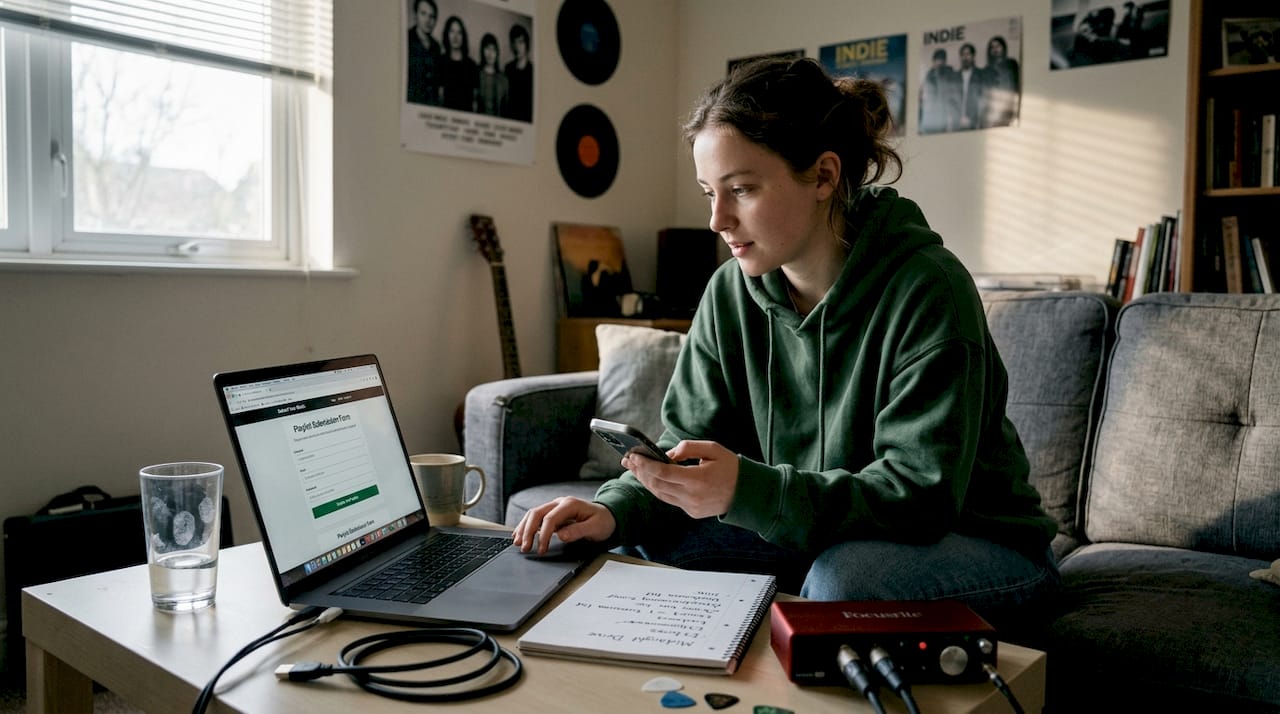
For playlist pitching, submit to Spotify editorial through your distributor dashboard at least 7 days before release. For independent playlists, reach out 2 to 3 weeks ahead with a personalized message, not a mass email. Artists who hit 1,000 first-week streams are 4.2 times more likely to land on algorithmic playlists. That milestone is very reachable with a focused pre-save push.
Optimizing your artist profile before release week also signals credibility to both curators and new listeners. Stay aware of music event updates in your genre, as syncing releases with trending moments can amplify organic reach.
Pro Tip: Nurture your email list. Email open rates average 30 to 50%, which is dramatically higher than the 2 to 5% organic reach you get from a social media post. Your list is your most reliable direct line to fans.
Avoiding common mistakes and troubleshooting your campaign
Even great plans encounter obstacles. Here’s how to sidestep the traps indie artists face most.
The most frequent errors that stall releases include:
- Uploading too late: Submitting your track less than 3 weeks before release eliminates your editorial playlist window entirely.
- Skipping pre-release buzz: Dropping music cold, without any teaser content or pre-saves, means you start from zero on release day.
- Inconsistent posting: Going quiet for 10 days and then flooding your feed confuses both your audience and the algorithm.
- Relying on one platform: Concentrating all effort on Instagram while ignoring TikTok, YouTube, or your email list leaves huge audiences untouched.
- Ignoring post-release analysis: Campaigns that skip the review phase repeat the same mistakes on the next release.
A surprise drop can backfire unless your fanbase is already established. Without pre-release momentum, even a strong track struggles to gain traction in the first critical 48 hours.
Campaign failures most often stem from poor sequencing and timing, while successful campaigns use 60-day structured plans with phased content. The data on payouts also puts urgency in perspective: the average stream pays roughly $0.004, and 78% of indie artists receive fewer than 500 streams per month. A structured workflow is how you avoid becoming part of that statistic.
For more on building lasting visibility, read our guide to promoting music online and learn why platforms that feature top releases can accelerate your discovery.
Analyzing results and evolving your workflow
With your campaign wrapped up, measuring outcomes is key to compounding your growth. Raw stream counts feel satisfying, but they rarely tell the full story.
The metrics that actually matter:
- Save rate: The percentage of listeners who save your track. A rate above 3% signals strong algorithmic potential.
- Repeat listens: How many times the same listener comes back. High repeat rates indicate genuine emotional connection.
- Monthly listener growth: Are you retaining listeners from previous releases or starting from scratch each time?
- Completion rate: What percentage of listeners hear the full track? Aim for above 55%.
- Geographic data: Where are your listeners located? This shapes tour planning and targeted ad spend.
Algorithmic success hinges on saves and repeat listens far more than raw stream numbers. Post-release reviews are not optional. They are the engine of improvement.
| Metric | Healthy benchmark | What it signals |
|---|---|---|
| Save rate | 3% or above | Strong listener intent |
| Completion rate | 55% or above | Engaging arrangement |
| Monthly listener growth | 10 to 20% per release | Compounding fanbase |
| Repeat listen ratio | 1.5x or above | Emotional resonance |
Schedule a monthly review of these numbers after every release. Systems built on real data always outperform gut-feel decisions. One strong release followed by silence is a missed opportunity. A series of reviewed, refined campaigns is how careers are actually built.
Why a repeatable promotion system beats single campaigns
Stepping back, here’s why the workflow mindset ultimately outperforms quick-fix strategies. Most indie artists pour everything into one release, then exhaust themselves waiting for a breakthrough. When it doesn’t come, they lose momentum and start over from scratch months later.
The truth is that algorithms, curators, and real fans all reward sustained activity. Every campaign you run is a testbed. You learn which content format your audience responds to, which playlist curators reply, and which posting times drive the most saves. Monthly releases compound those engagement signals over time, building a profile that platforms actively want to surface.
“Consistent, well-reviewed promotion builds more than hype. It creates momentum.”
Think of each release not as a standalone event but as one chapter in a longer story. The artists who grow steadily are the ones who treat long-term music promotion as a craft, refining their approach with every drop. Joy comes not just from the release itself but from watching each campaign perform a little better than the last.
Unlock your music’s potential: Next steps with BlockTone
Ready to turn knowledge into results? Here’s how BlockTone helps you get there.
At Blocktone Records, we believe every artist deserves a platform that grows with them. The structured workflow you have just learned is not a one-time checklist. It is a scalable system, and having the right partner makes all the difference.
Explore our music distribution tips to sharpen your release strategy, or dive into our resources on music discovery for artists to understand how listeners find new music in 2026. You can also learn more about the role of singles and albums in building a sustainable catalog. We are here to support your journey, every release at a time.
Frequently asked questions
How far in advance should I start my music promotion before release?
Plan your main promotion phases to begin 6 to 8 weeks before release, with your distributor upload ideally 3 to 4 weeks out to qualify for playlist opportunities.
What is the most important metric for music release campaigns?
Save rate above 3% and completion rate above 55% matter most for algorithmic success, outweighing total stream counts as signals of genuine listener engagement.
Do singles or albums work better for music discovery?
Singles every 4 to 8 weeks consistently outperform albums for fan discovery and algorithmic reach, making them the smarter choice for emerging artists building an audience.
What common mistakes should indie artists avoid with their promotion workflow?
The biggest risks are late distributor uploads, skipping pre-release teasers, inconsistent posting cadence, and concentrating all promotion on a single platform.
How does email compare to social media for music release engagement?
Email averages 30 to 50% open rates compared to just 2 to 5% organic reach per social post, making your email list a far more reliable channel for direct fan communication.