
20 Content Ideas From One Song
TL;DR
One song can generate weeks of useful content when you break it into performances, stories, production details, visual interpretations, fan conversations, and conversion-focused posts. The goal is not to publish the same chorus 20 times, but to give listeners different reasons to care about the music. Record a reusable library of footage, then adapt each idea to the platform and audience action it is designed to support.
Introduction
Finishing a song is difficult. Promoting it can feel even harder.
Many independent artists announce a release, upload one performance clip, share the cover artwork, and then run out of things to say. The problem is rarely a lack of creativity. It is usually the assumption that every post needs a completely new concept.
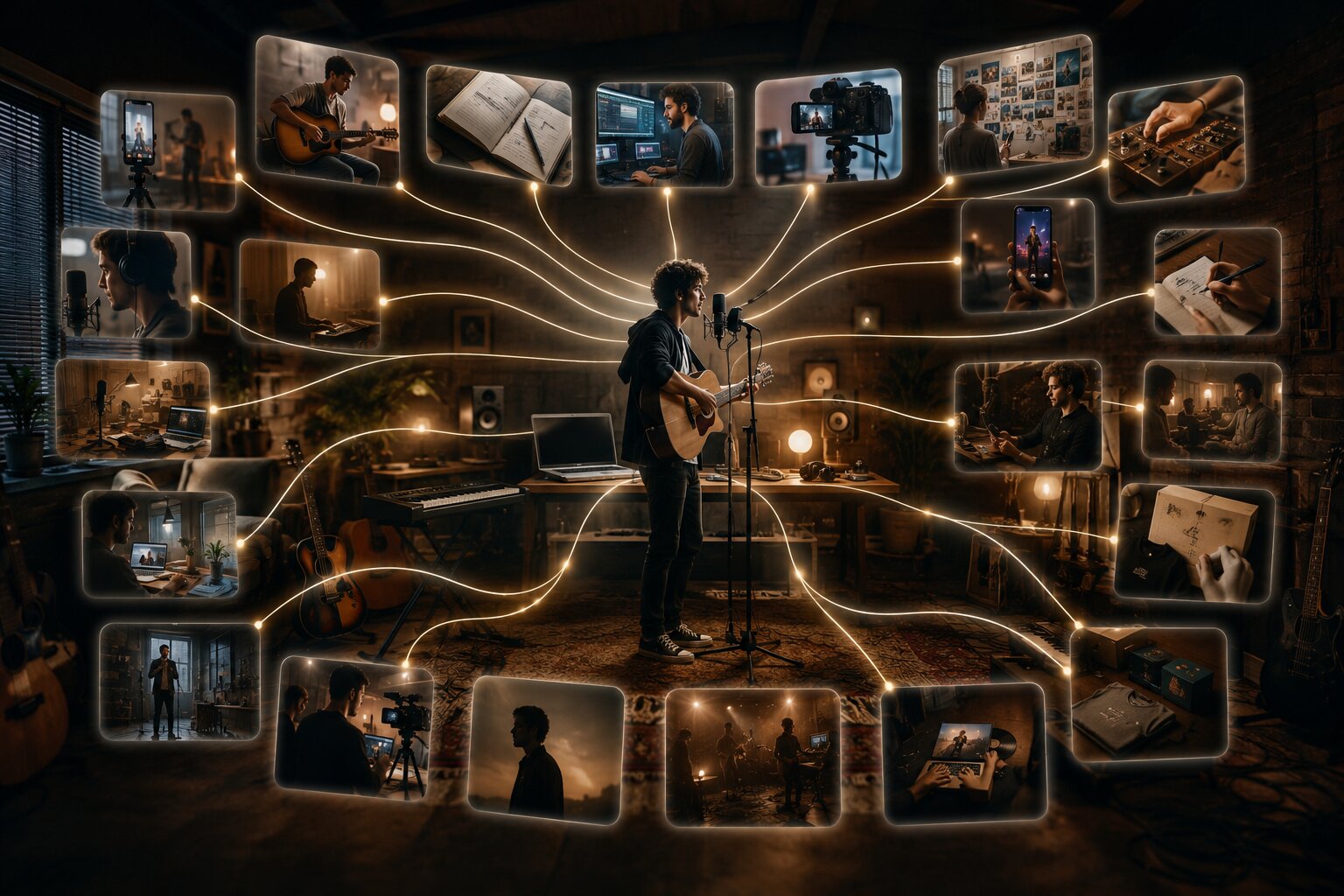
A single song already contains multiple content subjects: the lyrics, vocal delivery, production, instruments, artwork, recording process, creative decisions, and listener reactions. Each subject can become a different entry point for potential fans.
This guide presents 20 practical content ideas that can be created from one song. It also explains how to organize those ideas into a campaign that supports discovery, deeper fan interest, streaming, email growth, direct sales, and future releases.
Table of Contents
- Build a Content World Before You Build a Calendar
- Five Performance Ideas That Make the Song Feel Different
- Five Story Ideas That Give Listeners a Reason to Care
- Five Production Ideas for Musicians, Producers, and Curious Fans
- Five Fan-Focused Ideas That Create Participation
- Turn the 20 Ideas Into a Sustainable Release Campaign
- Frequently Asked Questions
Key Takeaways
| Point | Details |
|---|---|
| Change the angle, not only the format | A performance, lyric explanation, production breakdown, and fan question can all promote the same song without feeling repetitive. |
| Give every post one purpose | Decide whether the content should create discovery, explain the song, encourage participation, or drive a specific action. |
| Record content in batches | One organized session can produce vertical clips, photographs, visual loops, spoken explanations, and longer videos. |
| Adapt content to each platform | Short-form videos need an immediate hook, while email and long-form video can provide more context. |
| Keep the song central | Personality and storytelling should lead listeners back to the music instead of becoming disconnected content. |
| Measure meaningful actions | Look beyond views by tracking saves, profile visits, comments, repeat viewers, link clicks, signups, and purchases. |
Build a Content World Before You Build a Calendar
Before filming 20 posts, define the creative world surrounding the song. Write down its central emotion, most memorable lyric, strongest musical moment, visual atmosphere, and intended listener.
You should also identify the main action you want an interested listener to take. That action might be streaming the track, watching a full video, following your artist profile, joining your mailing list, buying a download, purchasing merchandise, or attending a show.
This preparation prevents the campaign from becoming a random collection of clips. Every piece of content should either deepen the song’s identity or help the audience move toward a useful next step.
For example, a vulnerable acoustic song might use close framing, natural light, handwritten materials, quiet room sounds, and direct explanations. A high-energy electronic track may be better suited to movement, rapid edits, lighting changes, production demonstrations, and crowd footage.
Create a Reusable Source Library
Instead of filming a completely new idea every day, capture a small library of source material before or around the release date.
- One complete performance filmed horizontally
- Two or three vertical performances
- Close-ups of instruments and studio equipment
- A clean shot of the cover artwork
- Behind-the-scenes photographs
- Spoken answers to several questions about the song
- Instrumental, a cappella, and alternate mixes where available
- Short visual loops without text
- One clear destination link for the release
This source material can be edited into platform-specific assets rather than requiring another shoot whenever you need to post. Spotify allows artists to attach short looping Canvas visuals to tracks, while Apple Music for Artists provides promotional assets, badges, links, and embeddable players. (Spotify for Artists – Canvas)
YouTube also allows eligible creators to turn portions of their existing videos into Shorts that link back to the original upload. That makes a full live session useful both as long-form content and as a source for short discovery clips. (YouTube Help – Create Shorts from your videos)
Pro Tip: Treat the song as the subject of the campaign, not merely as background audio for unrelated posts. A useful post should reveal something about the music, the artist, or the listener’s experience.
Five Performance Ideas That Make the Song Feel Different
1. The Strongest 15-Second Performance
Perform the section with the clearest emotional or musical payoff. This could be the central lyric, vocal run, guitar phrase, beat switch, melodic hook, or drop.
Begin immediately before the key moment. Avoid using the first several seconds to adjust the microphone, walk into position, or explain what the viewer is about to hear. The musical appeal should become clear before the viewer decides whether to continue watching.
The main mistake to avoid is automatically choosing the chorus. The strongest short-form section may come from a verse, bridge, intro, instrumental break, or final vocal line.
2. A Stripped-Back Version
Remove most of the production and perform the song with one instrument, a simplified beat, or an exposed vocal.
This works particularly well when the official recording is heavily produced. The contrast helps listeners notice the melody, lyrics, and emotional delivery underneath the final mix.
Do not force an acoustic arrangement onto a song when it weakens its identity. The stripped version should reveal another side of the composition, not reduce its energy without purpose.
3. A One-Take Room Performance
Record one uninterrupted take in a rehearsal room, bedroom, studio, stairwell, warehouse, or outdoor location that fits the atmosphere of the track.
Small imperfections can make a performance feel credible and immediate. However, authenticity should not become an excuse for poor preparation. Check the lighting, framing, background noise, vocal level, and distracting objects before recording.
A strong one-take clip can communicate musicianship and personality more effectively than a heavily edited promotional montage.
4. A Completely Different Arrangement
Reinterpret the song as a piano ballad, acoustic version, live-band performance, club edit, slowed arrangement, orchestral version, or genre experiment.
The purpose is not to replace the master recording. It is to show that the song has enough melodic or lyrical identity to survive a new setting.
Choose an arrangement that creates meaningful contrast. A slower version might expose emotional tension, while a live-band version might emphasize rhythm and performance energy.
5. An Isolated Performance Moment
Feature one musician or musical element at a time. You could highlight the bass line, backing vocal, guitar texture, drum pattern, synth part, harmony, or improvised ad-lib.
These clips reveal details that may disappear inside the complete mix. They also give producers, session musicians, and other collaborators material that they can share with their own audiences.
After playing the isolated part, include a few seconds of the full arrangement so viewers can hear how the element contributes to the finished song.
Five Story Ideas That Give Listeners a Reason to Care
6. The Real Meaning Behind One Lyric
Choose one specific line and explain what prompted it. Focus on a single image, phrase, or emotional contradiction rather than decoding the entire song.
A simple structure is to state the lyric, describe the situation behind it, explain why that wording felt right, and then play the corresponding section of the track.
Avoid explaining every metaphor. Leaving some interpretive space allows listeners to connect the song to their own experiences.
7. The Earliest Version of the Song
Share a voice memo, rough demo, rehearsal recording, handwritten draft, or early project session, provided that you have permission to use everything included.
Compare the early version with the final release. Point out how the tempo, melody, lyrics, arrangement, or production changed during the process.
The difference does not need to be dramatic. Even one altered word or removed instrument can reveal how creative decisions shape a finished record.
8. The Decision That Nearly Changed the Song
Explain one difficult choice made during writing, recording, or mixing. You might have deleted a verse, changed the key, replaced the drums, rewritten the chorus, kept an imperfect vocal, or removed an instrumental section.
Specific creative conflict produces a stronger story than a general statement about working hard on the track. It gives the audience a recognizable problem and shows how you approached it.
Avoid manufacturing drama. The decision can be small as long as it genuinely affected the song.
9. The Song’s Visual Mood Board
Show the colors, textures, locations, clothing, objects, photographs, films, or design references that influenced the song’s visual identity.
Use material you created, licensed, or have permission to display. The mood board can introduce the aesthetic later used for cover artwork, stage visuals, merchandise, videos, and social content.
Keep the selection focused. A clear visual world is more memorable than an assortment of references that do not share a recognizable mood.
10. What You Want the Listener to Notice
Tell the audience where to direct their attention during the next listen.
You might highlight a harmony that appears only once, a background sound, a lyric that changes meaning after the second verse, or an instrument that enters before the final chorus.
This turns passive promotion into guided listening. It gives existing listeners a reason to replay the track and helps new listeners understand what makes it distinctive.
TikTok has introduced music-focused Artist Account features such as Behind the Song, which is designed to help artists share the stories and inspirations connected to their music. (TikTok Newsroom – Artist Account features)
Five Production Ideas for Musicians, Producers, and Curious Fans
11. Build the Chorus Layer by Layer
Begin with one musical element and gradually add the drums, bass, chords, lead vocal, harmonies, and effects.
Keep the explanation accessible. Most listeners do not need a complete list of plugins, routing choices, or technical settings. They need to hear how each layer changes the song’s energy and emotion.
Use short labels or spoken explanations to help viewers understand what is being added. End with the full chorus so the progression has a clear payoff.
12. Show the Vocal Before and After Processing
Play a short section of the vocal without processing, followed by the final version used in the release.
Explain the creative intention rather than listing every parameter. Describe whether the processing made the vocal feel closer, wider, darker, dreamier, more aggressive, or intentionally less polished.
Do not frame the raw vocal as a mistake. The comparison should demonstrate how production supports the performance rather than suggesting that technology replaces musical ability.
13. Recreate One Signature Sound
Show how you created the track’s most recognizable sonic detail.
The sound might come from a traditional instrument, a field recording, a resampled vocal, an everyday object, an unusual microphone position, or an automation move.
Keep the demonstration focused on one result. A concise explanation is more effective than opening an entire session and moving through unrelated technical decisions.
14. Solo the Hidden Details
Reveal several sounds that listeners may not consciously notice, such as room noise, reversed textures, whispered doubles, percussion accents, background vocals, guitar slides, or transition effects.
After isolating each detail, play the complete section so the audience can hear how the parts work together.
This type of content can encourage repeat listening because viewers now have specific elements to find in the released track.
15. Explain What You Deliberately Removed
Production content often focuses on adding more. A more distinctive post can explain why you muted a part, simplified the drums, shortened the introduction, removed a harmony, or left more space around the vocal.
This demonstrates arrangement judgment rather than only technical ability. It also shows that an effective production decision may involve restraint.
Mistake to Avoid: Do not make every production clip understandable only to audio engineers. Connect the technical choice to the listener’s experience, such as tension, clarity, intimacy, movement, impact, or surprise.
Five Fan-Focused Ideas That Create Participation
16. Ask Listeners to Choose Between Two Versions
Present two intros, alternate covers, arrangements, visual treatments, performance styles, or short edits.
Use the response as genuine research rather than pretending that the audience controls a decision you have already finalized. Honest participation creates more trust than manufactured voting.
Keep the comparison simple. Asking people to evaluate too many options usually produces weaker responses.
17. Invite Interpretations of One Lyric
Post one lyric without explaining it and ask listeners what it means to them.
Later, publish your own interpretation and discuss some of the different readings. This creates two connected pieces of content from one prompt while showing that you value the listener’s perspective.
Choose a lyric with enough ambiguity to encourage discussion. A purely factual line may not generate meaningful interpretations.
18. Create a Fan-Use Version
Offer an instrumental section, clean transition point, danceable moment, open verse, drumless section, or visual template that gives other creators room to respond.
Participation works best when the prompt is flexible. Fans should be able to use the music for storytelling, performance, humor, fashion, filmmaking, dance, or everyday moments instead of being required to imitate one rigid concept.
Make the usable section easy to identify and explain what creators are allowed to do with it.
19. Respond to a Real Comment With the Song
Use a thoughtful listener question as the opening frame for a new video. Answer it with a performance, explanation, production demonstration, or behind-the-scenes detail.
This shows that comments can influence the campaign and gives other viewers a reason to participate in the conversation.
Select comments that lead naturally back to the music. Not every reaction needs a response video.
20. Show the Listener’s Next Step
Create one direct conversion post that tells an interested person exactly what to do next.
- Listen to the full song
- Watch the complete performance
- Follow the artist profile
- Join the mailing list
- Buy the digital release or physical edition
- Save the date for a show
- Share the track with one person
Do not include five competing calls to action in the same post. Match the action to the content. A production breakdown might lead to the full recording, while a packaging video might lead to a direct purchase.
Apple Music for Artists provides promotional tools such as customizable assets, links, badges, and embedded players that artists can use when directing listeners toward a release. (Apple Music for Artists – Promote your music)
Turn the 20 Ideas Into a Sustainable Release Campaign
You do not need to publish all 20 ideas on 20 consecutive days. Group them according to the stage of the campaign and the listener’s level of familiarity with the song.
| Campaign Stage | Suitable Content |
|---|---|
| Before release | Mood board, early demo, lyric preview, alternate-version vote |
| Release week | Strongest performance, song meaning, chorus breakdown, direct listening call to action |
| Weeks two and three | Stripped version, hidden production details, comment responses, arrangement experiment |
| Later catalog promotion | One-take performance, fan-use prompt, isolated instrument, story behind a creative decision |
A practical weekly rhythm might include one performance, one story, one technical or behind-the-scenes post, and one community-focused post.
The same source footage can be adapted for TikTok, Instagram Reels, YouTube Shorts, email, streaming-profile visuals, and longer YouTube uploads. However, the opening, duration, caption, and call to action should suit each destination.
Repurpose One Live Session Across Multiple Channels
A single 10-minute live-session recording could produce:
- One complete YouTube performance
- Three vertical performance excerpts
- One rehearsal photograph
- One vocal-focused clip
- One email about the recording session
- One looping streaming-profile visual
- One post directing viewers to the full performance
Repurposing should not mean publishing an identical asset everywhere. Adjust the framing and context so that each version feels native to the platform where it appears.
Measure Each Content Category Differently
Do not judge every idea only by raw views. Discovery posts may generate reach, while explanatory posts may produce longer comments, saves, profile visits, or repeat plays. A direct-sales post might reach fewer people but create more valuable fan actions.
Compare performances with other performances, storytelling posts with other storytelling posts, and conversion posts with other conversion posts. This gives you a more accurate picture of which formats deserve to be repeated during the next release.
TikTok for Artists offers eligible artists song-level and post-level analytics, while Spotify for Artists and Apple Music for Artists provide platform-specific information about releases and audiences. (TikTok Newsroom – TikTok for Artists)
A Natural Next Step With BlockTone Records
BlockTone Records helps independent artists think beyond one-day release announcements and build more complete campaigns around their music.
Use this 20-idea framework as a starting point, then adjust the balance of performances, stories, production content, and fan participation to fit your sound, resources, and audience. The strongest content system is not the one that produces the highest number of posts. It is the one you can repeat for future releases without exhausting yourself or weakening the song’s identity.
FAQs About Creating Content From One Song
How much content should I create for one song?
There is no required number. A focused independent campaign may use eight strong pieces, while a larger release may support 20 or more. Prioritize distinct angles and useful audience actions instead of trying to reach an arbitrary posting target.
Will posting the same song repeatedly annoy followers?
It can if every post uses the same clip, caption, and promotional message. Repetition becomes less noticeable when each post offers a new performance, story, production detail, interpretation, or opportunity to participate.
Should I post content before or after releasing the song?
Use both. Pre-release content can establish the song’s concept and create recognition. Post-release content can provide more context, respond to listeners, extend the campaign, and direct people toward a track that is already available.
Do musicians need professional video equipment to create release content?
No. A modern phone, stable framing, clear audio, and appropriate lighting can produce effective content. Professional equipment becomes more valuable when the concept requires advanced sound recording, multiple cameras, complex movement, or commercial-level visuals.
Which part of a song should I use in short-form videos?
Use the section that creates the fastest curiosity, emotional impact, or musical recognition. It may be the chorus, but it could also be an opening lyric, unusual production moment, transition, instrumental phrase, or final vocal line.
Should every music post include a streaming link?
No. Constantly asking for a stream can make a campaign feel transactional. Some posts should create interest, provide context, or encourage conversation first. Use a direct link when the viewer has a clear reason to continue to the full song.
How can I tell which song content ideas are working?
Define the intended result before publishing. Track reach for discovery content, watch time for performances, comments and shares for stories, profile visits for identity-building posts, and clicks, saves, follows, signups, or purchases for conversion content.
Sources Used