


Why Alyssa Grace’s “Bloodstream” Feels Impossible to Shake
Alyssa Grace’s “Bloodstream” is about escaping a damaging relationship while confronting the deeper emotional wounds that made leaving so difficult. The narrator is not simply grieving an ex-partner. She is trying to understand why instability feels familiar, why rejection makes her question her own worth, and why another person’s presence has become embedded in her identity.
The title captures that emotional entanglement. The relationship has entered her “bloodstream,” meaning it feels internal, involuntary, and almost biological. Even after recognizing that the relationship is unhealthy, she cannot immediately remove its influence from her thoughts, habits, or emotional responses.
Grace has explained that the song originally grew from a relationship with a man, although listeners have also connected its message to family relationships, friendships, and other painful attachments. At its heart, “Bloodstream” is about learning that loving someone does not make you responsible for saving them. (Genius Verified interview with Alyssa Grace)
The Release That Introduced a More Exposed Alyssa Grace
“Bloodstream” arrived in June 2026. The official music video was published on June 4, while major streaming platforms list June 5 as the single’s release date. Small differences like this can occur because videos, streaming releases, and regional platform updates do not always go live at exactly the same time. (Alyssa Grace – “Bloodstream” official music video)
The initial release also included “picking petals” and “dog with a bone.” “Bloodstream” was later placed on Grace’s seven-song project spilling my guts, released in July 2026. That context makes the track feel less like an isolated breakup song and more like a central chapter in a larger collection about romantic damage, emotional exposure, and the need to confess what has been kept inside.
Alyssa Grace and Steven Martinez are credited as the songwriters. Martinez produced the recording and contributed bass, synthesizer, guitars, drums, and piano, while Grace performed the vocals and acoustic guitar. Carson Ripley is listed as a co-producer, and MdL handled mixing and mastering. Apple Music categorizes the track as indie pop, although its acoustic foundation and direct storytelling also place it close to folk-pop and contemporary singer-songwriter music. (Apple Music – “Bloodstream” song page and credits)
Where Romantic Pain Meets Inherited Damage
The emotional center of “Bloodstream” is the narrator’s realization that her current relationship cannot be separated from what she learned earlier in life. She wants her partner to communicate, change, and provide security, but she also recognizes anger, fear, and mistrust within herself that appear connected to her family history.
This creates two overlapping conflicts. She is fighting to keep a relationship alive while also fighting not to repeat the behavior that shaped her. Instead of experiencing the breakup as a single adult disappointment, she processes it through wounds that were present long before the relationship began.
Grace has explained that the reference to being her father’s daughter concerns the psychological effect of where a person comes from. Recognizing a parent’s tone, anger, or behavior in oneself can create an identity crisis. The narrator begins wondering whether these reactions belong to her authentic personality or whether they are survival patterns learned from childhood.
That question gives the song more depth than a conventional account of incompatibility. The narrator does not only ask why her partner cannot stay. She asks whether something inherited has made her difficult to love.
Her uncertainty about being “too much” or not enough reflects the distorted self-evaluation that often develops in unstable relationships. Rather than asking whether the other person is capable of offering what she needs, she treats his withdrawal as evidence that she is fundamentally defective.
The song gradually challenges that belief. By its final movement, the narrator understands that she could not repair the person who hurt her. Leaving becomes an act of survival rather than proof that she failed.
Inside the Song’s Emotional Architecture
The Opening: A Childhood Wound Enters the Room
The first verse begins with the narrator looking backward. She considers whether she was too young to understand an earlier emotional injury and therefore never learned how to heal from it properly.
The past is not presented as something finished. It continues through her mistrust, anger, expectations, and reactions to men. Childhood experience becomes the hidden structure beneath the adult relationship.
She then focuses on impermanence and the need to value people before they disappear. The idea sounds partly like personal wisdom and partly like a warning aimed at someone who has become emotionally absent. She knows affection can vanish, yet she is still trying to persuade the other person to reconnect.
Her attempt to make him call reveals how much responsibility she has assumed. She has become the relationship’s emotional manager, doing the work of maintaining contact, encouraging accountability, and preventing distance from becoming permanent.
The Father’s Reflection: “Am I Becoming Him?”
One of the song’s most psychologically charged moments comes when the narrator identifies herself as her father’s daughter while immediately resisting what that connection might imply.
Biologically and historically, she cannot deny where she comes from. Emotionally, however, she wants to separate herself from the anger and behavior she associates with him.
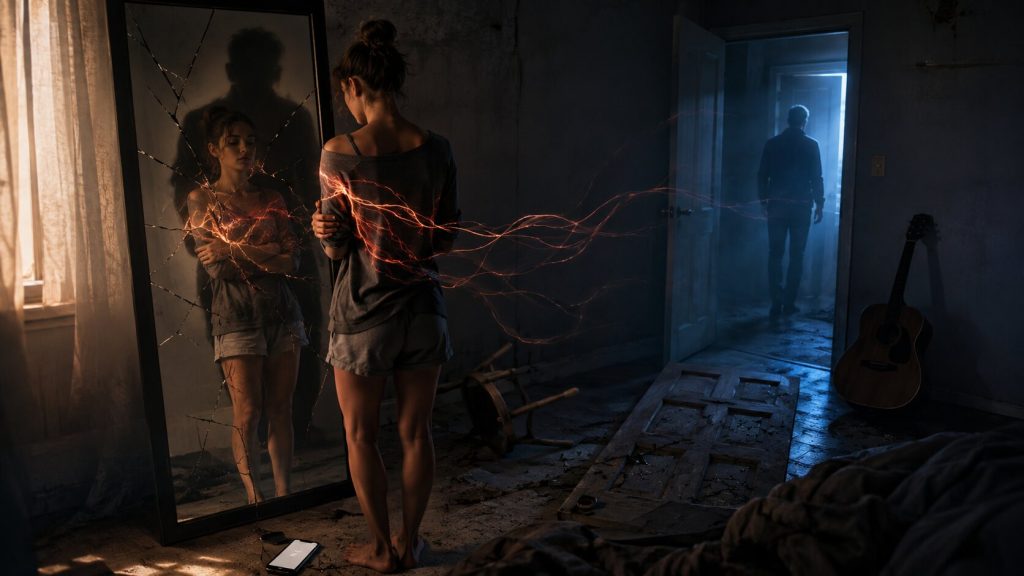
The mirror symbolizes visible resemblance, but hearing her father in her own voice is more unsettling. It suggests that inherited damage has moved beyond appearance and entered the way she reacts. Her anger becomes evidence that she fears she may reproduce the patterns that once wounded her.
The mirror therefore functions as more than a symbol of family resemblance. It becomes a test of identity. The narrator is asking whether awareness alone is enough to break an emotional cycle.
No Separate Pre-Chorus, Only Mounting Pressure
“Bloodstream” does not depend on a sharply separated pre-chorus. Instead, the opening verse moves directly toward the refrain, allowing memories of family, conflict with her partner, and the immediate need for reassurance to collapse into one another.
This structural compression reflects the narrator’s mental state. She does not calmly organize her history before arriving at a conclusion. Her past and present are happening simultaneously inside her.
The Chorus: A Breakdown on Her Mother’s Floor
The chorus places the narrator in an unusually vulnerable setting: crying on her mother’s floor. The image removes the appearance of adult independence and returns her to a parental space because the relationship has left her confused, exhausted, and emotionally exposed.
The floor represents collapse, but her mother’s presence also introduces safety and perspective. Grace has said that she does not often become deeply vulnerable with her parents, so bringing the problem to her mother signals that the pain has become too serious to contain privately.
The chorus then presents a painful conversation. The narrator wants her partner to change, but the response she receives is compassionate in tone and final in substance. He may care for her, yet he admits that he cannot meet her emotional needs.
This is not a dramatic declaration of hatred. That is part of what makes the moment so painful. The relationship ends not because all feeling has disappeared, but because feeling alone cannot create consistency, safety, or transformation.
“Am I Too Much?”: When Rejection Becomes Self-Interrogation
After hearing that her partner cannot give her what she needs, the narrator does not immediately hold him accountable. Instead, she turns the judgment inward.
She fears that her emotions are excessive while also worrying that she lacks whatever quality would make someone stay. These two conclusions contradict each other, but both place responsibility for the relationship’s failure on her identity.
This contradiction captures a recognizable pattern in unstable relationships. A person may repeatedly ask whether they were too demanding, not loving enough, too emotional, or somehow impossible to satisfy. The questions cannot be resolved because they are produced by insecurity rather than reliable evidence.
Prayer, Numbness, and the Limits of Control
The image of being on her knees carries two meanings. It resembles prayer, but it also resembles pleading.
The narrator appeals to God because direct communication with her partner has failed. However, her prayer is initially focused on making him speak to her rather than helping her leave. Even in desperation, her attention remains fixed on restoring the connection.
Numbness complicates the scene. She is emotionally overwhelmed, but she is also exhausted beyond ordinary feeling. The relationship has pushed her from panic toward shutdown.
The chorus concludes with the title metaphor, transforming romantic attachment into something that circulates through the body. Her former partner is no longer merely someone she remembers. He has become part of her internal chemistry.
The Second Verse: Violence Without Direct Contact
The second verse introduces an important qualification: the partner did not physically strike the narrator. However, the relief attached to that fact reveals how low her standard of safety has become.
She remembers him punching doors in anger. Violence directed at objects can still communicate threat, volatility, and intimidation. Within the song, the damaged doors demonstrate that his rage entered their shared environment even when it was not directly aimed at her body.
Grace has discussed how harmful behavior may be minimized when it does not fit a narrowly recognized category of abuse. Words, intimidation, property damage, and repeated emotional instability can still show that someone is unsafe or unhealthy to remain around.
The song therefore rejects the false assumption that a relationship must involve direct physical assault before its damage can be taken seriously.
Loving Someone Who Needed Love
The narrator does not describe the entire relationship as meaningless. She does not regret loving him because she believes he needed that love at the time.
This perspective is compassionate, but it also reveals the rescue dynamic that kept her attached. She interpreted another person’s damage as a reason to give more of herself, even as the relationship continued to hurt her.
The song makes an important distinction between regretting a relationship and recognizing that it had to end. The narrator can value the sincerity of what she offered without pretending that her love was capable of transforming the person who received it.
“I Made It Out”: The Song’s Quiet Victory
The final emotional turn is not triumphant in a conventional pop-song sense. The narrator still sounds affected by the relationship, but she recognizes that leaving was necessary.
She apologizes for being unable to help him, showing that her instinct to take responsibility has not completely disappeared. Yet that apology is followed by relief.
Grace has explained that only the other person could ultimately save himself. Remaining in the relationship would not have repaired him. It would only have prevented her own recovery.
The idea of making it out reframes the breakup as an escape. What initially feels like abandonment becomes survival.
The Ending: No Instant Emotional Detox
The returning refrain does not present a perfectly healed narrator. She may have physically left the relationship, but she still wants the person removed from her mind and bloodstream.
That unresolved ending feels psychologically truthful. A person can make the correct decision before their nervous system catches up with it. Physical distance can begin immediately, while emotional detachment may take months or years.
The song closes in the gap between escape and recovery.
The Symbols That Carry the Heaviest Weight
The Bloodstream
The central metaphor describes attachment as something internal and constantly circulating. The bloodstream sustains life, reaches every part of the body, and cannot simply be switched off.
By placing the former partner there, Grace communicates obsession, emotional conditioning, and the difficulty of separating love from identity. She has described the experience as being so consumed by another person that they seem to become part of everything you are.
The metaphor also connects romantic attachment to family inheritance. Blood represents both emotional obsession and biological lineage. The narrator wants her partner out of her bloodstream while fearing that her father’s influence is already present within it.
The Mirror and the Voice
The mirror represents inherited resemblance, while the voice represents learned behavior. Together, they dramatize the fear that trauma has not only happened to the narrator but has begun speaking through her.
At the same time, recognizing the pattern may be the first step toward refusing to repeat it. The image is frightening, but it also shows that the narrator has developed enough self-awareness to identify what she wants to change.
The Mother’s Floor
The floor symbolizes regression, exposure, and refuge. The narrator has been stripped of the composure associated with adulthood, but she has also reached a place where she can be witnessed honestly.
Being on the floor suggests that the relationship has brought her to an emotional low point. Being on her mother’s floor suggests that she has returned to a source of protection while trying to rebuild her perspective.
The Damaged Doors
Doors usually symbolize movement, boundaries, and escape. In “Bloodstream,” they become objects damaged during expressions of anger.
This inversion is significant. A door should provide an exit, yet his violence toward it makes the environment feel more dangerous. Later, the narrator’s realization that she made it out restores the door’s original function: she finally crosses the boundary and leaves.
Prayer
Prayer represents desperation, but it also reveals where the narrator directs hope when communication fails. At first, she hopes for the other person to respond. Eventually, the song suggests that her hope must shift toward finding the strength to stay away.
The Real Experiences Behind “Bloodstream”
“Bloodstream” has autobiographical roots. Grace has confirmed that it was originally inspired by a man she knew and by her experience of leaving a difficult relationship.
She has also explained that one of the song’s central responses was influenced by something her father told her during the breakup. He loved her and understood that she was in pain, but he could not change what was happening on her behalf. Grace adapted that idea so it could also sound like a romantic partner admitting that love was not enough to provide what she needed.
This does not mean that every image in the song should be read as a literal documentary record. Songwriters often combine conversations, memories, emotional impressions, and altered perspectives into a single narrative.
Grace has not publicly identified the former partner in the reliable sources connected to the release. Claims about a specific person should therefore be treated as speculation rather than fact.
She has also acknowledged that listeners apply the song to relationships beyond its original romantic context. Its central themes—loving someone who cannot change, carrying family damage, and struggling to release an attachment—can apply to partners, parents, friends, and other emotionally formative relationships.
A Defining Chapter in the spilling my guts Era
“Bloodstream” fits Alyssa Grace’s broader catalog through its confessional writing, acoustic foundation, and tendency to describe emotional attachment through concrete physical metaphors.
Songs such as “picking petals” and “dog with a bone” similarly use recognizable objects or actions to explore uncertainty, fixation, and emotional pursuit. Their titles suggest repetitive psychological behavior: removing petals while waiting for an answer, refusing to release something once it has been seized, or carrying someone through the blood.
On spilling my guts, “Bloodstream” functions as one of the project’s clearest statements of purpose. The project title suggests involuntary confession and the need to release what has been held inside. “Bloodstream” describes the reverse movement: another person has entered the narrator so deeply that removing the experience becomes the central struggle.
Grace’s vocal performance strengthens that confessional quality. Rather than describing the relationship from a safe emotional distance, she sings as though each realization is arriving in real time.
The arrangement begins with relative restraint and expands as the distress intensifies. The production therefore mirrors the song’s emotional movement from reflection to confrontation, collapse, and eventual recognition.
A stripped version released in July 2026 further emphasized the song’s singer-songwriter foundations and its dependence on voice, phrasing, and narrative rather than elaborate pop production. (Alyssa Grace – “Bloodstream” stripped version)
What Remains After the Relationship Ends
The most convincing interpretation of “Bloodstream” is that it documents the moment a person stops confusing love with responsibility.
The narrator loves someone who is emotionally unstable and hopes that enough patience will inspire him to change. At the same time, she carries childhood wounds that make instability feel familiar and deeply personal. When he cannot meet her needs, she interprets his failure as proof that she is either excessive or inadequate.
Her breakthrough is not that she suddenly stops caring. It is that she accepts that caring cannot perform another person’s healing for them.
That is why the song’s final relief feels earned rather than celebratory. She has made it out, but the relationship remains in her thoughts, reflexes, and emotional bloodstream. Recovery begins with leaving, but it does not end there.
“Bloodstream” resonates because it gives language to the uncomfortable stage between danger and full recovery: the relationship is over, the necessary decision has been made, but the body has not yet learned that it is free.
FAQs About “Bloodstream” by Alyssa Grace
What does “Bloodstream” by Alyssa Grace mean?
“Bloodstream” is about leaving an emotionally damaging relationship while struggling with inherited trauma, insecurity, and intense attachment. The title describes how deeply another person can become embedded in someone’s thoughts, identity, and emotional responses.
Who wrote “Bloodstream” by Alyssa Grace?
Alyssa Grace and Steven Martinez are the credited songwriters. Martinez also produced the recording, while Carson Ripley is credited as a co-producer.
When was “Bloodstream” released?
The official music video was published on June 4, 2026, while major streaming services list the single’s release date as June 5, 2026.
Is “Bloodstream” based on a true story?
Yes. Alyssa Grace has said that the song was originally inspired by a man she knew and by her experience of leaving a difficult relationship. She has not publicly confirmed the identity of the person.
What does the bloodstream metaphor represent?
The bloodstream metaphor represents an attachment that has become internal, constant, and difficult to remove. It suggests that the relationship affects every part of the narrator’s emotional life, even after she has physically left.
Why does Alyssa Grace mention her father in “Bloodstream”?
The reference to her father explores how family history can shape adult relationships. The narrator recognizes traces of her father’s anger and behavior in herself and fears that she may repeat patterns she wants to escape.
What project is “Bloodstream” from?
“Bloodstream” was first released as part of a single package and was later included on Alyssa Grace’s seven-track 2026 project spilling my guts.
Sources Used