
The Independent Artist’s EPK: Press Photos, Bio, Links and Proof
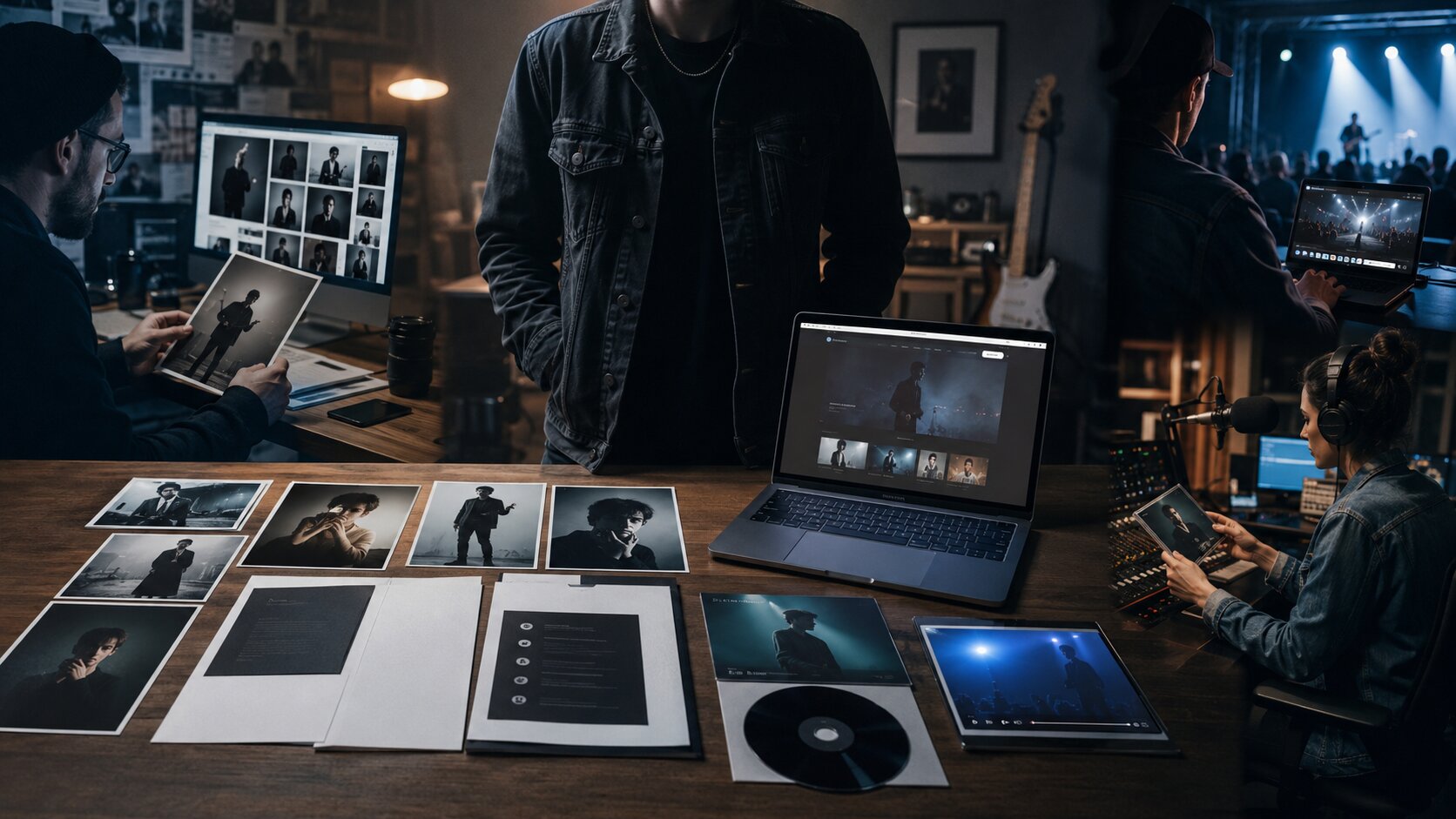
A useful EPK is not a digital scrapbook of everything you have ever done. It is a compact professional package that gives journalists, promoters, radio contacts, managers, labels, and other industry professionals the music, story, images, links, evidence, and contact details they need without searching across multiple platforms.
Build one strong master EPK, then change the emphasis depending on who you are approaching. Press photos must be publishable, the bio must explain the artist quickly, links should lead directly to useful assets, and every career claim should be accurate and verifiable.
Introduction
An independent artist can have excellent music and still make a weak professional impression when the person receiving a pitch has to search across several platforms just to understand the project.
That is the practical problem an electronic press kit, or EPK, is designed to solve. Instead of forcing a journalist to hunt for a usable photograph, a promoter to search for live footage, or a radio contact to work out which release is current, the EPK puts the most important professional material in one organized place.
A strong music press kit normally combines recordings, promotional photography, biography information, career highlights, relevant links, and contact details. The Musicians’ Union likewise recommends providing strong recordings, professional images, a concise biography, and easily accessible press materials when approaching media. (Musicians’ Union – Getting Press and Making the Most Out of Your Press Kit)
The difficult part is not collecting more material. It is deciding what the recipient actually needs, removing anything that creates friction, and presenting enough proof to make the artist credible without turning the page into a résumé archive.
Table of Contents
- Key Takeaways
- Build the EPK for the Person Opening It
- Press Photos Must Be Publishable, Not Merely Attractive
- Write a Bio That Gives Someone Else a Story to Tell
- Make Every Important Link One Click Away
- Use Proof That Strengthens the Pitch
- Package the EPK So Nothing Creates Friction
- Audit the Kit Before Every Serious Campaign
- Build Your Artist Infrastructure Beyond the EPK
- Frequently Asked Questions
- Sources Used
Key Takeaways
| Point | Details |
|---|---|
| Build around a purpose | A press EPK, booking EPK, and general industry EPK can use the same core assets while emphasizing different information. |
| Make photos immediately usable | Provide a small selection of high-quality images in useful orientations with clear photographer credits and appropriate usage permission. |
| Write for the recipient | The biography should explain the artist, musical identity, relevant history, and current project without becoming a full autobiography. |
| Curate links aggressively | Prioritize current music, strong video, official profiles, downloadable assets, and contact information instead of listing every account you own. |
| Use credible proof | Press coverage, performances, radio support, collaborations, audience data, and other milestones should be accurate and verifiable. |
| Remove friction | A clean EPK URL with organized downloadable assets is generally easier to use than a long email filled with large attachments. |
Build the EPK for the Person Opening It
The first question should not be, “What can I put in my EPK?” A better question is, “What does this particular recipient need in order to make a decision?”
That distinction changes the entire structure of the press kit.
A journalist deciding whether to cover a release needs a quick understanding of the artist, the story surrounding the current music, release details, photographs, credits, and previous coverage where relevant.
A promoter considering a booking is likely to care more about live footage, previous shows, audience fit, location, performance history, and booking contact information.
A radio contact needs fast access to the correct recording, artist and release information, and an easy way to follow up. A manager, label, publisher, or other potential partner may want a broader view of the artist’s catalogue, audience, positioning, recent momentum, collaborators, and professional team.
Current EPK guidance from Bandzoogle similarly recommends determining the purpose of the kit first and adapting its content for media, radio, booking, labels, or other specific recipients. (Bandzoogle – EPK Creation Guide)
Create a master asset library
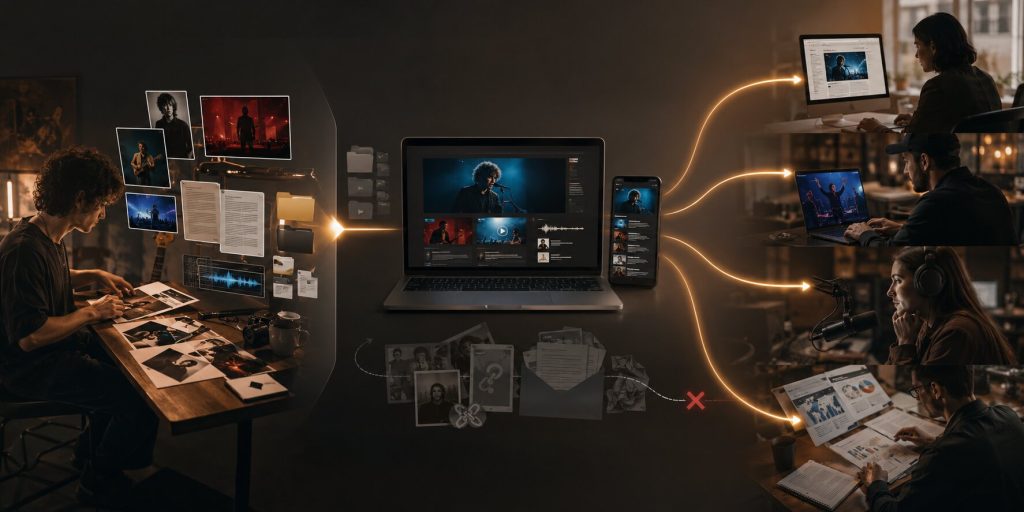
You do not need to rebuild every file from scratch whenever you send a pitch. Maintain one organized source library containing your current biography, short biography, press photographs, artwork, current release, selected catalogue links, strongest video, live footage, relevant press coverage, notable milestones, official profiles, credits, and contact information.
Then change the hierarchy according to the campaign.
- For a release campaign, lead with the release and its story.
- For press outreach, make the bio, current music, images, and relevant coverage prominent.
- For booking outreach, move live footage and performance history higher.
- For broader industry conversations, provide enough context to show where the project is going as well as where it has been.
Pro Tip: Your EPK should support the pitch rather than replace it. The email should explain why you are approaching that specific recipient. The EPK should make it easy for that person to verify the artist and access the material needed for the next step.
Press Photos Must Be Publishable, Not Merely Attractive
A visually impressive photograph can still be a poor press asset if an editor cannot crop it effectively, download a high-resolution version, identify the photographer, or determine whether the image is authorized for publication.
Treat a press-photo shoot as professional asset production rather than simply another content session for social media.
A practical EPK photo selection might contain:
- a strong landscape image;
- a portrait-oriented image;
- an image that also crops comfortably to a square;
- one photograph with useful negative space for editorial layouts;
- a quality live image if performance is central to the artist’s positioning.
Do not upload 20 nearly identical shots. A journalist or designer usually benefits more from a small set of clearly differentiated options than from an enormous gallery that transfers the selection work back to them.
Use sensible file names and credits
Rename exported files before adding them to the EPK. A file such as artist-name-photographer-name-landscape.jpg is significantly easier to identify later than IMG_8372_FINAL2.jpg.
Place the photographer credit beside the image download or include it clearly within the press-photo folder. Make sure you have the necessary rights or authorization to distribute photographs for promotional use. Apple Music’s artist-image requirements also emphasize that artists must have legal authorization for imagery they upload, reflecting the broader importance of controlling the rights to professional artist visuals. (Apple Music for Artists – Artist Image Guidelines)
It is also useful for your main EPK imagery to resemble the visual identity someone finds when they visit your official website, streaming profiles, and current social channels. Perfect uniformity is unnecessary, but an obviously outdated press kit can make an active project look neglected.
Write a Bio That Gives Someone Else a Story to Tell
An EPK biography is not supposed to document every stage of your life. Its job is to give another person enough accurate context to understand, describe, introduce, or write about the artist.
Start with what defines the project now: the artist name, location or relevant scene, musical identity, and current creative focus.
Paragraph one: establish the artist
Explain what kind of music you make and what distinguishes the project. Specific musical information is usually stronger than promotional adjectives.
Descriptions of production style, instrumentation, songwriting perspective, genre intersections, vocal character, performance format, or artistic themes give the reader something concrete. Claims such as “the next big thing” or “a completely unique artist taking the world by storm” provide almost no useful information.
Paragraph two: add relevant history
Include earlier releases, formative collaborations, notable performances, previous projects, or other background only when it helps explain the current artist story.
The goal is selective context, not completeness.
Paragraph three: bring the story to the present
Explain what the artist is releasing, touring, creating, or developing now. During an active campaign, this section often gives a journalist or presenter the most immediately useful context.
Keep both a short and a longer version of the bio. A compact paragraph is useful for event listings, introductions, and quick references, while a longer version can give journalists and industry professionals more context when required.
Concise writing also translates well to external artist profiles. YouTube Music currently allows artists to add a biography to their profile and notes that only an initial portion may appear before a user expands the text, making the opening sentence especially important. (YouTube Music Help – Manage Your Artist Profile)
Make Every Important Link One Click Away
An effective EPK reduces hunting. Someone reviewing the artist should not have to search manually for the current single, find a video through a social profile, request photo access, and then look elsewhere for a contact email.
Group links by function rather than presenting an undifferentiated collection of icons.
Listen
- current single, EP, or album;
- primary streaming destinations;
- private listening link when unreleased music is part of the pitch.
Watch
- current official video;
- best live-performance video;
- another highly relevant visual asset only if it adds something different.
Artist links
- official website;
- Spotify artist profile;
- Apple Music artist profile;
- YouTube channel;
- active social profiles relevant to the artist.
Downloads
- press photographs;
- release artwork;
- short and full biography;
- release information or one-sheet when useful;
- technical or stage information for booking-focused versions.
Contact
Clearly identify the appropriate email addresses for press, booking, management, or general enquiries when those roles are separate.
Avoid listing every platform simply because an account exists. An abandoned profile can make the presentation less convincing rather than more complete.
Use Proof That Strengthens the Pitch
Career proof is one of the most useful parts of an EPK when it is selected carefully. The purpose is not to make the longest possible achievements list. It is to give the recipient evidence that supports the specific pitch.
| Pitch Goal | Potentially Useful Proof |
|---|---|
| Press | Previous features, interviews, reviews, credible editorial quotes |
| Booking | Relevant venues, festivals, support slots, quality live footage, recent performance history |
| Radio | Previous station support, specialist-show activity, relevant airplay |
| Industry | Audience development, catalogue performance, collaborations, team growth, meaningful release momentum |
| General | Awards, grants, notable partnerships, or other independently verifiable milestones |
Use audience data with context
Streaming and audience numbers can be useful when they genuinely help the reader understand the project. Spotify for Artists provides artists with performance and audience analytics including listeners, streams, saves, and followers, while Apple Music for Artists provides its own performance data across Apple Music and related services. (Spotify for Artists – Analytics)
Numbers become more useful when they have context. Instead of placing a large figure on the page with no explanation, identify what it measures and, where appropriate, when it was recorded.
For example, “50,000 streams” is less precise than “50,000 Spotify streams across the catalogue as of July 2026.”
Do not inflate terminology. A placement on an independently created playlist should not be described as an official editorial placement. Opening a single concert for another artist should not automatically become “touring with” that artist. A short mention should not be presented as a major feature.
When your audience numbers are still modest, there is no need to manufacture impressive-looking metrics. A strong live performance, respected local booking, credible review, repeat media interest, worthwhile collaboration, or evidence of consistent development may support the pitch more effectively.
Package the EPK So Nothing Creates Friction
Your recipient should not need special software, account permissions, or several large downloads simply to investigate the artist.
For many independent musicians, a practical setup is one dedicated EPK webpage supported by one clearly organized download folder.
The Musicians’ Union recommends making electronic press material easily accessible through a straightforward link so journalists and editors can download what they need. (Musicians’ Union – How to Boost Your Chances of Getting Your Music Reviewed)
A useful EPK page order could be:
- artist name and concise positioning;
- current music;
- short biography;
- strong current press image;
- relevant video;
- selected career proof;
- press-photo and artwork downloads;
- official links;
- contact information.
The exact sequence can change according to the campaign. A booking EPK, for example, can move the live video considerably higher.
Keep the asset folder understandable
A downloadable folder might contain:
Press PhotosArtworkBioRelease InformationLogosLive Assets
Test every link and folder from a browser where you are not signed into the storage account. This is one of the easiest ways to catch permission problems before the EPK reaches a journalist or promoter.
A polished page with a locked download folder still creates a bad professional experience.
Audit the Kit Before Every Serious Campaign
An EPK becomes outdated quietly. The single described as “upcoming” gets released. Audience figures change. A new photograph becomes the main campaign image. A band member leaves. The strongest live video improves. A booking or press contact changes.
Make EPK maintenance part of your release and outreach workflow rather than treating the kit as something you build once.
- Is the first music shown still the music being pitched?
- Does the short biography accurately describe the project today?
- Are all press photos downloadable?
- Are photographer credits included?
- Do you have permission to distribute every asset?
- Are audience or streaming claims accurate and sufficiently current?
- Do important press mentions link to the original coverage?
- Do video links still work?
- Are private music links accessible to the intended recipient?
- Are folder permissions correct?
- Is the contact information current?
- Have obsolete or weak achievements been removed?
- Can someone understand the artist quickly after opening the page?
The final question is especially useful. An EPK can contain all the correct ingredients and still fail if the hierarchy is confusing.
Build Your Artist Infrastructure Beyond the EPK
An electronic press kit works best when it is part of a broader professional artist infrastructure rather than an attempt to replace everything else.
Your main website can serve fans with the wider catalogue, mailing-list signup, merchandise, tour dates, videos, and the broader artist story. The EPK has a narrower purpose: helping industry contacts evaluate, cover, book, or contact the artist quickly.
That distinction also makes the kit easier to edit. You do not have to squeeze every fan-facing feature into the EPK simply because it exists elsewhere on the website.
For more practical guidance on independent music releases, promotion, artist development, and music-business strategy, explore Block Tone Records. The goal is not simply to look professional during one pitch, but to build a repeatable system that supports future releases and opportunities.
FAQs About EPKs for Independent Artists
What does EPK stand for in music?
EPK stands for electronic press kit. It is a digital collection of professional artist materials such as music, biography information, promotional photographs, videos, career highlights, official links, and contact details.
Does an independent artist really need an EPK?
An EPK becomes especially useful when you regularly approach journalists, promoters, venues, festivals, radio contacts, managers, labels, or other industry professionals. It saves the recipient from searching across multiple platforms for the information needed to evaluate the artist.
Should an artist EPK be a PDF or a webpage?
A dedicated webpage is usually more flexible because it can combine streaming links, video, current information, and downloadable assets under one URL. A PDF can still be useful as a supplementary one-sheet or when a recipient specifically requests that format.
How many press photos should be included in an EPK?
There is no universal required number. A small selection of genuinely different, high-quality images is usually more useful than a large gallery of similar shots. Include useful orientations, clear photographer credits, and files suitable for publication.
Should I include Spotify streaming numbers in my EPK?
Include streaming figures when they genuinely strengthen the pitch and can be stated accurately. Add enough context to explain what the number represents and when it was measured. If the figures are not meaningful yet, stronger qualitative evidence may be more persuasive.
Can I use the same EPK for press and booking?
You can use the same underlying asset library, but the hierarchy should change. A press-focused EPK should emphasize the current story, music, biography, images, and coverage, while a booking EPK should make live footage, performance history, and booking information more prominent.
How often should an artist update an EPK?
Review the EPK before every major release, tour, press campaign, or serious outreach cycle. Update it whenever important information changes, including the current release, biography, photos, team, contact information, videos, or career evidence.
Sources Used
- Musicians’ Union – Getting Press and Making the Most Out of Your Press Kit
- Musicians’ Union – How to Boost Your Chances of Getting Your Music Reviewed
- Spotify for Artists – Analytics
- Apple Music for Artists – Artist Image Guidelines
- YouTube Music Help – Manage Your Artist Profile
- Bandzoogle – EPK Creation Guide