

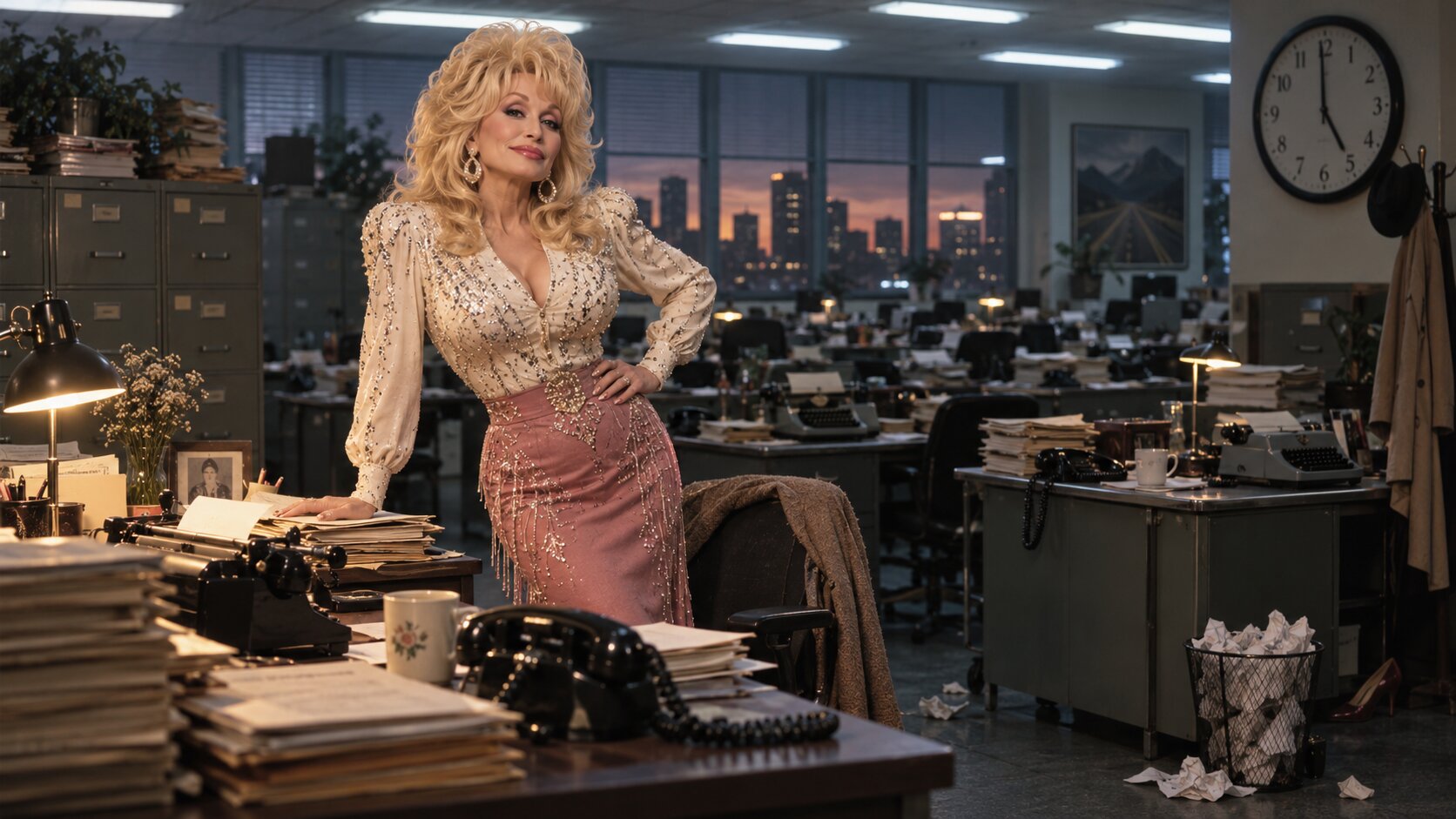
Dolly Parton’s “9 to 5” Meaning: Work, Power and Ambition
Few protest songs sound as cheerful as Dolly Parton’s “9 to 5.” Its bright piano, driving rhythm, and instantly memorable melody make the record feel celebratory, but beneath that upbeat surface is a pointed criticism of workplace inequality, low pay, limited advancement, and the frustration of seeing other people benefit from your labor.
Written for the 1980 film 9 to 5, the song transforms an ordinary office routine into a broader story about workers who are ambitious and capable but have little control over the systems deciding their pay, recognition, and opportunities. That tension between frustration and optimism is one of the main reasons “9 to 5” became much more than a movie theme.
A Workday Anthem with Much More on Its Mind
At its core, “9 to 5” is about people giving their time, intelligence, and energy to a job while feeling that the rewards flow disproportionately toward those above them. The narrator is not opposed to work. In fact, she is motivated, alert, and clearly interested in building a better life.
The problem is that hard work does not automatically produce mobility. Someone else controls the salary, the promotion, the recognition, and ultimately how valuable the worker is allowed to become within the organization.
That distinction is essential to the song’s meaning. “9 to 5” is not simply a complaint about having to wake up and go to work. It questions what happens when employment becomes an unequal exchange in which workers are expected to contribute constantly without receiving comparable power or reward.
The movie behind the song was closely connected to the experiences of women working in clerical jobs. The real 9to5 movement organized women who faced problems including low wages, disrespect, limited advancement, and sexual harassment in the workplace. The Library of Congress describes it as a grassroots movement of women clerical workers who organized to demand better conditions. (Library of Congress)
Parton’s lyrics are broad enough, however, that the narrator does not belong only to one office or one profession. The central frustration can apply to anyone who feels that their labor is necessary but their contribution remains undervalued.
From a Movie Set to a Number-One Song
“9 to 5” was created for the comedy film of the same name, starring Jane Fonda, Lily Tomlin, and Dolly Parton. The movie marked Parton’s first major film role, with Parton playing Doralee Rhodes, one of three women who confront an abusive and sexist workplace culture.
Parton wrote the theme song while the film was being made. One of the most famous details about its creation came from the way she used her acrylic fingernails. Without constantly having a guitar available on set, Parton tapped her nails together while developing the rhythm and melody. The sound resembled the clicking of an office typewriter, making it especially appropriate for the film. She later explained that she worked on the song over roughly a week, developing ideas during filming and continuing with a guitar at her hotel. (Howard Stern)
The single was released on November 3, 1980, and also appeared on Parton’s 9 to 5 and Odd Jobs album. Parton wrote the song herself, while Gregg Perry produced the recording. The album expanded the working-life theme beyond the title track, making “9 to 5” the centerpiece of a broader collection concerned with labor and ordinary people.
The record became a major crossover success. The Library of Congress notes that “9 to 5” reached number one on both the country and pop charts in 1981, confirming its ability to connect with audiences far beyond Parton’s traditional country base. (Library of Congress)
Its awards recognition was equally significant. The song received an Academy Award nomination for Original Song, with the Academy officially crediting both its music and lyrics to Dolly Parton. (Academy of Motion Picture Arts and Sciences)
It also won two Grammy Awards, including recognition for Parton’s country vocal performance and songwriting. The Recording Academy identifies “9 to 5” as the title song from the film and one of Parton’s major Grammy-winning recordings. (Recording Academy)
Why the Song Sounds Happy While Saying Something Angry
One of the smartest qualities of “9 to 5” is the contradiction between its sound and its subject. The arrangement is lively, playful, and almost relentlessly energetic. The circumstances described by the narrator are far less cheerful.
She is tired, financially pressured, and dependent on people higher in the workplace hierarchy. Her ideas may be useful without receiving enough recognition. Advancement depends on someone else deciding when or whether she deserves it.
Parton could have presented those experiences through a slow or openly confrontational protest song. Instead, she makes the frustration catchy. That decision turns an individual grievance into something communal. Listeners are invited not merely to sympathize with the narrator but to sing along with her.
The song therefore contains two opposing forces. The workplace controls schedules, salaries, titles, and promotions. The worker still possesses intelligence, humor, ambition, friendship, and dreams about a life beyond the immediate limitations of the job.
The company may control the paycheck, but it cannot completely control the worker’s imagination. That stubborn optimism keeps “9 to 5” from becoming a song of defeat.
Inside the Lyrics: How the Workday Unfolds
The Morning Routine: Creating Your Own Motivation
The opening verse begins with familiar actions: waking up, preparing for work, and trying to generate enough energy to begin another day.
Parton’s brief image of a “cup of ambition” is more revealing than a simple reference to morning coffee. The narrator is effectively drinking motivation. She has to prepare herself not just physically but psychologically for another cycle of work.
The choice of the word “ambition” matters because it immediately establishes that this worker wants something from life. She is not unmotivated. She wants progress and possibility. The later frustration comes from realizing that effort and ambition do not necessarily produce advancement when the structure around her controls the available opportunities.
The Chorus Turns Routine into a Workplace Complaint
The chorus expands the story from daily inconvenience into economic criticism. The narrator works consistently but feels financially squeezed. Her contribution creates value, yet she does not believe she receives a fair share of that value.
Money is only one part of the complaint. Recognition matters too. The song repeatedly suggests a workplace in which ideas and effort can travel upward while credit does not always travel back down.
That makes the chorus more sophisticated than a simple complaint about salary. Parton recognizes that people can feel exploited through a combination of low compensation, invisible labor, lack of acknowledgment, and restricted professional mobility.
The Career Ladder Is Turned Upside Down
As the lyrics progress, Parton introduces one of the song’s sharpest images: the idea of the “boss man’s ladder.” A career ladder normally symbolizes an individual employee moving upward through effort and achievement.
Here, the metaphor works differently. Workers appear to become the support that allows someone else to climb. Their labor creates the conditions for another person’s success.
The image raises a larger question: when a company prospers, who receives the greatest benefit? Employees may solve problems, manage customers, produce ideas, organize information, and keep operations functioning, while the largest financial and professional rewards accumulate elsewhere.
That is where “9 to 5” moves from dissatisfaction with one unpleasant boss toward criticism of a broader hierarchy.
The Repetition Feels Like a Clock
Unlike many pop songs, “9 to 5” does not need an elaborate pre-chorus to create anticipation. Its sections move forward rapidly, maintaining a constant sense of motion.
That musical construction suits the subject. A working day can also feel repetitive and automatic: wake up, commute, arrive, complete tasks, watch the clock, go home, and start again.
The arrangement rarely seems willing to stop. Even at its most cheerful, it carries the listener forward with the same unavoidable momentum as a schedule.
The Story Expands from One Worker to Many
An important shift occurs when the frustration stops feeling entirely individual. The narrator recognizes that other people share the same hopes and limitations.
This changes the meaning considerably. An employee who has been overlooked may initially assume the problem is personal: perhaps she has not worked hard enough, proven herself enough, or waited long enough.
When many workers experience similar obstacles, however, the problem begins to look structural rather than individual. Shared frustration becomes the beginning of solidarity.
That interpretation is especially relevant to the historical background of the movie. The 9to5 organization grew from women comparing their experiences as office workers and discovering that problems they had treated as private were widespread. Smithsonian history of the movement notes that organizer Karen Nussbaum and other workers gathered information about clerical employees and used those shared experiences as the basis for organizing. (Smithsonian American Women’s History Museum)
The Ending Keeps the Dream Alive
By the final refrains, the narrator understands her circumstances more clearly. Promotions can be controlled from above. Work can enrich people with greater power. Individual employees can be made to feel replaceable even when their contributions are essential.
Yet the song does not end in surrender.
The narrator continues to imagine something better. This is one of the most important parts of the emotional arc. Awareness has increased, but ambition survives.
“9 to 5” never promises that one employee will suddenly defeat the entire system. Its optimism is more realistic than that. The worker may not immediately control the organization, but she can understand what is happening, recognize that she is not alone, and refuse to let the workplace define the full extent of her aspirations.
Coffee, Clocks, and Ladders: The Song’s Symbolic Language
The song’s imagery is built from ordinary workplace objects and routines, but many of them carry larger meanings.
The title itself represents more than a specific shift. “9 to 5” becomes shorthand for externally controlled time. A large part of the worker’s waking day belongs to an institution operating according to a schedule she did not create.
The morning coffee represents self-generated energy. The organization expects productivity, but the employee must find the motivation necessary to provide it.
The ladder represents hierarchy and advancement. Normally, climbing a ladder suggests personal progress. Parton complicates the image by suggesting that workers can become the steps supporting another person’s rise.
References to ideas, credit, and promotion introduce another kind of inequality: visibility. A worker can be valuable enough to generate results while remaining insufficiently powerful to guarantee recognition for those results.
Finally, the contrast between money and dreams becomes the song’s central philosophical tension. Employers may determine wages and job titles, but the narrator continues to imagine possibilities beyond what her current workplace offers.
Through these simple images, “9 to 5” becomes a song about time, class, authority, gender, recognition, and personal dignity without ever sounding like a lecture.
Is “9 to 5” Based on a Real Person or Event?
There is no verified evidence that the narrator of “9 to 5” represents one specific real person. The character is better understood as a composite worker whose experiences reflect problems shared by many employees.
The song does, however, have a strong real-world foundation. It was written for a film inspired in part by actual women office workers and the labor organizing that emerged around their experiences.
The historical 9to5 movement organized clerical workers who faced low pay, poor treatment, limited opportunities, and workplace discrimination. Those experiences helped shape the cultural environment behind the film, even though Parton’s song tells its story through a generalized narrator rather than documenting one worker’s biography.
So the most accurate answer is that “9 to 5” is not a literal true story about one person, but its workplace frustrations were grounded in very real social and economic conditions.

Where “9 to 5” Fits in Dolly Parton’s Songwriting
Parton had already established herself as a particularly observant storyteller long before “9 to 5.” Songs such as “Coat of Many Colors” approached class and childhood through intimate memories, while “Jolene” turned romantic insecurity into a tightly focused character drama. “I Will Always Love You” transformed a difficult professional separation into a graceful emotional farewell.
“9 to 5” uses the same gift for direct language and memorable imagery, but its scale is different. Instead of concentrating mainly on one highly personal relationship, the song creates a worker who can represent millions of listeners.
The recording also arrived at an important point in Parton’s crossover career. By the late 1970s she had already expanded beyond the traditional country audience, with songs such as “Here You Come Again” reaching the pop charts. 9 to 5 then gave her a major film role and produced a theme song that reached number one in both country and pop. (Library of Congress)
Despite that mainstream crossover, “9 to 5” retains qualities found throughout Parton’s writing: accessible language, humor, empathy, strong characterization, and an instinct for turning everyday experiences into larger emotional stories.
That combination allows the track to function simultaneously as country-pop, film music, social commentary, and a workplace anthem.
Why “9 to 5” Still Connects with Listeners
The most convincing interpretation of Dolly Parton’s “9 to 5” is that it explores the gap between the value workers create and the recognition they receive.
Its narrator is ambitious but constrained. She is useful but undervalued. She wants to move forward but recognizes that important decisions about money, credit, and opportunity remain in the hands of people with greater authority.
Parton makes that frustration memorable by wrapping it in some of the brightest and most energetic music of her career. The rhythm suggests movement, the melody suggests optimism, and the lyrics describe a worker gradually recognizing the unfairness surrounding her.
That contrast is why the song never feels completely bitter. Its message is critical without becoming hopeless.
More than a story about one office, “9 to 5” is about what happens when people realize that being hardworking does not guarantee being treated fairly. The song’s lasting power comes from the belief that understanding that imbalance can be empowering rather than defeating.
The boss may control the schedule, the promotion, and the paycheck. The worker still has her own ambition, identity, and dreams.
FAQs About “9 to 5”
What does “9 to 5” mean in Dolly Parton’s song?
Who wrote Dolly Parton’s “9 to 5”?
When was “9 to 5” released?
Was “9 to 5” written for the movie?
Did Dolly Parton really use her fingernails in “9 to 5”?
Is “9 to 5” based on a true story?
How successful was Dolly Parton’s “9 to 5”?
Sources Used
- Library of Congress – Dolly Parton timeline, including “9 to 5” chart and award history
- Library of Congress – Dolly Parton discography
- Library of Congress – history of the 9to5 women clerical workers’ movement
- Howard Stern – Dolly Parton on writing “9 to 5” and using her acrylic nails
- Recording Academy – Dolly Parton Grammy history and “9 to 5” awards
- Academy of Motion Picture Arts and Sciences – 1981 Original Song nomination for “9 to 5”
- Smithsonian American Women’s History Museum – Karen Nussbaum, 9to5, and women’s workplace organizing