

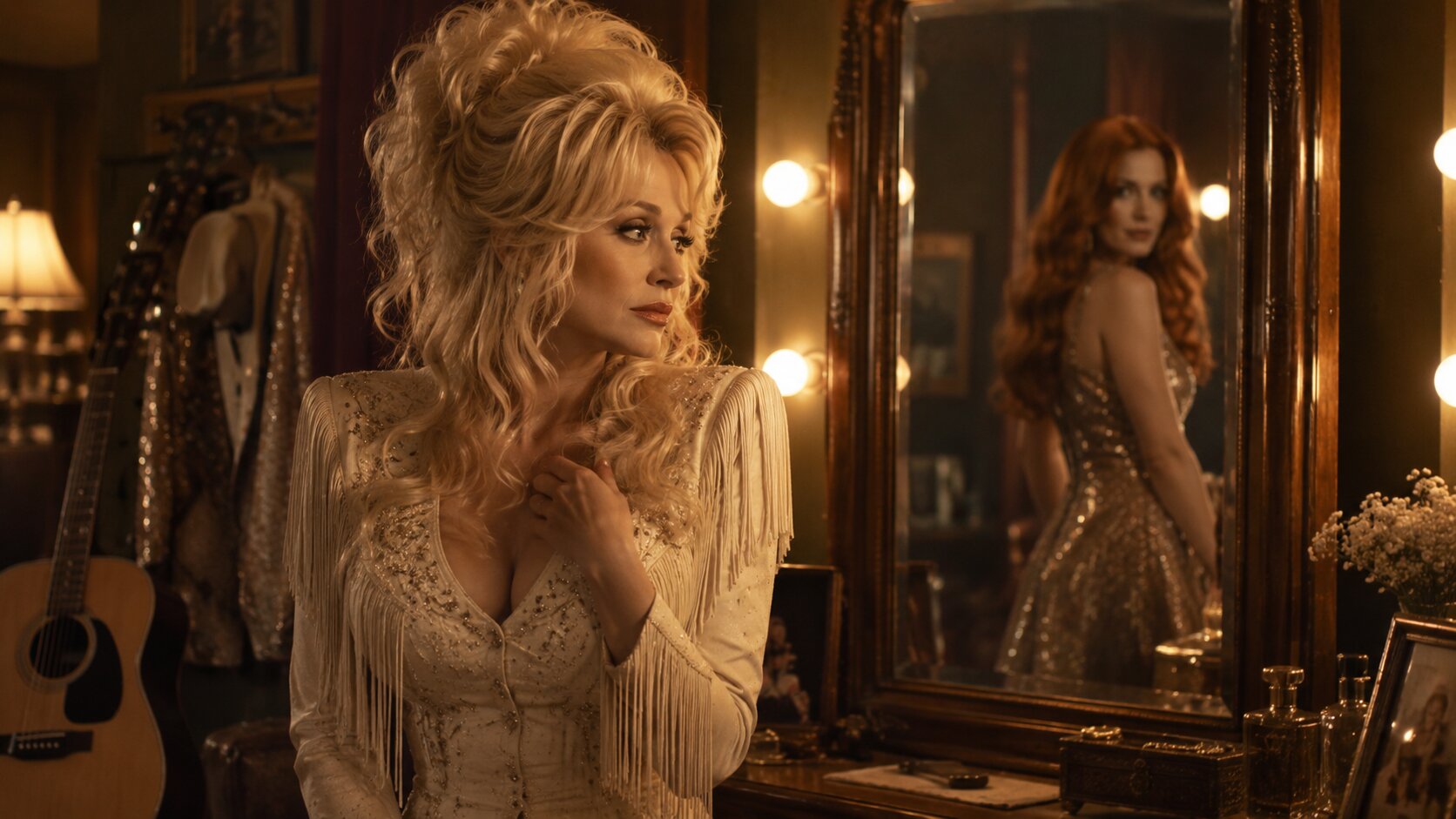
Inside “Jolene”: The Love Song Built Around a Rival
The Short Answer: What Is Dolly Parton’s “Jolene” Really About?
“Jolene” is about the fear of losing someone you love to a person who seems impossible to compete with. Instead of attacking her romantic rival, Dolly Parton’s narrator openly acknowledges Jolene’s beauty and appeal, then asks her not to pursue the man at the center of the relationship.
That choice gives the song its defining emotional tension. “Jolene” is certainly about jealousy, but it is not primarily powered by anger or revenge. Its deeper subject is vulnerability: the frightening realization that another person may have the power to disrupt your relationship because the person you love might choose them.
Parton has explained that the song drew from two separate real-life inspirations. The romantic situation was inspired by a redheaded bank teller who paid attention to her husband, Carl Dean, while the name “Jolene” came from a young redheaded fan Parton met after a performance. (NPR Illinois)
The result is not a documentary account of one woman. It is a carefully constructed song in which Parton combines real observations, emotional exaggeration, and storytelling into a situation that feels universal.
From a Bank Teller to a Country Classic
“Jolene” was released by RCA Victor on October 15, 1973, as the first single from Parton’s album of the same name. The album Jolene followed in February 1974. Parton wrote the song herself, while Bob Ferguson produced the original recording. (The Dolly Parton Discography)
The single became an important milestone in Parton’s solo career. It reached No. 1 on the country chart in 1974 and also crossed over to the pop market, reaching No. 60. The Library of Congress places “Jolene” at the beginning of a remarkable period in which several Parton singles reached the top of the country chart. (Library of Congress)
The song’s reputation continued to grow long after its original release. The Recording Academy included the original RCA single in the Grammy Hall of Fame as part of its 2014 class, recognizing its lasting historical and artistic importance. (Recording Academy)
Musically, the recording is remarkably economical. A persistent guitar pattern creates tension almost immediately, while the arrangement leaves enough space for Parton’s voice and the story to remain at the center. Rather than building toward an enormous climax, the song keeps circling the same fear.
That circular quality is essential. The music sounds unable to escape Jolene in much the same way that the narrator cannot stop thinking about her.
Why the Plea Is More Powerful Than an Attack
One of the most unusual aspects of “Jolene” is the way Parton writes the romantic rival. Jolene is not portrayed as ridiculous, unattractive, dishonest, or obviously inferior. The narrator does almost the opposite: she describes her as extraordinarily desirable.
That immediately changes the emotional balance of the song. The narrator cannot comfort herself by deciding that her rival has nothing to offer. She understands exactly why her partner could be interested in Jolene, and that understanding makes the threat feel more convincing.
The song is therefore built on comparison. Jolene grows larger in the narrator’s imagination while the narrator’s own confidence seems to shrink.
Parton also makes another striking choice: the narrator directs her plea toward Jolene rather than toward the man whose loyalty is supposedly at risk.
That creates an uncomfortable imbalance of power. The narrator behaves as though Jolene has the final say over what happens to the relationship. Instead of demanding reassurance from her partner, she asks her rival to show restraint.
From a strictly rational perspective, responsibility for fidelity would also belong to the partner. Emotionally, however, the narrator is not approaching the situation rationally. She is frightened, and fear has transformed Jolene into the person who seems capable of determining her future.
How the Story Unfolds, Verse by Verse
The Refrain: One Name Becomes an Obsession
The repeated use of Jolene’s name is one of the simplest and most effective devices in the song.
Rather than merely identifying the other woman, the repetition makes her feel omnipresent. Each return to the name sounds like the narrator falling back into the same anxious thought. She may attempt to explain the situation, describe Jolene, or make an argument, but everything eventually leads back to the person she cannot stop thinking about.
The refrain therefore functions simultaneously as a plea and an expression of fixation.
Importantly, the narrator does not clearly establish that Jolene has already destroyed the relationship. Much of the song concerns what Jolene could do. That uncertainty keeps the tension alive. The narrator is trying to prevent a feared future rather than simply reacting to a confirmed betrayal.
First Verse: Admiration Becomes Self-Doubt
The first descriptive verse presents Jolene as almost impossibly beautiful. Her physical features are described with vivid natural imagery, turning her into something larger than an ordinary romantic competitor.
But listeners should remember that the song never gives us an objective portrait of Jolene. We see her entirely through the narrator’s eyes.
That distinction matters because insecurity magnifies comparison. Jolene may indeed be attractive, but the narrator’s fear makes each attractive quality feel overwhelming. Every detail becomes further proof that she cannot compete.
Parton gives Jolene a vivid physical presence while providing almost no comparable description of the narrator herself. Jolene becomes visible; the narrator seems to disappear.
This imbalance is one of the song’s most effective psychological details. Jealousy often works in exactly that way: attention becomes concentrated on everything another person possesses while confidence in one’s own value fades into the background.
Second Verse: The Rival Enters a Private Space
The next stage of the song makes the threat more intimate. The narrator reveals that her partner speaks about Jolene while sleeping.
The song never establishes precisely what this means. It could suggest a serious attraction, a passing fascination, or simply an incident that the narrator has interpreted in the most threatening possible way.
Emotionally, however, the effect is clear. Jolene has entered a space the narrator cannot control.
She cannot negotiate with a dream, inspect another person’s private thoughts, or make herself the exclusive subject of someone else’s unconscious mind. That helplessness pushes the song beyond ordinary jealousy.
Parton also keeps the man himself surprisingly indistinct. He rarely becomes a fully developed character. Instead, the lyrical spotlight remains on the relationship between the narrator and the woman she fears.
Final Verse: Pride Gives Way to an Appeal for Mercy
Later in the song, the narrator changes her argument. Rather than focusing only on Jolene’s beauty, she emphasizes what losing the relationship would mean to her.
The emotional logic is essentially that Jolene has other choices, while this particular man means everything to the narrator.
This is where “Jolene” becomes especially vulnerable. The narrator is willing to sacrifice pride and acknowledge an unequal position if doing so might preserve the relationship.
She is not threatening Jolene or claiming moral superiority. She is asking for mercy.
That makes the confrontation more painful than a conventional rivalry song. The narrator does not believe she can win through confidence, force, or persuasion. She can only hope Jolene chooses not to use the power the narrator believes she possesses.
Why the Song Does Not Need a Traditional Bridge
“Jolene” does not depend on a dramatic bridge that suddenly resolves the conflict or introduces a completely new viewpoint. Instead, it circles back through the same emotional territory.
That structure mirrors the narrator’s mental state. She describes Jolene, explains the threat, makes her plea, and returns to the same anxiety.
There is no answer from Jolene. There is no definitive reassurance from the man. There is no clear resolution.
The song ends while the emotional question is still open, which helps explain why the tension remains powerful even after repeated listens.
Beauty, Power, and the Symbolism Beneath “Jolene”
The most important symbolic idea in “Jolene” is beauty as a form of power.
Jolene’s appearance matters because the narrator believes attractiveness gives her influence. Beauty is not simply decorative within the song; it becomes something that might redirect affection and destabilize an established relationship.
The natural imagery surrounding Jolene reinforces that impression. Her features are associated with vivid colors and qualities that suggest warmth, vitality, and almost effortless magnetism.
At the same time, the narrator gives herself none of these advantages. Her identity is defined almost entirely through fear of losing someone.
That creates one of the song’s most revealing contrasts: Jolene is described by what she possesses, while the narrator is defined by what she might lose.
Another recurring idea is choice. The narrator recognizes that love cannot be protected simply by wanting it badly enough. Another person can choose differently, and that lack of control is the source of the song’s deepest anxiety.
Seen this way, “Jolene” is not only about romantic jealousy. It is about the broader fear that something central to your happiness can depend partly on decisions you cannot make for other people.
Was Jolene a Real Woman?
There is a real-life basis for the song, but the famous Jolene should not be understood as a straightforward portrait of one person.
Parton has explained that the memorable name came from a young fan she met after a show. She liked the sound of “Jolene” and remembered it as a potential song title.
The romantic storyline came from a different woman: a redheaded bank teller who attracted the attention of Parton’s husband, Carl Dean. Parton later described the episode with humor, explaining that Dean seemed unusually enthusiastic about visiting the bank because the teller paid him attention. NPR has preserved Parton’s account of that story from an earlier interview. (NPR Illinois)
The character in the song is therefore best understood as a composite. One real person contributed the name, another situation supplied the seed of romantic jealousy, and Parton transformed those ingredients into a much more emotionally intense story.
This distinction is important when interpreting the lyrics. The song contains autobiographical inspiration, but that does not mean every description or event should be treated as literal biography.
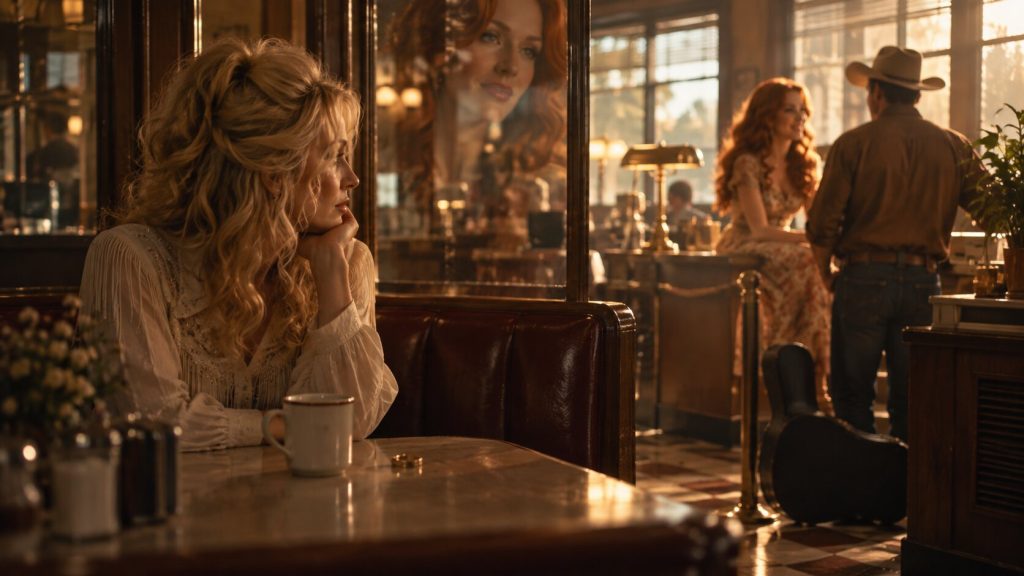
Where “Jolene” Sits in Dolly Parton’s Career
“Jolene” emerged during one of the most significant transitional periods in Parton’s career.
She had already become nationally known through her work with Porter Wagoner, but by the early 1970s she was increasingly establishing an independent identity as a songwriter and solo performer. In 1974, the same year “Jolene” topped the country chart, Parton left Wagoner’s television and road show. The Country Music Hall of Fame describes the early-to-mid-1970s as an especially fertile period in her career. (Country Music Hall of Fame and Museum)
The Jolene album is particularly revealing because it also contains “I Will Always Love You,” the song Parton wrote around the end of her professional partnership with Wagoner.
The two songs approach the possibility of separation from almost opposite directions.
In “Jolene,” the narrator desperately wants to prevent someone from leaving. In “I Will Always Love You,” departure becomes necessary and is accepted with tenderness.
Together, they demonstrate Parton’s ability to write convincingly about conflicting emotional positions. One song captures the fear of abandonment; the other accepts that love can remain meaningful even when people go their separate ways.
They also illustrate a defining characteristic of Parton’s songwriting: complex emotions are expressed through stories that remain immediately understandable.
Why “Jolene” Still Feels So Immediate
The enduring power of “Jolene” comes partly from Parton’s willingness to let the narrator sound vulnerable.
There is no revenge fantasy. The narrator does not discover that her rival is secretly inferior. She does not suddenly recover her confidence and announce that she no longer cares.
Instead, she admits fear.
That makes the song unusually recognizable even for listeners who have never experienced its exact scenario. Most people understand comparison: the moment when someone else appears more attractive, more interesting, younger, more successful, more confident, or simply easier to love.
“Jolene” gives that insecurity a specific face and name.
Yet Jolene herself remains silent throughout the song. She never confirms the narrator’s fears, explains her motives, or makes a decision within the lyrics. Much of her enormous power therefore exists inside the narrator’s imagination.
That is one reason the song remains richer than a simple story about a romantic rival. It captures the way insecurity can transform another person into a symbol of everything we fear we are not.
By combining that psychological vulnerability with an unforgettable melody and remarkably concise storytelling, Dolly Parton turned a small real-life spark into one of country music’s defining songs.
FAQs About “Jolene”
What does “Jolene” by Dolly Parton mean?
Who wrote “Jolene”?
Is “Jolene” based on a true story?
Why does Dolly Parton describe Jolene as so beautiful?
What is the chorus of “Jolene” about?
What album is “Jolene” from?
Was “Jolene” a No. 1 hit?
Sources Used
- NPR Illinois – Dolly Parton’s account of the real-life inspirations behind “Jolene”
- Library of Congress – Dolly Parton timeline and “Jolene” chart history
- Country Music Hall of Fame and Museum – Dolly Parton career biography
- Recording Academy – 2014 Grammy Hall of Fame inductees
- The Dolly Parton Discography – “Jolene” single release, recording, credits, and chart details
- Qobuz – Jolene album credits