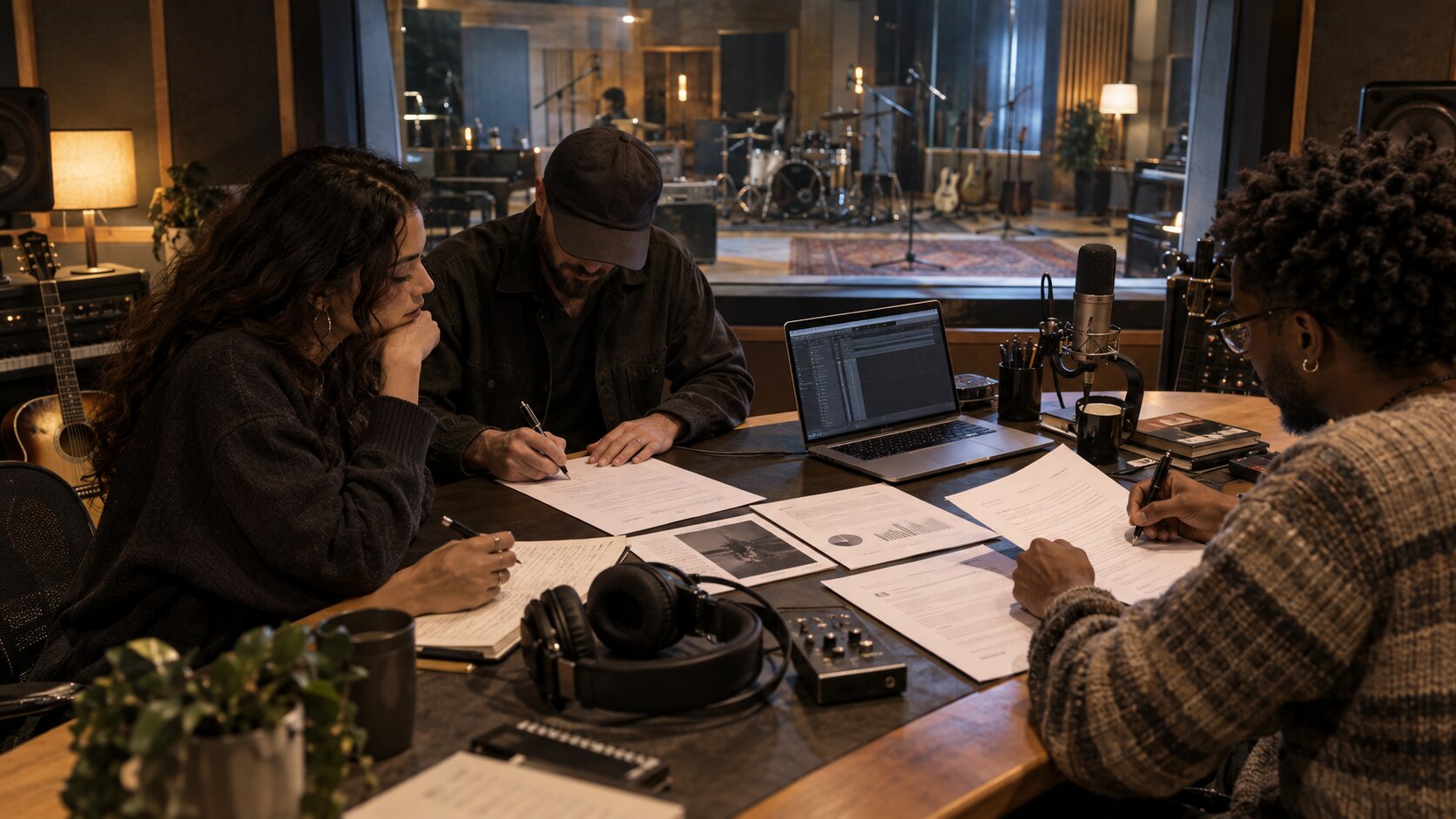
Work-for-Hire in Music: Ownership Rules Before the Session Starts
TL;DR
Paying a producer, songwriter, or session musician does not automatically make their contribution a work made for hire. Under U.S. copyright law, work-for-hire status follows specific legal rules, while ownership of the musical composition and ownership of the sound recording must be considered separately.
The most practical approach is to document ownership, compensation, songwriting splits, master rights, credits, and any copyright assignment before recording begins. A signed agreement is especially important when independent contractors are involved.
This guide focuses primarily on U.S. copyright law and is provided for general educational purposes, not individual legal advice.
Introduction
A recording session can create much more than an audio file. A singer may improvise a melody, a producer may rewrite a chorus, a guitarist may create a distinctive part, and several people may contribute to the final recording. By the end of the session, multiple participants can have different assumptions about who owns what.
That is why the phrase work for hire deserves careful attention before the session starts. It is sometimes used casually to mean, “I paid you, so I own the result.” U.S. copyright law is considerably more specific than that.
Copyright law also distinguishes between the underlying musical composition and the recorded performance. The U.S. Copyright Office explains that music and lyrics can constitute one copyrighted work while the sound recording is a separate copyrighted work. (U.S. Copyright Office – Copyright for Musicians)
This guide explains how work-for-hire rules apply to music, why independent contractors require special attention, and what artists, producers, labels, songwriters, and session musicians should settle before anyone starts recording.
Table of Contents
- Work-for-Hire Changes Authorship, Not Just Payment
- Employee Sessions and Freelance Sessions Follow Different Rules
- The Nine-Category Test Is Where Music Deals Get Tricky
- Keep the Song, Master, and Session Contribution Separate
- Write the Deal Before the Red Light Comes On
- Use a Fallback Assignment Instead of Betting on One Phrase
- Run This Rights Check Before Anyone Records
- Keep the Business Side as Organized as the Session
- FAQs About Work-for-Hire in Music
- Sources Used
Key Takeaways
| Point | Details |
|---|---|
| A fee does not automatically transfer copyright | Hiring and paying someone establishes compensation, but copyright ownership depends on work-for-hire rules, another ownership rule, or a valid transfer. |
| Employees and freelancers are treated differently | Work created by an employee within the scope of employment can qualify under one route, while commissioned freelance work must satisfy additional statutory requirements. |
| The composition and master are separate | Owning a sound recording does not automatically mean owning the melody, lyrics, or other rights in the underlying composition. |
| “Work for hire” is not a magic phrase | For specially commissioned works, the statutory conditions must be satisfied; contract wording alone cannot automatically create work-for-hire status. |
| A fallback assignment can reduce uncertainty | An agreement may separately provide for a copyright transfer if the contribution ultimately does not qualify as a work made for hire. |
| Sign before creation begins | Resolving ownership before the session is much easier than reconstructing everyone’s intentions after a release becomes commercially important. |
Work-for-Hire Changes Authorship, Not Just Payment
Copyright normally begins with the author or authors who create the protected work. A genuine work made for hire operates differently: the employer or other qualifying party is considered the author for copyright purposes and, unless the parties have agreed otherwise in writing, generally owns the copyright. (Cornell Legal Information Institute – 17 U.S.C. § 201)
That distinction can affect much more than who receives the final WAV files. Work-for-hire status can affect who is legally regarded as the author, how long the copyright lasts, and whether certain statutory termination rights are available.
For works created on or after January 1, 1978, the Copyright Act provides a different copyright term for works made for hire: generally 95 years from first publication or 120 years from creation, whichever expires first. (Cornell Legal Information Institute – 17 U.S.C. § 302)
The practical point is straightforward: work for hire is an authorship and ownership concept, not simply a payment arrangement.
Calling a session “work for hire” in an invoice, email, or conversation does not necessarily make it legally so. The actual requirements depend on how the creator is working and what kind of work is being created.
Employee Sessions and Freelance Sessions Follow Different Rules
U.S. copyright law provides two principal routes to work-made-for-hire status. The first concerns work prepared by an employee within the scope of employment. The second concerns certain specially ordered or commissioned works that meet additional statutory conditions. (Cornell Legal Information Institute – 17 U.S.C. § 101)
When the creator is genuinely an employee
Imagine a media company employs an in-house composer whose regular job is creating music for company productions. Music created within that person’s actual employment duties may fall under the employee route.
Independent music sessions often look different. A freelance producer may operate a separate business, work with many clients, provide their own equipment, choose their own schedule, and be hired only for a specific project.
Courts do not decide employment status solely according to the label used in a contract. In Community for Creative Non-Violence v. Reid, the U.S. Supreme Court discussed agency-law factors such as the hiring party’s control, the skill required, who provides tools, the duration of the relationship, payment methods, employee benefits, tax treatment, and other circumstances. (Cornell Legal Information Institute – CCNV v. Reid)
A freelancer needs more than a paycheck
If the creator is an independent contractor rather than an employee, simply paying a flat fee is not enough to establish work-for-hire status.
For the specially commissioned route, the parties generally need an express signed written agreement stating that the work will be considered a work made for hire, and the work itself must fit within one of the categories specified by the Copyright Act. (U.S. Copyright Office – Works Made for Hire, Circular 30)
This distinction matters constantly in independent music because producers, beatmakers, engineers, musicians, arrangers, and songwriters frequently work as independent contractors rather than traditional employees.
The Nine-Category Test Is Where Music Deals Get Tricky
The commissioned-work branch of the work-for-hire definition applies only to certain kinds of works. Section 101 identifies nine statutory categories:
- A contribution to a collective work
- Part of a motion picture or other audiovisual work
- A translation
- A supplementary work
- A compilation
- An instructional text
- A test
- Answer material for a test
- An atlas
A standalone sound recording is not expressly listed as its own category in the current statutory definition. This is one reason a generic “producer work-for-hire” clause should not be treated as an automatic solution for every recording arrangement.
That does not mean music-related material can never qualify under the commissioned-work route. The analysis may depend on what is being created and how it will be used. Music created specifically as part of an audiovisual production, for example, presents a different situation from a producer independently creating an audio-only commercial release.
The U.S. Copyright Office also notes that certain musical arrangements can be examples of supplementary works, depending on the circumstances. (U.S. Copyright Office – Circular 30)
Three studio situations worth separating
A session guitarist is paid a fixed fee to perform on a single. The fee establishes the agreed compensation, but it does not by itself answer every possible copyright question about original creative contributions made during the session.
A freelance producer builds the instrumental and helps write the chorus. Now there may be questions involving both the sound recording and the underlying composition. Treating the entire relationship as a single undefined “work-for-hire” arrangement can obscure the fact that different rights are involved.
A composer creates music specifically for a film or another audiovisual production. Because audiovisual works are expressly included in the statutory categories, this arrangement may present a stronger basis for commissioned work-for-hire treatment when the other legal conditions are also satisfied.
Pro Tip: Do not ask only, “Is this producer work for hire?” Ask, “Which contribution are we discussing, which copyright does it affect, and what legal mechanism will give the intended party ownership?”
Keep the Song, Master, and Session Contribution Separate
A recording project can contain several overlapping rights. Treating them as one undifferentiated bundle is one of the easiest ways to create ownership disputes.
The U.S. Copyright Office distinguishes a musical work, which can include music and lyrics, from a sound recording, which protects the fixation of a particular series of sounds. (U.S. Copyright Office – Musical Compositions and Sound Recordings)
| Rights Issue | Question to Settle |
|---|---|
| Composition | Who contributed protectable songwriting material such as melody or lyrics, and what are the agreed ownership shares? |
| Master recording | Who will own or control copyright in the finished sound recording? |
| Producer compensation | Is the producer receiving a flat fee, royalty participation, another form of compensation, or a combination? |
| Songwriting split | Did the producer, artist, beatmaker, or another participant contribute to the composition? |
| Credit | What producer, performer, engineering, songwriting, or other credits have been agreed? |
| Third-party material | Who is responsible for identifying and clearing samples, loops, beats, interpolations, or other outside material? |
| Deliverables | Who receives the final masters, stems, multitracks, instrumentals, alternate versions, and project files? |
An artist can own the master while sharing the composition with co-writers. A producer can receive a negotiated royalty without owning the entire master. A session musician can perform on a recording without automatically becoming a songwriter.
These are different legal and commercial questions. They should therefore be addressed separately rather than compressed into one vague clause stating that one party owns “all rights.”
Write the Deal Before the Red Light Comes On
The easiest time to resolve ownership is before anyone creates material whose value later becomes disputed.
Before a recording session begins, the parties should try to establish the following:
- What each participant is being hired or engaged to do
- Whether work-for-hire treatment is intended and legally appropriate
- Who is expected to own the finished master
- Whether songwriting contributions are expected
- How songwriting splits will be documented
- Whether the producer receives a fee, royalties, or both
- How session musicians will be compensated
- What credits have been promised
- Whether samples, loops, beats, or other third-party material can be used
- Who must deliver stems, multitracks, instrumental versions, and source files
- What ownership arrangement applies if work-for-hire treatment is unavailable
- Whether union, label, publishing, management, or other existing agreements affect the project
The project should also be identified clearly enough that everyone understands which recording, song, or deliverable the agreement covers.
Do not let an unexpected songwriting contribution disappear into a production fee
Creative roles frequently change once a session begins. An artist may arrive with verses but no chorus, while the producer develops a new melody and contributes lyrics during production.
If that happens, the producer’s role may no longer be limited to production. A potential songwriting contribution should be discussed and documented rather than assuming the original production fee resolves everything.
A written split confirmation prepared while the session is still fresh can prevent conflicting recollections later when the composition is registered, royalties are administered, or a licensing opportunity appears.
Use a Fallback Assignment Instead of Betting on One Phrase
Because commissioned work-for-hire status depends on statutory requirements, agreements frequently address copyright ownership through more than one legal mechanism.
One common approach is to state the parties’ intended work-for-hire treatment while also including appropriate copyright-assignment language if the contribution is later found not to qualify as a work made for hire.
Under 17 U.S.C. § 204, a transfer of copyright ownership generally must be evidenced by a written instrument signed by the owner of the rights being transferred or that owner’s authorized agent. (Cornell Legal Information Institute – 17 U.S.C. § 204)
This creates an important distinction. With a genuine work made for hire, the qualifying hiring party is considered the author and initial copyright owner. With an assignment, copyright may first arise in the creator and then be transferred under the contract.
The difference can matter later. For example, the Copyright Act’s termination provisions treat works made for hire differently from ordinary copyright grants. (U.S. Copyright Office – Copyright Act, Chapter 2)
Pro Tip: The objective of the contract should be to describe the intended business outcome accurately. Do not assume that inserting the phrase “work made for hire” by itself guarantees that outcome.
For commercially significant recordings or complicated collaborations, having a qualified music attorney review the agreement can be particularly valuable.
Run This Rights Check Before Anyone Records
1. Identify everyone’s role
List who is acting as the artist, producer, engineer, beatmaker, songwriter, featured performer, session musician, arranger, or other contributor. A single person may perform several roles.
2. Determine the nature of the working relationship
Do not assume that paying someone for a day makes that person an employee. Determine whether the arrangement is actually employment or an independent-contractor engagement.
3. Identify the copyright being discussed
Ask whether the agreement concerns the underlying composition, the sound recording, a musical arrangement, audiovisual material, or another deliverable.
4. Test any claimed work-for-hire status
For a commissioned independent-contractor contribution, confirm whether the work fits a statutory category and whether the signed written agreement expressly addresses work-for-hire treatment. The Copyright Office explains that specially ordered or commissioned works must meet the relevant statutory requirements to qualify. (U.S. Copyright Office – Works Made for Hire)
5. Address copyright transfer separately where appropriate
If the intended commercial arrangement requires the commissioning party to own particular rights regardless of whether work-for-hire status applies, the contract should address an appropriate copyright assignment or other transfer mechanism.
6. Separate compensation from ownership
Document fees, producer royalties, songwriting shares, expenses, payment deadlines, and other compensation independently from copyright ownership language.
7. Archive the paperwork with the recording
Keep signed agreements, songwriting split confirmations, sample information, invoices, credits, contributor details, and rights records together with the final project archive.
Clear documentation makes later distribution, copyright registration, royalty administration, licensing, and catalog management easier because the ownership history can be reconstructed without relying on old messages or memory.
Keep the Business Side as Organized as the Session
Independent artists often preserve every mix revision and stem while leaving rights documents scattered across emails, messages, cloud folders, and old laptops. A finished recording should have an equally organized rights record.
BlockTone Records publishes practical music-business guidance for independent artists, producers, and music professionals covering ownership, royalties, distribution, release planning, and long-term catalog management.
The principle is simple: know what you created, know what you own, know what you licensed, and document those decisions while everyone still remembers what happened in the room.
FAQs About Work-for-Hire in Music
Is a paid session musician automatically work for hire?
Can a music producer be hired on a work-for-hire basis?
Does work for hire mean the producer or musician cannot receive royalties?
Can a songwriter’s contribution be a work made for hire?
Is buying a beat the same as commissioning work for hire?
Should a work-for-hire agreement be signed before the recording session?
Do U.S. work-for-hire rules apply to international music collaborations?
Sources Used
- U.S. Copyright Office – Works Made for Hire, Circular 30
- U.S. Copyright Office – Copyright for Musicians
- U.S. Copyright Office – Copyright Registration of Musical Compositions and Sound Recordings
- Cornell Legal Information Institute – 17 U.S.C. § 101, Definitions
- Cornell Legal Information Institute – 17 U.S.C. § 201, Ownership of Copyright
- Cornell Legal Information Institute – 17 U.S.C. § 204, Execution of Transfers
- Cornell Legal Information Institute – Community for Creative Non-Violence v. Reid