

Why “Die With a Smile” Turns the End of the World Into a Love Test
“Die With a Smile” sounds like a grand romantic duet, but its central idea is more unsettling than a conventional love song. Lady Gaga and Bruno Mars imagine a situation in which tomorrow suddenly disappears, forcing one question to the surface: if there were almost no time left, who would you choose to spend it with?
That hypothetical catastrophe gives the song its emotional urgency. Death is not really the destination of the story. It is the device that removes distractions, arguments, hesitation, and future plans until only the relationship remains.
At the Edge of Everything: What Is “Die With a Smile” About?
“Die With a Smile” is about recognizing the value of a relationship when confronted with the possibility that time could run out. The singers imagine the end of the world and conclude that their most important final act would simply be to remain beside the person they love.
The song therefore works less as a literal fantasy about dying and more as a thought experiment about priorities. If there were no guaranteed tomorrow, unresolved conflicts would suddenly seem smaller and emotional honesty would become much more urgent.
Lady Gaga has described the song as fundamentally being about love. In a 2024 interview with Vogue, she also characterized the collaboration with Bruno Mars as a genuine conversation rather than simply a conventional pop pairing. (Vogue)
That idea of conversation is useful for understanding the record. Beneath the enormous vocals and cinematic production, the lyrics revolve around a familiar fear: realizing too late how much another person matters.
A Midnight Session That Became a Surprise Release
“Die With a Smile” was released on August 16, 2024. It marked the first official collaboration between Lady Gaga and Bruno Mars and initially arrived as a standalone single rather than as part of a newly announced Gaga album.
The collaboration came together quickly. According to Gaga, she was finishing work on her own album in Malibu when Mars invited her to his studio to hear something he had started. She arrived around midnight, connected with the idea, and the pair stayed up through the night finishing the writing and recording. Mars likewise praised Gaga’s contribution to the finished song. (Universal Music Canada)
The credited songwriters are Lady Gaga, Bruno Mars, Dernst “D’Mile” Emile II, Andrew Watt, and James Fauntleroy. Gaga, Mars, D’Mile, and Watt are credited with producing the recording. Musically, it is presented as a large-scale love ballad, while its arrangement draws on the feel of classic pop, soul, and soft-rock duets.
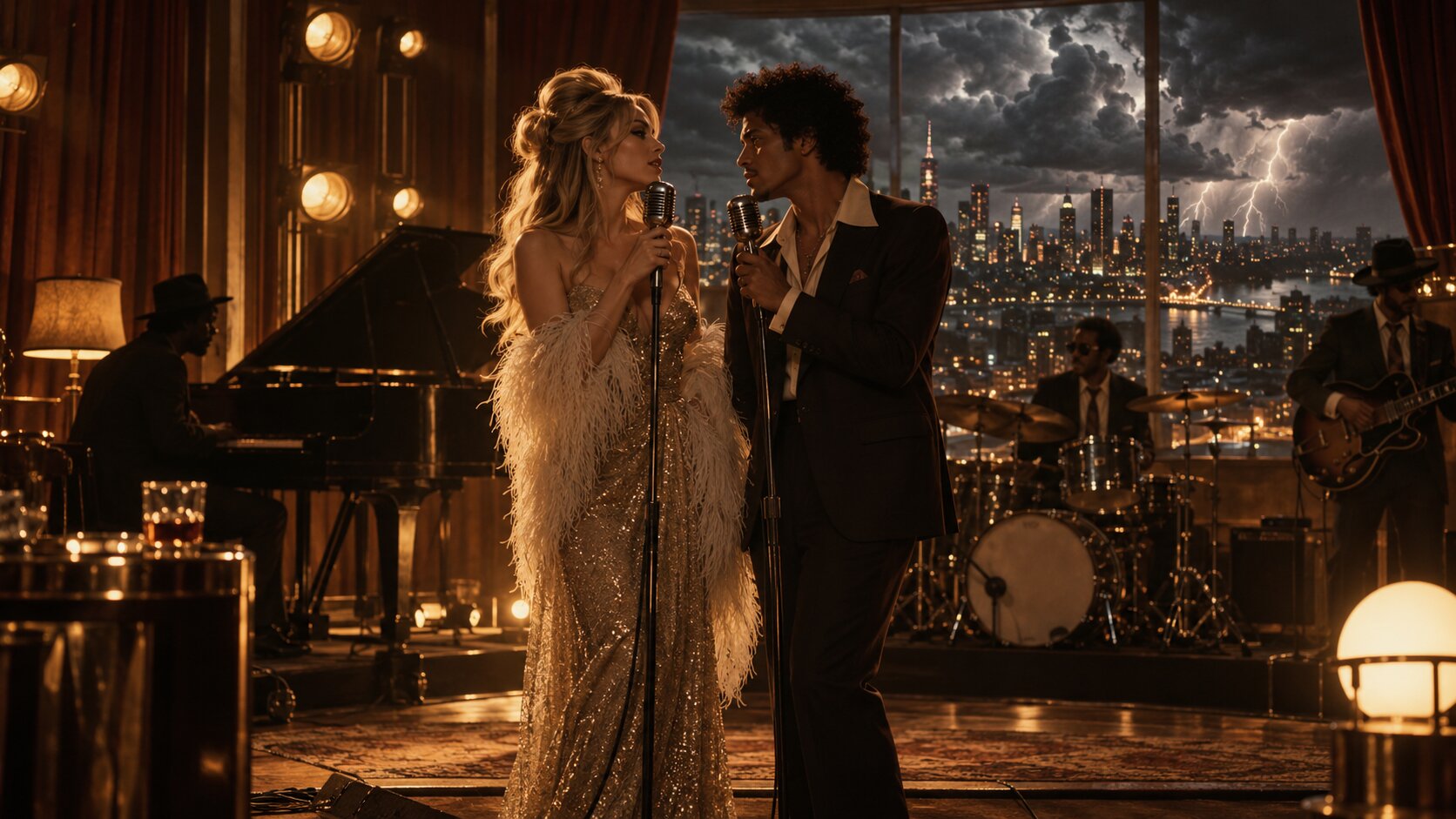
The retro character extends to the visual presentation. Instead of surrounding the song with futuristic imagery, Gaga and Mars lean into an older television-performance aesthetic. That choice gives the record a deliberately timeless quality: the emotional problem could belong to almost any decade.
Although it began as a standalone collaboration, “Die With a Smile” was later incorporated into Lady Gaga’s Mayhem. It appears as the closing track on the standard edition of the album. (Lady Gaga Official Store)
The song also became a major commercial success. It eventually reached No. 1 on the Billboard Hot 100 after a gradual climb, giving the collaboration an unusually long life well beyond its initial release week. (Billboard)
At the 2025 Grammy Awards, “Die With a Smile” won Best Pop Duo/Group Performance, confirming that the song’s success extended beyond streaming and chart performance into major industry recognition. (GRAMMY.com)
Why Mortality Makes the Love Story More Intense
The most important idea in “Die With a Smile” is not death itself. It is impermanence.
The song removes the comfortable assumption that there will always be another morning to apologize, another weekend to reconnect, or another year to say what has been left unsaid. Once that assumption disappears, the characters become much more certain about what they value.
That creates the song’s central tension: the relationship appears to be imperfect, yet its imperfections do not erase its importance.
There are hints of arguments, exhaustion, and emotional friction. This is not a fantasy about two people who have never struggled. Instead, the song imagines two people realizing that conflict and devotion can coexist.
That distinction makes the title more meaningful. To “die with a smile” does not suggest being pleased about death. The smile represents emotional completeness: the possibility that being beside the right person could make even the worst imaginable final moment feel less frightening.
There is another layer to the premise. The apocalyptic scenario allows the singers to express enormous emotions without requiring the listener to believe that the world is literally ending. The catastrophe functions as a pressure test. Once everything else has been removed, is this still the person you choose?
For both narrators, the answer is yes.
From a Bad Dream to a Final Embrace: Lyrics Breakdown
Verse 1: A Nightmare Reveals What Matters
Bruno Mars opens the story with a dream involving separation and goodbye.
Dream imagery matters because it lets the song introduce mortality indirectly. The narrator does not begin inside an actual disaster. Instead, his subconscious forces him to experience the possibility of loss before anything has really happened.
When he wakes, the relationship looks different. This becomes the first emotional turn of the song: fear creates clarity. An imaginary loss produces a genuine change in perspective.
The verse captures a familiar experience. People sometimes understand another person’s importance more clearly after briefly imagining life without them. Rather than dismissing the dream, the narrator treats its emotional effect almost like a warning.
Pre-Chorus: Tomorrow Is No Longer Guaranteed
The pre-chorus transforms private fear into a broader philosophy. The narrator recognizes that nobody can guarantee the future, so postponing affection begins to seem irrational.
The implication is not simply that the couple should be more romantic. It is that love should not constantly be delayed until circumstances become perfect.
This is where the song expands beyond one relationship. People often behave as though difficult conversations, apologies, affection, and reconciliation can always wait. “Die With a Smile” challenges that assumption by compressing an imagined lifetime into one final night.
The promise is therefore less about dramatic sacrifice than presence. Wherever the other person goes, the narrator wants to remain close.
Chorus: The Apocalypse Is Really a Question
The chorus enlarges the scenario from one disturbing dream into the end of the entire world.
That dramatic scale could easily make the song feel excessively theatrical, yet the characters’ desired response remains surprisingly simple. They do not want to escape, become immortal, accomplish one final ambition, or save something material.
They want proximity.
That contrast is central to the chorus. The external event is unimaginably large, but the response is intimate: being together, holding one another, and refusing to spend the final moments apart.
The end of the world can consequently be understood on two levels. Literally, it creates the cinematic doomsday scenario that gives the chorus its scale. Figuratively, it can stand for any experience that suddenly exposes how fragile the future is: separation, illness, grief, crisis, or simply the realization that time is finite.
Verse 2: Gaga Lets Conflict Into the Romance
Lady Gaga’s verse changes the emotional texture because it acknowledges tension between the lovers.
Instead of presenting devotion as effortless, the song allows arguments and emotional exhaustion into the relationship. The characters apparently have moments when communication becomes difficult and neither side seems to have much left to say.
That makes the commitment that follows more significant.
The relationship is described partly through the language of conflict, but the idea is not that fighting is romantic. Rather, the narrator decides that the relationship is still worth protecting despite the difficulty surrounding it.
Love is therefore not demonstrated through the absence of conflict. In this song, it is revealed by what remains after the conflict.
Gaga’s verse stops “Die With a Smile” from becoming a completely idealized romance. The couple has experienced enough tension to recognize its imperfections, yet when confronted with the possibility of permanent loss, pride and frustration suddenly seem less important than attachment.
Bridge: Language Starts Falling Away
By the bridge, the song no longer needs much narrative explanation. The arrangement grows while the emotional vocabulary becomes simpler.
That reduction is meaningful. After dreams, uncertainty, arguments, and hypothetical catastrophe, the conclusion can be expressed almost instinctively: stay here, remain close, do not let the final moment be spent apart.
The duet format becomes especially important here. The emotional message is no longer presented only as one person confessing something to another. Gaga and Mars increasingly operate as a pair, turning the song from an individual declaration into mutual commitment.
Outro: No New Argument Is Needed
The ending does not introduce a final twist. Instead, the song returns to its central promise with greater vocal intensity.
Structurally, that repetition makes sense. The narrators have already answered the only question that really matters within the song.
If everything disappeared tomorrow, they know where they would want to be.
The ending therefore feels less like discovering something new and more like becoming completely certain about something they already suspected.
The Song’s Quiet Symbols: Time, War, Dreams, and the Last Party
Several recurring images give “Die With a Smile” more depth than its straightforward love-song premise initially suggests.
The dream functions as a rehearsal for loss. Nothing irreversible has happened, but imagining separation is enough to change the narrator’s understanding of the relationship.
Tomorrow represents assumed time. The song repeatedly challenges the tendency to behave as though opportunities for affection, forgiveness, or reconciliation will remain available indefinitely.
The ending party introduces another layer. Parties normally suggest celebration, company, and continuation. Imagining the final party ending transforms something joyful into a metaphor for existence itself: eventually, the lights come up.
Conflict and battle imagery make the relationship feel like something requiring effort. The song does not suggest that love should always feel like combat. Instead, it asks which struggles are worth continuing when time becomes limited.
Most importantly, the smile changes the emotional meaning of death. It does not eliminate fear or sadness. It symbolizes the absence of one particular kind of regret: reaching the end while knowing you chose to spend the remaining time with the person who mattered most.
That distinction is essential. The fantasy is not a wish for death. It is a wish for emotional certainty in circumstances where death cannot be avoided.
Biography or Fiction? What We Actually Know
There is no confirmed evidence that “Die With a Smile” recounts a specific relationship, breakup, disaster, or personal event involving Lady Gaga or Bruno Mars.
The artists have publicly explained how the collaboration came together, but they have not identified one particular person as the lyrical subject. Gaga has discussed the record in broader terms as a song centered on love and emotional connection.
It is therefore more responsible to read the lyrics as a constructed romantic scenario created by multiple songwriters rather than as direct autobiography.
Listeners can naturally connect the song to the artists’ personal lives, and individual interpretations may be emotionally meaningful. However, without a statement from Gaga, Mars, or the other writers linking the story to a particular relationship, those theories remain speculation.
Where It Sits Between Gaga’s Power Ballads and Mars’s Retro Soul
“Die With a Smile” occupies a natural meeting point between Lady Gaga’s and Bruno Mars’s established musical identities.
For Gaga, its closest relatives are her large-scale emotional ballads rather than her most electronic dance-pop records. The piano-led drama, progressively stronger vocals, and romantic vulnerability recall the side of her catalog that became especially prominent through songs associated with A Star Is Born.
At the same time, the record fits Mars’s long fascination with earlier eras of popular music. His catalog repeatedly draws on classic soul, R&B, funk, rock, and traditional studio craftsmanship. His work with Silk Sonic made that retro instinct especially explicit, while “Die With a Smile” redirects it toward a sweeping romantic duet.
The song nevertheless avoids sounding as though it belongs entirely to either artist.
Mars begins from a controlled, soulful position, while Gaga brings increasing theatrical force and vocal roughness. By the climax, much of the appeal comes from hearing those two approaches meet without either performer becoming merely a supporting guest.
Its later placement at the end of Mayhem creates an additional contrast. Much of the album explores more aggressive, electronic, chaotic, or dark pop territory, while “Die With a Smile” closes the standard tracklist with comparatively traditional instrumentation and an emotionally direct proposition.
Why the Premise Still Lands
The most convincing interpretation of “Die With a Smile” is ultimately simpler than its apocalyptic imagery suggests: love becomes easier to understand when time becomes impossible to take for granted.
Lady Gaga and Bruno Mars use the imagined end of the world not to romanticize tragedy but to remove every distraction surrounding a relationship. Ambition, resentment, routine, pride, and uncertainty all lose importance when there may be no tomorrow.
What remains is the desire to be beside one person.
That is why the song can function simultaneously as a romantic duet, a meditation on mortality, and a reminder not to postpone affection. Its catastrophe is hypothetical, but the question underneath it is immediate: if time suddenly became short, would the people you love already know what they mean to you?
FAQs About “Die With a Smile”
What does “Die With a Smile” mean?
Who wrote “Die With a Smile”?
Is “Die With a Smile” based on a true story?
What is the chorus of “Die With a Smile” about?
Why does “Die With a Smile” talk about the world ending?
What album is “Die With a Smile” on?
Did “Die With a Smile” win a Grammy?
Sources Used