Beat Licenses Explained: Exclusive vs Non-Exclusive Rights
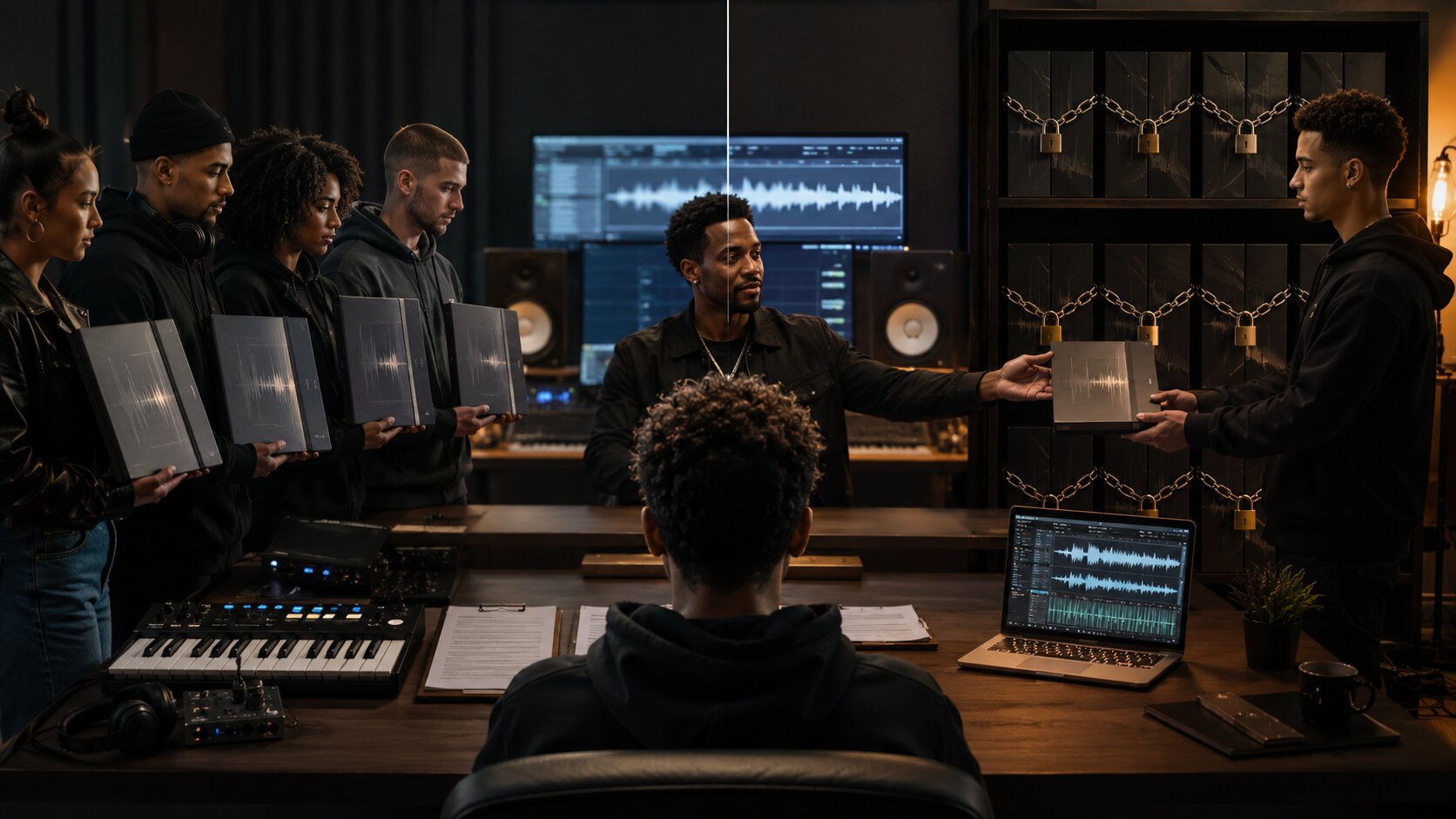
A non-exclusive beat license generally allows you to release music commercially while the producer remains free to license the same instrumental to other artists. An exclusive deal usually prevents future licenses from being sold, but it does not automatically mean you receive every copyright, publishing interest, or master right.
The safest approach is to judge a beat license by its written terms rather than its name. Before releasing a song, check ownership, publishing splits, usage limits, royalties, Content ID rules, samples, term, territory, and what happens to licenses sold before an exclusive deal.
Introduction
Finding the right beat can happen in minutes. Understanding exactly what you are buying can take considerably longer.
An artist may see options such as MP3 lease, WAV lease, unlimited license, trackout license, or exclusive rights and assume that paying more simply means receiving more ownership. Beat licensing is more complicated. Producers can create different terms for different licensing tiers, which means two agreements carrying similar names can grant substantially different rights.
That distinction becomes increasingly important once a song moves beyond a demo. Distribution, streaming, YouTube monetization, publishing registration, synchronization opportunities, label discussions, and sample clearance can all depend on clauses inside the license agreement.
This guide explains how exclusive and non-exclusive beat licenses work, which contractual terms deserve the most attention, and how independent artists can choose an appropriate license before investing heavily in a release.
Table of Contents
- The License Name Matters Less Than the Contract
- What a Non-Exclusive Beat License Really Gives You
- Exclusive Rights Can Still Come With Important Limits
- Seven Clauses to Inspect Before Releasing the Song
- Choose the License Around the Song’s Trajectory
- Run This Rights Check Before Paying
- What Happens When an Exclusive License Is Sold Later?
- Beat Licensing Decisions With BlockTone Records
- Frequently Asked Questions
Key Takeaways
| Point | Details |
|---|---|
| Non-exclusive does not mean non-commercial | Many non-exclusive licenses permit commercial releases, but only within the conditions written into the agreement. |
| Exclusive does not automatically mean total ownership | Exclusivity, copyright ownership, publishing shares, and ownership of the finished master should be examined separately. |
| Earlier licensees may remain authorized | Buying exclusive rights later does not necessarily cancel valid non-exclusive licenses that were issued previously. |
| Composition and recording rights are different | A commercially released song can involve separate copyright interests in the underlying composition and the sound recording. |
| Content ID requires special attention | YouTube requires exclusive rights to material used as Content ID reference content, creating complications for recordings built around non-exclusive beats. |
| The contract controls the deal | Usage limits, royalties, term, territory, sync rights, samples, credits, and registration requirements can vary between producers. |
The License Name Matters Less Than the Contract
A beat license gives an artist permission to use intellectual property controlled by another party under agreed conditions. Purchasing a beat license is therefore not simply the same as purchasing an audio file.
One reason beat agreements can become confusing is that a finished song may contain more than one copyright interest. The U.S. Copyright Office distinguishes between the musical work, meaning the underlying composition, and the sound recording, meaning a particular recorded performance. Those rights can be separately owned, licensed, and transferred. (U.S. Copyright Office)
With a licensed beat, the producer may control rights connected to the instrumental composition, the recorded instrumental, or both. Once an artist adds lyrics, melodies, vocals, instruments, editing, and production, additional ownership questions can arise around the completed song and master recording.
Terms such as “lease,” “unlimited,” and “exclusive” should therefore be treated as convenient product labels rather than complete descriptions of your legal rights. BeatStars explains that producers determine their own pricing and can customize licensing terms, so the agreement attached to the purchase should always be reviewed directly. (BeatStars Help Center)
Pro Tip: Open the full contract for every licensing tier you are considering and compare the actual clauses line by line. Do not assume two licenses called “unlimited” or “exclusive” contain the same rights.
What a Non-Exclusive Beat License Really Gives You
A non-exclusive beat license normally allows the producer to license the same instrumental to multiple artists. Your permission to use the beat can still be commercially valuable, but another musician may also legally obtain permission to create and release a different song with the same instrumental.
This arrangement can make sense for independent artists who release frequently, are testing a new sound, have limited production budgets, or do not need exclusivity for a particular project.
The more important question is not simply whether another artist can use the beat. You need to determine exactly what your own license permits.
Check What Commercial Uses Are Included
Depending on the agreement, a non-exclusive license may address:
- commercial streaming and digital downloads;
- music videos;
- live performances;
- radio broadcasts;
- monetized social media content;
- physical distribution;
- synchronization use;
- the duration of the license;
- geographic territory;
- stream, sale, or distribution limits;
- producer credits;
- publishing ownership;
- producer royalties;
- Content ID restrictions.
Some higher-priced non-exclusive tiers also provide better production files. Airbit notes that different licenses can include formats such as WAV files and track stems while granting different usage terms. (Airbit Help Center)
The Main Trade-Off Is Shared Access to the Beat
Another artist may obtain a valid license and release a song using the same instrumental. That does not inherently invalidate your own release. It simply reflects the non-exclusive nature of the agreement.
For an independent single with a modest campaign, this may be an acceptable compromise. The calculation can change when significant money is being invested in advertising, publicity, video production, label development, or synchronization pitching.
Exclusive Rights Can Still Come With Important Limits
An exclusive beat deal generally means the producer agrees not to continue selling new licenses for the beat after the exclusive transaction. BeatStars states that when an exclusive license is sold through its marketplace, the beat is removed from further Marketplace and Pro Page sales. (BeatStars Help Center)
However, exclusivity should not automatically be interpreted as “I now own everything.”
An agreement might grant an artist exclusive exploitation rights while allowing the producer to retain a publishing share. Another agreement could contain a broader copyright assignment. The producer might also retain royalty participation in the finished master.
If a contract actually transfers U.S. copyright ownership rather than simply licensing use, U.S. copyright law generally requires the transfer to be in writing and signed by the owner of the rights being conveyed. (U.S. Copyright Office, Copyright Ownership and Transfer)
Publishing and Exclusivity Are Separate Issues
Suppose a producer writes the instrumental composition and an artist writes the lyrics and vocal melody. Depending on their agreement, both may hold interests in the completed composition.
Those shares should be documented rather than assumed. The Mechanical Licensing Collective provides songwriter split-sheet guidance designed to help collaborators record ownership percentages and other information needed for accurate registration. (The MLC Song Split Sheet Toolkit)
When considering an exclusive deal, answer these questions separately:
- Who owns or controls the original beat?
- Who owns the finished master recording?
- What percentage of the musical composition belongs to each contributor?
- Who administers each publishing share?
- Does the producer receive additional royalties from the master?
Getting exclusive rights to use an instrumental does not, by itself, answer all five questions.
Seven Clauses to Inspect Before Releasing the Song
The commercially important part of a beat license is the detailed permission underneath the product name. Before distributing the song, inspect the following areas carefully.
1. Term and Territory
Determine whether the license is perpetual or valid only for a specified period. If it expires, establish whether the song must be removed, whether the license can be renewed, and what happens to copies or streams generated before expiration.
Territory matters as well. If your distributor sends music worldwide, make sure the agreement grants rights compatible with worldwide distribution rather than only selected countries.
2. Commercial Exploitation
Confirm that the agreement covers the ways you actually intend to use the song. Streaming, downloads, physical releases, paid performances, monetized videos, advertising, and synchronization are distinct forms of exploitation.
If you expect to pitch the song for films, television, games, commercials, or other sync opportunities, inspect the synchronization clause specifically.
3. Usage Thresholds
Some non-exclusive licenses contain limits tied to streams, sales, distributed copies, videos, performances, or other forms of use.
If the agreement contains a limit, determine what happens once that threshold is reached. You may need to upgrade, renew, or negotiate additional rights. Do not assume continued exploitation automatically becomes authorized.
4. Publishing and Songwriter Splits
Determine whether the producer receives a share of the composition and document that percentage before registrations are submitted.
Keep your split information consistent when registering the work with performing rights organizations, publishers, publishing administrators, or mechanical royalty systems. Conflicting ownership data can make royalty administration more difficult.
5. Master Ownership and Producer Royalties
Do not confuse the instrumental recording with the finished master that contains your vocals and additional production.
Check who owns the completed master and whether the producer receives royalties from it. A producer can potentially retain financial participation even if an exclusive beat agreement gives the artist substantial control over the instrumental.
6. YouTube Content ID
Content ID deserves particular attention because automated copyright claims can affect other legitimate users of the same beat.
YouTube states that Content ID reference files require exclusive rights in the relevant territories and identifies non-exclusively licensed third-party material as unsuitable for exclusive reference use. A song based on a non-exclusive beat therefore should not automatically be submitted to Content ID simply because you commercially released it. (YouTube Help)
Even an exclusive beat purchase does not guarantee that every element of the finished recording qualifies. Third-party loops, samples, or other material that you do not exclusively control can create additional restrictions.
7. Samples and Third-Party Material
Ask whether the instrumental contains samples, interpolations, third-party loops, melodies, vocals, or other material that the producer did not create entirely from scratch.
Then read the agreement to determine who is responsible for obtaining any additional permissions. Purchasing an exclusive beat cannot transfer rights that the producer never owned or controlled in the first place.
Choose the License Around the Song’s Trajectory
There is no universal rule stating that a serious artist must purchase every beat exclusively. The appropriate option depends on how the recording will actually be used.
| Situation | Option Worth Considering |
|---|---|
| Demo, early single, or lower-budget release | Non-exclusive license |
| You need WAV files or stems for detailed mixing | Higher-tier non-exclusive or exclusive license |
| You release music frequently and need to control production costs | Non-exclusive licenses with suitable commercial terms |
| You plan a substantial advertising campaign around one priority track | Broader non-exclusive terms or an exclusive agreement |
| A label or investor requires stronger control over the instrumental | Negotiated exclusive rights |
| The track is being positioned for a significant sync opportunity | Contract review and potentially custom or exclusive rights |
| You need unusual ownership, royalty, or publishing terms | Custom agreement rather than relying only on a standard license tier |
An exclusive license makes the most sense when exclusivity provides real commercial value. Paying substantially more simply because the word “exclusive” sounds more professional may not improve your release.
The opposite mistake can also be expensive. Spending heavily on recording, visuals, promotion, and advertising while relying on a restrictive entry-level license can create problems if the song performs better than expected.
Pro Tip: Choose the license according to the expected commercial life and investment level of the song, not simply according to how strongly you feel about the beat.
Run This Rights Check Before Paying
Before purchasing a beat for a commercial release, work through this checklist:
- Read and save the complete license agreement.
- Confirm that the producer or seller controls the rights being licensed.
- Determine whether the agreement is exclusive or non-exclusive.
- Confirm that commercial distribution is permitted.
- Check the license duration and geographic territory.
- Identify any stream, sale, copy, video, or other usage limits.
- Verify whether the purchase includes MP3, WAV, and/or tracked-out stems.
- Confirm ownership of the finished master.
- Document publishing and songwriter percentages.
- Determine whether additional producer royalties are payable.
- Review producer-credit requirements.
- Check YouTube Content ID restrictions.
- Determine whether synchronization rights are included.
- Ask whether the beat includes samples or other third-party material.
- Save the contract, receipt, correspondence, and proof of payment together.
If an important term is unclear, resolve it before releasing the song. For high-value releases, label agreements, substantial advances, complicated sample issues, or significant rights transfers, obtaining advice from a qualified music attorney can be appropriate.
What Happens When an Exclusive License Is Sold Later?
This is one of the most important distinctions between exclusivity and complete uniqueness.
Imagine that Artist A purchases a valid non-exclusive license in January. Artist B then purchases exclusive rights to the same beat in June. Artist B should not automatically assume that Artist A must remove the earlier song.
BeatStars explains that customers who purchased non-exclusive licenses before an exclusive sale can generally continue using the material according to the terms of their existing agreements, although customized producer contracts can affect the details. (BeatStars Help Center)
Before paying a premium for an exclusive beat, ask:
- Have non-exclusive licenses already been sold?
- What rights were granted to those earlier customers?
- Can existing licensees renew or upgrade their agreements?
- Does the exclusive contract explicitly address earlier licenses?
- What exactly becomes exclusive after your purchase?
The commercial value of an exclusive beat depends on knowing what the producer is agreeing not to do in the future and what rights have already been granted in the past.
Beat Licensing Decisions With BlockTone Records
For independent artists, choosing a beat is only one part of preparing a commercially viable release. Production files, contracts, songwriting splits, credits, publishing information, sample documentation, and release plans should all be organized before a campaign becomes difficult to change.
BlockTone Records publishes practical music-industry guides for independent artists who want to approach releases, rights, promotion, and career development more systematically.
The most useful habit is to treat your beat license as part of the permanent rights documentation for the song rather than as a receipt you forget about after downloading the instrumental.
FAQs About Exclusive and Non-Exclusive Beat Licenses
Is a non-exclusive beat license good enough for Spotify and Apple Music?
Does buying exclusive rights mean I own the beat copyright?
Can two artists legally release songs using the same beat?
Can I use YouTube Content ID with a leased beat?
What happens if my song exceeds the limits in my beat license?
Do I need an exclusive beat license before signing with a record label?
Are exclusive beat licenses always better than non-exclusive licenses?
Sources Used
- BeatStars Help Center – differences between licenses and licensing terms
- BeatStars Help Center – selling non-exclusive and exclusive licenses
- BeatStars Help Center – existing non-exclusive licenses after an exclusive sale
- Airbit Help Center – beat licensing overview
- U.S. Copyright Office – copyright information for musicians
- U.S. Copyright Office – copyright ownership and transfer
- YouTube Help – Content ID eligibility and exclusive rights
- The Mechanical Licensing Collective – Song Split Sheet Toolkit