


Cody Johnson’s “Take Me Back (Leave Me There)” Turns Heartbreak Into a Place to Hide
Cody Johnson’s “Take Me Back (Leave Me There)” is a breakup song with an important twist: the narrator is not really asking an ex to restart the relationship. Instead, he wants to return to one vivid memory of intimacy, warmth, and reconciliation and remain there, even if the woman herself continues moving forward without him.
That distinction gives the song its emotional weight. The past becomes less like a chapter he wants to reopen and more like a private refuge from the loneliness of the present. Rather than bargaining for another chance, he asks for something impossible: to be placed inside the happiest version of what they once had.
The Song’s Real Request Isn’t a Reunion
The central meaning of “Take Me Back (Leave Me There)” comes from the tension built into its title. “Take me back” initially sounds like a familiar plea for reconciliation. The words in parentheses immediately change that expectation. He does not want to be taken back as a boyfriend; he wants to be taken back in time.
The narrator understands that the relationship has ended. He even makes room for his former partner to continue with her life. What he cannot do as easily is detach himself from the emotional atmosphere of their past. His solution is fantasy: if reality will not give him the relationship again, memory can at least give him somewhere to go.
This makes the song more complicated than a straightforward “I want you back” ballad. There is acceptance on the surface and resistance underneath it. He accepts the goodbye as an event, but emotionally he remains attached to a scene that occurred before the goodbye mattered.
Where the Track Sits in the Banks of the Trinity Era
“Take Me Back (Leave Me There)” was released on May 29, 2026, ahead of Cody Johnson’s Banks of the Trinity album, which arrived on June 26. It appears as the fourth track on the 16-song project. (Apple Music)
The song was written by Kelly Archer, Troy Cartwright, and Pete Good. Johnson is therefore the performer and interpreter of the story rather than one of its credited writers. The official album announcement identifies Trent Willmon, Johnson’s longtime collaborator, as the producer of Banks of the Trinity. (Cody Johnson Official Website)
Musically, the track stays within country but favors an intimate, slow-burning mood instead of a hard-driving honky-tonk approach. Contemporary reviews noted its swaying, sensual quality and the way Johnson’s restrained delivery lets the longing carry the performance. That atmosphere matters because the song is built around recollection rather than confrontation: it is supposed to feel like slipping into a memory late at night, not starting another argument.
The larger album gives that backward-looking impulse additional context. Johnson said Banks of the Trinity was partly inspired by memories of his childhood in Sebastopol, Texas, and by a desire to tell listeners more about where he came from. “Take Me Back (Leave Me There)” is not specifically about those childhood memories, but its fixation on returning to a meaningful past fits naturally inside a record deeply interested in memory, home, identity, and the places people mentally revisit. (Cody Johnson Official Website)
Why the Parenthetical Changes Everything
The most important piece of writing in the song may be the parenthetical phrase in the title. Without “Leave Me There,” the phrase “Take Me Back” would suggest reconciliation. With it, the request becomes almost dreamlike.
The narrator knows that time only moves in one direction. He knows the woman can leave. He knows the breakup does not have to be reversed. Yet emotionally, he asks to be separated from that timeline. She can go forward while he stays behind.
That creates one of the song’s most painful contradictions: he sounds realistic about her freedom while being unrealistic about his own ability to let go. In other words, he is not denying the breakup. He is trying to escape its consequences.
Memory therefore becomes both comfort and trap. Returning mentally to a happy night helps him survive the current loneliness, but wanting to remain there indefinitely suggests that nostalgia is preventing emotional movement. The song never fully tells us whether remembering is healing him or keeping him stuck, and that ambiguity is part of its appeal.
Following the Memory as It Unfolds
Verse One: A Season Changes, but He Hasn’t
The opening immediately establishes that time has passed. The movement from summer toward fall is more than seasonal description: it signals transition. The world is changing, and the relationship has already moved into the past.
The narrator is alone, unable to sleep, with enough distance from the relationship that receiving her calls or expecting her attention is no longer part of ordinary life. Nighttime removes distractions, and the emotional defenses of the daytime begin to collapse. His loneliness sends him searching backward.
What comes to mind is not an abstract statement such as “we were happy.” Instead, he remembers physical details associated with a romantic evening: wine, dancing, closeness, and the quiet atmosphere afterward. The specificity is crucial. Real nostalgia rarely arrives as a summary; it arrives through objects, light, smells, gestures, and rooms.
The first verse therefore acts almost like a doorway. The present is sleepless and empty. The remembered room is warm and inhabited. The chorus allows him to cross from one into the other.
Chorus: A Bedroom Frozen in Time
The chorus builds the memory through small domestic details. Clothing left on a chair, morning light coming through blinds, and an ordinary gesture involving her hair create a scene that feels intimate precisely because it is not grand.
These details represent something larger than physical attraction. They show familiarity. This was a relationship in which the narrator once had access to another person’s unguarded, everyday world. The bedroom is not simply erotic space; it symbolizes belonging.
Morning light is especially significant. A romantic night could be dismissed as temporary passion, but daylight suggests what came after—the quiet moment when both people were still together. The memory survives because it combines desire with domestic comfort.
When he asks to be left there, he is effectively choosing a frozen image over current reality. The chorus becomes an emotional photograph that the rest of the song keeps returning to.
Verse Two: Letting Her Leave Without Letting Go
The second verse contains the song’s clearest sign that this is not a conventional reconciliation plea. The narrator does not demand promises. He does not insist that she withdraw the goodbye. He acknowledges that she has the right to move on.
That apparent maturity makes what follows more affecting. He may release the person, but he cannot release the memory.
The image of a southbound Greyhound bus gives her departure physical movement. Buses suggest distance, direction, and one person watching another disappear down the road. It is classic country imagery, but here it also creates a sharp contrast: she is traveling while he wants to remain completely still.
Her future has motion. His fantasy has none.
This contrast reveals the emotional architecture of the entire song. The narrator is not trying to control where she goes. He is trying to control where his mind stays.
Bridge: The Memory Narrows to One Night
By the bridge, the remembered scene becomes even more specific. The couple had apparently experienced conflict, reconciled, and then shared an intimate night together. That sequence adds another layer to the memory.
He is not simply remembering attraction. He is remembering repair.
The fact that they came together after disagreement may explain why this particular moment has become so powerful in retrospect. At the time, reconciliation could have felt like proof that the relationship could survive its difficulties. From the narrator’s present position, however, the scene becomes bittersweet evidence of a closeness that ultimately did not last.
The wine and slow dance return as recurring anchors. Repetition works the same way memory often does: the mind circles the same details because they have accumulated emotional significance. What might have been ordinary objects in the original moment become almost sacred after the relationship is gone.
Final Chorus and Outro: Choosing the Loop
The final return to the chorus does not provide resolution. There is no new conversation, no reunion, and no indication that the woman changes her mind. Instead, the song keeps returning to the same remembered space.
That lack of narrative progress is meaningful. The narrator himself has not progressed either. He is emotionally looping.
By repeating the desire to remain inside the memory, the ending emphasizes how grief can distort time. A person can intellectually understand that something is over while continuing to revisit one moment as though enough repetition might make it present again.
The song ends without solving that contradiction, which is more emotionally credible than forcing a sudden moment of closure.
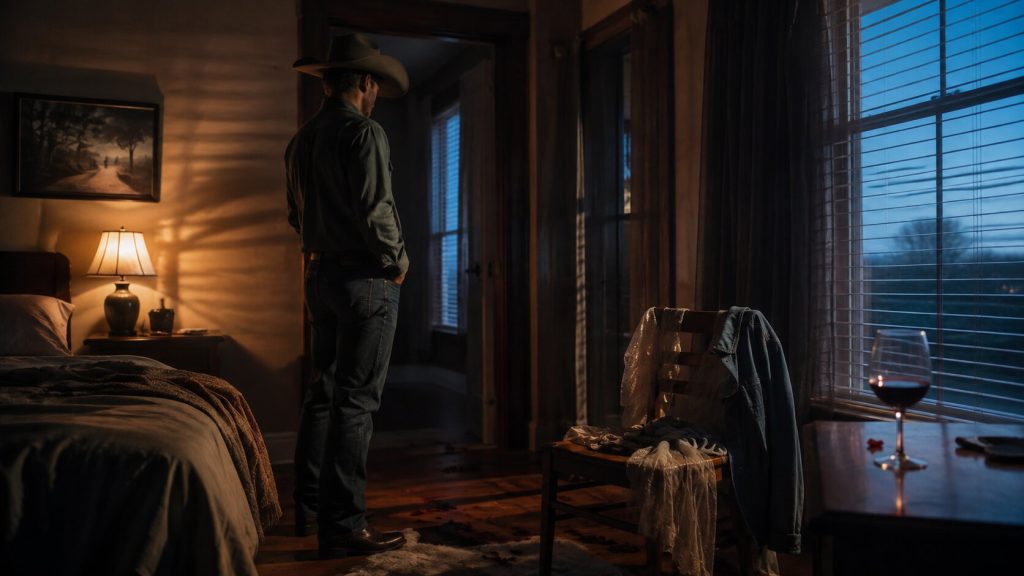
Five Ordinary Images That Carry the Heartbreak
Summer Turning Into Fall
The seasonal transition signals time passing after the relationship. Summer commonly carries associations of warmth, abundance, and freedom, while fall introduces cooling temperatures and decline. The song does not need to make that symbolism explicit; the movement between seasons quietly mirrors the emotional change from intimacy to loneliness.
Red Wine and the Slow Dance
Wine and dancing form the romantic center of the memory. They suggest a private ritual rather than a dramatic public event. Their importance comes from how completely they belong to the narrator’s remembered atmosphere.
The repeated appearance of these details also suggests that he has replayed the scene many times. They have become shorthand for the relationship at its best.
The Bedroom Chair
Clothing left casually on a chair is one of the song’s most effective pieces of imagery because it communicates familiarity without explanation. It is the kind of detail someone remembers only because they were actually present in another person’s private space.
Symbolically, the abandoned clothing also functions like evidence. The relationship is gone, but in his mental picture the room still contains traces of her presence.
Sunlight Through the Blinds
The shift from nighttime romance to morning light makes the memory feel complete. The narrator is not merely longing for passion; he is longing for the peaceful aftermath, when intimacy had turned into ordinary closeness.
The blinds also create an interesting visual boundary. Light enters from the outside world, but the narrator’s attention remains inside the room. The image reinforces the sense of a protected private world that no longer exists except in memory.
The Southbound Bus
The Greyhound image represents departure more directly than anything else in the song. It gives the former partner a route away from him while he remains stationary.
That opposition—her movement versus his stillness—is arguably the song’s deepest metaphor. One person is permitted to continue living forward; the other wants to inhabit a moment that has already ended.
How Much of This Story Is Cody Johnson’s Life?
There is no verified public evidence that “Take Me Back (Leave Me There)” describes a specific breakup from Cody Johnson’s own life. The official credits list Kelly Archer, Troy Cartwright, and Pete Good as the songwriters, with Johnson not credited as a writer. For that reason, treating the narrator as literally Cody Johnson would go beyond what the available evidence supports. (MusicRow)
Johnson’s performance can still sound deeply personal without being autobiographical. Interpretation is one of his strengths: much of traditional country depends on a singer inhabiting somebody else’s story convincingly enough that the emotional distinction between “written by” and “lived by” disappears during the performance.
There is also a useful distinction between the song and the album surrounding it. Johnson has publicly described Banks of the Trinity as a project connected to his own childhood memories and roots. That does not mean every narrative on the album is a literal episode from his biography. The verified autobiographical context belongs to the broader album concept, while this particular romantic storyline should be treated as a song narrative unless Johnson or its writers say otherwise.
Why This Song Belongs on Banks of the Trinity
At first glance, a sensual breakup song might seem separate from an album partly inspired by Johnson’s Texas upbringing. The deeper link is memory.
Banks of the Trinity repeatedly looks backward: toward places, identities, people, values, and experiences that helped shape a life. “Take Me Back (Leave Me There)” applies that backward gaze to romance. Instead of returning to a childhood road or hometown landmark, its narrator returns to a bedroom and one emotionally charged morning.
Johnson’s official biography for the album describes the project as looking back on foundational moments while continuing his traditional-country approach. That framing helps explain why this song feels at home on the record even though its storyline is not necessarily autobiographical. Both the album and the song ask what the past becomes once it can no longer be physically recovered. (Cody Johnson Official Website)
The track also fits Johnson’s broader catalog because his best-known material frequently depends on concrete storytelling rather than vague emotional statements. Songs such as “The Painter,” “Dirt Cheap,” and “’Til You Can’t” reach for larger ideas through recognizable human situations. “Take Me Back (Leave Me There)” uses the same basic strength but directs it toward desire, absence, and nostalgia.
Its emotional posture is different, though. There is no inspirational lesson to follow and no promise of lasting devotion. This time Johnson voices a character who knows the healthy direction is forward but would rather spend one more night inside the past.
What the Song Ultimately Leaves Us With
“Take Me Back (Leave Me There)” works because it separates wanting someone back from wanting a feeling back. The narrator appears to understand that the relationship itself may be finished. What he truly cannot surrender is the version of himself who existed inside one particularly vivid memory of love.
The bedroom details, changing seasons, morning sunlight, wine, slow dance, and departing bus all reinforce the same conflict between movement and stillness. Life keeps changing. She can leave. The seasons turn. Yet his mind returns to one room where nothing has changed at all.
That is why the parenthetical half of the title matters so much. “Take me back” is a request that might still be answered by another person. “Leave me there” is something only memory can provide.
Rather than presenting nostalgia as purely beautiful or purely destructive, the song allows it to be both. Remembering gives the narrator temporary shelter from loneliness, but his desire to stay inside that memory also reveals how far he remains from letting the past become the past.
Questions Listeners Ask About “Take Me Back (Leave Me There)”
What does “Take Me Back (Leave Me There)” by Cody Johnson mean?
Why does Cody Johnson say “leave me there” in the song?
Who wrote “Take Me Back (Leave Me There)”?
What album is “Take Me Back (Leave Me There)” on?
When was “Take Me Back (Leave Me There)” released?
Is “Take Me Back (Leave Me There)” based on Cody Johnson’s real relationship?
What is the main symbolism in “Take Me Back (Leave Me There)”?
Sources Used
- Apple Music – “Take Me Back (Leave Me There)” song page
- Cody Johnson Official Website – Banks of the Trinity track list and songwriter credits
- Cody Johnson Official Website – album announcement and Johnson’s comments on the project
- Cody Johnson Official Website – Banks of the Trinity background and artist biography
- MusicRow – Banks of the Trinity track listing and writing credits
- Today’s Country Magazine – review of “Take Me Back (Leave Me There)”