
Behind-the-Scenes Content Fans Actually Care About
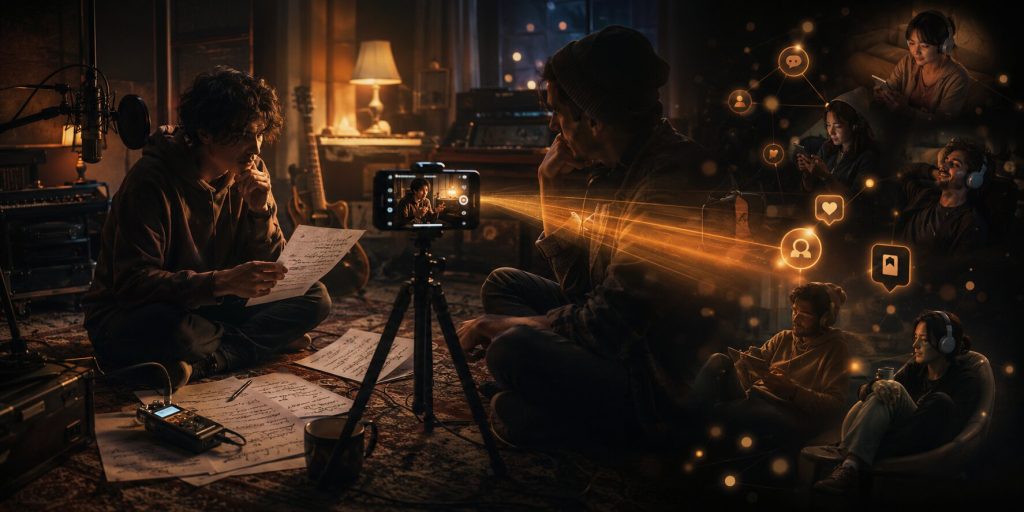
Effective behind-the-scenes content does more than prove that an artist was in a studio, rehearsal room, or backstage area. It reveals a meaningful decision, obstacle, relationship, or transformation that helps listeners understand the music more deeply.
The strongest approach is to capture moments with a clear story, adapt them to the platform where they will be published, and measure whether they generate conversation and deeper fan actions rather than passive views alone.
Independent musicians usually have more content opportunities than they realize. Rehearsals, demo sessions, production changes, artwork discussions, travel days, soundchecks, merchandise preparation, and post-show reflections can all become useful material.
The difficulty is that ordinary access is not automatically interesting. A silent video of a laptop running recording software may technically qualify as behind-the-scenes content, but it gives the viewer little context. Fans do not know what changed, what was difficult, or why the moment deserves their attention.
Strong behind-the-scenes content closes that information gap. It helps listeners understand the human choices behind a finished song while allowing the artist to remain intentional about privacy, image, and creative boundaries.
This guide explains what to capture, how to turn everyday music work into a repeatable content system, where different formats belong, and how to tell whether the material is strengthening your fanbase.
Table of Contents
- Key Takeaways
- What Fans Are Really Looking for Behind the Curtain
- Build Content Around Moments of Change, Not Random Footage
- Six Behind-the-Scenes Formats Worth Repeating
- Turn One Music-Making Session Into a Content Sequence
- Match the Moment to the Platform
- Protect Mystery, Privacy, and Creative Energy
- Measure Whether Fans Are Moving Closer
- Build a Stronger Story Around the Music
- Frequently Asked Questions
- Sources Used
Key Takeaways
| Point | Details |
|---|---|
| Access needs context | Explain what is happening, what is at stake, or what changed. Raw footage without a story is usually forgettable. |
| Decisions create interest | Show fans why you changed a lyric, removed an instrument, chose a visual concept, or rebuilt a live arrangement. |
| Small moments are enough | You do not need a documentary crew. A phone, a clear premise, and one meaningful moment can produce effective content. |
| One session can create several posts | Capture the problem, competing options, final decision, and result as separate pieces instead of publishing one unfocused montage. |
| Not everything should be public | Protect collaborators, unreleased material, personal relationships, exact locations, and parts of the process that should remain private. |
| Depth matters more than raw reach | Comments, replies, saves, repeat viewers, pre-saves, sign-ups, and fan references can be stronger indicators than views alone. |
What Fans Are Really Looking for Behind the Curtain
Fans rarely care about access simply because it is exclusive. They care when that access helps them understand the artist, the music, or their own relationship with the work.
A useful behind-the-scenes post usually answers at least one meaningful question:
- Where did this idea come from?
- What nearly went wrong?
- Why did the artist make this particular choice?
- Who helped shape the result?
- What changed between the first attempt and the finished version?
- What would a casual listener never notice without an explanation?
This is why a polished studio montage can underperform while a simple video explaining one rejected lyric creates a long discussion. The second post gives the audience something to interpret.
Spotify has expanded its artist tools around short-form video, release context, credits, Countdown Pages, and stories connected directly to recordings. These features reflect a broader effort to help listeners explore the people and creative processes behind the music. (Spotify for Artists)
The practical lesson is not that every artist needs to publish more video. It is that the finished recording should be surrounded by enough context for interested listeners to go deeper.
Replace “look where I am” with “here is what happened”
Consider the difference between these two captions:
Studio day. New music soon.
And:
We recorded this chorus three times because the polished version sounded too controlled. The take in the final song is the one where my voice started breaking.
The first provides location and promotion. The second provides tension, vulnerability, and a reason to replay the song later.
Behind-the-scenes content becomes valuable when it changes how the audience hears or understands the finished work.
Build Content Around Moments of Change, Not Random Footage
The most reliable content opportunities appear when something changes. That change may be musical, emotional, visual, logistical, or interpersonal.
Examples include:
- A producer removes the element everyone expected to keep.
- A rehearsal exposes a weak section in the live set.
- A song originally written as a ballad becomes an uptempo track.
- A collaborator introduces an unexpected instrument.
- The artwork concept changes after the artist hears the final master.
- A technical problem forces the band to perform differently.
- An audience reaction changes the way a song is arranged.
Use a simple three-part structure to turn one of these moments into a clear story.
1. Show the starting point
Establish what you were attempting before showing the work itself.
Today we were trying to make the second verse feel less crowded.
2. Introduce the tension
Explain the choice, disagreement, limitation, mistake, or uncertainty that made the moment difficult.
We kept adding harmonies, but every new layer made the lyric harder to understand.
3. Reveal the result
Let the viewer hear, see, or anticipate the solution.
We muted almost everything and kept one imperfect vocal double.
This structure works because it transforms routine work into a miniature narrative. The audience receives a beginning, a problem, and a payoff rather than an unexplained collection of studio shots.
Pro Tip: Record the explanation before you solve the problem. Retrospective commentary can be useful, but footage captured while the outcome is still uncertain often contains more natural energy.
Six Behind-the-Scenes Formats Worth Repeating
A sustainable content strategy needs recurring formats. Repeatable concepts reduce the pressure to invent a completely new idea every week while helping fans recognize ongoing series.
| Format | What to Capture | Why Fans May Care |
|---|---|---|
| The song’s first spark | A voice note, instrument pattern, phrase, visual reference, or memory that started the track | It connects the polished release to a recognizable human moment. |
| First version versus final version | A demo and master, original lyric and replacement, or programmed drums and live drums | The contrast makes the creative process easy to understand. |
| One decision that changed everything | A production choice, key change, tempo adjustment, vocal approach, or removed track | It reveals artistic judgment rather than simply showing activity. |
| The person behind the detail | A producer, engineer, musician, photographer, designer, or crew member explaining one contribution | It introduces the creative community surrounding the artist. |
| Rehearsal under pressure | Fixing a transition, changing the set, adapting to limited stage space, or recovering from a mistake | It gives live performances a sense of preparation and consequence. |
| Let the fans choose | Two artwork details, merchandise options, alternate arrangements, or possible set-list additions | It turns spectators into participants without surrendering the entire creative direction. |
TikTok has supported music-focused storytelling through initiatives such as Behind the Song and artist-specific account features. These tools are designed to help musicians explain the inspirations and stories connected to their tracks. (TikTok Newsroom)
Participation should still be genuine. Do not ask fans to vote on a decision you have already made unless you clearly present the activity as a preference test, prediction, or discussion rather than a binding choice.
Turn One Music-Making Session Into a Content Sequence
Constant filming can damage concentration and make collaborators feel as though every creative moment is being staged. A better system is to capture a few deliberate moments and distribute them over time.
Choose one content question before the session
Begin with a question that gives the footage direction. For example:
- Can we make the chorus feel larger without adding more instruments?
- Which vocal delivery fits the lyric?
- How will we translate this electronic track to a small stage?
- What detail makes this song sound recognizably like us?
A clear question helps the person filming recognize which moments matter and which footage is merely decorative.
Capture three anchor moments
- Record a short explanation of the goal.
- Capture one moment of work, experimentation, disagreement, or failure.
- Film the result or an immediate reaction to it.
These clips do not need to be published together. Separating them can create a sequence that encourages fans to follow the development of the song.
Collect supporting details
Film short shots of hands on an instrument, marked-up lyrics, microphone placement, effects pedals, room ambience, travel, setup, playback reactions, or equipment being changed.
Supporting footage is useful for editing, but it should illustrate the story rather than replace it. A collection of atmospheric shots without explanation may look attractive while communicating very little.
Record a clean reflection
At the end of the session, answer four questions:
- What changed?
- Why was the decision difficult?
- What should the listener notice?
- What still needs work?
The answers can become a voiceover, social caption, newsletter paragraph, video introduction, or talking point for a livestream.
Publish the journey in stages
A single recording session might produce the following sequence:
- Post one: The problem you are trying to solve.
- Post two: Two possible versions.
- Post three: The final decision and the reason behind it.
- Post four: The finished excerpt.
- Post five: What fans heard or noticed after release.
This approach creates continuity. Instead of repeatedly announcing that new music is coming, you give people a developing story to follow.
Match the Moment to the Platform
The same footage should not be posted identically everywhere. Each platform supports a different level of context, audience behavior, and participation.
TikTok, Instagram Reels, and YouTube Shorts: lead with the conflict
Begin with the most understandable sentence rather than a slow visual introduction.
- “This song originally had a completely different chorus.”
- “We removed the most expensive part of the production.”
- “I nearly deleted the vocal that became the final take.”
Avoid spending the opening seconds showing someone entering the studio, adjusting a chair, or putting on headphones. Establish the reason to watch before adding atmosphere.
YouTube: build an archive around the process
Longer videos can document a complete session, tour day, arrangement breakdown, release retrospective, or collaboration. YouTube Posts can support the main videos with text, images, polls, quizzes, and follow-up questions that keep the conversation active between uploads. (YouTube Help)
Use long-form video when the process contains enough development to justify it. Do not stretch a two-minute idea into a ten-minute upload simply because longer content appears more substantial.
Spotify: connect context directly to the release
Spotify Clips allow eligible artists to attach short vertical videos to their music and artist profiles. Countdown Pages can also bring together release preparation, pre-saves, track previews, and short artist videos before an eligible album or EP arrives. (Spotify for Artists)
This makes Spotify useful for content closely connected to a specific release, including track stories, studio moments, lyric context, countdown messages, live excerpts, and concise explanations of the project’s creative world.
Feature availability can vary by market, release type, and artist eligibility. Check the current Spotify for Artists dashboard before building an entire campaign around a tool you may not have access to.
Email and direct communities: reward attention with depth
A mailing list, fan group, Discord server, broadcast channel, or membership community can hold material that needs more explanation.
- A longer studio diary
- An approved private demo excerpt
- A detailed production breakdown
- A personal release reflection
- Early access to a documentary or rehearsal video
Do not simply repost every public social update. Direct supporters should receive greater context, earlier access, or a more meaningful opportunity to participate.
Protect Mystery, Privacy, and Creative Energy
Behind-the-scenes content does not require unrestricted access. Artists should decide in advance what belongs in public, what is reserved for committed fans, and what should never become content.
Public access
This category includes safe, understandable material intended for broad distribution: short studio stories, rehearsal clips, collaborator introductions, artwork details, tour preparation, approved demonstrations, and release reflections.
Core-fan access
This category includes more detailed material for mailing-list subscribers or community members: extended explanations, early previews, production notes, private livestreams, longer diaries, and deeper reflections.
Private material
This category should remain unpublished. It may include confidential conversations, unreleased collaborations without approval, private relationships, sensitive documents, exact locations, financial information, passwords, personal contact details, and emotionally raw moments you may later regret sharing.
Common mistakes include:
- Pretending a staged scene is spontaneous.
- Filming collaborators without clear consent.
- Showing visible session names, email addresses, file paths, passwords, or unreleased track lists.
- Explaining a song so completely that fans have no space for interpretation.
- Sharing every unfinished idea and weakening the impact of the final release.
- Turning every creative session into a content-production obligation.
Mystery can be part of an artist’s identity. The goal is not maximum exposure. It is selective access that makes the music feel more meaningful.
Measure Whether Fans Are Moving Closer
Views show distribution, but they do not automatically demonstrate connection. Evaluate behind-the-scenes content using signals that match its intended purpose.
| Objective | Useful Signals |
|---|---|
| Create curiosity | Watch time, completion rate, profile visits, and repeat views |
| Start conversation | Detailed comments, replies, questions, and direct messages |
| Encourage participation | Poll responses, fan submissions, and suggested interpretations |
| Support a release | Pre-saves, release-page visits, streams after viewing, and email clicks |
| Strengthen recognition | Returning viewers, recurring commenters, and fans referencing earlier episodes |
| Develop direct relationships | Mailing-list registrations, community joins, ticket interest, and merchandise interest |
Run a 30-day test using two or three recurring formats. Publish each format several times before judging it. One post may underperform because of timing, presentation, or an unclear opening rather than because the underlying concept is weak.
At the end of the test, ask:
- Which format generated the most specific comments?
- Which posts made people ask about the music?
- Which stories were easy to produce without disrupting the work?
- Which material attracted the type of listener you want to keep?
- Which concept should become a regular series?
The best format is not always the one with the largest reach. A studio breakdown watched by fewer people may be more valuable if those viewers return, save the song, join the mailing list, buy a ticket, or attend a show.
Build a Stronger Story Around the Music
Behind-the-scenes content works when it turns promotion into evidence of a real creative journey. Fans see the decisions, people, setbacks, experiments, and small details that shaped the recording instead of receiving another disconnected announcement.
Block Tone Records publishes practical guidance for independent artists building releases, audiences, and sustainable music careers. The aim is not to make content production more complicated, but to help musicians create a system that supports the music without taking over the creative process.
Start with one upcoming session. Choose one question, capture three anchor moments, and publish the story in stages. That is enough to begin building a stronger connection between the work and the people listening to it.
FAQs About Behind-the-Scenes Content for Musicians
What counts as behind-the-scenes content for musicians?
Behind-the-scenes content shows part of the creative, operational, or personal process surrounding the music. Examples include songwriting, recording, production decisions, rehearsals, artwork development, tour preparation, soundchecks, collaboration, merchandise production, and post-release reflection.
Does behind-the-scenes content need professional production?
No. Clear audio, stable framing, adequate lighting, and a strong premise are usually more important than expensive equipment. Phone footage can work well when viewers immediately understand what is happening and why the moment matters.
How often should an artist post behind-the-scenes content?
Use a frequency that can be maintained without interrupting the creative work. For many independent artists, one or two substantial behind-the-scenes posts per week will be more realistic than constant daily filming. Capturing material in batches during existing sessions can make the schedule easier to sustain.
Should musicians share unfinished songs?
Only when sharing supports the release strategy and every relevant rights holder approves. Consider using short excerpts, alternate arrangements, isolated production details, or before-and-after comparisons rather than publishing enough material to weaken the impact of the finished release.
What type of behind-the-scenes content usually creates the most interest?
Content involving a clear transformation, difficult choice, unexpected problem, emotional origin, or comparison often gives viewers a stronger reason to respond than a general studio montage. The specific result will still depend on the artist, audience, platform, and presentation.
How can a shy or private artist create behind-the-scenes content?
Focus on the work rather than unrestricted personal access. Film instruments, hands, approved project details, visual references, collaborators, rehearsal spaces, or equipment, then add a voiceover or written explanation. An artist does not need to expose their entire private life to provide meaningful context.
Can behind-the-scenes content help promote an older song?
Yes. An artist can revisit the original demo, explain an overlooked lyric, compare the first arrangement with the released version, show how the song changed onstage, or discuss something listeners began noticing after release. Catalog songs can gain fresh context without being presented as new releases.
Sources Used
- Spotify for Artists – Spotlighting the People, Connections, and Stories Behind Your Music
- Spotify for Artists – How to Use Clips
- Spotify for Artists – Countdown Pages
- YouTube Help – Learn About Posts
- YouTube Help – Tips to Connect With Your Community
- TikTok Newsroom – Introducing the Artist Account
- TikTok Newsroom – TikTok Launches Behind the Song