
Music Publishing for Independent Artists: The Royalties Most Musicians Miss
Releasing music through a distributor does not automatically mean you are collecting every royalty generated by your songs. If you write your own music, you may have publishing income from performance, mechanical, and synchronization rights in addition to money generated by the master recording. The practical priority is to register both your compositions and recordings correctly, then confirm which organization is responsible for each royalty stream.
Most independent artists understand distribution long before they understand publishing.
You upload a finished song, your distributor delivers it to streaming platforms, streams begin appearing in your dashboard, and eventually a royalty statement arrives. It is easy to assume that payment represents everything the song earned.
It usually does not.
A commercially released track can involve separate rights in the musical composition and the sound recording, with different licensing systems handling each one. The U.S. Copyright Office treats musical works and sound recordings as distinct copyrightable works. (U.S. Copyright Office)
For independent artists who also write their own music, that distinction matters financially. This guide explains where publishing royalties originate, which collection organizations may handle them, how metadata problems can interfere with payment, and how to build a royalty collection system that does not stop at your distributor.
Table of Contents
- One Song, Two Copyrights, Several Payment Paths
- The Three Publishing Royalties You Need to Track
- Build a Collection Stack Instead of Relying on Your Distributor
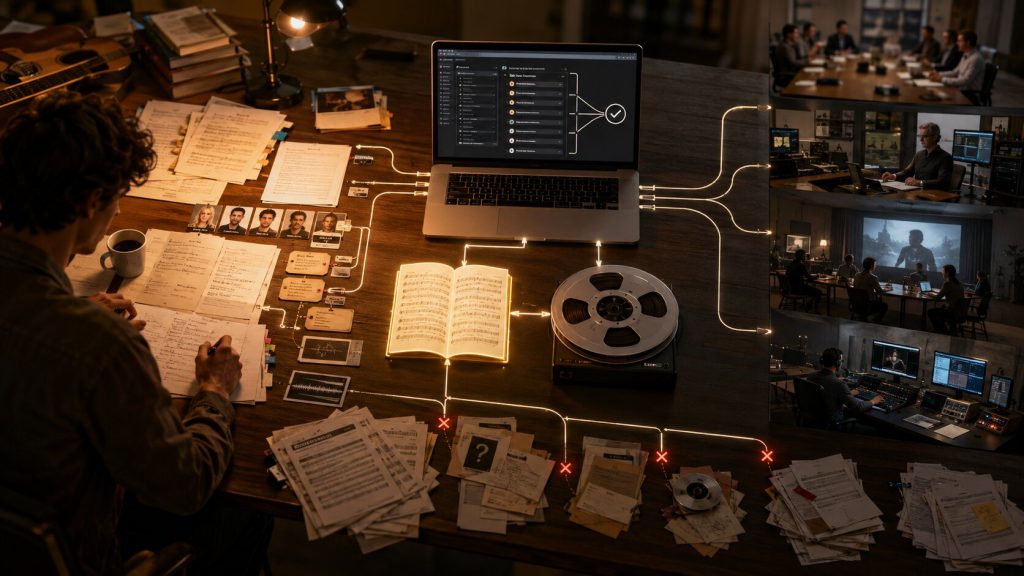
- Metadata Is Where Royalty Collection Often Breaks
- When Publishing Administration Is Worth Paying For
- Do Not Confuse Publishing Income With Recording Royalties
- A Quarterly Royalty Audit for Independent Artists
- Frequently Asked Questions
Key Takeaways
| Point | Details |
|---|---|
| Distribution is not publishing | Your distributor generally handles monetization of the sound recording, while composition royalties can travel through separate licensing and collection systems. |
| Streaming can generate mechanical royalties | Eligible interactive streaming and download activity can generate mechanical royalties for the underlying composition. |
| A PRO and The MLC do different jobs | Performing rights organizations collect public-performance royalties for musical works, while The MLC administers eligible U.S. digital audio mechanical royalties under the blanket license. |
| Metadata affects royalty matching | Inaccurate songwriter names, ownership shares, identifiers, or work-to-recording connections can make correct royalty matching more difficult. |
| Recording royalties are another lane | Organizations such as SoundExchange handle certain royalties related to sound recordings rather than songwriting and publishing rights. |
One Song, Two Copyrights, Several Payment Paths
Consider a completely independent singer-songwriter who writes, records, and releases a track without a traditional label or publisher.
That person may be acting as the songwriter, composer, recording artist, master owner, publisher or self-administered rightsholder, and possibly the producer. Those roles can belong to the same person, but they do not become one copyright or one royalty payment.
The composition is the underlying song: the lyrics, melody, and other protectable musical elements. The sound recording is a particular recorded performance of that composition.
This is why one stream can participate in more than one licensing and royalty system. SoundExchange, for example, distinguishes between public-performance rights in musical works and certain digital-performance rights in sound recordings. (SoundExchange)
Your distributor statement therefore answers only part of the revenue question.
Instead of asking, “How much did my release earn?”, ask: “Which rights did this use involve, and who is responsible for collecting each payment?”
That shift in thinking is the foundation of effective publishing administration.
The Three Publishing Royalties You Need to Track
Publishing becomes easier to understand once you stop treating “publishing royalties” as a single bucket. For most independent songwriters, three major categories deserve attention.
Performance royalties: when the composition is publicly performed
Public-performance royalties can arise when musical works are publicly performed through qualifying uses such as radio, television, venues, businesses, live performances, and digital services.
In the United States, performing rights organizations such as ASCAP and BMI represent songwriters, composers, and publishers and distribute eligible performance royalties according to their respective systems.
Independent writers commonly make two mistakes. The first is never joining an appropriate PRO or collective management organization. The second is joining but failing to register individual compositions correctly.
Affiliation establishes your relationship with the organization. It does not guarantee that every song you release will automatically appear with the correct titles, writers, ownership percentages, and identifiers.
Pro Tip: Make composition registration part of your release workflow rather than paperwork you plan to revisit only if the song becomes successful.
Mechanical royalties: streaming money that can sit outside distribution
Mechanical royalties originated around the reproduction of musical compositions and continue to apply to qualifying digital uses.
In the United States, The Mechanical Licensing Collective administers the blanket mechanical license for eligible interactive streaming and download services and distributes qualifying digital audio mechanical royalties to music publishers, administrators, and self-administered songwriters. The system began operating under the Music Modernization Act in 2021. (The Mechanical Licensing Collective)
This creates an important distinction for DIY songwriters: being affiliated with a PRO does not automatically replace mechanical royalty collection.
If you control your own publishing administration and nobody else is collecting eligible U.S. digital mechanical royalties for your compositions, you may need to register your works with The MLC.
If a publishing administrator already represents those shares, however, you should confirm what that administrator is registering before submitting duplicate claims yourself. Duplicate or conflicting registrations can create unnecessary administrative problems.
Synchronization income: valuable, but negotiated differently
Synchronization income can arise when a composition is licensed for use with visual media such as films, advertisements, television programs, games, trailers, or online productions.
Sync licensing differs from routine streaming royalty collection because permission is typically negotiated with the relevant rightsholder or representative. If an existing commercial recording is being used, the producer of the visual project may also need permission for the master recording.
For an independent artist who owns both the composition and the master, consolidated ownership can make licensing simpler because fewer parties may need to approve the use.
However, that advantage disappears quickly if songwriter splits are unresolved, a sample has not been cleared, producer ownership is ambiguous, or publishing information cannot be verified.
Build a Collection Stack Instead of Relying on Your Distributor
The practical way to manage music royalties is to map each right to its collection route.
| Revenue Lane | What It Relates To | Possible Collection Route |
|---|---|---|
| Distributor or master revenue | The sound recording on streaming and download services | Distributor or record label |
| Composition performance royalties | Public performance of the underlying song | PRO or local collective management organization |
| U.S. digital mechanical royalties | Eligible interactive streams and downloads of the composition | The MLC, publisher, administrator, or qualifying CMO |
| Synchronization income | Use of the composition with visual media | Publisher, administrator, songwriter, or other authorized rightsholder |
| Certain U.S. non-interactive digital-performance royalties | Eligible digital performances of the sound recording | SoundExchange |
| Neighboring-rights income | Certain uses of recordings and performances in applicable territories | Relevant neighboring-rights society, CMO, or representative |
The exact organizations you need depend on your country, repertoire, contracts, collaborators, and existing administration arrangements.
The goal is not to open an account with every royalty organization you discover. The goal is to know who already represents each right before adding another collection service.
Create a basic rights sheet for each release containing:
- songwriter and composer names;
- agreed composition ownership percentages;
- publisher or publishing administrator;
- PRO or CMO affiliation;
- master recording owner;
- distributor;
- ISRC for the recording;
- ISWC when assigned to the composition;
- release date and alternate titles;
- collaborator contact information;
- the organization responsible for each royalty category.
This simple document can reveal missing collection routes before they become catalog-wide problems.
Metadata Is Where Royalty Collection Often Breaks
A royalty organization cannot reliably identify the correct songwriter simply because the songwriter recognizes their own track. Collection systems depend on data that connects a use of a recording with the corresponding composition and its rightsholders.
The MLC provides tools and data programs designed to help rightsholders review work registrations, recording relationships, and unmatched or potentially unmatched data. (The MLC Data Programs)
International identifiers are also important.
An ISRC identifies a particular sound recording. An ISWC identifies a musical work. CISAC describes the ISWC as a unique international identifier used for musical works. (CISAC ISWC Network)
Do not treat the two identifiers as interchangeable.
Lock songwriting splits before the song is released
Suppose three people write a song. One writer records the split as 50%, 25%, and 25%, while another later registers 40%, 30%, and 30%.
The problem is no longer merely remembering who contributed what. Different registrations may now present conflicting ownership claims.
A signed split sheet completed close to the writing session is far easier to manage than reconstructing ownership years later.
Keep names and identifiers consistent
Maintain accurate records of legal names, professional names, publisher names, society affiliations, writer identifiers, and contact information.
A small naming difference may seem insignificant when you are looking at one song. Across large databases containing millions of works and recordings, consistent identifiers make accurate matching substantially easier.
The same discipline should apply when collaborators send you their information. Do not rely only on nicknames, social handles, or whatever name happened to be entered in the session file.
When Publishing Administration Is Worth Paying For
Independent songwriters can self-administer many aspects of their publishing. That does not mean self-administration is always the most efficient approach.
An artist with several straightforward solo-written songs may be comfortable maintaining registrations manually. A writer with a growing international catalog, frequent co-writes, multiple producers, sync activity, or dozens of releases may eventually spend a significant amount of time managing registrations and conflicts.
A publishing administrator may handle tasks such as:
- registering compositions with relevant organizations;
- claiming publishing royalties covered by the agreement;
- maintaining ownership data;
- working with multiple collection systems and territories;
- investigating conflicts or missing registrations;
- providing royalty statements and catalog administration.
Publishing administration should still be evaluated as a business arrangement rather than an automatic upgrade.
Before signing, ask:
- Which royalty categories will you collect?
- Which countries and territories are included?
- What commission or fees will you retain?
- How long does the agreement remain in force?
- Which rights remain under my direct control?
Most importantly, avoid appointing an administrator and then independently registering the same administered shares with multiple organizations without understanding who is responsible for those registrations.
Do Not Confuse Publishing Income With Recording Royalties
Some royalties that independent musicians overlook are not publishing royalties at all.
That distinction matters because registering a composition with publishing organizations will not automatically collect income owed to you as a performer or sound recording owner.
SoundExchange is not a replacement for a PRO
In the United States, SoundExchange administers statutory digital-performance royalties for sound recordings from qualifying non-interactive digital services. Potential recipients can include featured artists and sound recording copyright owners. (SoundExchange Digital Performance Royalties)
Those are different from songwriting performance royalties.
An independent artist who writes the composition and owns the master can therefore have relevant royalty relationships on both sides of the copyright divide.
Neighboring rights may require a different strategy
Recorded-music performance rights differ across territories. For example, PPL in the United Kingdom collects certain royalties for performers and recording rightsholders and also works with international partners for eligible uses abroad. (PPL International Royalties)
Eligibility and collection mechanisms vary by country. International artists should therefore investigate their domestic CMO or neighboring-rights organization instead of assuming that the U.S. framework applies everywhere.
YouTube can introduce another rights-management layer
YouTube Content ID can identify uploaded videos containing copyrighted audio or audiovisual material that matches reference files supplied by eligible rightsholders. Depending on the owner’s settings and applicable rights, a match can trigger actions such as monetization, tracking, or blocking.
For independent artists, the practical question is not simply whether the song exists on YouTube. You should know who is administering your recording rights and composition rights on the platform and whether multiple companies are attempting to claim the same rights.
A Quarterly Royalty Audit for Independent Artists
Royalty administration should not become something you investigate only after a song unexpectedly gains traction.
A simple catalog audit every few months can catch problems while they are still manageable.
For each released song, confirm that:
- composition splits still match the agreements between writers;
- the musical work appears correctly in the relevant PRO or CMO database;
- your mechanical royalty collection route is active where applicable;
- recording identifiers are correct;
- the composition is connected with the correct recording data where relevant;
- your publishing administrator has claimed only the rights covered by its agreement;
- recording-performance or neighboring-rights registrations are handled separately where applicable;
- banking, tax, contact, and account information is current.
Do not judge your royalty setup only by whether money arrived during the most recent statement period. Reporting schedules vary, some uses take time to process, and smaller catalogs may generate irregular payments.
Instead, search for structural problems:
- a released composition missing from a repertoire database;
- incorrect songwriter ownership percentages;
- an unclaimed work;
- duplicate or conflicting registrations;
- a recording that has not been connected with its composition;
- an old administrator still attached to rights that have moved elsewhere;
- incorrect artist, publisher, or songwriter identifiers.
These problems become more complicated to correct as your catalog grows.
Make publishing administration part of every release
Independent artists already maintain release checklists for masters, artwork, distribution metadata, pitching, social media, and promotion. Publishing should be part of the same workflow.
At BlockTone Records, we view the business infrastructure behind a release as part of the release itself. Before moving to the next track, document who wrote the current song, who owns the composition and master, who administers those rights, and which collection systems are responsible for paying each party.
A catalog organized from the first few releases is much easier to manage than one reconstructed after dozens of songs have accumulated.
FAQs About Music Publishing for Independent Artists
Does my music distributor collect publishing royalties?
Not necessarily. A distributor primarily handles delivery and monetization of your sound recording. Some distributors offer separate publishing administration services, but you should confirm exactly which composition royalties are included rather than assuming publishing collection is automatic.
Do independent artists need both a PRO and The MLC?
A self-administered U.S. songwriter may need relationships with both because they handle different royalty categories. PROs administer eligible public-performance royalties for compositions, while The MLC handles eligible U.S. digital audio mechanical royalties under the blanket license. If a publisher or administrator already collects your mechanical royalties, avoid creating duplicate claims.
Is joining The MLC free for songwriters?
Yes. The MLC states that there is no fee to become a member. Self-administered songwriters who qualify can register their works and receive eligible U.S. digital mechanical royalties directly through the organization.
Do I need to create my own publishing company?
Not always. A songwriter can self-administer publishing rights in some collection systems without creating a separate publishing company. Requirements can differ between PROs, CMOs, and territories, so check the rules of the organizations you intend to use.
What is the difference between an ISRC and an ISWC?
An ISRC identifies a specific sound recording, while an ISWC identifies the underlying musical work. Keeping both identifiers organized helps distinguish the recorded master from the composition it contains.
Can I collect publishing royalties from older releases?
Sometimes, but the amount that can be recovered depends on the organization, royalty type, territory, reporting history, and applicable claim or distribution rules. Artists should register compositions promptly rather than assuming historical royalties will remain available indefinitely.
Is a publishing administrator necessary for an independent artist?
No. Artists who control their publishing can self-administer many rights. A publishing administrator may become useful when a catalog grows across multiple territories, involves frequent collaborations, or requires more registration and royalty tracking than the artist wants to manage personally.
Sources Used
- U.S. Copyright Office – Copyright and music for musicians
- The Mechanical Licensing Collective – About The MLC and the Music Modernization Act
- The Mechanical Licensing Collective – Connect & Collect FAQs
- SoundExchange – Digital Performance Royalties
- CISAC – ISWC Network
- PPL – International and neighboring-rights royalties
- YouTube Help – How Content ID works