

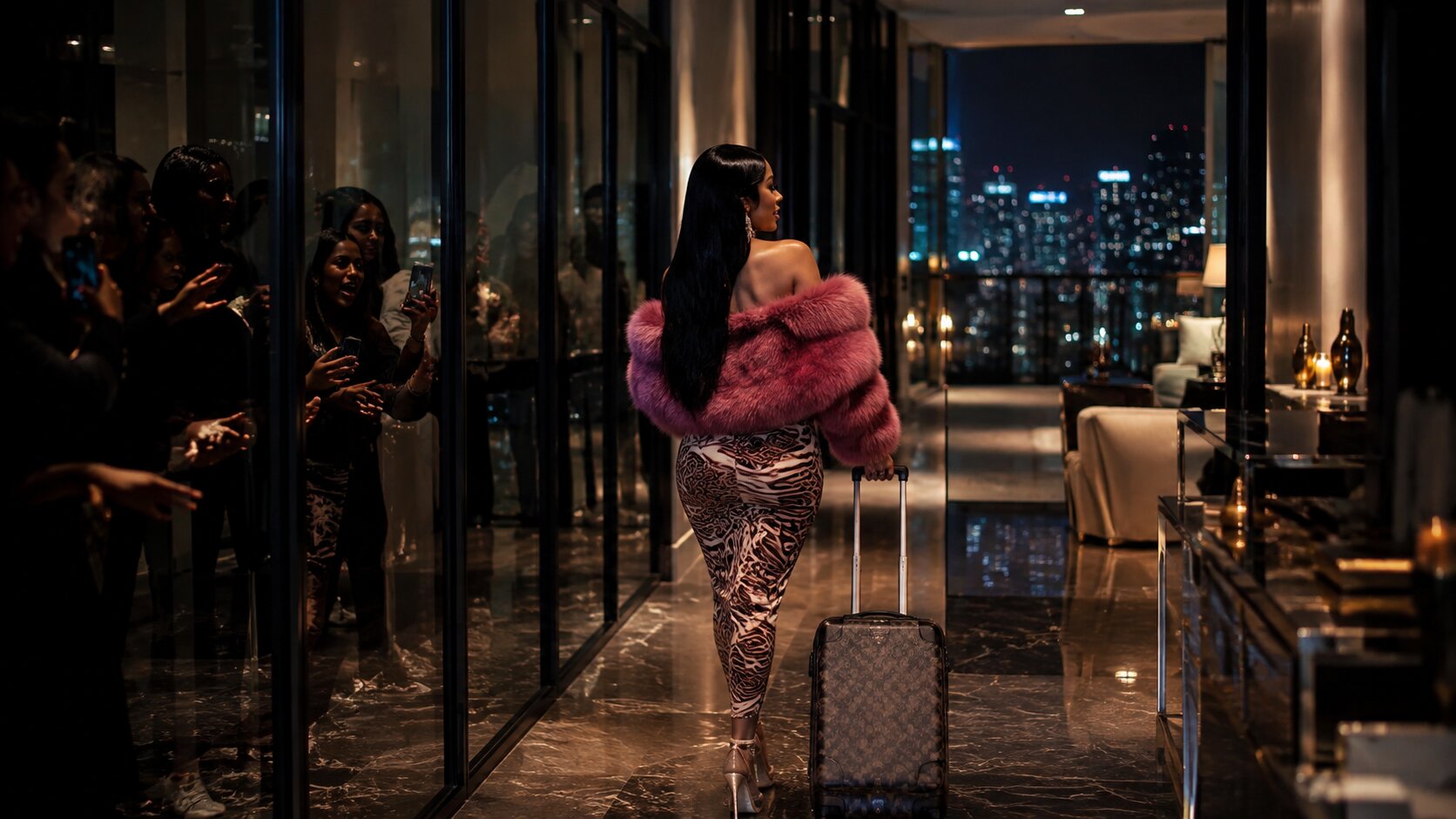
Cardi B Turns the Laugh Into a Weapon on “AH HA”
Cardi B’s “AH HA” is built around a simple power move: instead of arguing with critics, rivals, or men who think they can control her, she laughs at them. The title becomes less an expression of genuine amusement than a verbal shrug—a way of treating other people’s opinions as too insignificant to deserve a serious response.
That makes “AH HA” a classic boast record on the surface, but its most interesting theme is emotional independence. Money, clothes, vacations, sexual confidence, and social status all appear throughout the song, yet the real status symbol is not needing anyone’s approval. Cardi presents herself as someone who can be disliked, discussed, challenged, and watched without allowing any of it to determine her choices.
“AH HA” in One Sentence: Cardi B Is Laughing From the Top
At its core, “AH HA” is Cardi B mocking the idea that rivals, critics, or romantic partners have meaningful power over her.
The recurring laugh works as the song’s answer to almost everything. Someone hates her? She laughs. Someone tries to impress her? She has already experienced the lifestyle they are presenting. Someone believes a relationship can restrict her? She insists she can leave. Someone watches her online while claiming not to care? That contradiction becomes another joke.
That interpretation matches the song’s wider critical reception. Pitchfork described “AH HA” as a Cardi B track centered on laughing at haters, getting money, and humiliating undesirable men. (Pitchfork)
The crucial distinction is that Cardi is not trying to persuade anyone that she is successful. Within the song’s logic, success is already settled. Her job is simply to enjoy the fact that other people are still reacting to it.
After the Drama: Why “AH HA” Arrived Now
Cardi B released “AH HA” on July 31, 2026. Apple Music lists it as a one-song Hip-Hop/Rap single released through Atlantic Recording Corporation, making it a standalone release rather than a track originally included on her 2025 sophomore album, Am I the Drama?. (Apple Music)
The timing gives the song much of its victory-lap energy. “AH HA” arrived after Cardi had already completed the Little Miss Drama Tour, the arena run supporting Am I the Drama?. Before the single appeared, she previewed it in a beach clip that quickly attracted massive attention online. People reported that the teaser had accumulated more than 81 million views around the time of the song’s release. (People)
The song also reunited Cardi with producer DJ SwanQo, who previously produced her 2021 hit “Up.” The official credits available through Apple Music and Shazam list Belcalis Almanzar, James D. Steed, Jordan Thorpe, and Matthew “Sean Island” Allen as songwriters, with DJ SwanQo handling production. (Shazam)
Commercially, the song made an immediate impression. “AH HA” debuted at No. 3 on Billboard’s Hot Rap Songs chart, becoming Cardi B’s 30th top-10 entry on that ranking and extending her streak of earning at least one Hot Rap Songs top 10 across 10 consecutive years. It also entered the Billboard Hot 100 at No. 25. (Billboard)
That context matters because “AH HA” does not sound like an artist introducing herself or trying to prove that success might eventually arrive. It sounds like someone emerging from a major album-and-tour cycle and asking why she should still be intimidated by anybody watching from the sidelines.
Why the Song’s Real Flex Is Indifference
The obvious themes in “AH HA” are wealth, beauty, sex, competition, and celebrity. But those ideas all support a more specific argument: the person who cannot easily be provoked holds the power.
Throughout the song, other people are imagined as paying close attention to Cardi. They evaluate her appearance, relationships, possessions, social-media posts, and reputation. Cardi reverses that dynamic by presenting herself as far less emotionally invested in them than they appear to be in her.
That is why one of the song’s strongest ideas is that another person’s negative feelings are not automatically her responsibility. The attitude is intentionally cold. Cardi refuses the expectation that public criticism deserves a thoughtful response, apology, or explanation.
There is also an important relationship dimension. Before “AH HA” was officially released, a previewed line about a man being unable to “trap” her generated discussion online. Cardi later clarified on Instagram Live that she meant having a child with someone would not force her to remain in a relationship she wanted to leave. That interpretation is not merely fan speculation; Cardi explained the line herself. (Complex)
With that clarification in mind, “AH HA” becomes more than a song about being richer, more attractive, or more successful than somebody else. Its underlying claim is that attachment does not automatically create control. A relationship, another person’s expectations, or public attention does not give anyone authority over Cardi’s next decision.
How “AH HA” Escalates From Brush-Off to Victory Lap
Instead of developing one conventional story from beginning to end, “AH HA” accumulates examples of Cardi refusing to be impressed, intimidated, or controlled. Its verses grow increasingly confrontational while the recurring refrain repeatedly pulls everything back to the same answer: laughter.
The Opening: The Laugh Becomes an Answer
“AH HA” establishes its central gesture almost immediately. The repeated title phrase functions like punctuation after a flex or insult. Instead of explaining herself after every claim, Cardi responds with amusement.
This is important because “ah ha” can normally suggest realization—the moment when something suddenly becomes obvious. Cardi bends that expression into something closer to sarcastic confirmation. Each boast becomes another reason for her to react as though the result should have been predictable all along.
The laugh therefore creates emotional distance. Cardi is not simply claiming that her critics are wrong. She is suggesting that their attempts to challenge her are entertaining.
Verse One: Nobody Gets to Control the Story
The first verse moves rapidly between competition, relationships, status, and confrontation. Cardi questions whether the people positioning themselves against her are really as impressive as they claim to be, while simultaneously asserting her own freedom.
The relationship material is particularly significant because of Cardi’s public explanation of the “trap” line. Her point is that even major personal circumstances would not force her to stay in a relationship she no longer wants. In the context of the song, that turns romantic independence into another form of power.
The verse also expands beyond interpersonal conflict with a direct swipe at Donald Trump. Rolling Stone highlighted the political reference in its coverage of the single, noting that Cardi uses the track to take aim at both her haters and the president. (Rolling Stone)
The result is not a narrowly focused diss track. Instead, Cardi creates an environment in which almost anyone attempting to criticize, restrict, or compete with her can become a temporary target.
The Pre-Chorus: Indifference Becomes Status
The pre-chorus contains one of the song’s clearest attitudes: Cardi is not responsible for making her critics comfortable.
She also repeatedly undermines attempts to impress her with status. The implication is that the lifestyles or possessions someone else might use as evidence of superiority are already familiar territory to her.
That changes the meaning of the materialistic imagery. The flex is not merely “I own expensive things.” It becomes “you cannot use expensive things to make me feel inferior.”
In that sense, wealth functions psychologically as well as materially. It gives Cardi another reason to present herself as difficult to impress and therefore difficult to manipulate.
The Chorus: Visibility Becomes Part of the Competition
The chorus connects the song’s laughter with fashion, appearance, posing, and public visibility.
Ordinarily, glamorous social-media posts can be interpreted as attempts to obtain attention or approval. “AH HA” reverses that relationship. Cardi portrays visibility as something she can deliberately use because she already knows that critics are watching.
That creates one of the track’s recurring contradictions: people who supposedly dislike her remain unusually interested in what she wears, where she goes, what she owns, and what she releases.
The chorus therefore turns attention itself into a form of status. A photograph is no longer simply a photograph. Within the competitive world of the song, it becomes evidence of freedom and success placed directly in front of an audience that Cardi expects to react.
Verse Two: The Lifestyle Becomes the Counterargument
The second verse develops the same idea through vacation and luxury imagery. Cardi contrasts the appearance of an enviable lifestyle with actually having access to the experiences being displayed.
Travel, boats, fashion, physical confidence, and the ability to generate envy all become pieces of the same status narrative. She is not merely describing a glamorous environment; she is using it to emphasize the distance she sees between herself and the people judging her.
The more revealing idea, however, is the contradiction between hatred and attention. If someone supposedly cannot stand Cardi but continues following her activity and listening to her music, that hostility still requires engagement.
From Cardi’s perspective, the critic therefore becomes part of the machinery of her relevance. Scrutiny is converted into evidence that she remains difficult to ignore.
Verse Three: The Bragging Gets More Aggressive
By the third verse, the competitive posture becomes more confrontational. Cardi questions who can realistically compete with her, emphasizes financial power, boasts about desirability, and mocks people whose status she considers inferior.
The exaggeration is part of the performance. “AH HA” operates firmly within competitive rap tradition, where superiority is often communicated through escalating boasts rather than restrained realism.
Money and sexual confidence also become expressions of agency. Cardi consistently places herself in the position of the person making choices rather than waiting to be chosen. That distinction matters because it links the song’s most provocative boasts back to its larger theme of autonomy.
The Outro: A Schoolyard Taunt Gets the Final Word
Instead of ending with a dramatic revelation, “AH HA” closes with a deliberately childish, sing-song taunt.
That choice perfectly suits the rest of the track. By borrowing the language and rhythm of playground mockery, Cardi reduces the entire conflict to something she considers unserious.
The contrast is also comic. After spending the song referencing adult markers of status—money, relationships, sex, luxury, fame—she ends by responding to her opponents with the emotional sophistication of a schoolyard insult.
That is precisely the point. She refuses to grant her adversaries the dignity of a solemn final statement. The song ends with mockery because, in the world Cardi creates, being genuinely upset would mean giving the opposition too much power.
The Symbols Doing More Work Than They First Appear To
“AH HA” is direct rather than densely metaphorical, but several recurring images carry more meaning than their surface-level bravado initially suggests.
Laughter is the song’s central symbol. It represents emotional distance. Criticism becomes less threatening when Cardi can transform it into comedy.
Luxury represents more than money. Cars, jewelry, clothes, homes, and travel function as evidence that Cardi believes she has moved beyond the level at which ordinary comparison can make her feel inadequate.
Public images and social-media attention represent controlled visibility. Cardi understands that attention has value even when it comes from people who claim not to like her. In “AH HA,” being watched becomes proof that the watcher remains invested.
Romantic independence represents autonomy. Cardi’s own clarification of the relationship lyric makes this theme particularly concrete: emotional or family ties do not automatically eliminate her freedom to leave.
Finally, the childish taunt in the outro creates a deliberate contrast with the adult symbols of success surrounding it. Cardi can talk about money, sexuality, fame, and power and still reduce the confrontation to playground teasing. That contrast is one of the song’s sharpest jokes.
Is “AH HA” Really About One Person?
There is no verified evidence that “AH HA” as a whole is a diss track aimed at one specific rival, former partner, or celebrity.
Some lines naturally invite speculation because Cardi refers to enemies, relationships, critics, and people attempting to compete with her. However, attaching every bar to a named individual would require assumptions that neither Cardi nor reliable reporting has confirmed.
There is one clear real-world target: Donald Trump is directly referenced in the first verse. Cardi’s political criticism is therefore explicit rather than theoretical in that particular moment.
Cardi has also personally clarified the meaning of the relationship line about not being “trapped.” Beyond those confirmed points, claims that every insult corresponds to one hidden person should be treated as fan theory rather than fact.
The stronger interpretation is that “AH HA” intentionally keeps most of its opposition broad. That allows the song to function as a general victory-lap record rather than a detailed account of one feud.
Where “AH HA” Sits in Cardi B’s Larger Story
“AH HA” reconnects with one of Cardi B’s most recognizable modes: aggressive, humorous, highly quotable rap built around competitive confidence.
The connection to “Up” is especially notable because DJ SwanQo produced both songs. Pitchfork specifically highlighted the reunion when covering “AH HA.” Both records rely on compact hooks, sharp boasts, rhythmic punch lines, and phrases designed to become instantly memorable.
Thematically, “AH HA” also fits alongside tracks such as “Money,” “Press,” and “Enough (Miami),” as well as the broader public persona surrounding Am I the Drama?. Cardi frequently writes from the position of a celebrity whose visibility attracts admiration and hostility at the same time.
Her critics therefore become useful characters inside the music. Their attention provides something for Cardi to push against, while also proving that she remains culturally relevant enough to inspire strong reactions.
What makes “AH HA” particularly appropriate for this stage of her career is that it arrived after another major commercial chapter. Am I the Drama? had already reached No. 1 on the Billboard 200, and Cardi had taken the album on an arena tour before releasing the single. The track therefore sounds less like a promise of future success than a celebration of status she believes she has already secured.
The Last Word on What “AH HA” Means
“AH HA” is Cardi B turning indifference into a flex.
The expensive clothes, vacations, sexual confidence, competitive insults, and attacks on rivals provide the surface entertainment, but the song’s deeper source of power is its repeated refusal to let other people’s feelings determine Cardi’s behavior.
Critics can watch. Rivals can compete. Romantic partners can make assumptions. Cardi’s answer remains essentially unchanged: none of them get to decide what she does next.
That is why the laugh matters more than any individual boast. It transforms criticism into entertainment and unwanted attention into evidence of relevance. By the final taunt, Cardi is not arguing that everyone should like her. She is arguing that whether they like her or not has become beside the point.
FAQs About “AH HA”
What does “AH HA” mean in Cardi B’s song?
When was Cardi B’s “AH HA” released?
Who wrote “AH HA” by Cardi B?
What did Cardi B mean by saying a man cannot “trap” her?
Is “AH HA” a diss track?
What is the chorus of “AH HA” about?
How did “AH HA” perform on the charts?
Sources Used
- Apple Music – AH HA – Single page
- Shazam – “AH HA” song page, lyrics structure, and credits
- Billboard – report on the release of “AH HA”
- Billboard – “AH HA” chart performance and Cardi B’s Hot Rap Songs milestone
- Pitchfork – coverage of “AH HA” and DJ SwanQo’s production
- People – release context, beach teaser, and Little Miss Drama Tour coverage
- Complex – Cardi B’s explanation of the “can’t trap me” lyric
- Rolling Stone – coverage of “AH HA” and its Donald Trump reference