
Music Split Sheets: The Document Every Collaboration Needs
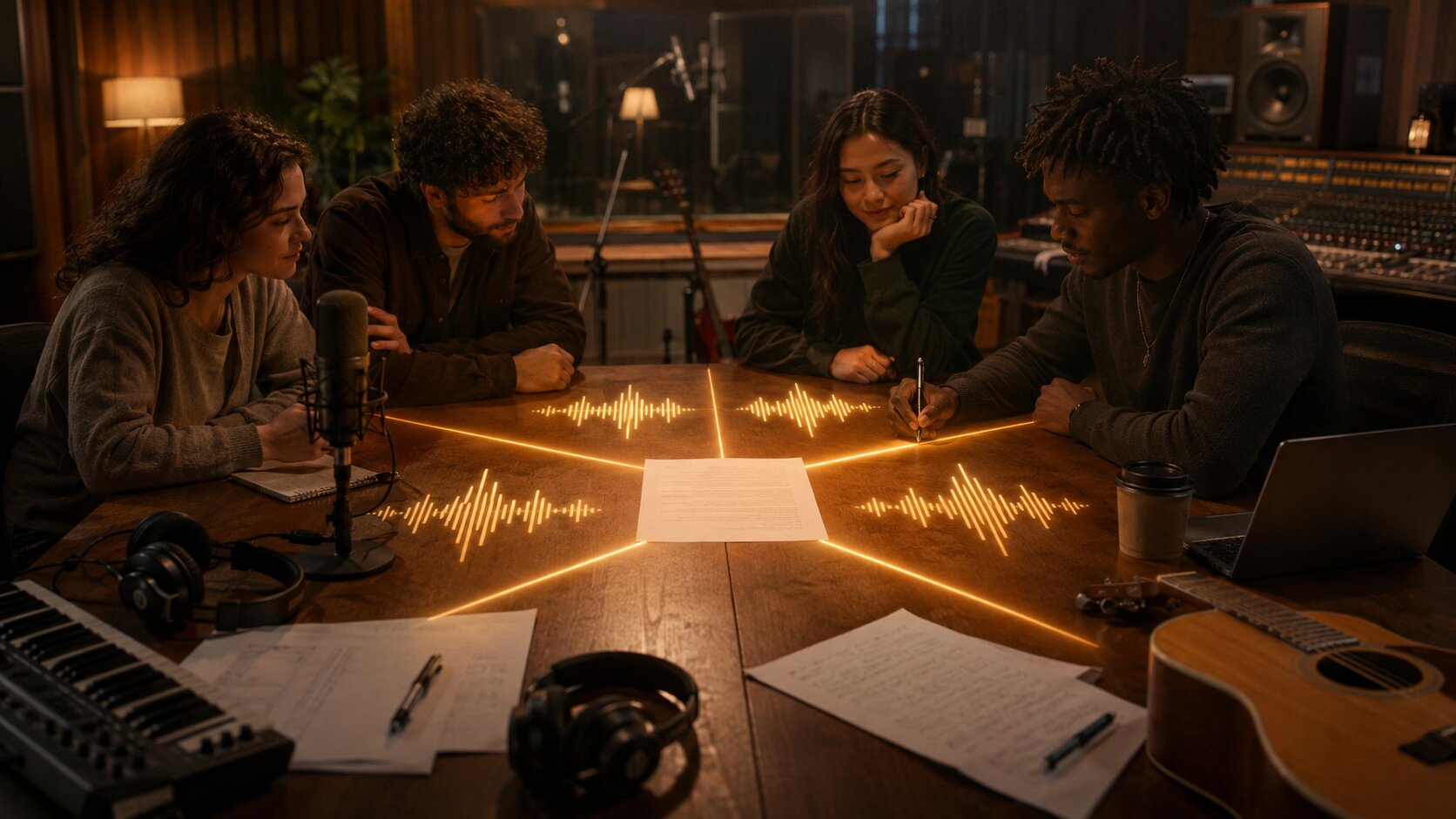
A music split sheet records who owns each percentage of a song’s composition before memories, expectations, or working relationships change. Complete it as soon as the contributors are known, confirm that the ownership percentages total 100%, and have every songwriter sign the same version.
The signed split sheet should then become the reference document for copyright registrations, performing rights organization submissions, publishing administration, mechanical royalties, and future licensing discussions.
A productive collaboration can create a strong song in a few hours. It can also create years of confusion if nobody documents who wrote what.
The problem rarely appears during the session. It usually appears later, when one collaborator registers a different percentage, a producer asks for songwriting credit, a publisher discovers conflicting ownership claims, or a sync opportunity requires immediate approval from every rightsholder.
A music split sheet gives collaborators a written record of their agreement while the creative process is still fresh. This guide explains what the document should contain, how to discuss percentages professionally, and how to carry the agreed information into royalty and copyright systems.
Table of Contents
- Settle Ownership Before the Release Process Begins
- Separate Composition Rights from Master Rights
- Record the Information Royalty Systems Will Need
- Choose Songwriting Percentages the Team Can Defend
- Move from a Creative Session to a Signed Agreement
- Turn the Split Sheet into a Registration Blueprint
- Recognize When a Split Sheet Is Not Enough
- Create a Repeatable Split-Sheet Workflow
- Build More Reliable Collaboration Systems
- FAQs About Music Split Sheets
Key Takeaways
| Point | Details |
|---|---|
| Document the composition split early | Agree on ownership before distribution, publishing registration, pitching, or royalty collection begins. |
| Separate the song from the recording | Composition ownership and master-recording ownership are different rights and may require separate agreements. |
| Make the ownership total 100% | Every contributor’s agreed composition share must fit into one complete 100% allocation. |
| Use accurate legal and industry information | Record legal names, contact details, PRO or CMO affiliations, publisher information, and IPI or CAE numbers when available. |
| Collect every contributor’s signature | A verbal agreement or group-chat message is difficult to rely on when registrations conflict. |
| Register the song consistently | The signed document should guide submissions to PROs, publishers, administrators, and mechanical-rights systems. |
Settle Ownership Before the Release Process Begins
A music split sheet is a written agreement identifying the contributors to a musical composition and the percentage owned by each person. It is commonly completed after a songwriting session, production session, writing camp, remote collaboration, or artist-development project.
The document matters because collaborative songs can create shared copyright ownership. Under United States copyright law, the authors of a qualifying joint work are generally co-owners unless an agreement establishes a different arrangement. (U.S. Copyright Office – Copyright Ownership and Transfer)
The best time to discuss splits is when the creative contributors are clear but before commercial activity starts. Do not wait until the recording has been distributed, a publisher wants to register the song, a sync supervisor asks for ownership information, or one collaborator has already submitted conflicting percentages.
The conversation does not need to interrupt the creative process. Some teams explain their split policy before the session and finalize the numbers afterward. Others reserve the final few minutes of every session for titles, credits, contact information, metadata, and ownership percentages.
Consistency makes the conversation easier. When split sheets are treated as routine administration rather than a sign of distrust, collaborators are less likely to interpret the request as personal or confrontational.
Pro Tip: Explain your split-sheet process before the first session. Saying that you document every collaboration in the same way feels more professional than raising the subject only after a disagreement appears.
Separate Composition Rights from Master Rights
A common mistake is assuming that one royalty percentage controls every source of income connected to a released track.
A commercial recording normally involves at least two separate copyrighted works:
- The musical composition: the lyrics, melody, harmony, and other protectable songwriting elements.
- The sound recording or master: the specific recorded performance and production captured in the final audio.
The U.S. Copyright Office treats musical compositions and sound recordings as separate works. Owning part of the composition does not automatically mean owning part of the master, and owning the master does not automatically create a songwriting share. (U.S. Copyright Office – Copyright Registration of Musical Compositions and Sound Recordings)
A standard songwriter split sheet usually addresses composition ownership. It does not automatically determine who owns the master, who recoups recording expenses, whether the producer receives points, or how featured artists are paid.
| Issue | Usually Covered by a Split Sheet? | May Require Another Agreement? |
|---|---|---|
| Composition ownership | Yes | Sometimes, if the arrangement is complex |
| Songwriter percentages | Yes | Usually not |
| Publisher information | Yes | A publishing agreement may still apply |
| Master ownership | Usually not | Yes |
| Producer fee | No | Yes |
| Producer royalty or points | No | Yes |
| Recording-cost recoupment | No | Yes |
| Sample clearance | It should be disclosed | A separate license or clearance is required |
When should a producer receive a songwriting share?
A producer’s job title does not automatically answer the songwriting question. The relevant issue is whether the producer contributed to the underlying composition and whether the collaborators agreed to recognize that contribution with ownership.
A producer who writes a melody, chord progression, lyric, vocal hook, or other compositional element may negotiate a writer share. A producer who only records, edits, mixes, or executes an existing composition may instead receive a fee, master royalty, or another form of compensation.
ASCAP notes that producers can be credited as writers when they contribute to a composition, with the registration reflecting the agreement reached by the collaborators. (ASCAP – Registering Your Music)
Do not use a composition percentage as an improvised replacement for an unresolved production fee. Songwriting ownership, producer compensation, master royalties, and recoupment should be discussed as separate issues.
Record the Information Royalty Systems Will Need
A useful split sheet must identify the song, the contributors, and the agreed ownership clearly enough for the information to be reproduced in later registrations.
Song information
- Current song title
- Working or alternate titles
- Date of the session or agreement
- Version description when several versions exist
- Intended artist or performer, when known
- Notes about samples, interpolations, pre-existing material, or outside writers
Titles often change before release. Recording both the working title and the final title can help prevent duplicate registrations and make older session files easier to identify.
Contributor information
Collect the following information for every songwriter or composer:
- Full legal name
- Professional or stage name
- Email address
- Phone number, when appropriate
- Performing rights organization or collective management organization
- IPI or CAE number, when available
- Publisher or publishing administrator
- Publisher IPI number, when available
Legal names are particularly important. A royalty system may not reliably connect a nickname, producer tag, or social-media handle to the correct songwriter account.
Songtrust recommends recording contributor identities, contact information, ownership percentages, affiliations, signatures, execution dates, and relevant song metadata. (Songtrust – The Ultimate Split Sheet for Songwriters)
Composition ownership
Record each contributor’s agreed ownership percentage and confirm that the total equals exactly 100%.
| Contributor | Contribution Summary | Composition Share |
|---|---|---|
| Writer A | Chorus melody and lyrics | 40% |
| Writer B | Verses and bridge | 30% |
| Producer C | Chords and instrumental hook | 30% |
| Total | 100% |
Contribution summaries are optional, but they can help explain the reasoning behind an unequal split. Keep them factual and concise rather than attempting to document every creative decision made during the session.
Signatures and version control
The final document should include a statement confirming that the listed percentages represent the parties’ agreement, a signature from every contributor, the date each person signed, and a method for approving future amendments.
Electronic signatures can make remote collaboration easier, but every contributor should receive the completed version. Store the signed document somewhere more durable than a temporary chat thread or direct-message conversation.
Choose Songwriting Percentages the Team Can Defend
There is no universal percentage formula for every songwriting session. Collaborators may divide the composition equally, assign shares according to contribution, or negotiate another arrangement that reflects their working relationship.
The goal is not to calculate the value of every minute spent in the room. The goal is to reach an informed agreement that all contributors understand and can explain later.
Equal splits
An equal split can work well when everyone entered the room as a co-writer, contributions overlapped throughout the session, or the team regularly operates under an equal-split policy.
For example, three writers could agree to 33.33%, 33.33%, and 33.34% so that the total reaches 100%.
Equal splits can preserve trust and reduce negotiation time, but they should not be assumed silently. A session musician, engineer, manager, photographer, or observer does not automatically become a songwriter simply because they were present.
Contribution-based splits
Unequal percentages may make sense when the roles were substantially different. One writer may bring a nearly finished song, another may create a new bridge, and a producer may add a protectable melodic or harmonic element.
Useful questions include:
- What material existed before the session?
- Who contributed lyrics, melody, harmony, or other compositional elements?
- Was the beat licensed before the session or created collaboratively?
- Did anyone introduce pre-existing material controlled by another party?
- Is any contributor working under a publishing, employment, or work-for-hire agreement?
Discuss the composition itself rather than basing percentages on fame, follower count, studio ownership, or who paid for the session.
Avoid retrospective leverage
A collaborator should not wait until a song gains commercial momentum and then use access to the master, stems, distribution account, or release schedule to demand a larger songwriting share.
Artists should also avoid describing a producer as work for hire after the session unless that status was properly agreed and documented. Work-made-for-hire treatment has specific legal requirements and should not be treated as an informal label.
When the parties cannot agree or the release has significant commercial value, pause the registration and obtain advice from a qualified music attorney.
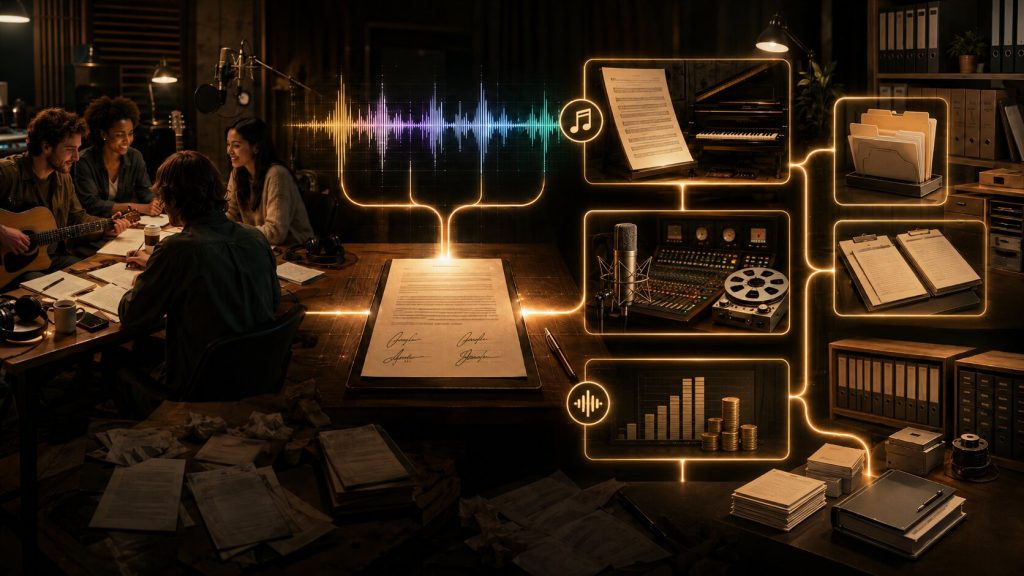
Move from a Creative Session to a Signed Agreement
A split sheet works best when it is built into the collaboration workflow rather than used as an emergency response to a dispute.
1. List everyone who contributed
Before the session ends, record every person who may claim a compositional contribution. Do not treat the studio booking, DAW project name, or group-chat membership as the official contributor list.
2. Identify pre-existing material
Ask whether the song contains a previously written verse, a leased beat, a melody from an older demo, a sample, an interpolation, or material controlled by a publisher.
This information can affect both the ownership calculation and the team’s ability to distribute or license the finished song.
3. Agree on composition percentages
Discuss the numbers directly. Statements such as “we will work it out later” or “everyone will be taken care of” do not establish a clear ownership arrangement.
4. Circulate one controlled version
Choose one person to prepare and circulate the document. Label the file clearly with the song title, date, and version number so that outdated drafts are not mistaken for the final agreement.
5. Collect every signature
A partially signed document leaves uncertainty. Follow up until each listed contributor has signed or has formally disputed the proposed terms.
6. Distribute and archive the completed document
Send the fully executed version to every contributor. Store it with the project files, licenses, contracts, stems, release metadata, and registration records.
Pro Tip: Keep an unsigned session recap in addition to the final agreement. The recap can preserve title changes, contact details, contribution notes, and unresolved questions without presenting unfinished negotiations as settled.
Turn the Split Sheet into a Registration Blueprint
Signing a split sheet does not automatically register the composition or collect royalties. The agreed information must be entered consistently into the relevant rights-management systems.
Depending on the contributor’s country and business structure, registrations may involve:
- A performing rights organization or collective management organization
- A music publisher or publishing administrator
- A national copyright office
- A mechanical-rights organization
- A label or distributor metadata system
- A sync representative or licensing catalogue
ASCAP explains that work registrations provide writer, publisher, and royalty information used to identify the parties entitled to payment. The Mechanical Licensing Collective similarly relies on musical-work registrations and ownership claims when administering eligible U.S. digital mechanical royalties. (The MLC – Work Registration)
Watch for different percentage formats
Your split sheet may express composition ownership on a 100% basis, while royalty organizations may display writer and publisher shares differently.
ASCAP generally separates the total into a 50% writer side and a 50% publisher side. BMI commonly describes the complete royalty using a 200% format, consisting of a 100% writer share and a 100% publisher share.
This does not mean the collaborators own twice the composition. It means the organizations use different displays for writer and publisher interests.
Before submitting a registration:
- Read the organization’s current registration instructions.
- Confirm whether the form asks for ownership, writer share, publisher share, or a combined total.
- Use the same legal names, titles, publishers, and identifiers used by the other collaborators.
- Confirm who is responsible for making the initial registration.
- Ask every contributor to review the submitted information.
Conflicting registrations can create overclaims, delay matching, or place royalties into dispute. The MLC provides claiming and overclaim tools because competing or incomplete ownership data sometimes needs to be corrected. (The MLC – Tools for Managing Musical Works)
Recognize When a Split Sheet Is Not Enough
A basic split sheet is useful for a straightforward composition agreement, but it should not be expected to resolve every business issue surrounding a recording.
Consider a more detailed agreement when the collaboration involves:
- A producer fee or advance
- Master royalties or producer points
- Recoupable recording expenses
- Exclusive services
- Delivery requirements
- Sample or interpolation clearance
- Ownership of stems and session files
- Approval or veto rights
- Credit placement
- Sync-licensing authority
- Publishing assignments
- Administration rights
- Label ownership or licensing
- Territory and contract-term restrictions
SoundExchange uses Letters of Direction for certain allocations of featured-artist sound-recording performance royalties to eligible producers, mixers, and engineers. That process concerns recording royalties and is separate from composition ownership. (SoundExchange – Guide to Letters of Direction)
A split sheet also cannot solve a clearance problem. Writing that a sample was used may identify the issue, but it does not grant permission to release the sampled material.
Treat the split sheet as one component of a broader rights-management system, not as a universal music contract.
Create a Repeatable Split-Sheet Workflow
Before the session
- Confirm who is attending as a writer, producer, engineer, musician, or guest.
- Ask whether anyone is bringing pre-existing material.
- Explain your normal split-sheet policy.
- Prepare a blank template.
Before contributors leave
- Confirm the working title.
- List all potential songwriters.
- Discuss the composition percentages.
- Record publisher and PRO or CMO information.
- Flag samples and unresolved ownership questions.
Within 24 hours
- Circulate one clean version.
- Correct spelling, legal names, and identifiers.
- Collect signatures.
- Save the completed document in the project folder.
Before release
- Confirm that master ownership and producer terms are separately documented.
- Check that the composition percentages total 100%.
- Register the work through the appropriate organizations.
- Compare every registration against the signed split sheet.
- Update the project record if the title changes.
Before accepting a sync or licensing opportunity
- Confirm who can approve the composition.
- Confirm who can approve the master.
- Verify that no ownership dispute remains.
- Make sure every rightsholder’s contact information is current.
This workflow cannot eliminate every disagreement, but it gives collaborators a shared factual record and makes downstream administration significantly easier.
Build More Reliable Collaboration Systems
A release strategy is only as reliable as the ownership information, metadata, and agreements behind it. BlockTone Records provides practical guidance for independent musicians building stronger release, promotion, rights-management, and artist-development systems.
Whether you are preparing your first co-written single or managing a growing catalogue, make split sheets a standard part of every collaboration rather than paperwork you chase after the release campaign has started.
FAQs About Music Split Sheets
“`
What is a music split sheet?
A music split sheet is a document that lists the contributors to a musical composition and the ownership percentage assigned to each contributor. It normally includes song information, legal names, publishing affiliations, percentages, signatures, and dates.
When should collaborators sign a split sheet?
Collaborators should complete and sign the split sheet as soon as the contributors and percentages are known, ideally at the end of the session or within the following day. It should be finalized before the song is registered, distributed, pitched, or licensed.
Do producers need to appear on split sheets?
A producer should appear as a songwriter when the collaborators agree that the producer contributed to the underlying composition. Production fees, master royalties, producer points, and recoupment should be documented separately.
Should every songwriter receive an equal percentage?
Not necessarily. Collaborators may use equal splits or contribution-based splits. The chosen approach should be discussed openly, account for pre-existing material, and be documented instead of assumed.
Does a split sheet cover master ownership?
A songwriter split sheet generally covers the musical composition, not the sound recording. Master ownership, recording costs, producer royalties, and featured-artist revenue may require separate agreements.
Can song splits be changed later?
Song splits can be amended when all affected parties agree. The revised percentages should be documented in a new signed agreement, and every organization holding the previous ownership information should be updated.
What happens if a collaborator refuses to sign?
Silence should not be treated as approval. Preserve the session records, identify the disputed issues, and avoid making contradictory registrations or licensing the song until the disagreement is resolved. Seek legal advice when the release has meaningful commercial value.
Sources Used
- U.S. Copyright Office – Copyright Ownership and Transfer
- U.S. Copyright Office – Musical Compositions and Sound Recordings
- ASCAP – Registering Your Music
- The Mechanical Licensing Collective – Work Registration
- SoundExchange – Guide to Letters of Direction
- Songtrust – The Ultimate Split Sheet for Songwriters