
Why “Party in the U.S.A.” Feels Like Home in a Strange Room
“Party in the U.S.A.” is about arriving somewhere unfamiliar, feeling visibly out of place and using familiar music to recover a sense of confidence. Although its title makes the track sound like a straightforward patriotic anthem, the lyrics tell a more personal story about culture shock, homesickness and the search for belonging.
The narrator does not immediately feel ready to celebrate. She enters Los Angeles surrounded by fame, fashion and people who appear more comfortable than she is. The party begins emotionally only after recognizable songs give her something familiar to hold onto.
The Meaning in One Clear Idea
At its core, “Party in the U.S.A.” shows how music can turn an intimidating environment into a space that feels manageable. The narrator cannot control the city, the crowd or the attention she believes she is receiving, but she can recognize the song coming through the speakers.
That recognition changes her physical and emotional state. Her tension decreases, she begins moving with the music and she stops thinking quite so intensely about whether she belongs. The song therefore presents pop music as a form of emotional grounding: a familiar sound creates a temporary home inside an unfamiliar place.
This interpretation explains why the track remains relatable even for listeners who have never moved to Hollywood. Its emotional situation can apply to a first day at school, a new workplace, a crowded event or any room where everyone else seems to understand the rules.
How a London Culture-Shock Song Became Miley’s L.A. Story
Hollywood Records released “Party in the U.S.A.” on August 4, 2009. The pop single was later included on Miley Cyrus’s 2009 EP The Time of Our Lives, a project released while she was moving beyond music directly connected to her Hannah Montana character. (Apple Music – Party In the U.S.A. – Single)
The credited songwriters are Lukasz Gottwald, Claude Kelly and Jessica Cornish, better known as Jessie J. Gottwald, professionally known as Dr. Luke, also produced the recording. The official audio credits identify Hollywood Records as the label and list all three writers. (Miley Cyrus Official Artist Channel – “Party In The U.S.A.” audio and credits)
The song was not originally conceived as a literal account of Cyrus arriving in Los Angeles. Claude Kelly has explained that it was first written for Jessie J. In that earlier version, the newcomer was a British woman experiencing the differences between London and Los Angeles. After the song was redirected to Cyrus, its details were rewritten around a girl traveling from Nashville to Hollywood. (American Songwriter – Claude Kelly on the song’s origin)
That history is important because it establishes the lyrics as crafted pop storytelling rather than an exact diary entry. The writers retained the original culture-shock concept while changing the narrator’s background so Cyrus could plausibly inhabit the story.
Cyrus later revealed that she recorded the track while filming The Last Song in 2009. She remembered being reluctant to give up her free time for the session and described the vocal as unusually difficult. She also said that she personally added the Britney Spears reference to balance the Jay-Z reference already present in the composition. (People – Miley Cyrus reflecting on recording the song)
The single became one of the defining hits of Cyrus’s early solo career. In the United Kingdom, it reached number 11 on the Official Singles Chart and remained on the Top 100 for 17 weeks during its original run. It later returned to several UK charts, showing how the song continued to circulate long after 2009. (Official Charts – “Party in the USA” chart history)
The Emotional Mechanism Behind the Song
The song begins with a dream that immediately becomes uncomfortable. The narrator has reached Los Angeles, a city associated with possibility, fame and transformation, but the reality of being there makes her feel exposed.
Everyone around her appears to understand how Los Angeles works. Famous people seem ordinary, fashionable strangers look socially prepared and the narrator becomes conscious of the differences between her background and the new environment.
Her anxiety is largely anticipatory. No one directly tells her that she is unwelcome. Instead, she interprets attention, clothing and unfamiliar surroundings as evidence that she may not fit in. The tension comes from her own fear of being judged.
Music interrupts this self-consciousness. When the radio or DJ plays an artist she recognizes, she no longer has to decode every detail of the room. The familiar sound provides a shared cultural language that she already understands.
The chorus repeats this transformation several times because confidence does not arrive permanently after one moment. The narrator becomes nervous, hears a familiar song, relaxes and then faces another social challenge. Music repeatedly restores enough confidence for her to remain present.
Following the Narrator Across Los Angeles
The Airport Arrival: Excitement Without Preparation
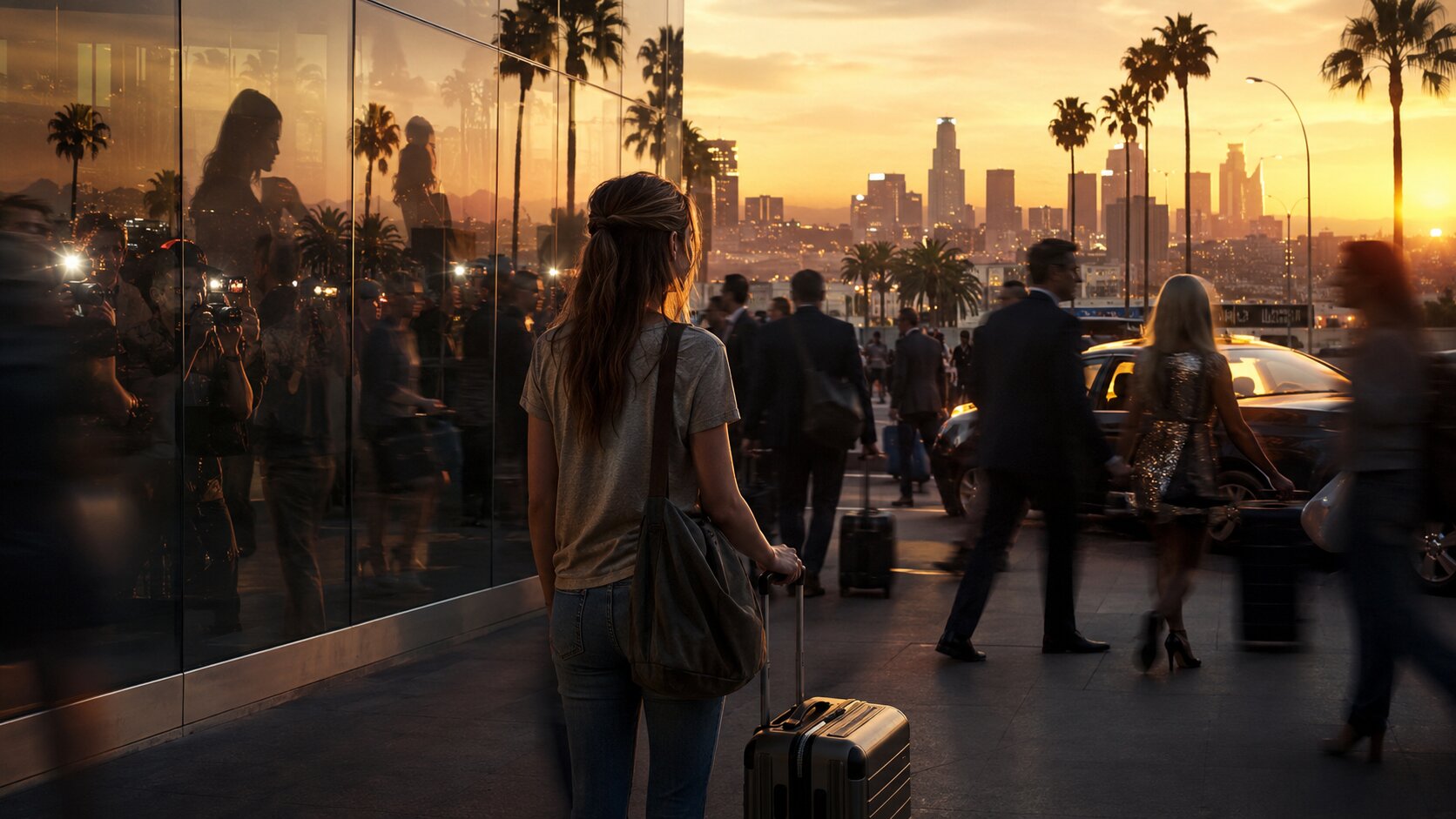
The opening scene places the narrator at Los Angeles International Airport carrying ambition but little certainty. She has reached a place that represents success, yet she does not know how to behave once she is inside it.
LAX functions as a threshold between her previous identity and the life she imagines for herself. Airports are transitional spaces: the traveler has left one world but has not yet settled into another. That makes the location an effective beginning for a song about reinvention and insecurity.
The narrator’s casual appearance also matters. Her clothing communicates comfort and regional familiarity, but it feels mismatched with the polished image she associates with Hollywood. Before anyone speaks to her, she has already decided that she may look wrong for the city.
The First Pre-Chorus: Anxiety Becomes Physical
The first pre-chorus moves from external observation to internal distress. Los Angeles is no longer simply impressive; it is affecting the narrator physically. Nervousness and homesickness make her question whether coming there was a mistake.
The taxi offers a temporary protective space. She can observe the city through a window without yet having to participate in it. When familiar music plays on the radio, that private environment becomes the location of her first emotional recovery.
The change is small but significant. The song does not remove her uncertainty about Los Angeles. It gives her enough comfort to continue moving through it.
The Chorus: A Familiar Song Creates Belonging
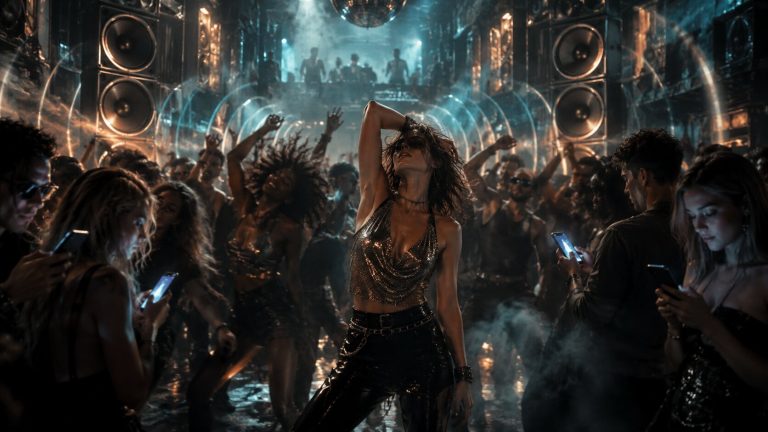
The chorus describes confidence returning through physical movement. The narrator relaxes, responds to the beat and allows herself to enjoy the moment instead of evaluating how she appears.
This is the central meaning of the “party.” It is not merely the club or the presence of other people. It is the narrator’s shift from self-surveillance to participation.
The phrase “in the U.S.A.” expands a private moment into a large communal setting. Yet the lyrics do not offer a detailed political or patriotic statement. America is presented mainly as a pop-cultural landscape made of cities, celebrities, regional identities and songs that strangers recognize together.
The Club Scene: When a Party Feels Like an Audition
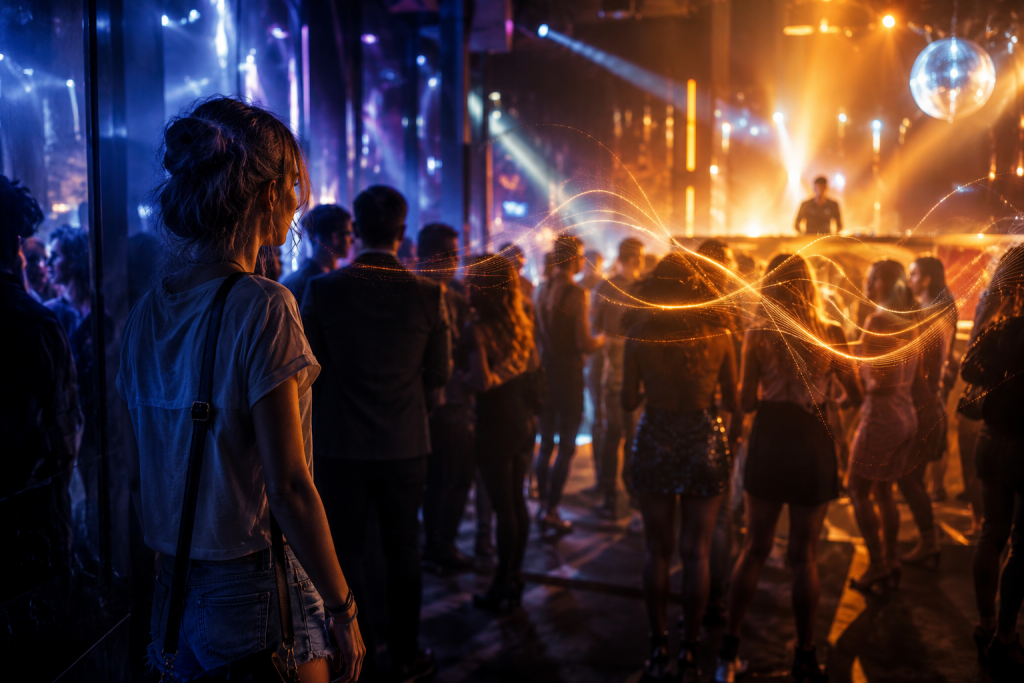
The second verse places the narrator in a more exposed environment. The taxi allowed her to watch Los Angeles from relative safety, but the club requires her to become visible.
She notices people looking at her and assumes that her clothes identify her as an outsider. Whether those strangers are truly criticizing her is less important than her belief that they are. The room begins to feel like an audition in which everyone else knows the correct costume and behavior.
The absence of her familiar friends increases the pressure. At home, those relationships would confirm her identity and make her feel secure. In Los Angeles, she must find another source of reassurance.
The Second Musical Rescue: Britney as a Personal Detail
The second pre-chorus repeats the narrator’s emotional pattern. Social pressure grows, homesickness returns and another recognizable artist comes through the speakers.
The Britney Spears reference has particular significance because Cyrus later confirmed that she added it herself. That means the completed recording is not entirely detached from her personal tastes, even though the broader storyline was written by other people.
Jay-Z and Britney Spears function as cultural passports within the song. The narrator may not know the people in the room, but she recognizes the music they are hearing. Shared recognition gives her an immediate connection to the crowd.
The Bridge: Home Remains an Alternative
The bridge reveals that leaving Los Angeles is still a genuine possibility. The narrator’s earlier confidence has not erased her homesickness, and part of her continues to imagine returning to the place where she feels understood.
This prevents the emotional arc from becoming unrealistically simple. One enjoyable chorus does not transform her into a completely fearless person. Her confidence remains fragile and must be rebuilt.
Once again, music gives her a reason not to leave immediately. Courage arrives not as a dramatic promise to conquer Hollywood but as a smaller decision to remain in the room for another song.
The Final Chorus: Observation Turns Into Participation
By the final chorus, the narrator has not become indistinguishable from everyone around her. She still carries her Nashville identity and remains aware that Los Angeles is different.
What changes is her belief that difference automatically excludes her. She discovers that participation does not require complete assimilation. She can enjoy the experience without erasing where she came from.
The song ends by repeating the emotional ritual that made this possible: tension rises, familiar music appears and movement replaces hesitation. Belonging begins as something she does before it becomes something she fully believes.
Four Symbols That Carry More Weight Than They Seem
LAX as the Doorway to Reinvention
LAX symbolizes entry into a new identity. The narrator has physically arrived in Los Angeles, but emotionally she remains between her old life and the person she hopes to become.
That uncertainty gives the airport scene its meaning. She has achieved the first part of the dream by getting there, but arrival does not automatically provide confidence, friendship or a sense of belonging.
The Taxi as a Temporary Safe Zone
The taxi represents a middle space between private insecurity and public performance. It protects the narrator while exposing her to the city one image at a time.
Her first confidence-building moment happens there, suggesting that people often need a smaller, safer experience before they can face a more demanding social environment.
Clothing as a Language of Social Status
The contrast between casual regional style and glamorous club fashion symbolizes competing ideas about success and identity. The narrator worries that her clothes reveal she does not understand the rules of Hollywood.
The song ultimately rejects the idea that she must completely redesign herself before she can participate. Her original identity is not presented as a flaw; the real obstacle is her fear that others will see it that way.
The DJ as an Emotional Guide
The DJ has no developed personality, but the role is structurally essential. Each time the narrator approaches emotional retreat, the DJ supplies the familiar music that helps her recover.
Symbolically, the DJ represents the unexpected source of comfort that appears in a difficult situation. The narrator cannot bring home with her physically, but a song can reproduce part of its emotional safety.
Is “Party in the U.S.A.” Based on Miley Cyrus’s Real Life?
The song is not a literal account of one verified trip, party or evening from Cyrus’s life. Its first version was written for Jessie J and followed a British newcomer arriving in America. The lyrics were later adapted to fit Cyrus’s Tennessee background and Hollywood image.
However, the finished recording is not completely impersonal. Cyrus was genuinely moving through a career transition in which she had to balance her Southern upbringing, Disney fame and growing identity as an independent pop artist. She also altered parts of the song, including the Britney Spears reference.
The most accurate description is personalized pop fiction. The storyline was professionally constructed, but it was adjusted until Cyrus could deliver it in a way that matched her public position in 2009.
There is no reliable evidence that the song describes a secret romantic relationship, a particular celebrity gathering or one identifiable real-life party. Claims connecting it to a specific person or event remain unconfirmed speculation.
Where the Song Sits in Miley Cyrus’s Career
“Party in the U.S.A.” arrived at a pivotal point between Miley Cyrus the Disney performer and Miley Cyrus the standalone pop star. The Time of Our Lives still served an audience that knew her through Hannah Montana, but its presentation placed increasing emphasis on Cyrus under her own name. (Apple Music – The Time of Our Lives EP)
The song shares the accessible optimism of “The Climb,” but the two tracks locate confidence in different places. “The Climb” presents perseverance as an internal commitment, while “Party in the U.S.A.” shows confidence being activated by music and shared experience.
Later Cyrus songs would present a more assertive relationship with public judgment. “We Can’t Stop” treats the party as a space the participants control, while “Midnight Sky” and “Flowers” place independence more firmly within the self.
In “Party in the U.S.A.,” she is still learning how to enter the room. The narrator requires an external signal before she can stop worrying about other people’s opinions. That uncertainty gives the song a vulnerability that many louder party anthems lack.
Why the Song Continues to Resonate
The lasting appeal of “Party in the U.S.A.” comes from the contrast between its enormous chorus and its relatively intimate emotional problem. Beneath the bright production is a narrator who is nervous, homesick and afraid of looking out of place.
The song offers a simple but believable solution. It does not promise that music will permanently solve isolation or transform an unfamiliar city into home. It shows that one recognizable song can make a difficult moment easier to survive.
That is why the track works simultaneously as a public celebration and a private story about anxiety. Crowds can sing it as an anthem, while individual listeners can recognize the smaller experience inside it: the moment when a familiar sound makes a strange room feel less hostile.
FAQs About “Party in the U.S.A.”
What does “Party in the U.S.A.” mean?
“Party in the U.S.A.” is about overcoming culture shock, homesickness and social anxiety after arriving in an unfamiliar city. Familiar music helps the narrator relax, regain confidence and feel connected to the people around her.
Who wrote “Party in the U.S.A.”?
The song was written by Lukasz Gottwald, Claude Kelly and Jessica Cornish, better known as Jessie J. Gottwald, professionally known as Dr. Luke, also produced the recording.
Was “Party in the U.S.A.” originally written for Miley Cyrus?
No. The original version was written for Jessie J and described a British woman experiencing culture shock after moving from London to Los Angeles. Its lyrics were later adapted around Miley Cyrus’s Nashville-to-Hollywood image.
Is “Party in the U.S.A.” based on a true story?
It is not a literal account of one confirmed event in Cyrus’s life. The song is best understood as personalized pop fiction: a professionally written storyline that was revised to fit parts of her background and public identity.
What is the chorus of “Party in the U.S.A.” about?
The chorus describes the narrator moving from tension to confidence when familiar music begins playing. Dancing becomes a sign that she has stopped watching herself so closely and has started participating in the moment.
Why are Jay-Z and Britney Spears mentioned in the song?
They represent recognizable popular music that makes the narrator feel less isolated. Cyrus later said the Jay-Z reference was already in the composition and that she personally added the Britney Spears reference.
What album is “Party in the U.S.A.” on?
The song appears on Miley Cyrus’s 2009 EP The Time of Our Lives, released by Hollywood Records.
Is “Party in the U.S.A.” a patriotic song?
It is frequently used as a patriotic celebration song because of its title and memorable chorus. The lyrics themselves are primarily about Los Angeles, homesickness, pop culture and finding confidence in an unfamiliar environment.
Sources Used
- Apple Music – Party In the U.S.A. – Single page
- Apple Music – The Time of Our Lives EP page
- Miley Cyrus Official Artist Channel – “Party In The U.S.A.” audio and credits
- American Songwriter – Claude Kelly on the origin and rewriting of “Party in the U.S.A.”
- People – Miley Cyrus on recording the song and adding the Britney Spears reference
- Official Charts – “Party in the USA” chart history