
DMs, Discord and Community: The New Fanbase Strategy
Social media can introduce listeners to your music, but direct conversations and dedicated community spaces are better suited to building lasting fan relationships. Use DMs to recognize genuine interest, invite the right listeners into a focused Discord server, and give members recurring reasons to participate between releases. The goal is not to build the largest server possible; it is to create a smaller community that listens, responds and returns.
Introduction
Most independent artists already receive signs of genuine fan interest. Someone writes a thoughtful comment, replies to several Stories, asks about an unreleased song or shares a track without being prompted. The problem is that these interactions are usually scattered across different platforms and quickly disappear beneath new content.
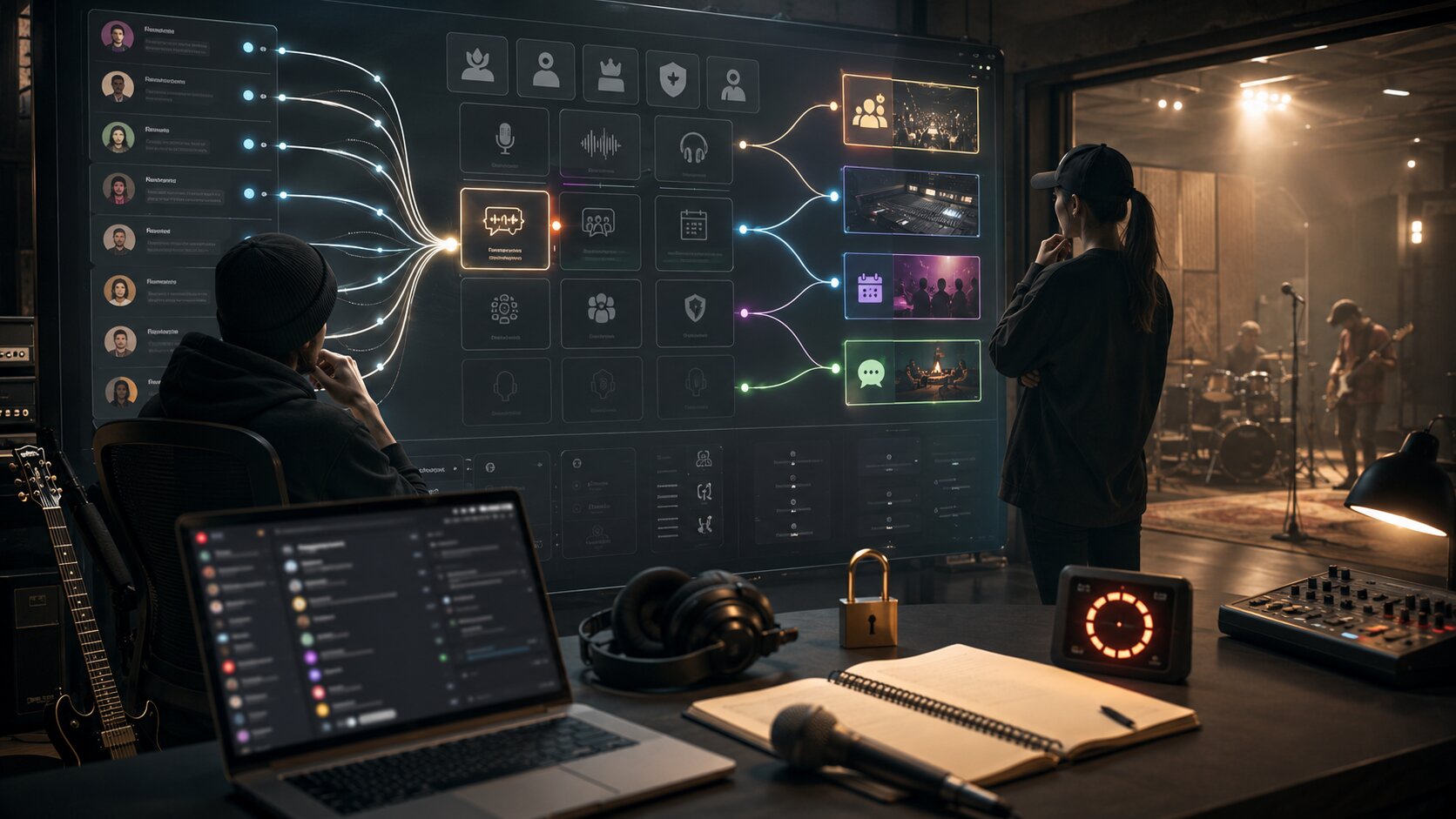
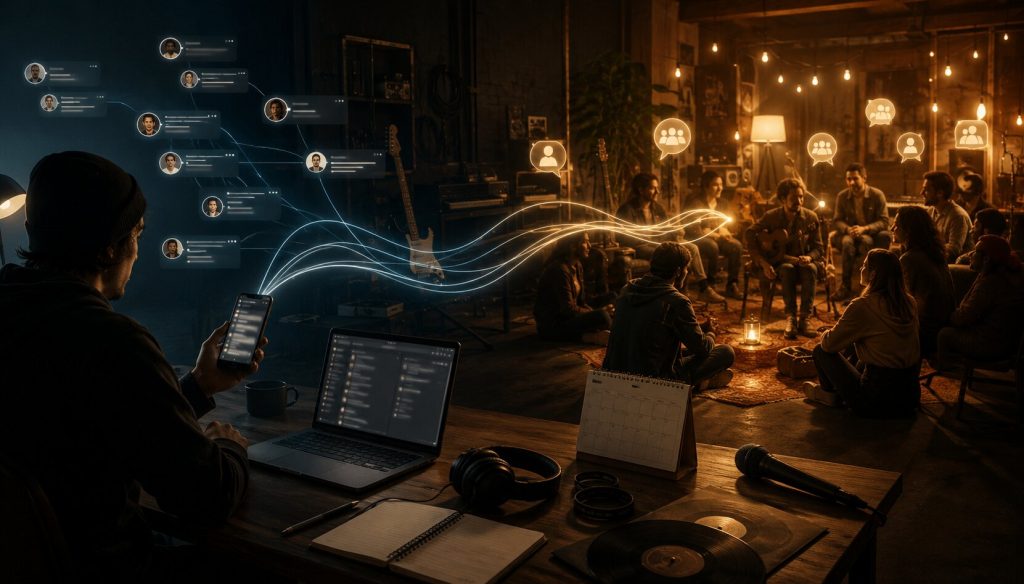
A community strategy connects those isolated moments. Public posts help people discover the music. Direct messages allow the artist to acknowledge individual listeners. A dedicated space such as Discord gives those relationships somewhere to continue.
This continuity matters because an artist’s most valuable supporters are rarely passive followers. Spotify describes “super listeners” as fans who intentionally seek out an artist’s music. In Spotify’s 2025 analysis, these listeners represented an average of 2% of an artist’s monthly audience while generating more than 18% of monthly streams and half of the artist’s ticket sales through Spotify. (Spotify for Artists – guide to developing super listeners)
This guide explains how independent artists can use DMs, Discord and direct fan communication without spamming followers, forcing artificial intimacy or creating a complicated server that nobody uses.
Table of Contents
- The Fan Journey Starts in the Inbox, Not the Server
- Use DMs to Identify Interest, Not Manufacture Intimacy
- Build a Discord That Solves a Specific Fan Problem
- Give Members Reasons to Return Between Releases
- Turn Conversation Into a Repeatable Release System
- Protect the Community Before You Try to Scale It
- Measure Belonging, Not Just Member Count
- A Practical 30-Day Community Launch Plan
- Build Direct Fan Relationships with Block Tone Records
- Frequently Asked Questions
Key Takeaways
| Point | Details |
|---|---|
| Use DMs as a bridge | Recognize listeners who have already shown interest and offer a relevant next step instead of sending mass promotional messages. |
| Give the community a clear purpose | A server focused on demos, production, local shows or a specific music scene is easier to understand than a generic official fan server. |
| Start with fewer channels | A compact and active server feels healthier than a large structure filled with empty rooms. |
| Create recurring participation | Listening sessions, studio updates, questions and member showcases give fans reasons to return between releases. |
| Moderate from the beginning | Rules, permissions and human oversight should be established before an invitation link is widely shared. |
| Track return behavior | Replies, repeat visits and event participation reveal more about community health than total membership. |
The Fan Journey Starts in the Inbox, Not the Server
Creating a Discord invitation link is easy. Giving a listener a convincing reason to click it is much harder.
A fan will normally move through several stages before joining an artist community:
- They discover a song, video or public post.
- They take a small action, such as commenting, sharing or replying.
- The artist acknowledges that action.
- A short conversation establishes mutual relevance.
- The listener receives an invitation to a more focused space.
- The community provides enough value for the listener to return.
Skipping directly from discovery to “Join my Discord” creates unnecessary friction. The listener does not yet know what the server offers, who participates or why it deserves another place in their daily notification feed.
Artists should begin by defining the role of each communication channel.
| Channel | Primary Purpose | Main Limitation |
|---|---|---|
| Public social posts | Discovery, reach and visibility | Conversations disappear quickly |
| Direct messages | Recognition and individual context | Difficult to scale manually |
| Broadcast channels | Direct updates with lightweight participation | Communication usually remains creator-led |
| Discord or private communities | Ongoing artist-to-fan and fan-to-fan interaction | Requires structure and moderation |
| Email lists | Reliable announcements and direct contact | Less conversational than community platforms |
Instagram broadcast channels can serve as a useful middle step between public social content and a full community. Meta has expanded broadcast channels with replies, prompts and performance insights, giving creators additional ways to involve followers without immediately moving them to another platform. (Meta – broadcast channel replies, prompts and insights)
The strongest system does not force every follower into the same destination. Casual listeners may prefer social updates. Highly involved fans may want Discord. Buyers, concertgoers and industry contacts may prefer email. The depth of the relationship should determine the invitation.
Use DMs to Identify Interest, Not Manufacture Intimacy
A useful artist DM begins with context. A weak artist DM begins with a streaming link.
Sending the same promotional message to every new follower may appear efficient, but it removes the personal value that makes direct communication effective. It also makes it difficult to distinguish genuine fan interest from polite responses.
Respond to observable interest
Prioritize listeners who have already taken a meaningful action, such as:
- Asking a specific question about a song
- Replying to several Stories
- Sharing a release voluntarily
- Attending a show
- Buying music or merchandise
- Submitting thoughtful feedback
- Participating in a livestream
The opening message should refer to the action. “Thanks for sharing the track” feels credible because it recognizes something the fan actually did. A generic statement about supporting the artist’s journey does not create the same connection.
Ask one easy and relevant question
A short question turns an acknowledgment into a conversation. It can also reveal what kind of community activity the listener may enjoy.
- “Which part of the track stood out to you?”
- “Do you usually listen to this kind of production?”
- “Would you be interested in hearing an early demo?”
- “Are you based near any of the cities on the next tour?”
Do not turn the conversation into an interview or request unnecessary personal information. The objective is to understand the listener’s interest, not to collect data from them.
Request permission before sending an invitation
An invitation works best after the fan has expressed interest. For example:
I have a small Discord community where I share demos and host listening sessions. Would you like the invitation?
This approach explains the value of the server and gives the listener a genuine choice. Sending an unexplained link is more likely to be ignored.
Pro Tip: Create different invitation paths for different types of fans. A producer may be interested in a feedback channel, while a concertgoer may care more about local event updates. Relevance is more important than sending every person to the same place.
Build a Discord That Solves a Specific Fan Problem
Fans do not need another empty group chat. They need a clear reason to enter and an immediate understanding of what they can do there.
A successful artist server might focus on one primary experience:
- Early access to demos and unfinished ideas
- Direct discussion about songwriting or production
- Listening parties and livestreams
- A community built around a local music scene
- Tour updates and fan meetups
- Feedback exchanges for artists and producers
- Member-only releases, merchandise or ticket opportunities
Choose one central promise before creating the channel structure. “Join for early demos and monthly listening sessions” is easier to understand than “Join my official community.”
Start with a compact server map
A new artist community may only need the following channels:
#start-here#announcements#general#music-and-demos#events#questions- One voice channel
Add specialist channels only when existing conversations justify them. Ten members speaking in two channels can make a server feel active. The same ten members distributed across twenty channels can make it feel abandoned.
Discord’s Community Onboarding feature allows new members to answer questions and receive appropriate roles and channels. Discord recommends making the most valuable default channels immediately accessible rather than overwhelming newcomers with a large server structure. (Discord – Community Onboarding FAQ)
Useful onboarding questions include:
- “What brought you here: music, production, shows or community?”
- “Which region are you in?”
- “Would you like notifications for releases, livestreams or tickets?”
- “Are you a listener, artist, producer or music professional?”
Match the channel format to the conversation
Standard text channels work for quick conversations. Forum channels are more useful when members need separate and searchable posts for production feedback, fan artwork, concert reports or music recommendations.
For listening parties, Q&As or studio streams, scheduled events can give members advance notice and an opportunity to indicate that they are interested. Discord provides native scheduled-event tools for voice channels, stage channels and external events. (Discord – Scheduled Events guide)
The tools are secondary to the purpose. Features cannot rescue a server that does not offer a clear and repeatable experience.
Give Members Reasons to Return Between Releases
A server that becomes active only when the artist needs streams is not a community. It is a promotional mailing list with additional steps.
Create a rhythm that continues when no release is being promoted. A simple monthly schedule could include:
- Week 1: A studio update or unfinished demo
- Week 2: A fan question, poll or recommendation thread
- Week 3: A voice chat, listening club or production breakdown
- Week 4: A member showcase or community recap
The material does not always need to be commercially exclusive. It needs to help members feel closer to the creative process and to one another.
Let fans influence small decisions
Participation becomes meaningful when the community can see that its input had a result. Fans might help choose:
- Merchandise color options
- Alternative artwork directions
- Songs for an acoustic performance
- Questions for an interview or livestream
- Cities for a possible event
- The next song to receive a production breakdown
Artists should not outsource their central creative identity to a poll. The goal is to invite fans into selected parts of the process where their input can be genuinely considered.
Encourage fan-to-fan value
The artist should not be the only reason members speak. Highlight fan projects, introduce people with shared interests and create opportunities for members to exchange music recommendations or creative advice.
A healthy community eventually produces conversations that do not require the artist to begin every discussion. This gives members a stronger sense of belonging while reducing the pressure on the artist to remain constantly available.
A useful planning balance is approximately 70% conversation and shared interest, 20% artist news and creative process, and 10% direct promotion. This is not a platform rule. It is a flexible framework that can prevent the server from becoming dominated by promotional requests.
Turn Conversation Into a Repeatable Release System
A fan community can support a release without making its members feel like unpaid members of the marketing team.
Before release
- Share a production detail instead of repeatedly posting the release date.
- Invite members to an early listening session.
- Ask which part of the song deserves a deeper explanation.
- Create one release-information channel containing the essential details.
- Identify members who voluntarily want to create content or share the track.
Early listeners can help reveal which lyrics, sounds or stories generate authentic reactions. Those reactions may inform later videos, interviews, captions and visual assets.
During release week
- Host a live first-listen event.
- Post one clear streaming or purchase destination.
- Share recording credits and behind-the-scenes stories.
- Provide approved artwork to members who ask to post.
- Thank fans individually for meaningful contributions.
- Open a discussion about interpretations and favorite moments.
Avoid notifying the entire server about every minor update. Excessive notifications encourage members to mute the server, which makes future announcements less effective.
After release
- Publish a production or songwriting breakdown.
- Share demo excerpts or alternate artwork.
- Highlight thoughtful fan reactions.
- Post performance or rehearsal footage.
- Run a community debrief.
- Connect the finished release to the next creative chapter.
This approach extends the conversation without repeating the same demand to stream the song.
Protect the Community Before You Try to Scale It
An artist community creates responsibilities as well as opportunities. Members need to know what behavior is allowed, how moderation decisions are made and how they can report a problem privately.
Establish written rules covering:
- Harassment and discrimination
- Spam and repetitive self-promotion
- Explicit or age-inappropriate content
- Impersonation
- Unsolicited private messages
- Sharing private information
- Disruptive behavior during live events
Discord’s AutoMod can help block selected words, suspected spam and excessive mentions before messages are published. However, Discord also notes that automated systems cannot understand every context, making human moderation essential. (Discord – AutoMod FAQ)
Additional safeguards include:
- Limiting administrator permissions
- Requiring basic verification before posting
- Separating public and member-only channels
- Appointing at least one trusted moderator
- Providing a private reporting process
- Avoiding public arguments about private disputes
- Removing unused bots and integrations
- Making age-related expectations explicit
Artists should also establish personal boundaries. You do not need to answer every DM immediately or remain present in Discord throughout the day. A weekly Q&A, scheduled listening session or stated response window is more sustainable than permanent availability.
Measure Belonging, Not Just Member Count
A server with 2,000 members and ten regular contributors is not automatically healthier than a server with 150 members and forty regular contributors.
Track indicators that reflect genuine involvement:
- The percentage of new members who post or react
- Members who return after seven or thirty days
- The number of distinct weekly participants
- Listening-party attendance
- Replies to community prompts
- Fan-to-fan conversations
- Clicks to music, tickets or merchandise
- Voluntary release-week participation
- Email signups or purchases originating from the community
Discord’s Server Insights can help community administrators review visitors, communicators and new-member retention. These indicators are more useful when evaluated over time instead of being treated as isolated weekly scores. (Discord – Understanding Server Insights)
Look for persistent patterns:
- New members join but never speak.
- One channel produces nearly all activity.
- Events attract people who do not return.
- Every discussion depends on the artist.
- Promotional posts repeatedly reduce engagement.
These patterns reveal structural problems that a larger invitation campaign will not fix.
A Practical 30-Day Community Launch Plan
Days 1–7: Define the promise
Choose the server’s primary audience and purpose. Write a one-sentence promise such as: “A private space for listeners who want demos, production notes and monthly listening sessions.”
Create the rules, select a moderator and build no more than six or seven essential channels.
Days 8–14: Invite a founding group
Invite approximately 10–30 people who have already shown interest through DMs, shows, purchases or repeat engagement. Explain that they are joining an early version of the community and ask what would make it useful.
Do not begin with a large public launch. A founding group gives you an opportunity to identify confusing channels, weak onboarding and moderation gaps before wider promotion.
Days 15–21: Test participation
Run one simple event and publish two discussion prompts. Observe where members naturally gather. Archive confusing or unused channels and improve the welcome message based on repeated questions.
Contact inactive founding members only when you have a specific and useful question. Do not pressure people to participate.
Days 22–30: Open the next invitation path
Add the invitation to one or two relevant touchpoints, such as an Instagram Story highlight, a post-show message or an email welcome sequence.
Continue inviting selected listeners through contextual DMs. Track which invitation sources produce members who actually return instead of measuring only the number of people who join.
At the end of the month, decide whether the community has demonstrated enough value to expand. Growth should follow evidence of participation, not replace it.
Build Direct Fan Relationships with Block Tone Records
A sustainable fanbase strategy connects strong music with consistent communication and realistic release planning. Block Tone Records provides practical guidance for independent artists developing audience-growth systems, community strategies and long-term music marketing plans.
The strongest community is not necessarily the one with the most channels, bots or members. It is the one an artist can manage consistently while continuing to create music and maintain healthy boundaries.
Frequently Asked Questions About DMs, Discord and Music Fan Communities
Is Discord worth using for a musician with a small fanbase?
Yes, provided that some listeners already want deeper interaction. A focused server with 20 active members can be more valuable than a large but inactive server. Begin with a small founding group before promoting the community publicly.
Should artists DM everyone who follows them?
No. Artists should prioritize people who have already commented, shared a release, purchased something, attended a show or asked a relevant question. Unsolicited promotional messages usually weaken trust rather than build a genuine relationship.
What should musicians post in a Discord server?
Useful content includes demos, studio updates, production discussions, listening sessions, fan questions, event announcements and member showcases. The server should remain active between releases rather than appearing only when the artist needs promotion.
How many channels should an artist Discord server have?
Most new artist communities should begin with approximately five to seven essential channels. Additional channels should be created only when recurring conversations need their own spaces. Too many empty channels can make a new server feel inactive.
Can Discord replace an artist email list?
No. Discord is useful for conversation and community participation, while email is better for reliable announcements and maintaining a portable contact list. Independent artists should use the two channels for different purposes.
How often should an artist interact with a fan community?
The schedule should be consistent and sustainable. Two or three meaningful interactions each week and one recurring monthly event can be more effective than constant low-value posting followed by a long period of silence.
What is the biggest mistake artists make with online fan communities?
The biggest mistake is treating the community as an audience that exists only to promote releases. Fans are more likely to remain involved when they receive recognition, access, useful conversations and opportunities to connect with one another.
Sources Used