

Global Music Royalties Hit €14.06 Billion: What CISAC’s 2026 Report Means for Songwriters
TL;DR: €14.06 Billion Is a Collections Figure, Not a Songwriter Payout Figure
CISAC says music collections reached €14.06 billion in 2025, up 11.9% year over year. Music was the largest of the five repertoires tracked in its 2026 Global Collections Report. It is a substantial headline: more licensed uses of music, more money passing through collective-management systems, and a larger pool attached to musical works and related rights administered by those societies.
But it is not a global recorded-music revenue total, and it is not an average—or direct—payday for songwriters. The number represents royalties collected by CISAC’s network of collective-management societies. That network comprises 228 societies across 111 countries and territories and represents more than five million creators. Collection totals can later be subject to the rules, mandates, matching processes and distribution schedules of the relevant society or rights administrator. They are therefore a measure of system-wide collection activity, not proof of what any particular writer received.
The most useful reading for independent writers and their teams is straightforward: a growing collection pool can matter only when a use can be connected to the correct work and the correct rightsholders. Register the composition, document who wrote what, confirm ownership splits, and keep the work’s identifying data consistent across collaborators and administrators. Those steps do not create a royalty rate or an audience. They help make an attributable use payable to the right people.
There is a second qualification in the headline. CISAC says that The Mechanical Licensing Collective (The MLC) was included in its reporting for the first time, and that inclusion materially affects the reported rate of growth. The report is valuable evidence of scale, but it should not be treated as evidence that every territory, society or songwriter income statement rose at the same pace.
Digital Now Drives 45.6% of Music Collections—So Composition Data Is a Payment Issue
Digital royalties accounted for 45.6% of music collections in 2025, according to CISAC’s Global Collections Report 2026. Across all repertoires, digital collections reached €6.57 billion, up 27.9%. For songwriters, the operational lesson is not simply that streaming and digital services are important. It is that work data is part of the payment infrastructure.
A songwriter, producer or publisher should separate two assets that are often blurred in independent release conversations. The composition is the underlying song: its music and lyrics, along with the ownership interests held by its writers and publishers. The master, or sound recording, is a particular recorded performance of that composition. Revenue attributable to a master is not the same as composition or publishing royalty income, even where the same person owns interests in both.
CISAC’s collections reporting concerns royalties administered through its collective-management network. For a writer, that makes accurate composition information essential: the work title, all writers, ownership shares, publisher details where applicable, and consistent metadata should be confirmed before or alongside release activity. The report specifically identifies accurate work registration, ownership splits and metadata as central to receiving digital royalties.
That work is most effective when it is handled before a track starts accumulating uses. A practical pre-release check should include:
- a written split agreement or equally clear written confirmation among collaborators;
- consistent spelling of writer and publisher names across registrations and release documentation;
- registration of the underlying work with the relevant administrator or society;
- confirmation that the registered shares total 100%; and
- retention of session, version and collaborator records when a work has multiple edits or contributors.
None of this guarantees that every use will be matched instantly or that every service and territory follows an identical route. Collective management is jurisdiction-specific, and the applicable administrator depends on the rights involved and the territory. Still, incomplete splits or conflicting work data create a problem before a royalty statement is ever issued: the system has less reliable information with which to identify and allocate the composition-side income.
For self-releasing artists, the distinction also prevents a common analytical error. Strong master-side income from a distributor or label accounting does not establish that the composition has been fully registered and collected; conversely, a composition royalty may arise from use of a song even where the writer does not own the master recording. Treat those income streams as connected to the same song, but administratively distinct.

Live and Background Music Overtake TV and Radio as the Second-Largest Source
The collection mix is changing beyond digital. Live and background music became the second-largest source of music collections in 2025, reaching €3.62 billion, up 7.3%. It overtook TV and radio music collections, which fell 3.0% to €3.32 billion. Live music alone reached €1.4 billion, an increase of 14.9%.
That does not mean a writer can assume that every stage performance, venue use or public play produces the same royalty, or that all uses are administered through the same route. The report is an aggregate collections view, not a venue-by-venue payment guarantee. It does, however, reinforce the value of clean repertoire records for writers whose songs travel through performance contexts as well as digital platforms.
For artists and managers, the relevant habit is documentation. Keep performance and setlist information where it is required by the relevant collection process, make sure songs performed live are registered as works, and resolve title variations before they become competing records. If a song is known by a working title, a translated title or a title that differs from the released recording, that discrepancy should be reconciled in the rights data rather than left for a later accounting cycle.
The same discipline applies to background uses. A larger aggregate category does not reveal which individual songs were used, how frequently they were used, or which creators were paid. It does show that the live-and-public-use side of music collection is now larger than the TV-and-radio category in CISAC’s 2025 data—useful context for teams that have focused their rights housekeeping exclusively on digital releases.
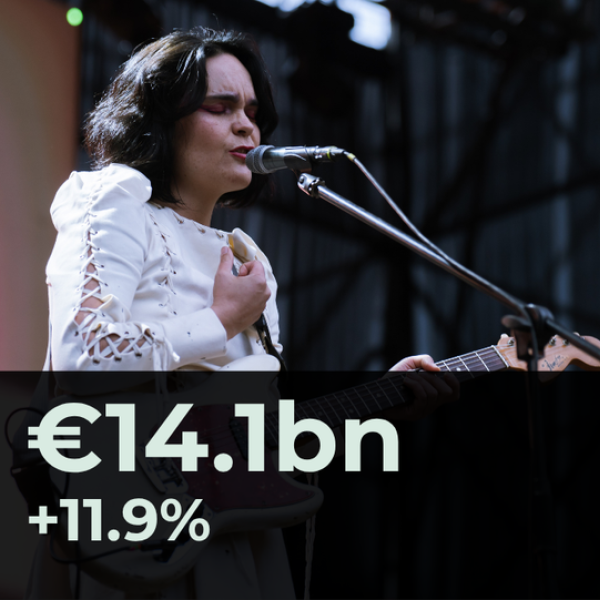
Official CISAC Global Collections Report 2026 music graphic showing €14.1 billion in music collections and 11.9% growth. — Source: CISAC
The MLC Effect: Why 11.9% Does Not Describe Every Market’s Underlying Growth
The 11.9% music-collections increase is real within CISAC’s reported data, but it is not a clean like-for-like shorthand for underlying royalty growth everywhere. CISAC says The MLC’s first inclusion accounted for approximately 52% of the overall €15.5 billion increase in global creator collections. Excluding The MLC, CISAC reports total collections growth of 5.3% rather than 11.3%.
Adding a reporting body can raise the amount being observed while also widening coverage, which is why the distinction matters. The resulting increase may reflect usage and collections growth, broader inclusion in the reporting network, or both. Since those explanations are not interchangeable—and neither is necessarily negative—readers should not turn a network-coverage change into a universal claim about songwriter earnings or demand in every market.
Regional figures make the point. Canada and the United States were the fastest-growing collecting region at 26.5%, partly because of The MLC’s inclusion, while Western Europe remained the largest region at €7.5 billion. The comparison is useful only with the qualifying context intact: one number describes the fastest reported growth rate in a region affected by a new reporting inclusion; the other describes the largest regional total.
For labels, publishers and managers, this is a reporting lesson as much as a market lesson. When assessing a headline collection figure, ask three questions before using it in a forecast or investor deck: what rights are included, which administrators are included, and whether the prior-year comparison covers the same reporting population. A global total is valuable context; it is not a substitute for territory-specific statements, repertoire data or an individual catalogue’s collection history.
A Growing Pool Does Not Solve Discovery for Local and Independent Catalogues
CISAC reports that music collections have grown 83.5% since 2016. Yet the report also warns that large digital catalogues do not guarantee visibility for local creators, because playlists and algorithms shape discovery. As SGAE’s report coverage notes, the growth in collections and access to audiences are separate questions.
That is the boundary around the €14.06 billion story. Rights-data readiness helps a creator claim money when a use is identified and attributable; it does not secure playlist placement, recommendation-system exposure or listener demand. Independent teams need both tracks of work: accurate registration and splits for the uses they earn, plus a release and audience strategy capable of generating uses in the first place. The collection pool has expanded sharply since 2016, but the route into audience attention remains uneven.