Sample Clearance for Independent Artists: The Risk Before Uploading
TL;DR: If your track contains audio taken from somebody else’s recording, you may need permission covering both the sound recording and the underlying musical composition. There is no universal rule allowing you to use a sample simply because it is short. The safest workflow is to identify every borrowed element, verify the relevant rights, secure any required licenses, and keep the documentation before distributing the track.
Sampling can turn a few seconds of existing audio into an entirely new creative idea. The production process may take minutes, but the rights attached to that audio can become one of the most complicated parts of releasing the song.
That problem often appears at the worst possible moment: the master is finished, artwork is ready, the release date is booked, and the artist is about to upload the track. Discovering an unresolved sample at that stage can affect distribution, monetization, publishing splits, future licensing opportunities, or the release schedule itself.
A recorded song can involve two distinct copyrighted works: the musical composition and the sound recording. Sampling an existing recording may therefore require authorization involving both sets of rights. (U.S. Copyright Office)
This guide explains how independent artists can audit samples before release, distinguish direct sampling from interpolation and covers, approach clearance, avoid common misconceptions, and decide what to do when permission is not available. It is general educational information and not legal advice.
Table of Contents
- The upload button is too late for a rights audit
- One sample can involve two different copyrights
- Trace every borrowed sound before you request permission
- Build a clearance request that a rightsholder can evaluate
- Five shortcuts that create false confidence
- When clearance stalls, change the recording or the schedule
- Create a clearance file before distribution
- Treat rights as part of release preparation
- Frequently Asked Questions
- Sources Used
Key Takeaways
| Point | Details |
|---|---|
| A sample can involve two rights | Using actual recorded audio may involve both the copyright in the master recording and the copyright in the underlying composition. |
| Short does not automatically mean safe | There is no universal number of seconds that automatically makes an unauthorized sample permissible. |
| A cover license is not sample clearance | Re-recording a composition and copying audio from an existing master are different uses with different licensing implications. |
| Beat licenses need auditing | Buying or licensing a beat does not automatically prove that every third-party sample inside it has been cleared for your release. |
| Royalty-free still means licensed | Sample-library material remains subject to the terms of the library agreement, including possible restrictions on certain uses. |
| Keep the paperwork | Save licenses, receipts, correspondence, ownership details, payment records, and any limitations that apply to the sample. |
The upload button is too late for a rights audit
Sample clearance should be investigated before distribution, not after the release has already been submitted.
Digital distributors generally expect artists to control or properly license the material they distribute. For example, DistroKid states that it cannot approve samples from another artist’s music on the uploader’s behalf and that permission is required for sampled material belonging to somebody else. (DistroKid Help Center)
This creates an important distinction: a distributor accepting an audio file does not mean a copyright owner has approved the sample.
The risk also extends beyond the initial upload. Rights issues can affect monetization systems, automated fingerprinting, sync opportunities, label negotiations, publishing administration, and future versions of the release.
For an independent artist funding promotion personally, an unresolved sample can therefore become a campaign problem as well as a copyright problem. Money may already have been spent on artwork, videos, advertising, manufacturing, or publicity by the time the issue appears.
Pro Tip: Add a sample-status field to your release checklist. Each track can be marked as original, licensed library material, clearance completed, or clearance unresolved before a release date is finalized.
One sample can involve two different copyrights
The central idea in sample clearance is that the song itself and a particular recording of that song can be separate copyright assets.
Sampling an existing master
Imagine taking a drum break directly from an existing commercial recording and inserting it into your production. You have copied part of an existing sound recording, often called the master.
At the same time, the recording may embody copyrighted melody, harmony, lyrics, rhythm, or other elements of the underlying musical composition. The U.S. Copyright Office explains that using samples from preexisting recordings may implicate both the sound recording and the musical work. (U.S. Copyright Office sampling guidance)
| Production Method | Existing Master Used? | Existing Composition Used? | Typical Rights Issue |
|---|---|---|---|
| Direct sample | Yes | Often yes | Master and composition clearance may be required |
| Interpolation or replay | No | Yes | Composition rights may still need authorization |
| Traditional cover recorded from scratch | No | Yes | Cover and mechanical licensing rules apply |
| Completely original material | No third-party master | No third-party composition | No third-party sample clearance issue |
| Licensed sample-library sound | Used under a library license | Depends on the material | The library’s license terms govern the use |
Interpolation is different from direct sampling
An interpolation generally involves re-performing part of an existing musical composition instead of copying audio from the original recording.
Because the original master recording is not being copied, the sound-recording rights issue can be different. However, the composition itself may still require permission. Replaying a recognizable melody is therefore not automatically a way to eliminate all clearance obligations.
A cover license does not clear a sample
A conventional cover involves creating a new recording of a previously released composition. Sampling involves copying audio from an existing sound recording.
Those are legally and practically different uses. A license that allows an artist to release a cover should not be assumed to provide permission to copy part of the original master recording.
Trace every borrowed sound before you request permission
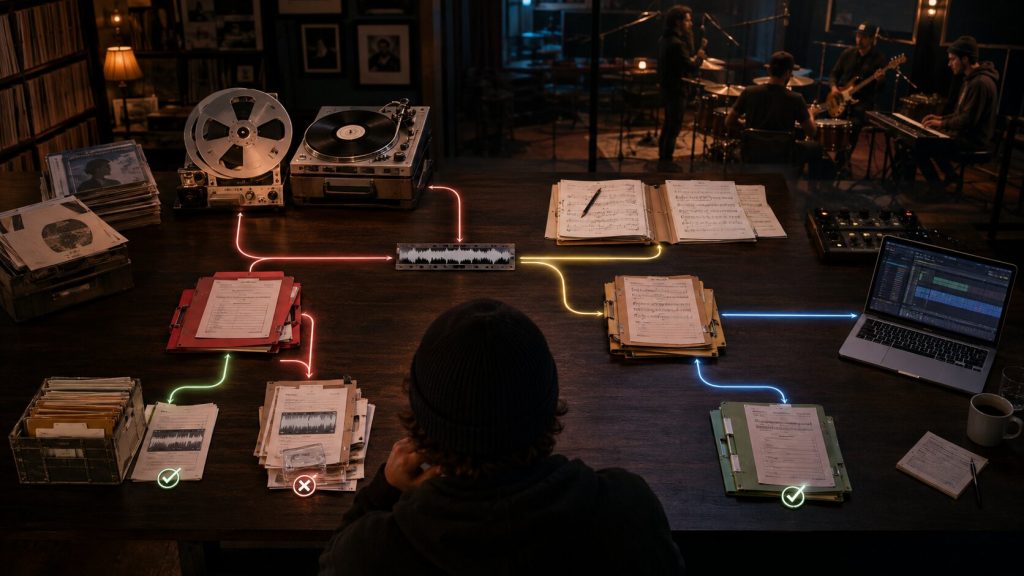
Before contacting a label, publisher, songwriter, or rights administrator, audit the entire session and identify everything that did not originate with you or your collaborators.
Do not limit that review to obvious vinyl samples. Check material sourced from:
- commercial recordings;
- vocals downloaded from the internet;
- producer stems;
- beat-store purchases;
- sample libraries and loop packs;
- film, television, game, podcast, or speech recordings;
- old sessions supplied by collaborators;
- audio described as free or royalty-free;
- third-party material embedded inside a purchased beat.
This last category deserves particular attention. A producer may have permission to use a sample personally without necessarily giving every later artist the rights required for a commercial release.
Ask what is inside the beat
If you purchased or licensed an instrumental from another producer, ask whether it contains third-party samples or interpolations.
- What is the source?
- Who supplied the material?
- What license covers it?
- Does that license permit commercial distribution by you?
- Are there revenue, territory, video, synchronization, or platform restrictions?
- Can the producer provide supporting documentation?
A beat license is only as useful as the rights actually granted by its terms.
Follow the ownership chain
For a composition, songwriter and publisher databases can help identify registered ownership information. The Mechanical Licensing Collective provides a Public Work Search for musical works, while Songview from ASCAP and BMI can also help with repertory research. (The MLC)
For a master recording, review official release credits, label information, catalog ownership information, and any verified rights transfers you can identify.
Finding the original artist’s name is not enough. The goal is to locate the party that actually has authority to approve your proposed use.
Build a clearance request that a rightsholder can evaluate
A message that says only “Can I sample your song?” leaves too many important questions unanswered.
A useful clearance request should explain exactly what has been sampled, how it appears in the new recording, and how you intend to exploit the finished track.
Prepare the following information:
- Original recording details: song title, artist, recording, and release information where known.
- Sample location: the portion of the source you used and the approximate duration.
- Your new recording: track title, artist name, and current version.
- Sample treatment: whether it is looped, chopped, pitched, reversed, isolated, repeated, or otherwise altered.
- Reference audio: a version that clearly demonstrates the proposed use.
- Planned exploitation: streaming, downloads, physical copies, music video, social media, synchronization, or other relevant uses.
- Territory: where you plan to distribute the recording.
- Term: how long the requested permission should remain effective.
- Release context: whether the release is independent, label-backed, part of an album, or connected to another commercial project.
Clearance terms can vary considerably. A deal may involve an upfront fee, a share of master income, publishing participation, songwriting ownership, credit requirements, usage restrictions, or a combination of these terms.
The critical point is that the agreement should clearly match the use you actually intend to make.
Do not treat an unanswered email, casual direct message, or a producer saying “it should be fine” as equivalent to documented permission from the relevant rights owner.
Five shortcuts that create false confidence
1. “I only used a few seconds”
There is no universal rule stating that three seconds, five seconds, seven seconds, or another fixed amount of copyrighted audio is automatically safe to use.
In the United States, fair use is evaluated using multiple statutory factors and depends on the specific circumstances. The Copyright Office warns against relying on predetermined amounts as an automatic fair-use rule. (U.S. Copyright Office Fair Use Index)
2. “I changed the sample until it became unrecognizable”
Pitching, reversing, chopping, stretching, filtering, or otherwise transforming audio can change its creative character, but those production techniques do not themselves grant a license.
If authorization is required for the underlying use, disguising the source does not create that authorization.
3. “I wrote ‘no copyright infringement intended’”
A disclaimer does not provide copyright permission. Stating that infringement was not intended does not replace a license from the relevant owner.
4. “I bought the beat, so everything inside it is cleared”
Beat licenses vary significantly. Labels such as “exclusive,” “unlimited,” or “premium” do not automatically explain how third-party samples have been handled.
Read the actual agreement and determine whether sampled or interpolated material is included, who is responsible for clearance, and whether your intended release is covered.
5. “Royalty-free means copyright-free”
Royalty-free material is normally licensed material, not material without copyright.
The license may permit broad commercial music use while still restricting redistribution of isolated samples, resale, sublicensing, automated fingerprinting, or other uses.
Platform rules can add another layer. YouTube requires users submitting reference material to Content ID to possess sufficient exclusive rights, meaning some commonly licensed or non-exclusive material may not be suitable for fingerprinting as an exclusive reference. (YouTube Help)
When clearance stalls, change the recording or the schedule
A sample does not have to remain in the final master simply because the production was originally built around it.
If permission cannot be secured, the practical decision is usually to change either the audio or the release plan.
Replace the sample
Identify the musical function the sample provides. Is it supplying texture, rhythm, harmony, atmosphere, a vocal hook, or a recognizable melodic idea?
You may be able to rebuild that function with original instrumentation, synthesis, sound design, session musicians, or properly licensed source material.
The objective should be to create a genuinely new solution rather than simply reproducing protected material in another form.
Consider an interpolation
If the essential element comes from the composition rather than the sonic character of the original recording, a newly performed version may remove the need to copy the original master.
That does not mean the underlying composition is automatically free to use. Composition permission may still be required.
Use appropriately licensed library material
Commercial sample libraries can provide useful alternatives when their licenses support your intended use.
Save the receipt, license version, download record, and any certificate associated with the exact material used in the track. Do not assume you will always be able to retrieve the same terms years later.
Move the song to a later release
If the sample is essential and clearance remains unresolved, delaying one song can be more manageable than placing an entire campaign on uncertain rights.
A release date can change. The ownership of the material inside the master does not change simply because the distribution deadline is approaching.
Create a clearance file before distribution
Sample documentation should be stored alongside masters, artwork, split sheets, lyrics, metadata, and other release assets.
For every sampled or licensed element, keep:
- the original source information;
- timestamps or descriptions of the sampled portion;
- master-owner correspondence;
- publisher or songwriter correspondence;
- signed licenses and executed agreements;
- sample-library receipts and certificates;
- the relevant license terms that applied when the material was acquired;
- payment records;
- publishing or songwriting splits;
- master-side royalty obligations;
- credit requirements;
- territory and duration restrictions;
- limitations involving videos, synchronization, advertising, physical releases, or fingerprinting;
- documentation received from producers or beat sellers.
Before distribution, ask one final question: can you identify where every non-original sound came from and produce documentation supporting your right to use it in the planned release?
If the answer is no, the track deserves another rights review before upload.
Treat rights as part of release preparation
For independent artists, release preparation should include more than mastering, artwork, metadata, and promotion. Rights readiness belongs in the same workflow.
At BlockTone Records, artists can find practical resources covering independent releases, music promotion, distribution, career strategy, and other decisions surrounding modern music releases.
Identifying sample issues early gives you more options. You can negotiate, replace material, reorganize the track, change the release schedule, or choose a properly licensed alternative before promotional commitments become difficult to reverse.
A stronger release sequence is simple: finish the record, verify the rights, document the permissions, and only then distribute it.
FAQs About Sample Clearance for Independent Artists
Do independent artists need to clear samples?
How many seconds of a song can I legally sample without permission?
Do I need permission if I replay the sample myself?
Can my music distributor clear a sample for me?
Are royalty-free samples safe to release commercially?
What if the original composition is in the public domain?
Should I clear a sample before or after uploading my song?
Sources Used
- U.S. Copyright Office – Sampling, Interpolations, Beat Stores and More: An Introduction for Musicians Using Preexisting Music
- U.S. Copyright Office – Fair Use Index
- DistroKid Help Center – Uploading Music That Contains Sampling From Other Songs
- YouTube Help – Content eligible for Content ID
- The Mechanical Licensing Collective – Musical works and ownership resources